

On 13 May 2026, a new job simulator game was released on Steam, the sort that have been popping up in droves for several years now. These games are easy to produce, often copied and pasted from one another, and frequently find an audience. In other words, it’s a formula that’s not particularly innovative, but one that keeps the risks to a minimum. But we’re not here to talk about job simulators. So, a few days ago, Steam—the virtual monopoly in video game distribution—allowed a certain ‘Plantation Simulator’ to be added to its catalogue. On the 26th of the same month, Mickaël Newton, a columnist for Histoires Crépues and other outlets, launched a petition calling for the game’s removal. What is going on? What does this incident on Steam tell us? Let’s take a look at the state of video game censorship.
What the hell is this?
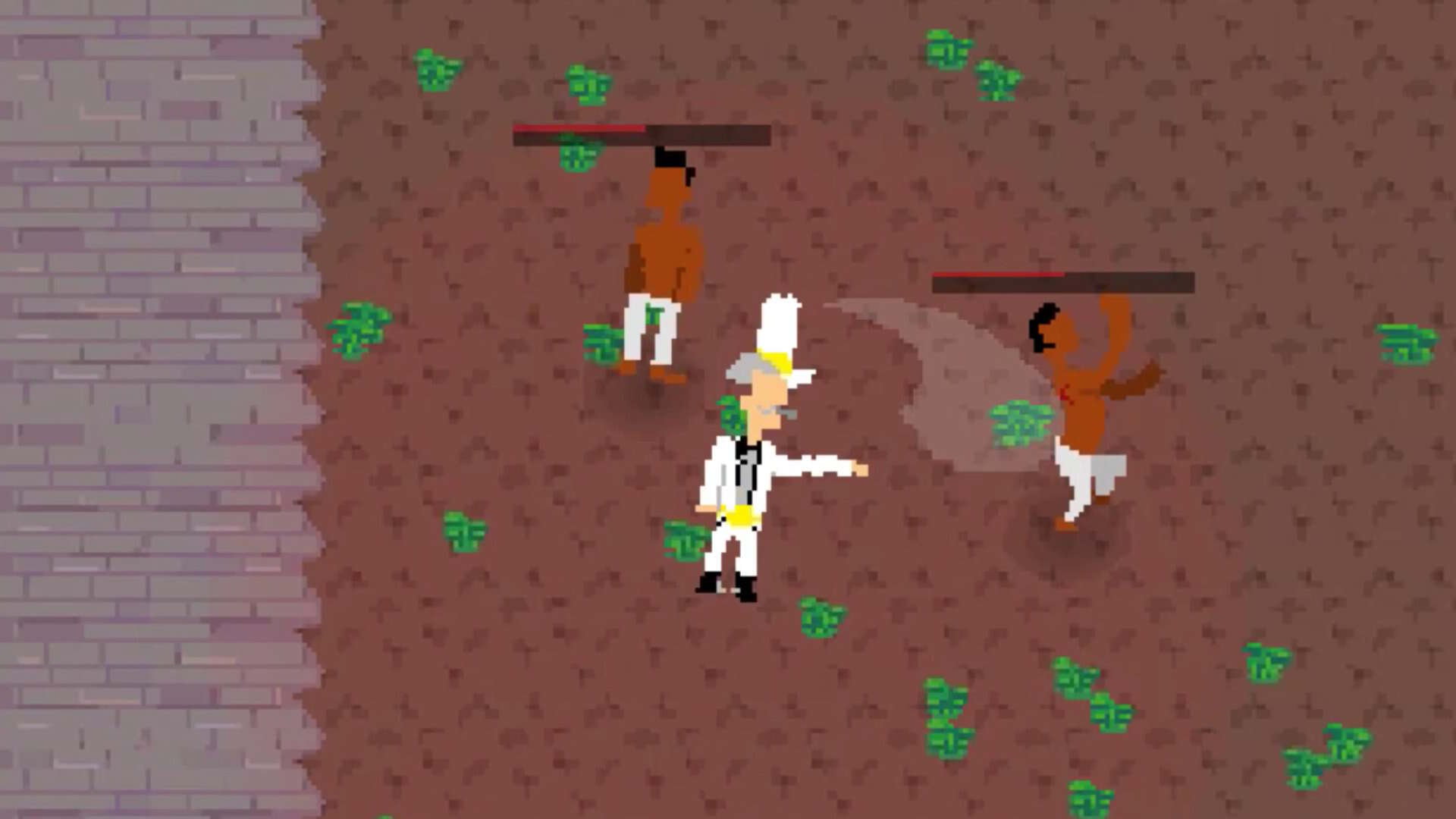
First of all, let’s provide a bit of context. The description of Plantation Simulator pitches a farming game in which, to boost their finances, players must encourage their virtual friends. The game’s title is as subtle as its content. Once you’re in the game, there’s no doubt about it: the glorification of slavery lies at the heart of the gameplay. The main character, in the AI-generated thumbnail and the pixelated mess of the game, is dressed like a typical pre-Civil War American slave owner. Leonardo DiCaprio, in the role he plays in Django, is less of a cliché. If only the problem ended there… In terms of gameplay, motivation takes the form of lashes of the whip meted out to “workers” in the middle of a field. Beyond that, the game is more than minimalist. The description on Steam reads: “Play as a determined plantation owner in Plantation Simulator, a simple yet satisfying farming simulation set in the era of New Age American plantations. […] But don’t worry! It’s all fair and happy!” When the game was released, the characters you could whip were racialised, but a few days later, in response to protests on social media, the asset was replaced by what appear to be women in bikinis that you can kiss.
AIt goes without saying that all the hallmarks of a toxic, racist and misogynistic troll are clearly evident here. The developer is a certain FzzyBzzy, who is no stranger to this sort of thing. Notably on their Steam page, we find a game called Crucifier, a racing simulator featuring people condemned to crucifixion in ancient Rome, and another called My Pet Femboy, a Tamagotchi-style game featuring trans people that you can abuse at will. On their X account, which has 461 followers, the bio describes the creator as the maker of the worst games known to humanity. There is nothing particularly interesting in the posts, which are merely attempts to capitalise on the controversy generated by their games whilst maintaining a conservative and intolerant, not to say hateful, undertone. The YouTube channel of the same name has around 90k subscribers for thirty videos. Active since 2012, the first videos served as a portfolio for 2D animation until six years ago. After a hiatus, activity resumed with trailers for upcoming gaming flops. For just over a year now, all content associated with the username FzzyBzzy has been characterised by provocation, abuse and hatred. Nothing new under the sun of the internet.
On 24 May 2026, the developer announced that they had requested the removal of their game, which will take effect on 27 May.
What does Steam do?
It didn’t take long for players to react. Posts on social media and reports on Steam had no impact on the game’s distribution. The world’s most popular platform remains silent. On the game’s page, we could see an overwhelmingly negative rating, mainly due to the change in the slaves’ design. Many lament the disappearance of Black characters, which seemed to be their main source of enjoyment in this sickening title. But then, what are the limits on Steam?
In July 2025, a date to which we shall return, Valve updated the user guidelines—which are easily accessible—as well as the publishing guidelines, which are far more obscure. Nevertheless, we find the usual restrictions regarding nudity and pornography, malware, local regulations in each country, NFTs, etc. Above all, we find the concepts of respect for the rules and for users. As far as we’re concerned today, Steam prohibits hate speech and offensive content – two concepts that can easily be associated with Plantation Simulator and other games by FzzyBzzy.
As for the measures available to users, Steam encourages them to report any content that breaches the aforementioned rules, assuring them that the moderation team will pay close attention to such reports and apply the appropriate sanctions. However, no action has been taken against this game, which glorifies slavery, racism and misogyny. Perhaps we do not share the same definition of respect. The developer admits to not understanding how their game managed to pass the approval process and end up in the hands of anyone, hidden behind an age verification system that is, in reality, nothing more than a ridiculous sham.
Censorship therefore failed to work for this game, at least during its two-week existence. Steam is not the worst offender in the world of video game distribution. Take the Roblox platform, for example: it contains a great many objectionable creations (glorifying mass killings) and problematic behaviours (paedophile predation). Even social media platforms are lax when it comes to their own rules, relying solely on repeated reports. The loopholes are well known and do not really concern the moderators.
The Horses case
The July 2025 update to the Steam Terms of Service includes a new clause that I haven’t mentioned before. Point 15 of the list of prohibited content reads as follows:
“15. Content that may violate the rules and standards established by Steam’s payment processors and associated card and banking networks, or internet service providers. In particular, certain types of adult-only content.”
Put simply, Visa, Mastercard and the like are gaining the power to select the games we play based on their own values, which they do not disclose. Worse still, the wording suggests that Steam may act before the payment processors raise a fuss. Put simply, this is censorship to avoid potential outrage from puritanical millionaires. This is what we see in Trump’s America, which bans certain words in scientific research—‘woman’, for example—to steer discourse towards conservative thinking, thereby stifling any attempts to counter-argue.
One might think that this rule, like the others, is a precautionary measure designed to appease intolerant reactionaries. The developers of the game Horses quickly realised that this was not the case, as their title was banned from release on Steam and Epic for this very reason. I won’t go into the specifics of this case, as Julien Djoubri already covered it at the time in an editorial which can be found here. But as a reminder, the game from Santa Ragione studio is intended to be provocative and shocking, featuring controlled nudity and human trafficking with the aim of being alarming and expository. I challenge anyone to find any trace of pornography or discrimination. We’re a long way from the cheap trolling of Plantation Simulator.

Censorship is political
These examples, which represent opposite extremes and are six months apart, highlight a two-tier system of censorship. This is not based on content—which is difficult to assess objectively and varies from game to game—but rather on who makes the request. This, incidentally, is the role of the PEGI organisation. When the community protests against discriminatory content, their voices fall on deaf ears. On the other hand, if a certain Ryan McInerney or Merit Janow, CEOs of Visa and Mastercard respectively, decide that a game offends their delicate sensibilities, it will immediately be deprived of visibility on platforms that account for the vast majority of global gaming transactions. How is this possible? Quite simply because these two companies hold a monopoly (I’m repeating myself, aren’t I?) over payment methods. In other words, losing a partnership with these giants guarantees the collapse of online platforms. The players are devouring themselves
It has been glaringly obvious for several years now that those in power are taking control of culture to push their agenda, which, strangely enough, is often linked to the far right. In France, we see this in the concentration of media ownership in the hands of a handful of billionaires. More recently, with Canal+ seeking to censor film professionals who signed an anti-Bolloré open letter, and the National Rally mayor of Vierzon cancelling a commemoration of the abolition of slavery. We are a long way from regulatory authorities that are supposed to safeguard freedom of expression within the legal framework (here too, there is much to be said). Censorship has become the means of silencing those who disrupt the powerful in their agenda and their morality. They are attempting to muzzle counter-culture, to restrict everything to a pseudo-benevolence. The very principle of culture is disappearing.
What should I do?
Resistance is the only way forward. At Point’n Think, we’ve said it time and time again: if you can, support anything that breaks the mould. Don’t give in to the temptation of mindless entertainment; Steam will never surprise you by offering up something absurd or bizarre. Culture and video games are means of resisting the alienation that is served up to us on a silver platter. Sites like Itch.io or GOG are accessible alternatives for experiencing video games in a different way. The wider the range, the more the industry will gain in diversity and creativity. Many studios keep an eye on what comes out of schools or game jams to fuel their own projects. Small teams (such as Deconstructeam) offer unique and memorable experiences. It is this diversity that allows games like Wanderstop to be a genuine form of therapy. Letting a handful of decision-makers choose for us what is worth playing is like condemning ourselves to eating the same dish over and over again until we vomit. All art forms have faced this predatory pressure. Yet, a group of resisters has always managed to keep diversity alive, even if only within much smaller circles. It is up to us to reject a bland global monopoly that leads to a narrowing of choice, job insecurity and the automation of artistic production.
Fight if you feel like it. Give your support to those campaigning for a diverse industry. From strikes to ensure the best possible conditions for creation, to festivals showcasing experimental games, to texts and videos that seek to open up new horizons – there is no shortage of opportunities to discover and share, and they cost nothing. And perhaps one day, we will look back with satisfaction on this world we have helped to create, in which we take infinite pleasure simply in playing.
Sources :
https://partner.steamgames.com/doc/gettingstarted/onboarding