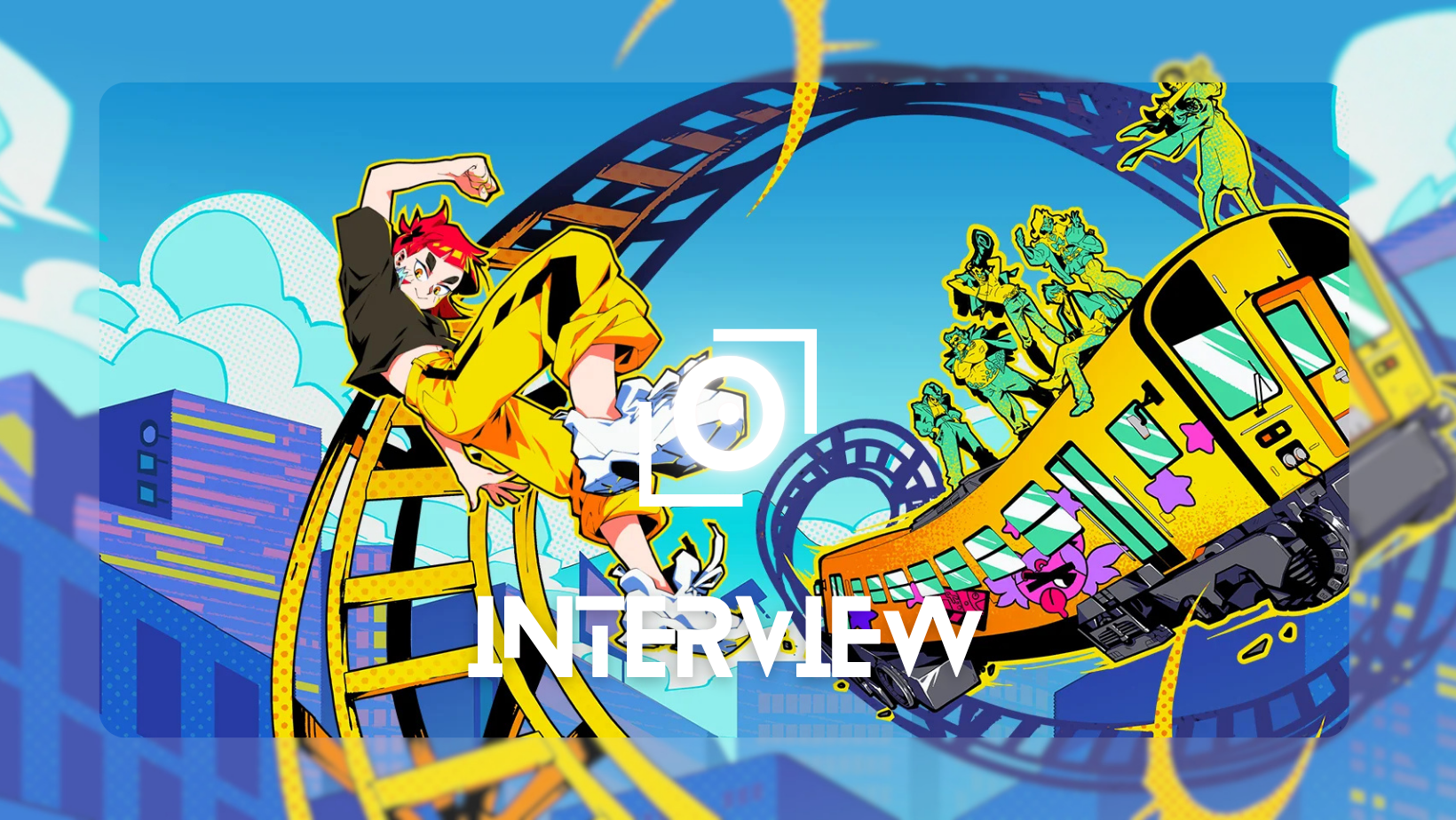
Denshattack! makes no secret of its origins: the Dreamcast as its sanctuary, *Jet Set Radio* and *Tony Hawk’s Pro Skater* as its grammar, and the Y2K aesthetic as its vocabulary. To set the stage for this journey through Japan, crafted in Barcelona, Portugal, and the United States, under an English publisher and a French label, Undercoders has assembled a lineup that reads almost like a shopping list for a VGM fan: Tee Lopes (Sonic Mania, and before that, a lifetime of remixing and fangames), Andrew One, Kid Katana (who also handled the mixing and mastering for the entire project), Sean Bialo, plus some twenty guests ranging from Shoji Meguro to Ryo Nagamatsu, from Kohta Takahashi to Harumi Fujita, including MIYACHI, Lotus Juice, 2 Mello, and VTube creator Ironmouse.
The result: 80 tracks, 230 minutes of music, far more than enough to accompany about fifteen hours of gameplay. A soundtrack that deliberately transcends its own boundaries, conceived as a standalone work as much as it is background music. We wanted to understand how the work is divided up on a project like this: who makes the final call, how do you brief a legend, and where does the line between homage and parody lie when composing for a generation that grew up playing the very games you reference over and over again? Tee Lopes, Andrew One, and Kid Katana answered these questions, each from their own studio, each offering their own take on the same journey.
PnT: An 80 track soundtrack for an arcade game that wraps up in about fifteen hours is almost more music than game. At what point did you realize the soundtrack needed to spill beyond the game itself, to exist as a standalone object?
Kid Katana: While working on the Denshattack! soundtrack, we kept in mind that we wanted to stick as closely as possible to the game’s sprawling, unhinged energy, so we quickly understood there would be a large number of tracks. The idea was to surprise the player with songs, guests, different styles, the same way you unlock new moves or trains as you progress. Once we’d confirmed the first guests, it became obvious the soundtrack was going to outgrow the game, more like an eclectic compilation. We also got the chance to reveal a few tracks ahead of the game’s release, both from the main composers and from guests like Richard Jacques, 2 Mello, Miyachi, or Ironmouse.
Tee Lopes: That was absolutely not my call, it’s simply that the creative team couldn’t help but keep piling more coolness onto the game, so more music became necessary, and everyone seemed really motivated to join this increasingly prestigious list of artists. In my view, the Denshattack! music has in a way become its own entity, running parallel to the game, given its scale and the fact that you can no longer talk about one without talking about the other.
PnT: Denshattack! summons Jet Set Radio, Tony Hawk, Y2K imagery. You all grew up with these games. How do you compose for nostalgia without making nostalgia? Where’s the line between homage and pastiche?
Andrew One: Personally, I think about that very rarely, if ever. I do have influences, like everyone, and there are certain moods or intentions I sometimes try to reach, but ultimately I just make music that I love and that genuinely sounds like me. If I can take it a step further, I think one of our goals in life is to discover who we really are, independent of social pressures and outside influences. To me, art is a reflection of the person who creates it. So again, I simply compose music I sincerely love.
Tee Lopes: That’s really not something I think about, probably because I’ve been in the field for a while now, and certain musical practices and techniques from the 90s and 2000s are simply woven into the tapestry of styles I’ve built up over time, so I don’t consciously set out to incorporate this or that homage. In my head, I just make music that, to me, fits the mood and aesthetic of the game and what’s happening on screen, while taking the opportunity to be versatile and have fun. I don’t think any of us intentionally referenced those classics in a spirit of homage.

PnT: The game has you riding a train, not a skater. Did that absurdity of the concept change anything in your writing? A train is mass, inertia, a mechanical rhythm: where does that show up in the music?
Andrew One: Oh, without a doubt. It’s not just the fact that you ride a train, but also the whole unhinged nature of the game’s various levels. All of that clearly pushed me to explore more original, even downright wackier ideas in my own music. As for the train and its mechanical rhythm specifically, that also shaped some of my decisions while composing. For example, I used train sounds as percussive elements, and in some tracks I even composed with that characteristic rhythm in mind.
Tee Lopes: Absolutely! I remember taking on this project because its sheer absurdity felt like a great opportunity to go off the rails with the soundtrack, no pun intended. I do a lot of work in the revival niche, which often requires me not to stray too far from a franchise’s established sound, or risk the fans demanding blood. That can sometimes feel a bit restrictive, so part of the appeal of this project for me came from the feeling that it was a chance to be genuinely creative and unconstrained. It was incredibly therapeutic in that sense.
PnT: When I think of a train, a whole set of sounds comes to mind: level crossings, the clatter of rails, doors closing, station announcements, the sharp screech of braking. How do you go about translating or working these sensations into your compositions?
Andrew One: Yes, as I mentioned in my previous answer, that ranged from directly using those sounds to weaving their rhythms into my composition, all the way to building chords out of the same notes as the train horns. Actually, on one of my earlier tracks, Coastline Funk, I was asked to tone that down a bit, since it risked clashing with the game’s sound effects!
Tee Lopes: All those sounds, level crossings, the clatter of rails, doors closing, are very specific to trains, so they immediately bring back memories of stations and journeys we’ve taken, whether when we were younger or even just in our current daily routine. The other artists and I found plenty of creative ways to work these elements into the music. Sometimes we used them rhythmically, turning the ding-ding of a level crossing into a percussive element. Other times we used them to build tension or a sense of buildup. For instance, as a train approaches, the sound naturally intensifies, so that can work almost like a rise leading into a drop. There are so many ways to use these sounds to pull the player straight into that world. And since it’s already a familiar world for most people, there’s also that nice moment of recognition when you hear something in the music and think, oh, that’s actually a train sound. I started playing with that idea from the very first track, almost as an experiment, and then some of the other artists picked it up too and found their own creative ways to use that kind of element.
PnT: Andrew, you mixed and mastered the entire album on top of composing. How do you give sonic cohesion to a record that swings from breakbeat to punk to J-Pop, with sessions coming in from all over the world?
Andrew One: With a lot of blood, sweat, and tears! And smiling. And a lot of joy! The challenge wasn’t just the sheer number of musical styles and artists involved, but also managing to give the whole thing real cohesion without stripping each contributor of their own style and identity. As you can imagine, it’s fairly technical work, but to sum it up, it represents an enormous number of hours spent listening, experimenting, re-listening, making decisions, and hoping it all comes together. And I think it was worth it! I’m incredibly proud of what we all accomplished.

PnT: What’s it like composing alongside people like Meguro or Mitsuyoshi, whose records you probably wore out as teenagers? Were there real exchanges, or did everyone just deliver their tracks separately? On that note: Shoji Meguro, Harumi Fujita, Ryo Nagamatsu, Kohta Takahashi. How do you brief a legend? Did you dare ask them for revisions?
Kid Katana: All the guest artists were briefed using gameplay footage from the section where their contribution was expected. The challenge was asking them to do what they know how to do, in line with the cult franchises they’ve worked on, while adapting to the specific context of this game and moment (level, boss, trick park). All these artists, especially the Japanese ones, are professionals used to working with studios, so they’re open to feedback, and we were lucky that the Denshattack! pitch appealed to them a lot, which made the work more enjoyable. They were generally very engaged in the relationship with us, I’m thinking in particular of Kohta Takahashi, who explained his creative process on social media on his own initiative.
Tee Lopes: Of course, it’s absolutely surreal to work alongside musicians and composers we’ve listened to our whole lives, whether through the games themselves or just by listening to their music. Some of these people were already active before I was even born, so it’s hard to put into words just how legendary they are to me. They literally helped write the history of something as culturally significant as video games. What always strikes me is how incredibly approachable, grateful, and humble they are. Sometimes I genuinely don’t think they realize how admired they are by those of us who grew up loving video games and know exactly who helped build what. And yes, there were definitely exchanges. I worked directly with Ryo Nagamatsu, known for his work at Nintendo (Splatoon, Mario Kart), and it was a real pleasure working with him. We became good friends, expressed a lot of mutual admiration for each other’s work, and he was always incredibly open and enthusiastic about being part of the project. There was never any hesitation to say, hey, maybe we could try this, or to suggest something that might improve a track. They were always very receptive to that, and again, incredibly humble about it. Truly great people to work with, on every level.
PnT: Tee, your path runs from fangames and YouTube remixes to official commissions for SEGA. Denshattack! looks like the culmination of that culture: a game made by Jet Set Radio fans, featuring the actual Jet Set Radio composers. Is VGM becoming a genre that keeps citing itself in a loop? And is that a problem or not?
Tee Lopes: No, I don’t think it’s a problem at all. I think it’s simply a sign that a lot of us had a childhood or youth filled with great moments worth remembering and celebrating. People recognize themselves in these things, and there’s always a certain joy in spotting a reference to something that mattered to you or that became, over the years, part of your identity. I also wouldn’t say VGM is a genre that only cites itself in a loop. I understand where that idea comes from, because a lot of the games and game music being produced today, especially in the indie space, can be fairly derivative. But at the same time, there’s also an enormous amount of completely original, creative work being done every day. So for me, the important thing is simply not to stay stuck in the past. As long as we keep creating, experimenting, and moving things forward, I think it’s entirely legitimate to revisit and reference the things we love. Those influences are part of who we are, so it’s natural that they show through sometimes.
PnT: There are sung tracks, rap (MIYACHI, Lotus Juice, 2 Mello), a VTuber (Ironmouse). This is a soundtrack clearly aiming beyond the VGM audience. Do you compose for the player, for the vinyl listener, or for both at once? And do those two listeners want the same thing?
Andrew One: That’s a subject close to my heart, because I think game music is, overall, among the best music out there. It has everything it needs to reach a much wider audience and establish itself more firmly in the broader musical landscape. I’d really like to contribute to that movement, or at least do my part. Fortunately, Kid Katana and I share exactly that vision, and we’re all working in that direction. That said, speaking for myself, when I compose, I try above all to make good music, music I sincerely love, whatever the style or brief. And honestly, I think that’s what everyone is looking for: good music that simply lets us enjoy the moment. Beyond just writing good compositions, there are also ways to help bring game music and the wider public closer together. For example, inviting artists from outside the video game world to collaborate, making “classic” style music videos to accompany one or two singles, or promoting this music beyond just the video game market and community.
Tee Lopes: The choice of artists wasn’t entirely based on my suggestions or decisions. The developer, the publisher, and Kid Katana handled the contractual side and the outreach to artists, so I had limited say in who would do what. Honestly, I was mostly drawn to the challenge of working with whoever they brought on board. It’s always fun for me to find ways to fold different styles and artists into my own music, and vice versa. For instance, I wasn’t very familiar with Ironmouse’s work before this project, so this collaboration gave me a reason to dig into what she does. Then there was 2 Mello, who wrote the lyrics, which brought in a completely different element. As for who I compose for, the game always comes first. The music has to complement what’s happening on screen and enrich the player’s experience, because that’s what it was written for. With any luck, we also end up with something catchy and interesting enough that people want to listen to it on its own, whether on vinyl, streaming, whatever. But to me, that’s a consequence of doing the first job well. I make music for a video game, not for a personal album, so the priority is always to serve the game.
PnT: The game’s Japanese-ness is manufactured from Barcelona, Portugal, the United States. How did you work through that? Was having Japanese composers on the roster a safeguard, a dialogue, a necessity?
Kid Katana: That was indeed one of the points we stayed vigilant about on this project. We absolutely wanted to avoid any misunderstanding or inconsistency, with a Spanish studio (Catalan, specifically), an English publisher, a French label, and Western lead composers. So of course, including Japanese artists in the roster was a necessity from the start. Beyond that, the idea was to match the work the game itself was doing: the in-depth research on Japan carried out by Undercoders, and the involvement of the Japanese localization team. Beyond a safeguard, just as the game takes you across Japan by train, we wanted to represent different strands of Japanese music (anime, J-Pop of course, but also punk or rap). So we went looking for both established artists and emerging groups like JUNKY58% and The DO DO DO’s.
Tee Lopes: I can only speak for myself, but I never really saw it as a form of validation or a necessity. To me, it was secondary to the excitement of getting to collaborate with great Japanese artists whose work I’ve admired for a long time. Ultimately, it’s about making quality art with talented people, regardless of nationality. That said, since the game is set in Japan, and the music often involves lyrics and therefore language, it made complete sense to work with Japanese artists. So for me, it was really a mix of joy and honor, but also a very natural way of bringing the project closer to Japan.
PnT: The game is a genuine journey across Japan and even a bit beyond, moving from region to region toward the goal. How do you give each of them a musical identity? Does it draw on reality, on the artists’ own backgrounds, or is it tied to the faction that occupies it in the game?
Andrew One: It was mostly the visual look of the levels that inspired me, but also the different regions and the factions they belonged to. I always kept in mind that the story takes place in Japan, and that inevitably shaped some of my choices. That said, for me the music grew fairly naturally out of the moods and world the game gave off.
Tee Lopes: Unfortunately, I haven’t had the chance to visit Japan yet, though I hope to go soon. But the developers and the publisher know the locations depicted in the game very well. They went there, rode the trains, and gathered an enormous amount of information that they shared with me and the other musicians. They were also very good at describing the identity of each level and the themes surrounding it, which then gave me direction for my own research. For example, there’s a level built around a fire festival, so I looked into traditional Japanese festival music, the traditional instruments associated with it, and the kinds of sounds you might actually hear in the streets. I then took some of those elements and blended them with urban and electronic music, samples, and the rest of the game’s musical language. So I had a solid starting point for each area, with pointers on where to draw inspiration and which local elements could be worked into the music without it feeling forced.
PnT: The levels cover all kinds of challenges, races, boss fights, trick challenges. How is that variety reflected in the compositions?
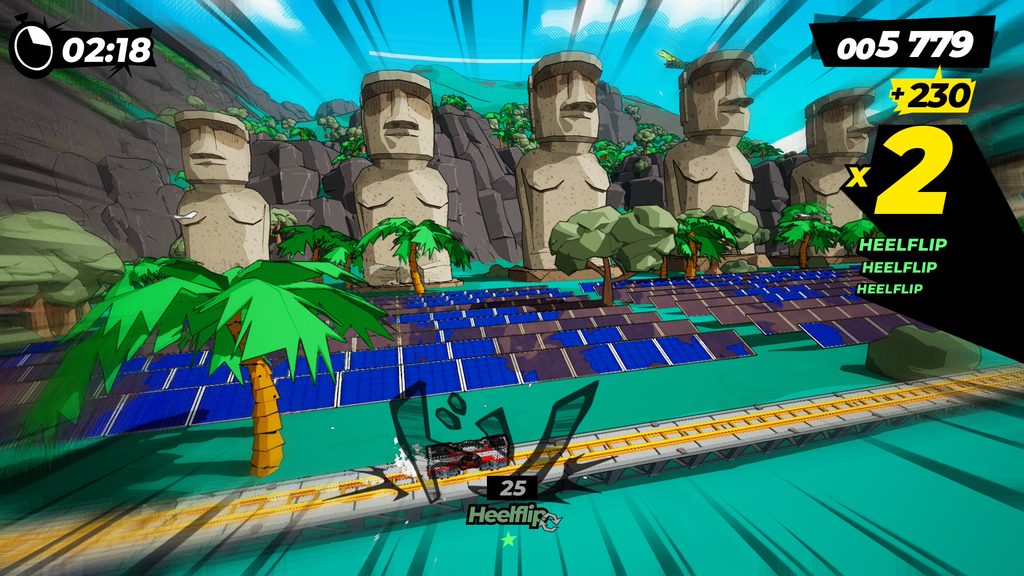
Andrew One: We did talk a lot about these different moods. For instance, the boss fight music was the most ambitious material in the game. It had to be structured into several sections capable of looping independently of one another, so the music could evolve dynamically over the course of the fight. We had to compose with that in mind. The races, meanwhile, drew more on the soundtracks of Japanese racing games from the late 90s and early 2000s, to recreate that very particular atmosphere.
Tee Lopes: I think it comes through in the different elements of the music. A trick challenge, for example, might call for something that sounds cool, funky, maybe even a little cocky, because you’re pulling off tricks and showing off your skill. A boss theme, on the other hand, can be much more intense or oppressive, using minor chords and other musical devices that build tension and make the challenge feel bigger. And then, of course, there’s the BPM, the tempo of the track, which can immediately convey a certain sense of speed or urgency. So for every type of challenge, we have all these musical tools at our disposal, and we use them to create a feeling that matches what’s happening on screen for the player.
PnT: Some stages have real gameplay gimmicks, I’m thinking of the last level of chapter 7 against Suzuna Sei and its train scale rhythm game. To what extent did these levels create new working constraints or shape how you compose?
Andrew One: Sean handled that one! That said, every boss level came with its own composition challenges, both in terms of style and structure. For example, on my track The Wretchound, the action takes place in a very cyberpunk level with a lot of different gameplay phases. I chose to draw on the raw, aggressive energy of Prodigy, while also wanting to work in, at one point in the track, a section evoking the atmosphere of Blade Runner. In the end, I’d talk more about challenges than constraints!
Tee Lopes: As for my own work, I didn’t really have to compose under that kind of constraint. I mostly got to write freely, basing things on what felt right for the level’s theme and the function of that particular game mode. The developers then handled a large part of the implementation and made their own creative calls, even going as far as moving certain tracks to the end. I think they made excellent choices, and it really shows in the final result and in how the game was received.