Christoffer Bodegård spent eight years developing Esoteric Ebb, almost entirely on his own from Gothenburg, a 1.25-million-word CRPG that transposes the mechanics of Dungeons & Dragons 5th Edition into a post-war city called Norvik, where players take on the role of a cleric summoned for a week of municipal elections. After graduating with a degree in game writing from Skövde in 2015, at the bottom of his class, he initially took on a series of narrative design contracts for horror and survival projects, founded a company that collapsed in 2017, and then decided to handle everything himself: gameplay coding, 3D modeling, writing, and art direction. The game was published by Raw Fury in March 2026 after four years of iterations, a budget that nearly doubled along the way, and a commercial resurgence sparked by a PC Gamer article in January of that same year. Hailed everywhere as a “Disco-like” (a label he himself embraces), Ebb stands out for its direct engagement with Dungeons & Dragons, its integration of political ideologies directly into character traits, and its commitment to taking seriously what role-playing games typically treat as mere backdrop. This interview, conducted after the game’s release, looks back on the eight-year production process, the method for writing choices, the game’s political framework, and the role of total creative control in an indie economy that leaves less and less room for it.
Point’n Think : You’ve said you landed in last place of the 2015 Skövde Game Writing class, and that you learned programming defensively, because you’d been warned a game writer rarely finds work. In hindsight, did that early pragmatism, having to do everything yourself, shape your relationship to the craft, or is it the opposite, that a deeper need for total control found its expression through those constraints?
Christoffer Bodegård : It’s a bit of a mix. I originally hated programming, and yes, did it out of necessity. Over time, I did learn to really love it. But during my university studies, I preferred the idea of working directly with programmers. Up until I ended up in a situation with my first company, which crashed and burned in 2017-ish. After that, I decided to always retain full creative and effective control of my projects – which includes being able to manage the entire codebase by myself. While I work with a bunch of wonderful programmers today (who make sure things are optimized and actually playable), I still handle all of the basic gameplay programming myself, so I never lose control of the direct player experience.
PnT : Your bachelor’s and master’s theses both try to answer a single question: how do you write good choices? Seven years later, with 1.25 million words of Ebb behind you, do you have an answer, even a tentative one, even one that contradicts the 2018 version?
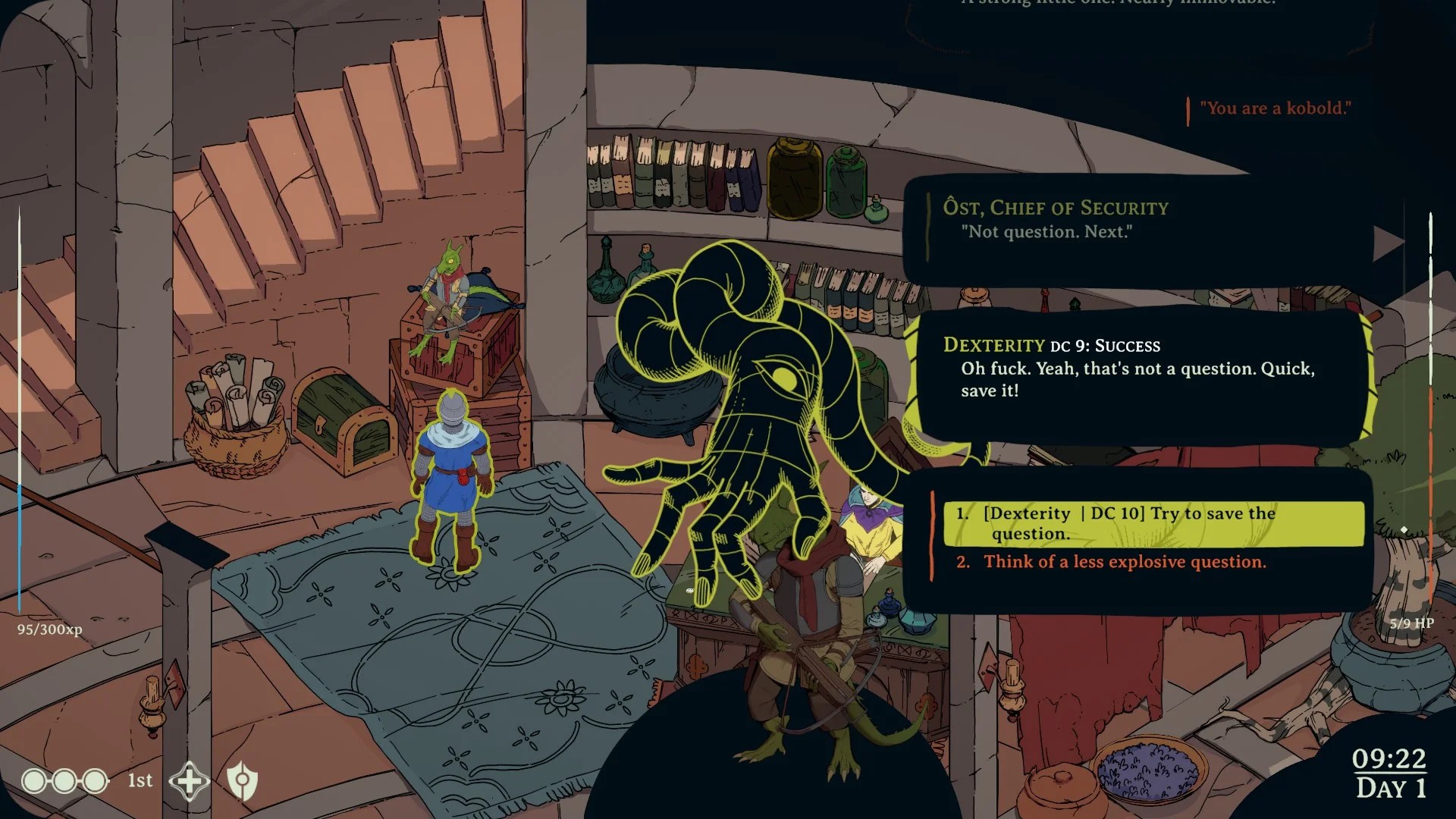
Christoffer : Pretty much everything I ‘discovered’ during that academic work has proved to stay true. Which is: the more context the player has surrounding a choice, the more that choice has the ability to lead to positive agency when feedback is received. Or something like that. And it might seem obvious, but really it’s one of those things that I think feels a bit counterintuitive when designing an experience. Whether that’s a TTRPG or a digital one. A DM usually wants to have suspense and tension by leaving the player in the dark, and some players like that too. But from what I’ve seen, most players get a much better experience by just pelting them with context clues. When playing D&D for example, I always try to chime in with as many ‘your character knows that’, and ‘your gut feeling is’, and ‘you sense that’ as I can. This is the main reason, in my eyes, why the Disco talking skills (or as I call them, Chimes) are so effective.
PnT : Before Esoteric Ebb, you did freelance work on cinematic horror, survival games, projects like Gori at Angry Demon Studio. What remains from those years as a narrative design fixer in the way you wrote Ebb? Is there a discipline of commissioned work that served you, or is Ebb precisely a counter-project to all of that?
Christoffer : The work I did on those projects was absolutely essential for me to get some more solid experience in basic narrative development. As in, linear storytelling. The normal storytelling! While I also got the chance to work on a fun (unreleased) point and click adventure game during my university studies, as well as a bunch of novel writing, it was extremely healthy to get a couple of years of actual linear script writing and narrative development done. It was also great to work as a ‘fixer’, since I didn’t have any emotional investment into the project itself – I was just paid to make it better, with goals set by the OG developers. It’s a very different beast from having your own darling, where you can do anything you want. I like limitations. They breed creativity and so on. Which is probably why I loved working with the expectations of making a so-called Disco-like, as well as within the framework of the 5e system. Those two always gave me strict guidelines to fall back on.
PnT : You describe early 2022 as the moment when everything pivoted: you found an art style, then a story you truly believed in. Can you describe concretely what the prototype looked like just before that pivot, and what changed in your eye, was it a vision that sharpened, or was it you who stopped searching for a vision?
Christoffer : I believe the prototype I was stuck on in 2020/2021 was an isometric grid-based 3D world, with painterly textures, and pixel art characters – a bit like the 2DHD trend – where you played as a sad cleric. The narrative never got too far in this prototype, since I never managed to settle for the visuals or tone. But in mid 2021, I went through some personal stuff (GOT DUMPED), and to distract myself I ended up scrapping all the visual work, and I went back to basics: worldbuilding. I sat in the darkness for about two months writing a lore-bible called A Freestrider’s Guide to Askan. The PDF is still floating around the community to this day, but it was essentially a solid compilation of all the lore stuff I’d been working on up until that point, solidified and documented into a shape that remained mostly canon up until the release of Esoteric Ebb.
Once I had this bible to lean on, I spent November/December of 2021 just hacking away at another dreaded enemy of mine: 3D modelling. I actually learned how to use Blender. And I discovered the silly UV-mapping method that allows for really fast and easy production of hand-drawn isometric backgrounds. Then I did some dumb grease pencil solution for all the dynamic characters, which was a bit too silly, so we ended up scrapping that for the full production. But these two techniques allowed me to, despite my low-grade art skills, create an actual neat-enough-looking game world. Thus the 2022 prototype was born.
PnT : In your pre-launch “pre-mortem,” you call your trajectory a “ridiculously stupid path” and actively dissuade anyone from following it. But you did it anyway. What, inside you, made the unreasonableness bearable, pride, faith, absence of alternatives? And do you think a game like this can exist otherwise than through that kind of individual unreasonableness?
Christoffer : I was told once, by someone very wise, to ‘Please just finish a project for once in your god damn life’. Or something like that. And I took it to heart. EBBRPG, as I called it, felt like it had so much potential, and I always felt like there was something deeply interesting about taking my own spin on the Planescape: Torment (and then the Disco Elysium) formula. Of course, it took four years of trial and error in order for me to find what was interesting. But I do sincerely believe that this type of interactive writing needs a very specific skillset in order to be produced. You need to have an understanding of both the literary twang (not-boring text), and the mechanical design (pacing of choices/dynamic content) while keeping it all coherent in a nonlinear system. So for me, Ebb could only exist through my own unreasonable stubbornness in refusing to stop iteration until it got good enough to reach my own standards. Then, after that, it’s just a question of whether or not I have good enough taste. Which, as it turns out, I think I have? At least statistically, I think my taste has been proven to be decent. So if you happen to have personal savings to burn, and want to risk it all on your own taste – then do what I did!
PnT : You’ve said that just before the Raw Fury advance landed, you didn’t have enough to pay rent. At what specific moment, during those lean years, did you seriously consider stopping, and what made you keep going the next morning?
Christoffer : I did always have a number of backup plans. I always do. Though yes, I did genuinely run out of liquid cash right as the first RAW FURY injections got pumped into my veins. But if I needed another six months, I always had the ability to sell a small part of the company. Or I could have taken a risky loan. Or I could have moved out of my apartment and moved back home to my parents. I’m very privileged to have had those options, not everyone does.
But there was a serious moment after I released the first demo (which I called the ‘Second Draft’ demo at the time) – a moment where I just had to genuinely accept that the game probably wouldn’t be some massive hit. The demo came out at the start of December 2024, and while the six hundred or so people who played it really liked it, I spent that Christmas planning out when exactly in 2025 I would pause production on the game. I actually never stopped looking for a job in the industry all throughout development, so my main hope was to leverage the demo to land a writing gig at some international studio.
Then, on the morning of January 12th, that one PC Gamer article changed my entire life. Which was neat. After that, I understood that the game was solid enough of a creature to bank my entire soul on, and that the only thing I needed to do until release was make the game as good as I possibly could make it.
PnT : You say you were probably the first to write “Disco-like” on r/DiscoElysium. Defining yourself so frontally by another game is a choice that can be read several ways, humility, marketing pragmatism, or the conviction that a nascent genre needs a name. Do you still see that label as a good deal today, or is it costing you something in return?
Christoffer : It’s so dumb! It’s idiotic! But it’s also very funny to just throw yourself into a marketing hellhole like that. Hey, I’m a ‘solo developer’ and I wanna try to make a game comparable to the most celebrated literary gaming success in history! What could possibly go wrong?
I always just approached it like this: the comparison is inevitable. Competing with Disco is stupid. So let’s just have fun with it. Your DM doesn’t worry about whether he’s good enough to compare with Tolkien, Pratchett, or Kurvitz. Your DM is here to have fun with his players. The structure/mechanics of the adventure is straight up a mix between Planescape: Torment, Disco Elysium, and the modern 5e mechanics. Then the writing, the improv, the jokes, the themes are all just whatever I wanted to focus on. Whatever I found funny and interesting. I love Disco, but I never had any interest in changing my writing to fit their tone and themes. Whether or not I succeeded in doing something interesting with that setup – that’s up to the players.
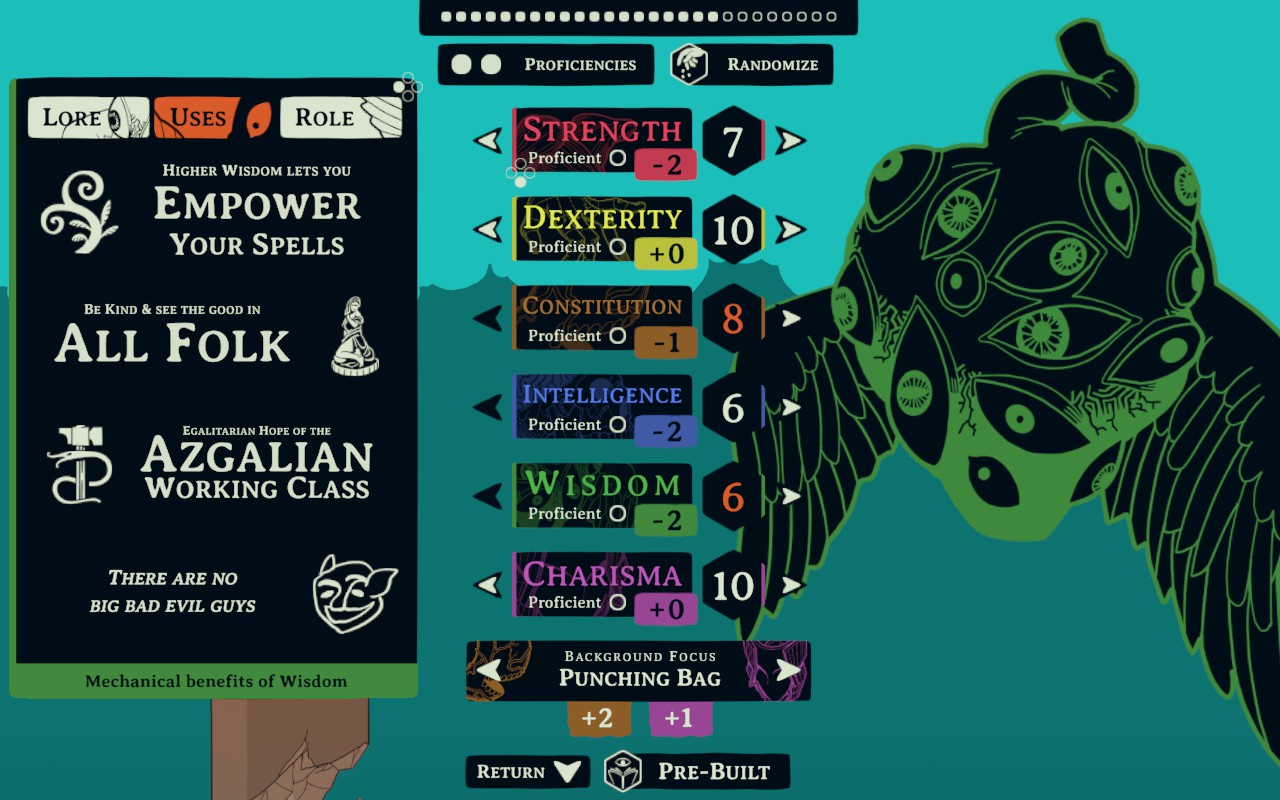
PnT : The choice to tie each D&D stat to a political ideology (Strength = nationalism, Wisdom = Azgalism, etc.) is a very strong design gesture, because it denies the player any mechanical neutrality: raising a stat is literally embracing a political voice in your head. Did that structure impose itself early, or did you have to resist the temptation to do something more “neutral” to avoid alienating part of your audience?
Christoffer : It was fairly early on. Even that lore-bible was written strictly from the perspective of a Freestrider, with all the biases that includes. But I think the important thing to mention here is that the political alignment of the ability scores is only for the cleric. In the Esoteric 5e ruleset, the goal is allow for the player to customize what their ability scores actually mean. For the cleric, Strength is masculinity and nationalism. For Snell, Strength is survival and stubbornness. For Ettir, Strength is stoicism and protection. Every character can express themselves differently in this system, and each ability score should be used to mold a unique personality.
As for the Cleric, putting a political alignment on each of the stats just works out nicely from a design perspective. I picked out six ideologies (out of many dozens that exist in the world) and mapped them out, giving each some space to shine. But I’d argue that most people in this world do not have internal debates like this. It’s just- me. I’m the kind of person who happens to believe in many contradictory ideologies at the same time. So the Cleric’s internal struggle is just a self-insertion of my own exploration of political thought. Which is really fun to write, by the way.
But going more ‘neutral’ is absolutely something that was suggested to me many times during development. But the problem is that I have a pretty decent understanding of a bunch of ideologies, and the fact is that centrism (or ‘apoliticalness’) is arguably one of the most insidious forces of tyranny. The best peasant in your kingdom is one who is perfectly happy with the way things are.
And I think it was Kurvitz who said, when talking about Disco’s writing, that one of the things that makes it so good (and engaging) is that it’s constantly and aggressively poking at the player and forcing them to take a stand. Interactive writing is only interesting when interesting choices are presented, and thus conflict is good. Neutrality is boring. And so on.
PnT : The Charm Person spell comes up a lot in your interviews as the moral case study of the game, a low-level D&D spell whose legal and ethical implications you take completely seriously. Why pick that spell as the pivot rather than something more spectacular? Do you consider a large part of Ebb’s work to be precisely about taking seriously what D&D treats lightly?
Christoffer : It’s primarily because it’s one of the lowest level charm spells. I wanted to do some stuff with the cantrip Friends as well, but it was a bit too difficult to implement in a fun way. But I really wanted to limit myself to everything low tier- no fourth level spells or above. Mainly to show that even really ‘simple’ spells, ones a basic not-very-epic wizard has access to, would fundamentally change society.
And to answer your other question: yes. It’s a tone originating from one of my long-time D&D groups, where my players always play as if everything is real. They don’t play as if they’re in a story, or heroes of some fantasy tale – they treat it as if they are real people dealing with magical bullshit. And I love that. Whenever they get access to Create Food and Water, it always becomes a discussion about how exactly the local economy is impacted by the existence of this fascinating spell.
Ebb then is just an extrapolation of that expression of realism. Which allows it to stand out in comparison to a lot of other fantasy satire. Lots of things are jokes, yes, but it’s not Monty Python. Whenever I add something ridiculous (usually by improv during a session) I then force myself to explain that crazy element. Why? Fun challenge I guess. It also opens up for way more emotional resonance.
PnT : The “short rest” scene between the Cleric and Snell in the dungeon, the conversation about the father, is the one critics cite most and the one you’ve admitted, in other interviews, to pushing almost to the end of production out of fear of fumbling it. The theme of masculinity, male loneliness, the relationship to the father runs through the whole game. Where does that come from for you, and what did the CRPG medium let you say on this subject that another format wouldn’t have allowed?
Christoffer : Those themes were set at the start of 2022. It came entirely from the fact that I’m so horribly interested in them. Everything in Ebb is a reflection and an exploration of modern bullshit that I like talking about. It’s how I’m able to write 2-5k words a day (during the most hectic production period) – if the content wasn’t ridiculously engaging for me, then I would never be able to lock in like that.
It’s really useful to have the ability to choose which topics you want to explore, and from which angle, via your character build. For example, most journalists play either Wisdom (soft-hearted leftist) or Dexterity (sharp capitalist), which is a bit funny looking back. If you go scan the more right-leaning forums, you’ll find way more Strength Clerics, going full Nazgalist. This was on purpose of course. I wanted to reach out to different people on different levels, while exploring the same questions. I didn’t always hit the mark perfectly, but these angles allowed me a lot more breathing room. The player will excuse (and even enjoy) a magocratic rant way more if you purposefully chose to go full-on wizard-god-king Intelligencemaxxing.
As for that scene with Snell, funnily enough I only needed to do one full editing pass on it before sending it out. It contains these six sections towards the end, where each of the ability scores get to give a completely unique elaboration upon Snell’s story. But each of them are locked behind a pretty high DC. So one thing I always have to keep in mind when reading feedback on the game is that most players only play it once. Most players will only see two, max three of these expressions. That, for me, makes it hilariously funny to read reviews sometimes. Obviously I’m not expecting anyone to play it more than once, but it seems like everyone will come out of it with a slightly (or majorly) differing opinion on the Cleric, the world, the themes, and on me.
PnT : You’ve been theorizing the notion of “negative agency” for a long time: everything that makes a player suffer a choice without understanding it. The Chimes, in Ebb, are your answer, a voice that warns the player about the likely nature of an action before they take it. But some designers argue the opposite, that opacity is part of roleplaying. How do you defend your stance against that objection, and are there moments in the game where you voluntarily gave up that transparency?
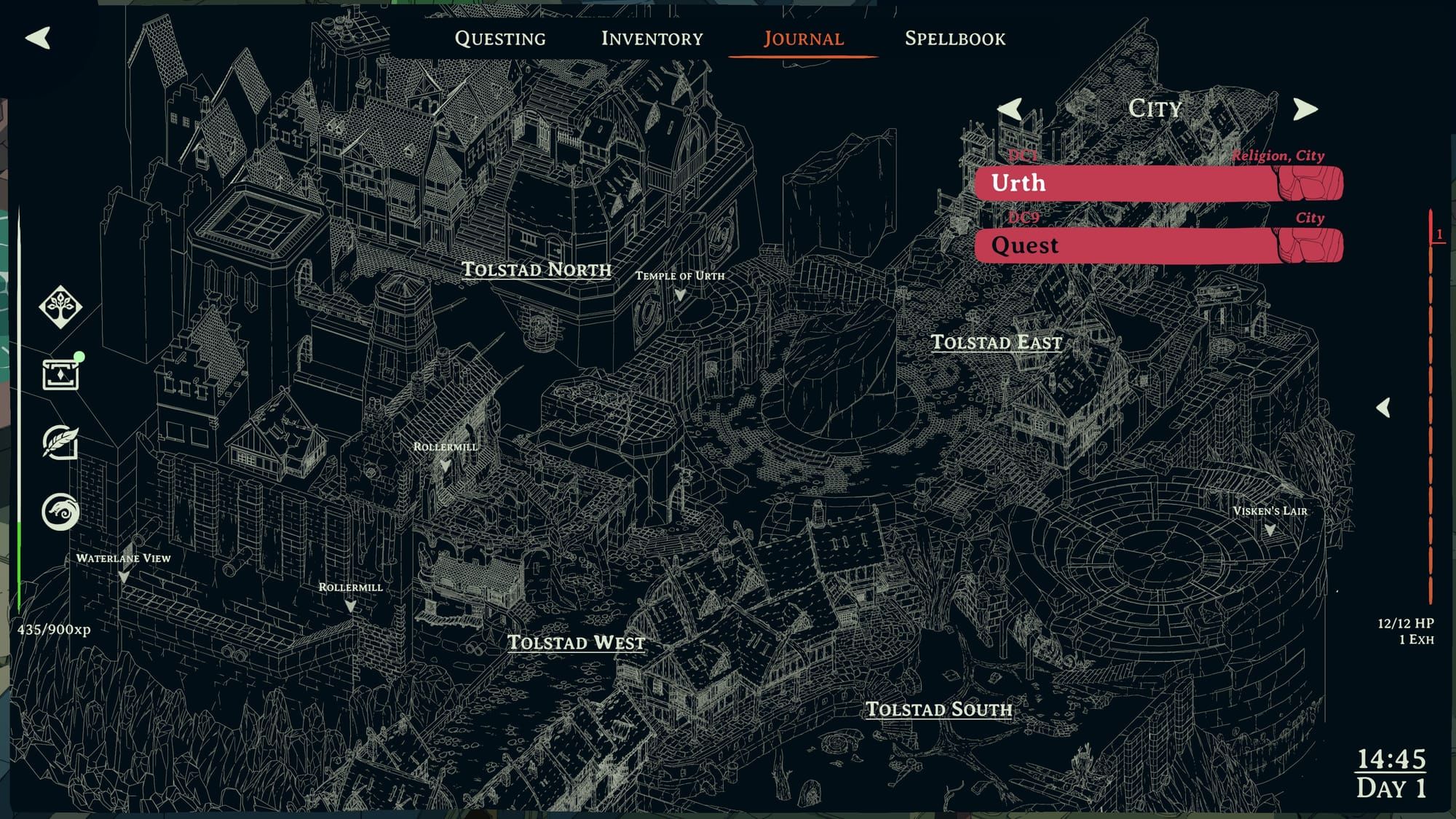
Christoffer : I’ve been experimenting a bit with that thought lately. One part that’s absolutely ‘opaque’, is just the nature of the dynamic content. A player will see approximately 40% of the game’s writing on a regular playthrough – and there is no decent way for me to explain how much they are missing. At least none I can see right now. So I guess I would say that the system itself has enough hidden information as it is, that we don’t really need to attempt to hide anything more. And of course, technically speaking, if I did do a bunch of opaque bullshit lying to the players (like fudging dice) then the goal is to never let the player actually know. So if I did, I would never admit to it in interviews either. But my general tip to anyone getting into interactive writing is: learn the rules before you break them. And I’m probably just starting to inch into the skill level where I’m allowed to break shit.
PnT : In the post-release PC Gamer interview, you say “most players only saw half the game, and that’s fine by me, you’ve got to miss stuff in order to feel like the world is bigger than you.” That’s a rare philosophy in an era where players document and complete everything to 100%. Do you think that philosophy has a commercial cost? And did you have to fight to hold it, including internally with Raw Fury?
Christoffer : Yes on the first one. And also, not really on the second one. Technically speaking, Esoteric Ebb was planned, and pitched to Raw Fury, as a 300k word count, maybe 12h game. I tend to say that the budget realistically only really stretched to fit the development of an 8 hour adventure game. Not a 30-something hour RPG. And in the end, Raw Fury bumped the budget up by almost double that original sum. During development they did give me some light encouragement to not balloon the word count too much (oops) and they did give me strict deadlines to stick to. But beyond that? They definitely saw the potential of going larger. They were also, probably, pretty nervous about putting out a highly political game written by a single, slightly insane, author. But they also funded the hiring of my wonderful editor Phil Jamesson, so I’m sure that calmed them down a bit.
In all seriousness, the fact that we managed to put out a game this huge is a testament to the incredible (and highly efficient) work done by all of my collaborators. The plan was always to launch the game with way less detailed artwork and way fewer musical tracks and sound effects. But I’m humbled by the fact that every single one of the amazing artists who worked on Ebb over-delivered, without ever sacrificing the quality of the work. I’m hoping to work with all of them in the future as well. (And thank you to Raw Fury for paying for the extra hours.)
PnT : Esoteric Ebb releases in a context where Western democratic institutions are in real crisis, where abstention reaches record highs, where parties with distinctly “numenist” overtones are gaining ground. You say your game is “very political” because it takes place during election week, and that every conversation becomes a “battlefield.” Did you write Esoteric Ebb against something specific in your era, or is your relationship to politics in fiction more detached than that?
Christoffer : Numenism is such a great word. I bet about 60% of readers have to google it to know what it means, but that’s part of the fun. (I, too, had to google it a couple of years ago.)
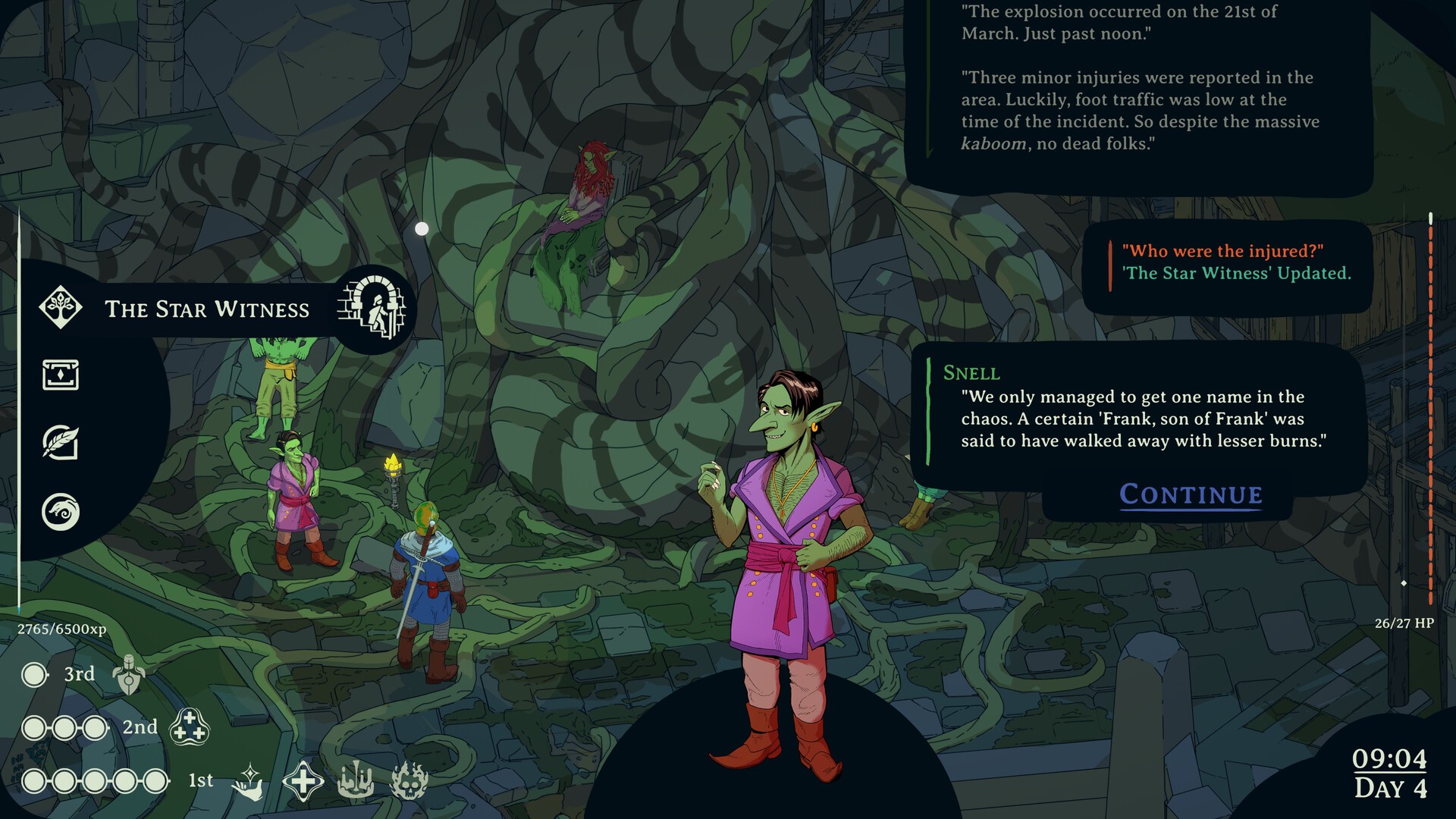
Esoteric Ebb is written directly to interact with, and act in relation to, everything that’s going on today. There’s no political topic in the game that doesn’t interest me in an intensely shit’s-happening-right-now kind of relevant way. And I built the reality of Postwar Era Norvik to be shaped in various referential and sometimes allegorical ways with several different modern conflicts, movements, ideas, and even individual people. Primarily because it’s fun as hell to write. To have Dexterity chime up in your mind and state, “Immigration is objectively always good,” and then try to write nine different, entirely politically unique, ways of answering that question. That’s a fun exercise on its own.
I’m agrarian btw.
PnT : You’ve built an entire world, The Esoteric Coast, of which Norvik is only one city. With Sudden Snail, you talk about a long career in interactive writing. After eight years inside Ebb, where do you want to go now? Stay in that setting and explore other corners of it, or leave entirely, and what does the Christoffer of 2026 want to prove that the one of 2018 couldn’t even imagine?
Christoffer : 2018 Chris is twenty-two years old and wants to do something interesting with his lonely life. He also wants a job where he’s allowed to write fun stuff all day – and he is clearly insane enough to just keep throwing shit at the wall until something sticks.
2026 Chris is thirty years old, and wants to keep improving at interactive writing. He feels like he’s barely scratched the surface, and that his EGO probably isn’t too big already. As for what that will look like in, like, 2032 when the next game is ready? He cannot say.
Why am I writing this in third person?