Imagine an apartment. It’s beautiful—objectively speaking. Natural light streams through, light-colored hardwood floors, a pearl-gray sofa, a thriving houseplant. The walls are white and bare. Not a single shelf. Not a single book spine, not a single edge of a case, not a single vinyl record sticking out. Nothing to grasp, nothing to turn over in your hands, nothing that tells you who lives here. Yet it’s all there. The thousands of movies, the hundreds of games, entire discographies: somewhere, in a subscription, behind a screensaver. You just have to ask.
This apartment isn’t a dystopia. It’s a Pinterest mood board, an Airbnb listing, a decorative ideal that we’ve collectively validated with a flurry of likes. It’s also, I believe, the most accurate portrait of what the cultural industry has in store for us: a world where we’ll have access to everything and own nothing. We’ve never had so many works of art at our fingertips. We’ve never held so few in our hands.
In January 2028, Sony will release its final disc. The announcement came on July 1, in a blog post written with impeccable politeness: after that date, no new PlayStation games will be released in physical format. The apartment with white walls has just gained another room.
« Hire-me »
Let’s start with what’s obvious. In late June, at the Lille Game Camp, 1,800 French video game professionals gathered in a rather lackluster atmosphere. The gathering, which was supposed to be casual, turned into a massive networking exercise for castaways. In the crowd, one participant had a QR code hanging from his bag, reading “Hire Me.” It’s worth pausing to consider this image: someone who creates worlds, reduced to turning himself into a clickable link.
The backdrop behind them is familiar, but the sheer scale of it all is dizzying. Nacon, the sector’s second-largest employer in France, has been placed in receivership following the cancellation of a 40-million-euro line of credit; its studios are either up for sale or have been shut down: Spiders, Big Bad Wolf, and Nacon Tech have already closed their doors, with Midgar Studio set to follow suit soon. Don’t Nod, the studio behind *Life is Strange*, is implementing a restructuring plan that threatens 150 employees. Quantic Dream is laying off staff following the failure of its latest game. In Lyon, Arkane is holding its breath as it awaits Microsoft’s decisions. And this figure, almost surreal: in one year, job postings in the sector in the Île-de-France region have plummeted by 95%.
You could chalk all of this up to economic cycles: the free money of 2020 and 2021 inflated a bubble, the bubble burst, investors became cautious, and AI serves as both a bogeyman and an excuse. All of that is true, and none of it says anything about the climate. The French video game industry right now resembles a high-rise building at night: you look at it from the street, and the lights in the windows go out one by one. Spiders, lights out. Big Bad Wolf, lights out. Entire floors at Don’t Nod, at Quantic Dream. Behind the windows that are still lit, you can make out people finishing a game while wondering if they’ll still be there when it’s released. It was in this twilight that Sony published its blog post. On July 1, a few lines of impeccable politeness, barely audible amid the din of closures. And that is precisely what should alarm us: while studios are shutting down, another project is moving forward, methodically, without layoffs or bankruptcies. The project of dispossession.
A Natural Adaptation
Let’s take another look at Sony’s press release. The end of physical discs is presented there as “a natural progression,” a simple adaptation to consumer preferences, with consumers reportedly overwhelmingly favoring digital formats. The numbers seem to back up the company’s claim: digital sales now account for the overwhelming majority of console game sales. Move along—you asked for it.
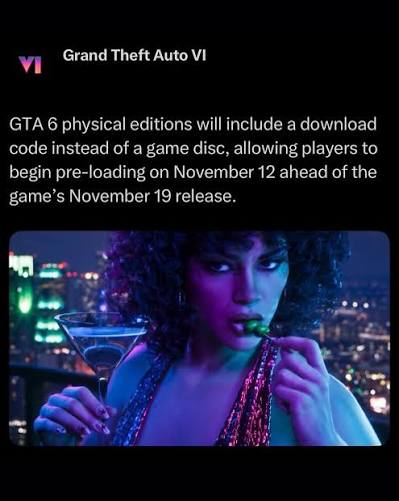
Except that preferences don’t just appear out of thin air. The industry has been orchestrating this shift for fifteen years: consoles sold without disc drives, boxed games reduced to download codes (hello, GTA VI), constant promotions on digital stores, and subscription services presented as the only reasonable option. They made physical media expensive, bulky, almost a luxury item, and then noted with regret that people were turning away from it. It’s an old tactic: manufacture consent, then invoke it.
And this trend began long before consoles without disc drives: it started inside the boxes themselves. Remember what used to be inside them? The Metal Gear Solid booklets, the Final Fantasy character profiles we’d read in the car before we’d even started the game, the GTA map we’d unfold on the bed to locate the hideouts. The booklet was a gateway, an antechamber to the game, sometimes a work of art in its own right. Then it got thinner, year after year, replaced by a single sheet of safety instructions in twelve languages, until we ended up with boxes containing nothing more than a bare disc in a plastic tray, if not just a simple download code. We methodically stripped the object of its substance, and then we realized that people no longer felt attached to it. Of course: it’s easy to mourn an empty shell.
As for the numbers that are supposed to prove everything, it’s worth taking a closer look at how they’re calculated. When we’re constantly told that digital is crushing physical sales, a large portion of these statistics compare things that aren’t comparable: on one hand, boxed games; on the other, total online spending—which includes full games as well as DLC, expansions, season passes, weapon skins, virtual currencies, and digital artbooks. Physical games will never sell a weapon skin for 4.99 euros: we’re not comparing two formats; we’re comparing a single item to an ecosystem of microtransactions designed to be bottomless. And these analyses overlook an entire segment of reality: the secondhand market, which is invisible in publishers’ revenue figures since it brings them no profit, even though it fills entire shelves, keeps stores in business, and allows players on a tight budget to build a gaming culture. The market that’s declared moribund has already been cut in half before the numbers are even tallied.
And we need to identify what is actually changing in January 2028. It’s not a format that’s disappearing, it’s a right. A physical disc can be bought, lent, resold, given as a gift, and kept. A digital game isn’t bought, it’s rented. What you “own” on a store is a license to use it, one that’s revocable and dependent on the platform’s discretion, the survival of a server, and the validity of an account. The Stop Killing Games movement was built precisely on this premise: entire works erased from reality because a company decided that maintaining them was no longer worth the cost. In the all-digital world, shutting down a server is a book burning that doesn’t even produce smoke.
Video games aren’t inventing anything; they’re catching up. Spotify has already done this for music: artists have become content providers, paid pennies on the dollar, dependent on recommendation algorithms they have no control over. Netflix and its competitors have done the same for film: movies that appear and disappear from catalogs like loss leaders, sometimes removed even before their release for tax reasons (we still remember how Batgirl was handled). It’s the same pattern everywhere: a handful of platforms, almost all American, almost all backed by GAFAM, have inserted themselves between the artists and us. They capture the value, decide what’s visible, what’s recommended, and what even exists. We are no longer audiences for works; we are subscribers to services.
The philosopher Byung-Chul Han calls this the reign of non-things: objects that dissolve into information, a world where we no longer hold on to anything. I can’t think of a better definition for the apartment with white walls. And I don’t think this is a debate about format, disc versus file, boomer versus digital native. It’s a debate about power. Who owns the works. Who decides their survival. Who inherits what.
The House Without Shelves
Here’s the part where people will tell me I’m getting off track, and that’s precisely why I’m writing this editorial. Because I believe this economy of dispossession is visible. That it has produced its own images, its own palette, its own aesthetic genre. When a culture organizes its own emptying, it eventually shows up on screen.
Look at the movies from the last fifteen years. Color has faded away, slowly, shot by shot. Blockbusters are bathed in a standard gray-blue hue; color grading crushes the tones; beige and charcoal have replaced Technicolor. Denis Villeneuve has made the washed-out desert his signature; Christopher Nolan films worlds in shades of stone. I’m not accusing them of anything: these are the filmmakers’ choices, coherent, and often magnificent, even. But filmmakers are also barometers. When the greatest filmmakers of their generation converge toward chromatic extinction, when the same desaturation permeates Instagram interiors, home renovations, and even brand logos, all flattened into the same “millennial gray”, we must ask ourselves what this grayness is reflecting.
And then there are the liminal spaces. Think back to how far we’ve come: a simple photo of a yellowish, carpeted office hallway posted on 4Chan with an unsettling caption, which in just a few years became a genre in its own right. The Backrooms evolved from creepypasta to short films by Kane Parsons, a teenager who became a director, and then to a feature film produced by A24. Video games followed suit, from *The Exit 8* and its endlessly looping Japanese subway corridor to the countless “pool rooms”, those clean, well-lit, tiled pools where the water stands still and no one will ever come to swim.
Let’s pause to consider what these images show, because that’s where it all comes together. Familiar, functional spaces: hallways, lobbies, shopping malls, swimming pools. Spaces in perfect condition, neither dilapidated nor menacing. And spaces that are absolutely empty. Empty of people, empty of objects, empty of traces. No clutter, no wear and tear, no sign that anyone has ever lived there. Mark Fisher would have called this “the uncanny”: not the presence of what shouldn’t be there, but the absence of what should be there. An entire generation, born into the digital age, has made this absence its defining imagery. It shudders at places that resemble, down to the last detail, the world being prepared for it: accessible, clean, infinite, and where there is nothing to grasp.
And if you doubt that this imagery has anything to say about our times, look at what television has done with it. Severance takes place almost entirely in a liminal space: the endless white hallways of Lumon, the deserted open-plan offices, the timeless light of the basements. The setting is the subject. Severance tells the story of employees stripped of their own memories, split in two by their company, whose working hours are so completely captured that they no longer belong to them. The great contemporary narrative of dispossession is filmed in the very settings that our generation has elevated to an aesthetic. It all fits together.
The liminal space is the home without shelves that has become an aesthetic genre. It is the apartment described at the beginning of this text, pushed to its logical conclusion: a space where life has been replaced by availability.
What a Bookshelf Does
Now we need to talk about exactly what is lost when shelves disappear. Because it’s not about organization. A shelf has never been about storage: when it comes to storage, the cloud does it better, for less money, and without dust. No server can do what a shelf does.
A bookshelf displays. It tells anyone who enters the room who you are, what you’ve loved, what you’ve been through. It’s a biography in slices, complete with youthful mistakes and moments of pride. A bookshelf invites: the friend who scans your shelves with their eyes, who tilts their head to read the titles, who pulls out a case and asks, “Is this any good?” ”, is performing an act that no recommendation algorithm will ever replace. A bookshelf circulates: you take a game from it to lend it out, you ask for it back for months, and you eventually give it away. The object gets scratched, its corners worn, bearing the marks of its journey from hand to hand.
Above all, a bookshelf endures. It outlives accounts, subscriptions, platforms, and even its owner. This kind of legacy has one material condition: that there be something to inherit. Libraries, game libraries, and family record collections are machines for passing on culture. A PlayStation Network account, on the other hand, dies along with its password. No one will ever rummage through a deceased father’s Steam library with the same emotion one feels when looking at his vinyl records.
This is the essence of cultural transmission that the all-digital world is draining away: not access to works, which has never been more widespread, but the passing down of works. From one hand to another, from one generation to the next, with the body, time, and wear and tear as evidence of the journey. A culture that is transmitted only through streams is a culture that starts from scratch with every subscription.
Bring Back Some Color
I’m not going to wrap up with a five-point action plan, because I don’t have one, and because I’m wary of editorials that pretend to have one. But I also reject the stance of resigned observation—the one that elegantly describes the disaster and then goes back to business as usual.
There are still actions we can take. Buy physical copies while you still can, and January 2028 reminds us that this won’t last forever. Support those who still produce physical goods: independent physical publishers, shops that are hanging on, DRM-free platforms like GOG, labels that press soundtracks, and print magazines. Support those who preserve: video game archiving organizations, media libraries that lend out games, and the people at Stop Killing Games who fight to ensure that a purchased work remains playable. And support those who are creating, right here, right now: French studios weathering the storm, laid-off teams rebuilding on a human scale, and those who continue to believe that a game is more than just a service.
None of this alone will reverse the trend. But the trend isn’t a law of physics. Sony explains that the end of the physical disc is in line with our preferences: the least we can do is prove that our preferences still exist, that they haven’t been entirely manufactured, that there’s still something within us that wants to hold on to, keep, lend, and pass on.
The apartment with white walls isn’t inevitable, it’s just a style. And a style can be changed. A shelf, for starters. A few cases on it, a worn vinyl record, a dog-eared game we’ve lent out too many times. A splash of color on the walls, one strip at a time.