
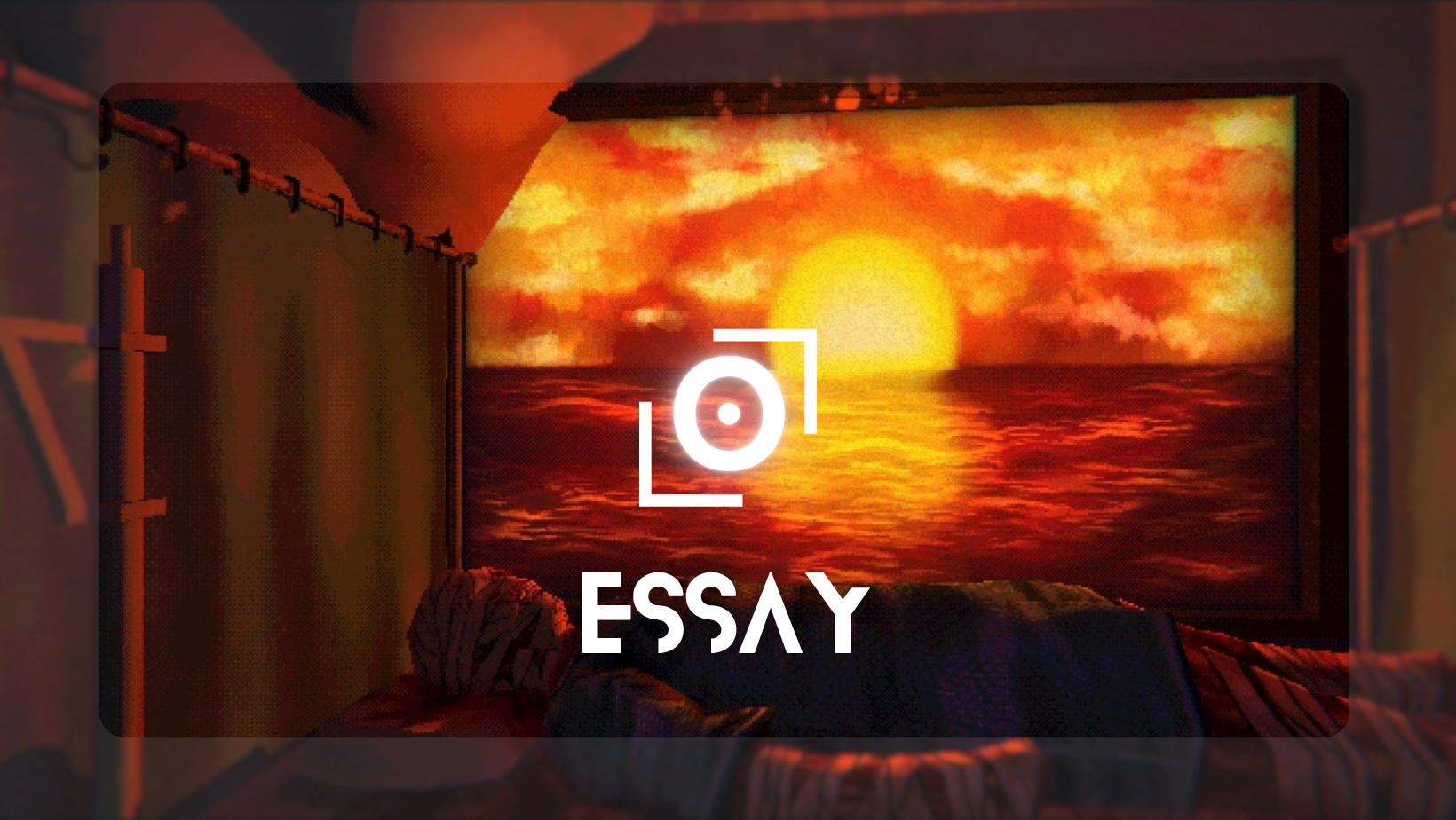
There’s a moment in Arctic Eggs when you realize something is wrong. Not a specific moment, not a jump scare, not a ghostly apparition, not a plot twist. More like a slow build-up, a sense of unease that creeps up on you without you knowing where it’s coming from. You’re in a foggy city of the future, cooking eggs after being arrested for attempted escape. That’s it. You hold a frying pan, flip the food, serve residents waiting for their meals. The NPCs have faces that ripple like liquid surfaces. They talk about government conspiracies, a certain Saint of Six Stomach who rules the city, the possibility of frying an egg on top of Everest. Caged chickens watch us in silence while we cook their offspring. None of this is horrifying, but it’s all terribly strange and unsettling.
Arctic Eggs isn’t a horror game. It’s an absurd and funny cooking simulator, developed by The Water Museum and released in 2024. It has a 96% positive rating on Steam. And yet, the word that comes up most often in reviews is “unsettling.” Where does this unease come from when there’s nothing to fear?
This unease is not isolated. It appears, in different forms but with the same texture, across a constellation of independent games that all share a common aesthetic: that of the PlayStation 1. Low-resolution textures, angular polygons, fog that swallows environments, faces that are not quite faces. Mouthwashing traps five characters inside a drifting spaceship. Threshold places us in a high-altitude border post where the air is thin and a train passes without us knowing what it carries. Iron Lung welds us inside a windowless submarine, at the bottom of an ocean of blood. Anatomy has us explore a suburban house that deteriorates a little more with each restart of the game. Crow Country drops us into an abandoned amusement park.
What connects these games is not survival horror. It is not PS1 nostalgia. It is not “retro horror.” It is something more insidious, an horror that does not manifest but persists, that shows nothing yet leaves traces. A horror of what remains once everything has been stripped away. A residual horror.
What remains after everything has been taken away
Survival horror has its pillars. A monster, or at least an identifiable threat. A limited arsenal that makes the player vulnerable. A hostile, codified setting: the mansion, the hospital, the abandoned town. A rising narrative tension that culminates in a confrontation. Jumpscares have their own rules: timing, sonic rupture, the sudden reverse shot. Lovecraftian cosmic horror relies on the unspeakable and on scale, the horror of the incomprehensible, of what exceeds human understanding.
Residual Horror borrows something from cosmic horror, in the sense that horror can emerge from what we do not understand. But it does not need the cosmic, nor the grandiose. It operates at the scale of a corridor, a kitchen, a train platform. It requires neither tentacled creatures nor interstellar abysses. It only asks for a world that trembles slightly, for a question that remains unanswered. Residual Horror is a horror of traces, of what persists after everything has been removed. The monster has been removed, or was never there. The explanation has been removed. The graphical resolution has been removed. Narrative clarity has been removed. What remains is a residue: of unease, of image, of meaning. And it is within this residue that anxiety takes hold.
It rests on four mechanisms:
- First, a state of permanent perceptual uncertainty. You never quite know what you are looking at. Forms oscillate between the familiar and the unknown. A corridor might lead somewhere or dissolve into fog. The image itself is unstable, and that instability contaminates everything it shows.
- Then, absence as presence. Horror lies not in what is shown, but in what is missing. A hole that once existed and is now gone. A train whose contents we never learn. An ocean we never see. A word left unspoken. The void left by subtraction is more unsettling than any monster, because it forces the player to fill it themselves.
- Also, the persistence of unease. Residual Horror does not resolve. There is no final boss embodying evil, no twist that explains everything, no catharsis. The unease remains after the credits, like a stain on the retina, a residue in the literal sense, something the image has imprinted into the player’s body and that refuses to fade.
- And finally, the medium as the material of anxiety. Horror does not only pass through narrative or design; it emerges from the very texture of the image from its grain, from the trembling of polygons. The technical medium is not a neutral vehicle: it is the place where horror occurs.
In his video Sur les traces de l’Abstract Horror, Alt236 identifies in cinema a form of horror that withdraws from the clarity of evil, a terror born from “the incomprehensible, the unspeakable, the immeasurable, that which offers us no path toward understanding.” He traces it across films as varied as Kairo, Under the Skin, Cube, Begotten, and 2001, and names it Abstract Horror. Residual Horror shares this lineage. But it distinguishes itself through its grounding in a specific medium, video games, and in a specific aesthetic, that of the PS1. It is not merely an abstract horror: it is a horror that emerges from the very material of the game, from its technical limitations transformed into an expressive language. Abstract Horror is the horror of what cannot be named. Residual Horror is the horror of what can only be inferred from incomplete traces.
Where does Residual Horror come from?
The original PS1 games were not trying to produce this kind of unease. They were aiming for realism, working within the technical means of their time. The fog in Silent Hill, which later became one of the most powerful narrative tools in the history of horror games, was originally a technical workaround to mask the console’s limited draw distance. The warping textures, the jittering vertices, the blocky faces in Resident Evil were not aesthetic choices. They were material constraints imposed by a machine that simply could not do better.
As detailed by the Game Next Door channel in its video essay on the PSX revival, reproducing this aesthetic today relies on a precise set of parameters: textures limited to 256 by 256 pixels (as opposed to 2048 by 2048 in contemporary AAA), a fog effect to obscure rendering distance, polygon jitter when the camera moves (due to the console’s computational limits), and shadows drawn directly into textures rather than calculated in real time. Each element was a constraint. None was a choice. But together, they produce a specific effect: a world that trembles, dissolves into mist, and never quite anchors itself in reality.
What is crucial is that low-poly alone is not enough to produce this effect. Game Next Door makes this clear: Superhot, Content Warning, Totally Accurate Battle Simulator are all low-poly games, and none of them generate unease. What defines the PSX look and, by extension, Residual Horror is the combination of all these stacked constraints. The residue emerges from the accumulation of limitations. Remove the fog, or the jittering, or the low-resolution textures, and the effect dissipates. It is their convergence that creates this low-resolution uncanny valley, one that an entire generation of players internalized, unknowingly, as the natural register of fear.
The first creators to consciously exploit this register did so in two radically opposed ways. On one side, Puppet Combo. The New York–based studio of Benedetto Cocuzza, active since the early 2010s, has produced a remarkable number of short horror games inspired by 1980s slashers and PS1-era survival horror: Babysitter Bloodbath, Murder House, Nun Massacre. Here, the PSX aesthetic serves a conventional horror framework: a killer, a weapon, a chase. This is Residual Horror in a weaker sense, the image is degraded, but the structure of fear remains classical.
On the other side, Kitty Horrorshow. Since the mid-2010s, this independent developer has been releasing short, often free experiences on itch.io, built through radical subtraction. Anatomy (2016) is the founding gesture. A suburban house, audio tapes to collect, no monster, no combat, no jumpscare. The horror emerges from the space itself and from the game’s gradual degradation, which corrupts a little more with each restart. Kitty Horrorshow does not make horror with the PSX aesthetic, but through the PSX aesthetic. The very material of the game becomes threatening.
Between these two poles, a community has taken shape. Haunted PS1, founded in 2018 on Discord by Nate Hackett, brought together dozens of developers around annual compilations (the Demo Discs) and regular game jams. The article Ghastly Graphics compares this scene to DIY zines and underground shot-on-video cinema: the same shared tools, the same free distribution, the same embrace of “bad” aesthetics as a value. In 2018, Paratopic (Arbitrary Metric) marked a turning point. Its co-creator Jess Harvey explains that what they wanted to evoke was not the PS1 or 3DFX chips, but the hauntology of the past. Lo-fi is no longer a nostalgic homage, it becomes a true writing tool.
Five games that outline the contours of the genre
Anatomy (Kitty Horrorshow, 2016) – Architectural residue
You enter a suburban house. It is dark. You find an audio tape in the kitchen and place it into a player. The voice that emerges theorizes a story. It describes the house as a living organism. The kitchen is the stomach, the place where food enters and is transformed. The hallways are veins, conduits linking the organs together. The bedroom is the site of dreams and vulnerability, where the body of the house and the body of its inhabitant merge most intimately, so much so that it becomes unclear which contains the other. You search for other tapes, in other rooms. The house is empty. Nothing attacks you. But the textures are grainy, the lighting sparse and harsh, and every opened door reveals a space that seems to observe you rather than welcome you.
Then the game crashes.
You restart. The textures have changed, darker, more corrupted, as if a digital mold had spread during your absence. The sound is distorted. The tapes no longer say the same things, or they say the same things in a different register, more aggressive, more intimate. You move through a house that is no longer quite the same house. And the game crashes again. And with each restart, the corruption deepens, visual errors multiply, the program itself seeming to resist being used.
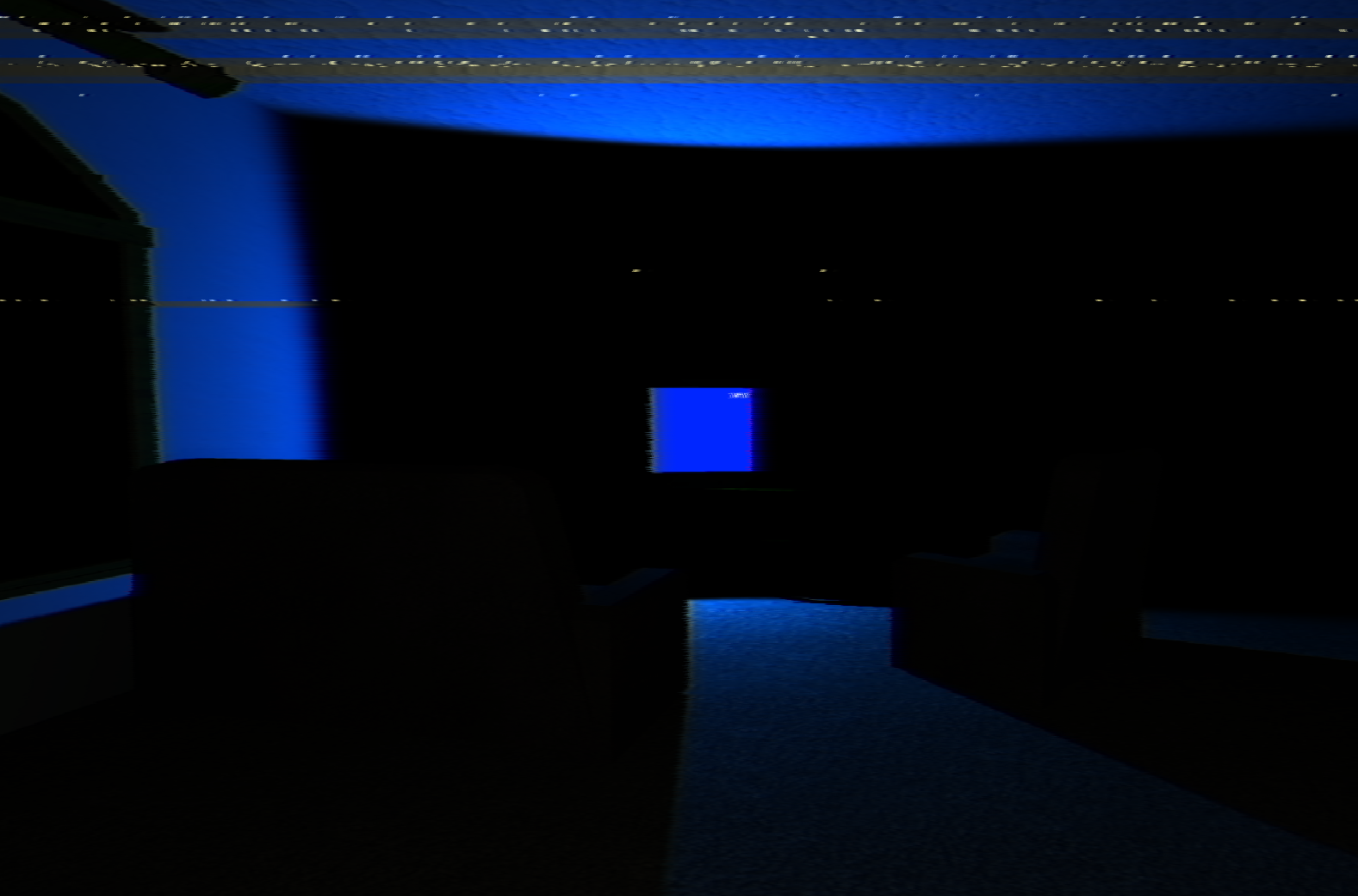
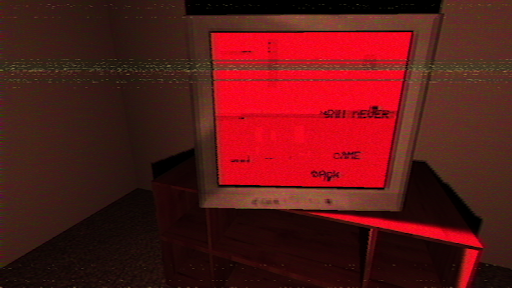
This is the founding gesture of Residual Horror. Anatomy does not simply tell a horror story within a PS1-like setting, it turns the medium itself into a hostile entity. Each playthrough leaves a residue of corruption within the program. The game is literally contaminated by the act of playing it, as if our presence in its files had introduced a virus. In an interview with Slate, Kitty Horrorshow explains that she avoids jumpscares because she finds them “uninteresting”, they are attacks against the player. What interests her instead is creating situations where the player has to move forward against their will, where it is their own actions (opening a door, going down a staircase, restarting the game) that produce the horror. The “dread scare,” as she calls it, in opposition to the jumpscare: “a jump scare is when you are attacked. A dread scare is when you have to do something, even if you don’t want to.”
This reversal is essential to understanding Residual Horror. The horror does not come toward us, we move toward it, step by step, knowing that each action worsens the situation. And the cursed medium is not a VHS tape, as in Ring. Here, the cursed medium is the program itself. The house in Anatomy is not haunted in the classical sense. It is the game that is haunted—and by playing it, we haunt it further.
Mouthwashing (Wrong Organ, 2024) – The unspeakable residue
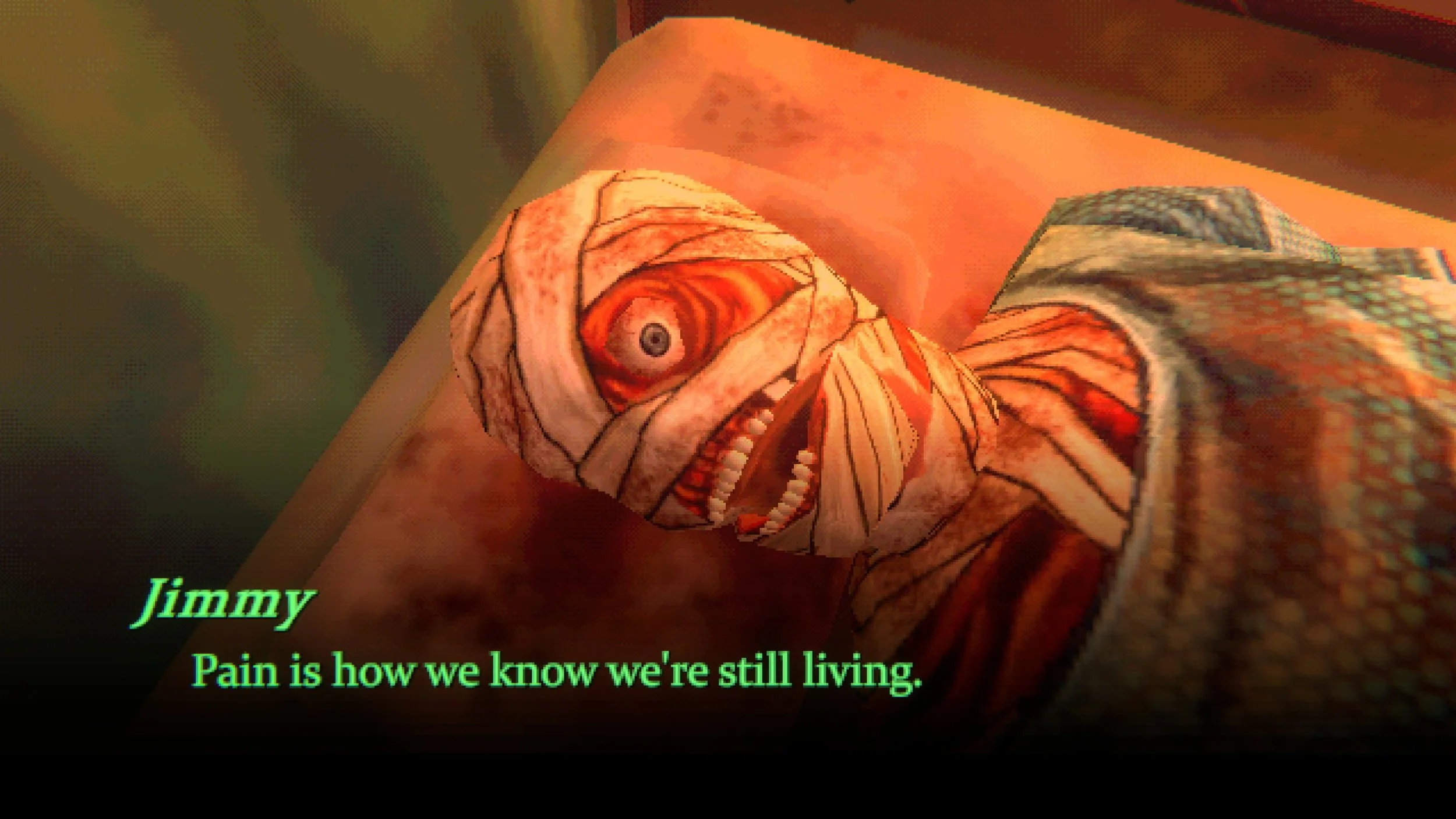
Mouthwashing begins with an irreversible act. You are at the controls of a spaceship, the Tulpar, and the only way forward is to turn right, disable all safety systems, and crash straight into an asteroid. Then you open your eyes in the body of Jimmy, the ship’s second-in-command, aboard a collapsing vessel drifting through space. Captain Curly has been almost entirely burned in the accident. He is wrapped in bandages from head to toe, a single eye visible, a mouth from which only screams emerge. The crew, a tired technician, an awkward intern, and a silent nurse, await death as they lose their grip on reality. And then the cargo hold is opened. It is filled with mouthwash. They are going to die for mouthwash.
The game has become one of the most striking indie successes of 2024, with over 500,000 copies sold, an intense fandom, and discussions that never seem to end. Its main theme is influenced by Twin Peaks, as the studio Wrong Organ explains in a dev diary: “an ambient piece, a calm-before-the-storm, hinting at what you are about to experience before you have even started playing.” But it is the video essayist Ache who best identifies what gives Mouthwashing its real power, in a video essay dissecting what she calls “a great void” at the center of the work.
The first reading of the game, the one that presents itself immediately, is the horror of capitalism. Six lives discarded overnight, a crew learning one week before the crash that this is their final contract and that they will all be laid off. Ache puts it bluntly: “this horror of not knowing where to go, of drifting in the void, of having a death timer hanging over your head, that’s also what layoffs, unemployment, precarity feel like under a capitalism where you only have the right to live if you work.” The cargo of mouthwash is the perfect image: human lives sacrificed for a trivial product, a consumer good that exists only to mask bad breath to mask the smell of what is rotting.
But that is not the story Mouthwashing is telling. The real shift comes in a final flashback. We learn that Anya, the withdrawn and silent nurse, is pregnant with Jimmy’s child, the player’s character. And suddenly, the entire behavior of the crew reconfigures. Anya locked herself in the infirmary not out of madness, but because that is where the gun was hidden. Swansea guarded the entrance to the engine room because a vent led from there to the infirmary, because he was protecting Anya. It was Jimmy who crashed the ship. Not Curly. It was Jimmy who, from the very beginning, wanted to erase everything.
The entire story, as Ache shows, revolves around a violence that is never named: rape. The game stages the imposed silence surrounding sexual violence and reproduces that silence within its own narrative. The player goes through the entire game without the word ever being spoken. Anya’s pregnancy, her relationship with Jimmy, are addressed only in a handful of lines. The clues are there: the coldness between them, Jimmy’s inappropriate jokes, Anya’s immediate terror upon learning she is pregnant, Swansea’s protective behavior but the game refuses to assemble them for us. As Ache puts it: “I felt bad, I felt stupid and dirty, I felt complicit for not having put the words to it immediately.”
This may be the most radical manifestation of Residual Horror. The monster in Mouthwashing, this grotesque caterpillar made of infant limbs, fragments of fetuses, and pieces of toys, emerging from Jimmy’s hallucinations and pursuing him through ventilation shafts, is not a monster in the conventional sense. It is the form taken by trauma when it is denied any articulation. Ache describes it in terms that are almost a definition of the genre: “this trauma doesn’t disappear, it stays there, unable to find expression, formless, erupting like a mass of mutilated flesh and devastating our mind. It is a trauma that was never able to be formulated, so it remains hidden at the edges of our unconscious, waiting to spill out all at once.” A residue that finds no words, so it takes shape, the worst possible shape.
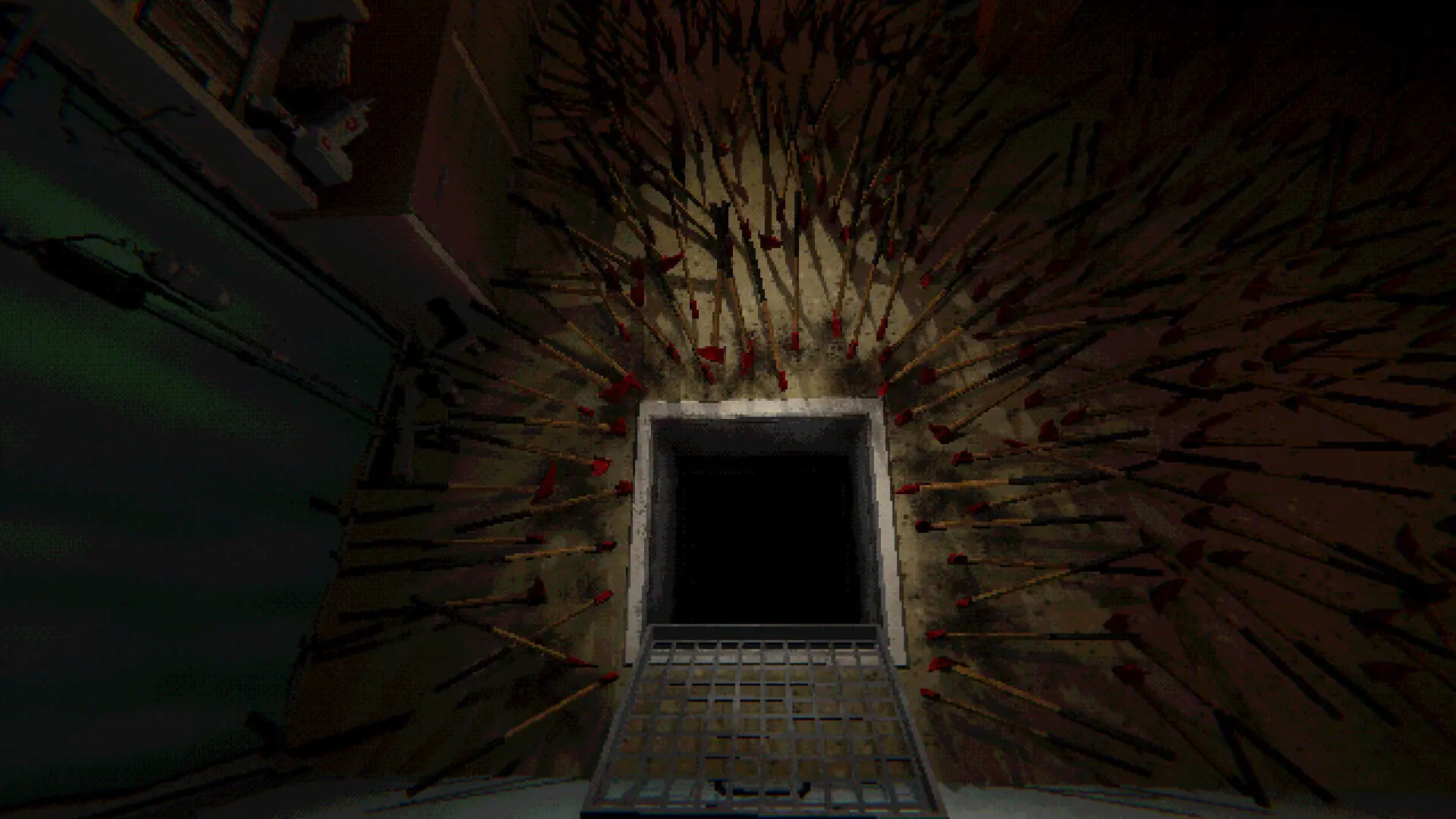
What makes Mouthwashing even more singular is its point of view. Ache highlights this clearly: the monster does not spill into Anya’s mind. We are inside Jimmy’s mind, the aggressor’s. The game refuses to tell the story of a victim consumed by an evil she cannot express, doomed to a tragic end. What it tells instead is that crimes also haunt the one who commits them. That inflicted terror circulates, that despite all the barriers erected to protect oneself from one’s own violence, it returns, formless, in violent flashes. The ending, with Jimmy and Curly alone, devouring each other in a fusion of indistinguishable flesh, offers no redemption. Just two accomplices, the two men, condemned to confront the continuity of bodies they themselves broke, to reproduce again and again what was inflicted upon Anya: penetration, the violation of boundaries, the forced merging of flesh, because it is the only language that remains to him.
The PSX aesthetic is inseparable from all of this. Dithering, low-resolution textures, blocky faces render expressions ambiguous, intentions unreadable. The grain of the image prevents clear vision, just as the narrative structure prevents naming what happened. The blur of the image becomes the moral blur of the story. And the hallucination sequences, those landscapes of flesh, those organic cavities we probe, those phallic forms that emerge and engulf, would not be the same in high definition. It is the grain, the trembling, the indistinction of textures that give them their nightmarish quality, that sensation of looking at something the eye refuses to decipher. The Residual Horror of Mouthwashing operates on every level simultaneously: in the image, in the narrative, in silence, in the player’s body.
Threshold (Julien Eveillé, 2024) – Mechanical residue
Julien Eveillé’s trajectory is, in itself, a signal (you can discover our interview with him just here). An AAA designer at Arkane Studios (Dishonored 2, Deathloop), then at Crytek (Hunt: Showdown, Crysis 4), he chose to go solo and adopt the PSX aesthetic for an auteur project. This is not a developer defaulting to low-poly, this is someone who has worked on some of the industry’s most ambitious productions and deliberately chooses constraint. In his interview with Game Next Door, he explains that the PSX aesthetic allows for rapid iteration, for radically changing a character or a level without investing hours in polish. But the choice clearly goes beyond production convenience. It is a choice of atmosphere. A choice of what the game refuses to show.
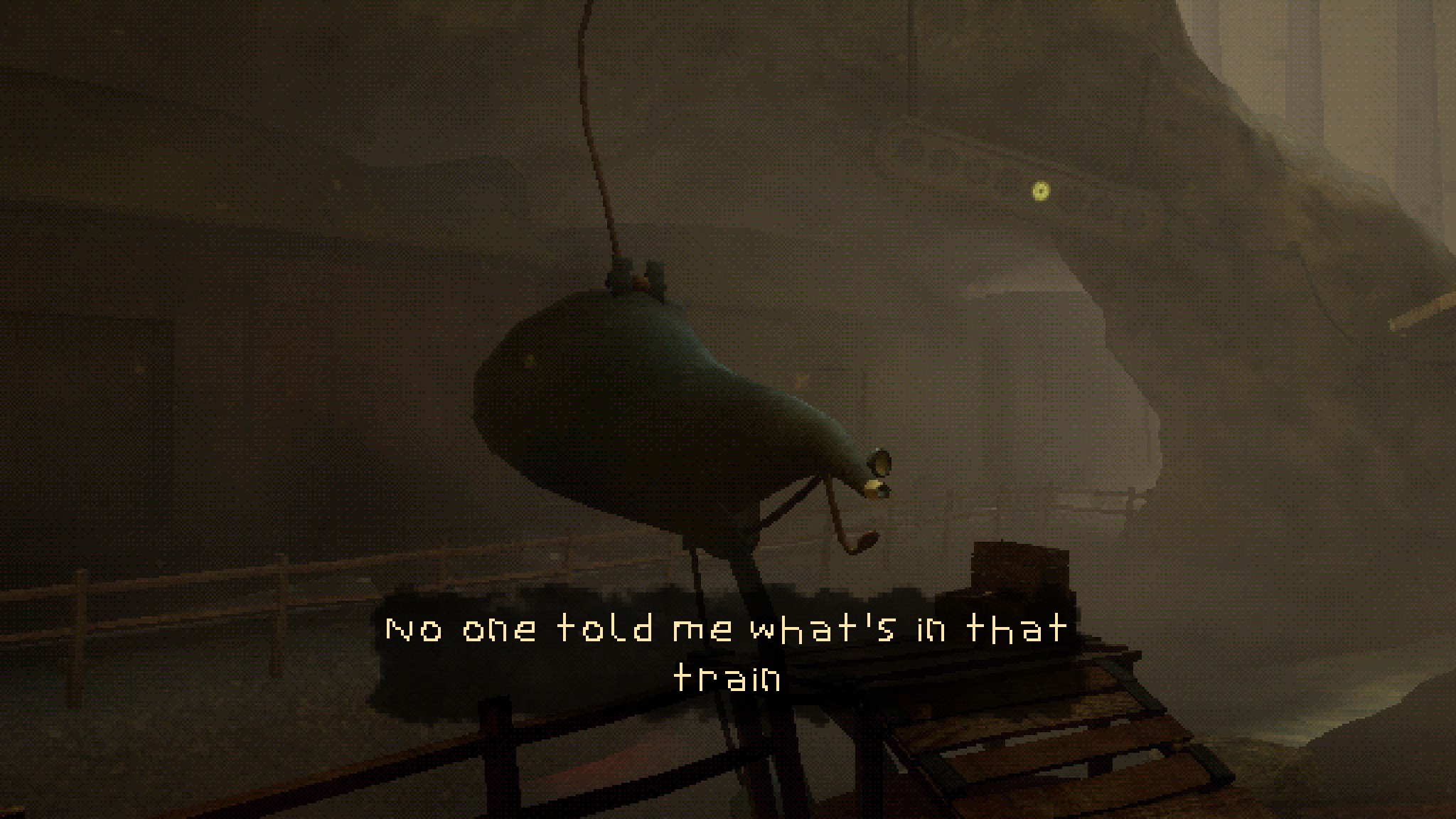
Threshold takes place in a high-altitude border post. You are the new arrival. Your predecessor is buried right next to the building. Your colleague, Mo, is relieved that someone has come to share the burden, he answers your questions, but you are never quite sure whether he is reliable. In the background, a train passes endlessly, a continuous stream of wagons whose contents remain opaque, and your job is to keep it moving by blowing a whistle. The problem is that blowing consumes your air, and at that altitude, air is a limited resource. Running, jumping, speaking, everything consumes that precious air. The game establishes a tension loop where survival depends on constantly managing what you can afford to do. Breathing has a cost.
The most singular design gesture is the difficulty mechanic tied to the country selected at the start of the game. At launch, the game asks for your nationality. It displays your flag with solemnity. And it modifies the experience, without further explanation. The difficulty changes. Why? The game does not say. It is a game design gesture without equivalent in the industry: a system that recognizes the player as a situated individual, that rejects the universality of classical survival horror, and introduces a specific unease, the game knows something about you, and it uses that information opaquely.
What does the train carry? We never truly find out, or only in fragments, through deductions, through clues that never quite align. Why did the predecessor die? The answers exist somewhere, scattered throughout the game, but they never form a complete picture. Reviews of Threshold converge on the same observation: the game lasts barely over an hour, yet its secrets and multiple endings invite repetition, and each run leaves new questions open. The residue, here, lies in the system, in the questions the mechanics pose without answering, in the sense that the game contains more than it is willing to reveal.
Threshold is a game that feels like a sketch, in the literal sense of the blockout Eveillé describes. The buildings are rough, the border post could be anywhere, the surrounding mountains could be any mountains. And it is within this incompleteness that unease takes hold: you inhabit a world that has not finished forming, that could still become anything. A world that, by refusing to specify itself, forces you to fill in the blanks. And the blanks we fill, at altitude, with thinning air and the distant screams of the train are never reassuring.
Iron Lung (David Szymanski, 2022) – Perceptual residue
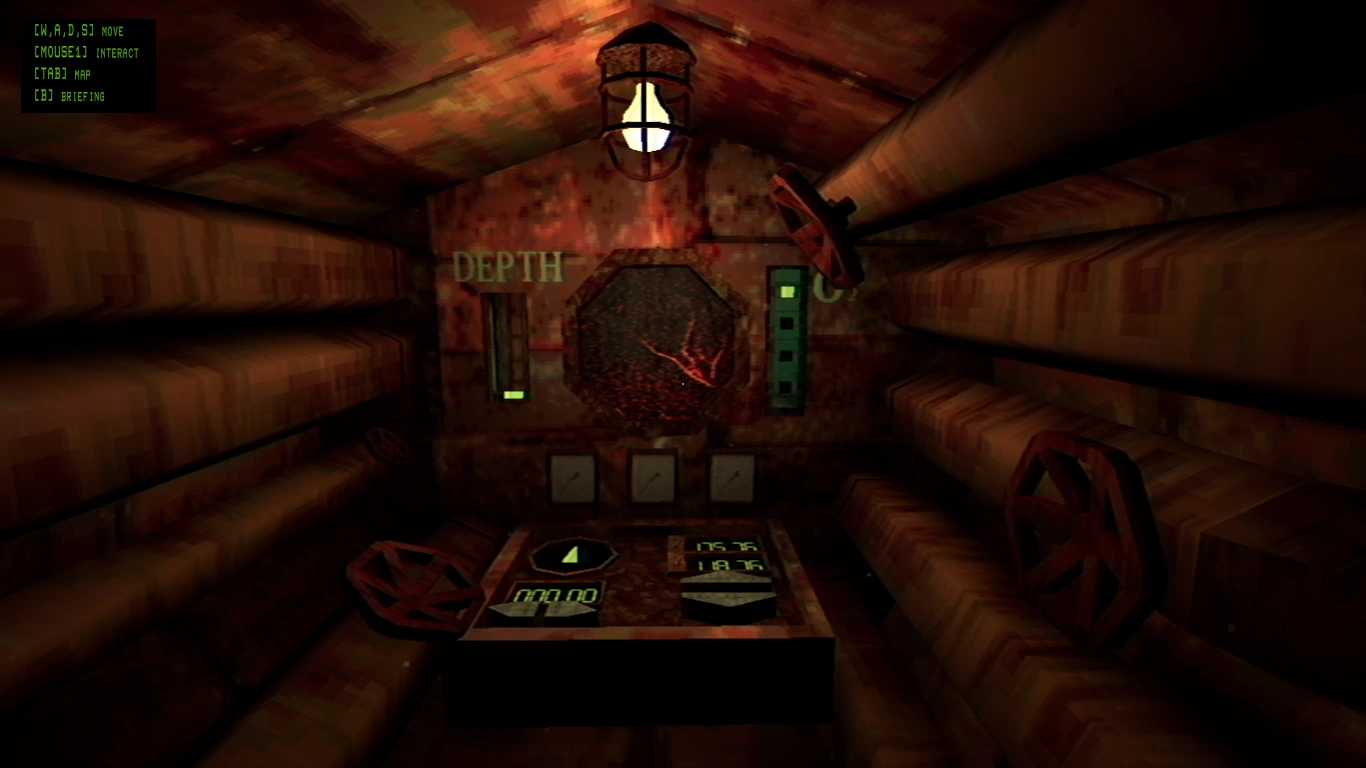
In an indeterminate future, an event known as the “Quiet Rapture” has caused all stars and habitable planets in the universe to disappear. Only space stations, ships, barren moons, and the survivors who were on them remain. On one of these moons, an unexplained phenomenon has produced an entire ocean of human blood. A condemned prisoner, you, is sent to explore it in a makeshift submarine, the SM-13, nicknamed “Iron Lung.” The submarine is welded shut from the inside. The viewport is sealed, covered in metal due to the pressure. There is no window. The only way to perceive the outside is through a grainy camera mounted at the front, taking black-and-white still images, low-resolution snapshots where every form is ambiguous, where a rock could be an artificial structure, where a shadow could be a living organism. You navigate blind, on an incomplete map, plotting coordinates, hoping not to collide with something. A message left by a previous occupant warns that the mission is a death sentence.
Iron Lung is Residual Horror pushed to its extreme logic. David Szymanski, also the creator of Dusk, a frenetic boomer shooter, making the contrast all the more striking, drew inspiration from a visit to the Loch Ness museum in Scotland with his wife. The core idea: blurry photos of the monster are more terrifying than any clear image, because they allow the brain to construct its own horror. The game’s central concept translates this directly: the player never sees what surrounds them. They perceive only residues of images, grainy visual fragments, indistinct shapes, patches of light and darkness in snapshots that resemble ultrasounds. In one photo, you can make out what might be a massive face. You take another photo. The face is gone. Or it was never there.
The game is short. Everything takes place in a single setting, the submarine’s interior, cramped, rusted, barely lit. Sound does most of the work: metal creaks, dull impacts against the hull, wet, unidentifiable noises. Tension builds through the accumulation of these ambiguous signals, never resolving into a classical confrontation. It is a game where you fight nothing, you only navigate, photograph, and interpret. The horror is entirely perceptual. It lies in the gap between what the camera shows and what the brain constructs from those fragments.
Iron Lung is, in a sense, the most literal of all these games in its relationship to residue. The photographs taken by the player are residues, fragmentary traces of a world never directly seen, incomplete visual imprints from which one must reconstruct, infer, fear. The entire game is an exercise in interpreting residues. And the ultimate residue is the one that remains in the player’s mind after those thirty minutes, that face glimpsed in a photograph, which may not have been a face, but which one is never entirely sure about.
Arctic Eggs (The Water Museum, 2024) – Atmospheric residue
We return to where we began. Arctic Eggs is not a horror game, and that is precisely why it matters for this analysis. It is the limit case of Residual Horror, the one that tests its boundaries and, through absurdity, reveals its purest mechanism.
You are in Antarctica, in 2091, in a foggy city that resembles a Soviet block transplanted to the South Pole. You are a “Poultry Peddler,” condemned to cook eggs for the inhabitants after being caught attempting to escape. The mechanic is simple and singular: you hold a pan with the mouse, tilt it to flip the food, manage the cooking. First eggs. Then eggs and cigarettes. Then eggs, cigarettes, and pufferfish. Then rifle ammunition falling into the pan along with everything else. Each customer has their own demands. One man regrets having spent his twenties raising a manta ray. Another recommends drinking early in the day because “it’s good to get your crying done before night.” Several people ask you the same question, like a koan: “Can you fry an egg at the top of Mount Everest?” The answers oscillate between thermodynamics and the existential.
The character models have a rippling, rough skin, as if you were playing a 1999 PC game under the influence of something substantial. The dialogue swings between delirious and abrupt, with intentional typos. And yet, within this absurdity, moments of sadness and boredom surface without warning. Motifs repeat, flamingos, dolphins, Polish girlfriends, like the obsessions of a dream that refuses to end. The city is watched by armed guards, the chickens are caged, the “Saint of Six Stomachs” rules over everything, and no one seems free to leave.
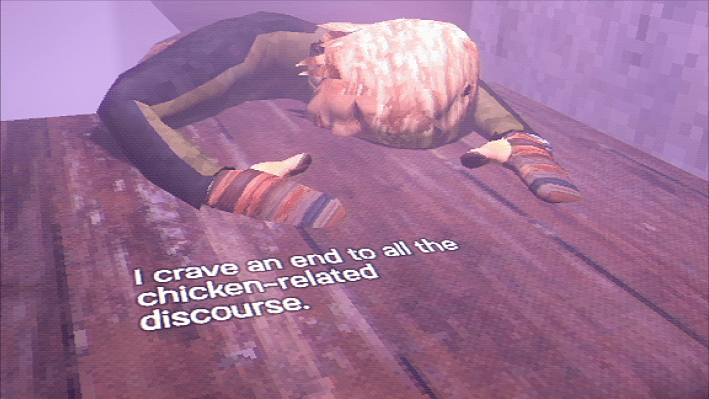
The residue here is purely atmospheric. Nothing concrete remains after the game. No twist, no revelation, no traumatic scene, no jumpscare. Just a lingering sense of strangeness, a weird aftertaste that cannot be explained and does not fade. It proves that the PSX aesthetic alone is enough to generate unease, even in a playful, absurd, often humorous context. The rippling faces, the fog, the coarse textures, the angular volumes of the buildings create a background discomfort that persists beneath the humor like a cold current under a warm surface.
Arctic Eggs may be the purest form of Residual Horror precisely because it has no horrific intent. It shows that the residue does not depend on a genre, on a narrative, or on a device. It depends on a material, the PSX material, with its grain, its instability, its faces that are not quite faces. When that material is present, unease follows, regardless of context. You can cook eggs in it. The unease remains.
Obsessions of the residue
If these games shared only an aesthetic, Residual Horror would be nothing more than a visual movement, a graphic trend. But they also share remarkably coherent thematic obsessions that run across the corpus without ever having been coordinated. It is this convergence between form and content, between degraded image and the stories it carries, that turns Residual Horror into a genre of its own.
The first obsession, the most pervasive and perhaps the least discussed, is work as a trap. Residual Horror does not stage adventurers, warriors, or paranormal investigators. It stages workers. People stuck in a position, a contract, a function, for whom horror does not come from a supernatural curse, but from the system that employs them.
Mouthwashing is the most explicit example. The crew of the Tulpar are workers, employees of Pony Express, a space freight company. They are not on a heroic mission. They are transporting goods. The game insists on this banality. The ship feels like a workplace, with its routines, hierarchies, and office tensions. The reveal of the cargo, mouthwash and nothing but mouthwash, is the moment when capitalist horror crystallizes. Six human lives at stake for a trivial product. And one week before the crash, they were informed they would all be laid off. Ache is ruthless in her reading of the game: “having a death timer hanging over your head, that’s also what layoffs, unemployment, precarity feel like under a capitalism where you only have the right to live if you work.”
Threshold drives the point home with an almost unintentional dark humor. The border post is a workplace. The player is literally hired to blow a whistle and collect tickets. The predecessor is buried nearby, a silent memento mori of what this “job” does to people. Mo, the colleague, is relieved that someone has come to share the burden, like an office worker glad not to be alone covering shifts. The lack of air becomes a transparent metaphor for burnout. Work consumes you. It quite literally takes your breath away.
Arctic Eggs pushes the logic into dystopian absurdity. The “Poultry Peddler” is a forced worker, condemned to cook for others as punishment for attempting to escape. The job is not chosen. It is imposed as a sentence. Iron Lung goes even further. The player character is a convict sent on a suicide mission by an organization that does not see him as a life, but as a consumable resource, a human resource. Freedom is promised in exchange for the mission. A message left by a previous pilot warns that the promise is a lie. SIGNALIS, in another register, fills its corridors with worker androids, Replikas serving an authoritarian system, their bodies degrading, rotting, turning against them.
These characters are not heroes confronting evil. They are cogs jamming within a machine that crushes them. And the PSX aesthetic, with its blocky characters, confined spaces, and horizons swallowed by fog, becomes the exact visual translation of this condition. Human forms reduced to their simplest expression, trapped in spaces that leave them no room to exist.
The second obsession is the body as a site of violence. Residual Horror is populated by bodies that no longer hold together, burned, enclosed, suffocated, degraded. The burned body of Curly in Mouthwashing is the most striking image. A human being reduced to a single eye to witness horror and a mouth that can only scream without being understood. Ache describes him as the embodiment of powerless complicity. Curly can only observe the consequences of what he helped sustain. But it is Anya’s body that becomes the true center of gravity. Controlled, forcibly pregnant, deprived of autonomy. The game shows how the impossibility of abortion becomes a tool of control over her body.
In Threshold, the player’s body is subjected to constant physiological constraint. Air is scarce. Every action consumes oxygen. Running becomes a luxury. Speaking has a cost. The body becomes a meter that empties. In Iron Lung, the body is welded into a metal box, immobilized, powerless, subjected to the crushing pressure of the depths, reduced to fingers inputting coordinates and eyes scanning grainy images. In SIGNALIS, the bodies of the Replikas decay, rot, transform into monsters. Body horror becomes literal. It is the worker’s body turning against itself when the system that sustains it collapses.
And the PSX aesthetic itself is a form of permanent body horror. The characters in these games are already degraded bodies, polygonal approximations of human forms, residues of silhouettes. Their faces do not have enough polygons to express emotion, yet they have too many to be abstract. They are trapped in a low-resolution uncanny valley, a zone where the represented body is neither alive nor dead, neither human nor object. It is a residual body, what remains of a body once resolution has been stripped away. And this residue of a body echoes the mistreated bodies these games depict. The trembling polygonal body is also the body of the precarious worker, the condemned sent to die, the woman whose pregnancy is controlled. These games emerge at a time when the body has once again become a central political issue. Abortion rights under attack worldwide, sexual violence going unpunished, burnout normalized, working conditions deteriorating. Residual Horror gives form to what it feels like to inhabit a body that is not considered a body.
The third obsession is confinement as a permanent condition. The drifting Tulpar in the void (Mouthwashing). The border post surrounded by mountains and thin air (Threshold). The house that degrades a little more with each visit (Anatomy). The space station with endless corridors (SIGNALIS). The submarine welded shut from the inside (Iron Lung). The Antarctic city no one escapes (Arctic Eggs). These are prisons, not open worlds.
Classical survival horror also uses confinement, the mansion in Resident Evil, for instance. But there, it is a temporary device of tension. The player searches for an exit and eventually finds it. Residual Horror turns confinement into an existential condition. There is no exit. The border post in Threshold leads nowhere, beyond it there are only mountains and air too thin to breathe. The Tulpar drifts in interstellar space, no rescue will come. Iron Lung is welded shut, literally, physically, definitively sealed. Arctic Eggs loops in on itself. The Poultry Peddler was captured trying to escape, and the punishment is to remain. One might think of Vivarium, mentioned by Alt236, with its housing estate that cannot be left, where every attempt to flee leads back to house number nine. But Residual Horror does not even present escape as a hope. Confinement is the starting point, not the climax. The residue is also what remains when all exits have been sealed, when only the interior is left, and the interior keeps shrinking.
The fourth obsession, perhaps the most structuring, is imposed silence, the unspeakable. Residual Horror is a genre of withheld meaning. These games do not simply refuse to show, as horror cinema does with off-screen space. They refuse to name.
Mouthwashing is the most radical case. The rape is never spoken. The word does not exist in the game. And this silence is not an omission. It is the subject itself. Mouthwashing stages the way victims are prevented from articulating violence, from even putting words to it. Curly, the captain, only half listens to Anya, assuring her he will talk to Jimmy without acknowledging the gravity of the situation. The game places us in the exact position of this passive complicity. We see the signs, we sense the horror, but we do not name it, and the game does not help us do so.
But the unspeakable extends beyond Mouthwashing. Threshold refuses to say what the train carries, and that refusal is the very engine of its anxiety. If we knew, we could contextualize, rationalize, distance ourselves. Silence prevents distance. Arctic Eggs has its NPCs talk constantly, but never clearly. They circle around subjects we cannot identify, asking philosophical questions about eggs and Everest that seem to conceal something else, without ever revealing what. SIGNALIS fragments its narrative into letters, logs, cryptic notes, non-linear flashbacks, and stubbornly resists any single interpretation, generating hundreds of contradictory theories among players. Anatomy describes the house in organic terms without ever naming what inhabits it. We know the house is alive. We know it does not want us there. But we will never know what it is.
These games practice a systematic withholding of meaning. They create a linguistic residue, what remains when words have been removed. The horror lies not in what we learn, but in what we can never fully articulate. And it is within this silence that the player is forced to project their own fears, their own traumas, their own voids. Residual Horror makes the player an active participant in their own anxiety, not by putting them in danger, but by denying them the tools to name what is wrong.
These four themes are not layered onto the aesthetic. They are its formal expression. The fog that devours the environment is imposed silence made visible. The world that never becomes fully legible is a system that refuses to be understood. The trembling image is the body that no longer holds. The closed space without exit is the polygon that lacks enough faces to form a horizon. The convergence is total. And it is this convergence that makes Residual Horror a new genre.
Why the residual image frightens
In 1970, the roboticist Masahiro Mori described the uncanny valley, that gap of unease that opens when an artificial form almost resembles a human, but not quite. A robot whose movements are too fluid to be mechanical, but not fluid enough to be alive. A CGI face whose eyes do not move as they should. The theory is usually applied to the overly realistic, to an excess of fidelity that betrays the artifice.
But there is an inverse uncanny valley, that of the not-real-enough, and that is the one that concerns us here. A PSX face has eyes, a nose, a mouth. Together, it should form a face. But the polygons are too few, the textures too blurred, the proportions too approximate. The nose is a triangle, the eyes are stains, the mouth is a line that does not move when the character speaks. The result is neither abstract, like pixel art which embraces stylization, nor fully figurative, like modern 3D which achieves resemblance. It exists in an uncomfortable in-between, a residual face, a failed attempt at representation. A face trying to be a face and not quite succeeding. And it is in this visible failure that strangeness takes hold.
The effect is especially powerful because it is constant. In a horror film, the uncanny valley appears in specific moments, the reveal of a creature, a distorted face. In a PSX game, every character, every NPC, every reflection in a mirror exists within that valley. The unease is not episodic. It is the texture of the world itself. There is no “normal” moment against which the strange can stand out. Everything is strange, all the time, at the same low, constant intensity. A perceptual background noise, a continuous visual hum.
This idea of noise has a precise theoretical grounding. In an essay on the Haunted PS1 aesthetic, the blog Intermittent Mechanism mobilizes the concept of “medium-specific noise,” borrowed from film theorist Arild Fetveit. The idea is that every technological medium produces its own kind of noise. The grain of 16mm film. The tracking lines of VHS. The dithering and jittering of the PS1. This noise is not content. It is interference, friction between the signal and the medium that carries it. For a long time, these noises were seen as flaws, technical imperfections to be corrected or hidden. But when a medium becomes obsolete, when 16mm is replaced by digital, when VHS is replaced by DVD, when the PS1 is replaced by the PS2, then the PS3, the PS4, the PS5, these flaws transform. They stop being imperfections and become markers. First markers of nostalgia, then markers of authenticity, and finally expressive tools.
The comparison with analog cinema is revealing. As Intermittent Mechanism puts it, a digital file is a series of zeros and ones, infinitely copyable, without loss, without alteration, and in that sense, without life. It is a perfect, immaterial, eternal signal. A strip of 16mm film, on the other hand, is a physical object. It gets scratched as it passes through a projector. It fades over time. It accumulates dust, marks, scars of use. It degrades, and if it degrades, it has a lifespan. And if it has a lifespan, then in a sense, it is alive. The grain, the scratches, the color variations are not noise. They are vital signs of a medium that exists in time, that ages, that carries the traces of its own use.
PSX noise works the same way. Polygon jitter, that trembling of surfaces when the camera moves, is not a stylistic effect. It is the trace of a processor struggling to compute vertex positions quickly enough. Texture warping, that undulation of surfaces, that distortion of perspective as you move, is the trace of a hardware architecture unable to correct these distortions. Fog is the trace of a rendering engine that cannot display beyond a certain distance. Each of these flaws is the mark of a machine struggling against its own limits, the noise of a medium fighting to produce an image it does not quite have the means to produce cleanly.
A 4K game with ray tracing at 60 frames per second is a perfect, transparent signal. A window onto a virtual world where the glass disappears. A PSX game is a struggling signal. You see the glass. You see its flaws, its cracks, its distortions. You see the medium itself, faltering, failing. And it is this visible fragility, this sense that the image could disintegrate at any moment, that the world might stop holding together, that produces the unease specific to Residual Horror.
Dithering, that granular veil covering PSX images like a layer of sand, intensifies this sensation by placing a layer of opacity between the player and the world. It forces the eye to work, to interpret, to complete what the image refuses to deliver clearly. It is the cinematic off-screen principle. What is not shown is more frightening than what is shown. But Residual Horror systematizes it in a way cinema cannot. Here, the entire image is off-screen. Everything is veiled, approximate, incomplete. The player does not look at a world. They decipher it, constantly, without ever being sure of what they are seeing. This constant perceptual uncertainty is what distinguishes Residual Horror from classical horror, where moments of uncertainty alternate with moments of clarity. Here, there is only uncertainty, a fog not just in the environment, but in the image itself.
And then there is warping, that bending of textures as the camera moves, caused by the lack of perspective correction on the PS1. It may be the most insidious effect, because it touches something fundamental: the stability of space. In a modern game, walls are stable, solid, reliable. They remain in place when you move. Architecture can be trusted. In a PSX game, walls tremble. Surfaces ripple. Textures deform as you pass by.
It is this quality of structurally unstable space that Gareth Damian Martin, in their work on video game architecture with the journal Heterotopias, connects to Michel Foucault’s concept of heterotopia. For Foucault, a heterotopia is a place that exists in the real world but contests the rules of real places. A mirror, a cemetery, a ship, a theater. The PSX space is a digital heterotopia. It resembles a real space, a corridor, a house, a ship, but obeys different rules. Surfaces do not hold still. Proportions shift with the point of view. Shadows are painted into textures rather than generated by light, making objects appear to float rather than rest on surfaces. You inhabit a space that refuses to be reliable, and this architectural unreliability sits at the core of the unease.
Julien Eveillé frames it through the vocabulary of level design when he explains to Game Next Door that working with a PSX aesthetic is “permanent blockout.” In level design, blockout is the sketch phase. Grey cubes, rough volumes, provisional shapes used to test flow and proportions before the art pass comes in to dress everything, stabilize it, finalize it. In a PSX game, the art pass never arrives. The blockout is the game. Everything remains provisional, sketched, unfinished, a world that has not finished forming and could still become anything. The player inhabits a draft. And a draft, by definition, is a space where everything can still change, including for the worse.
There is also something only video games can produce, something that fundamentally distinguishes Residual Horror: inhabitation. In cinema, we contemplate the degraded image. We observe it from the outside, as spectators. In a PSX game, we inhabit it. We walk through the fog. We touch the trembling walls. We open doors that lead into darkness. The unease is not only visual, it is kinesthetic. You feel in your hands, through the controller or the mouse, the resistance of a world that does not want to be traversed cleanly.
What this horror says about us
In Ghosts of My Life (2014), Mark Fisher defines hauntology as the persistence of futures that never came to be, ghosts of aborted possibilities. The term, borrowed from Jacques Derrida, describes a present haunted by what could have been but never was. PSX horror games are hauntological objects par excellence. They resemble games that could have existed in 1998 but never did. They are the ghosts of an alternative library, of a parallel PlayStation that would have produced Mouthwashing or Iron Lung instead of Crash Bandicoot. Playing them means inhabiting a distorted memory of something we lived, or a memory that is not even ours for players too young to have known the PS1. Residual Horror is the horror of falsified memory.
But there is something more aggressive than hauntology at work. Several developers and critics converge on a key idea: these games do not simply use nostalgia, they turn it against the player. The PSX aesthetic enters through familiarity. It resembles childhood memories, afternoons spent in front of a console, a deeply internalized sensory comfort. And once inside, it reveals something terrible.
Jess Harvey, co-creator of Paratopic, describes her game’s world as a “desolate, wrong space,” a place that is not frightening because it is dark or filled with monsters, but because it is wrong. Something is off, but you cannot say what. The article Retro Horror Mania on Polydin pushes the idea further: “Lost media horror weaponizes your nostalgia against you. PS1 graphics were the symbol of the innocent time we spent on our console, having fun after a long day in school. So now, of course, it should be a source of horror.” And the line that captures the mechanism best: “The most terrifying feeling is nostalgia left to rot.” Nostalgia left to decay. Residual Horror does not celebrate the past. It contaminates it. The residue is a childhood memory that has gone bad.
There is also a political dimension to the residue. The silence surrounding sexual violence in Mouthwashing is not a narrative accident, it is a mechanism of power. Capitalism, layoffs, disposable lives, the absurd cargo, intersects with patriarchy, rape, control over Anya’s body, forced pregnancy. Residual Horror is not just the horror of what remains after the image degrades. It is the horror of what remains when an entire society refuses to name its own violence.
Ultimately, Residual Horror refuses catharsis. Classical survival horror offers release. You kill the final boss, order is restored. The slasher offers the final girl, the one who survives. Residual Horror offers none of that. Mouthwashing ends without moral resolution. Threshold leaves its questions open. Anatomy corrupts itself with every restart. Iron Lung ends in darkness. There is no relief, no cleansing, only the residue that persists. It is a post-cathartic horror, one that perhaps corresponds to a time when clean resolutions, political, ecological, existential, feel increasingly out of reach. You cannot rinse it away. The aftertaste remains.
Why now
There is a crucial distinction between two waves of retro revival in independent games. The Hi-Bit pixel art of the 2010s, Fez, Owlboy, Sea of Stars, Sonic Mania, evokes the era of the Super NES, a moment of mastery when 2D had reached full technical and artistic maturity. Developers knew how to make polished, beautiful 2D games. The PSX aesthetic evokes the opposite: the chaotic beginnings of 3D, a period where nothing was codified, where developers experimented in every direction, where results were as fascinating as they were unstable. Residual Horror is not born from nostalgia for perfection. It is born from nostalgia for instability. It calls back to a time when virtual worlds had not yet found their rules, and perhaps that is why it resonates with a present that also feels like it has lost them.
While major horror studios are focused on high-fidelity remakes, Resident Evil 4, Silent Hill 2, Dead Space, Residual Horror occupies the space left open. No remakes, no servile nostalgia, but a reappropriation of past aesthetics to say something new. The transition of Iron Lung from game to film, with a commercial success far beyond its niche, is a signal. The movement is spilling beyond its original medium.
It is also a genre of solitary developers. Wrong Organ (Mouthwashing), Julien Eveillé (Threshold), The Water Museum (Arctic Eggs), Kitty Horrorshow (Anatomy), Nathan Hamley (Hollowbody), David Szymanski (Iron Lung), almost all work alone or in very small teams. The low-resolution aesthetic is not just an artistic choice. It is what makes these games possible. Low-poly allows a single person to build a complete 3D world. But what is striking is how an economic constraint has become a language. Johanna Kasurinen of Wrong Organ puts it bluntly in Rolling Stone: “You don’t need cutting-edge graphics to make something that resonates.” The PS1 is no longer a memory. It is a grammar.
Residual Horror embraces emptiness, blur, absence. In an era saturated with legible images, 4K resolution, open worlds overloaded with markers and objectives, the choice to show almost nothing becomes a form of resistance. Not an explicit, militant resistance. More like a shared instinct among a generation of creators who sense that visual excess has killed something, and that to recover fear, you have to recover lack.
In Silent Hill 2, a message painted in red across newspapers covering a storefront reads: “There was a hole here. It’s gone now.” Alt236 cites it in his video as a moment of pure abstract horror. The setting in which the message appears gives it an unsettling aura, without it being entirely clear why. It may be the sentence that best captures Residual Horror. The horror is not in the hole. It is in the fact that it was there and is no longer. What frightens is not the presence of evil, but the trace of its passage. The residue.
The corpus keeps expanding. Sorry We’re Closed pushes the PSX aesthetic into vivid pink palettes, proving that residue is not necessarily grey. Heartworm extends the legacy of Silent Hill with a renewed narrative ambition. Skinfreak explores the slasher with a sense of rhythm that goes beyond Puppet Combo. The next project from Wrong Organ promises to move beyond the walking sim. The question remains open: how far can a horror that shows nothing go? What will remain when nothing remains? You turn off the game. The screen is black. And the unease is still there, lodged somewhere between the retina and memory, in that blurred zone where polygons still tremble, where faces are not quite faces, where a train passes in the distance and you do not know what it carries. The residue persists. That is its nature. That is its power.
Sources
- Alt236, Sur les traces de l’Abstract Horror (2025) – https://www.youtube.com/watch?v=SyUJmn4pDEo
- Ache, Mouthwashing ou pourquoi notre monde se dévore lui-même (2024) – https://www.youtube.com/watch?v=duf-KzGnT2s
- Game Next Door, Le retour de la 3D moche (2024) – https://www.youtube.com/watch?v=fJkWOfPTkDI
Written sources :
- Patrick Dolan & Andrew Bailey, « Ghastly Graphics: Tool Fandom, Bad Cinema, and the Haunted PS1 Game Development Community », International Journal of Creative Media Research (2023) – https://ijcmr.online/2/article/view/16/19
- Intermittent Mechanism, « The Haunted PS1 Aesthetic and Medium-Specific Noise » (2022) – https://intermittentmechanism.blog/2022/10/31/the-haunted-ps1-aesthetic-and-medium-specific-noise/
- Rolling Stone, « Horror Game Renaissance: Indie Developers Bring Back Retro Grime » (2024) – https://www.rollingstone.com/culture/rs-gaming/horror-game-renaissance-playstation-retro-1235134578/
- NME, « The Resurgence of the PS1 Horror Game » (2021) – https://www.nme.com/features/gaming-features/the-resurgence-of-the-ps1-horror-game-3076237
- GamesRadar, « Indie Devs Discuss Why Low-Poly Works So Well for Horror » (2024) – https://www.gamesradar.com/games/survival-horror/indie-devs-discuss-why-low-poly-works-so-well-for-horror-i-actually-think-those-limitations-encourage-weird-unique-compromises/
- Polydin, « Retro Horror Mania: Why PS1-Style Games Are Dominating Indie Horror » (2025) – https://polydin.com/retro-horror/
- Mark Fisher, Ghosts of My Life (2014) – éditions Zero Books
- Gareth Damian Martin, Heterotopias – https://www.heterotopiaszine.com