

2013, millions of people, young and old, slip the long-awaited disc into their favorite console. Soon, the sirens of American law enforcement echo through the loudspeakers, accompanied by the hubbub of an anonymous gunfight. The stars, emblematic symbols of the player’s search index during the game, appear on the screen, while one of them is incorporated into a grandiloquent R. R, one letter is enough, Rockstars don’t need more. Without waiting long, the action gets underway, with players taking part in a rather violent heist. In just a handful of minutes, the saga’s irremovable basics are presented one after the other, along with a few new features that are set to serve as a revolutionary engine for the saga’s narrative, including the presence of a daring character change that takes place with a snap of the fingers, in a snap of the fingers. Fingers quickly slip back onto the triggers of various weapons. Bullets fly, hurried footsteps tread the convoluted corridors of the building that was the victim of this murderous assault, and once the last barriers are crossed, bags are filled with greenbacks. Then it’s off to the outside, where the police are stationed. After a brief exchange of words, they head for an accomplice’s car, parked nearby. Then the escape. Then the ambush. Then failure.

The American Dream
Far from the opening of Grand Theft Auto IV, which at the time revolved around a timeless promise of greatness, that of the American dream, the fifth opus in Rockstar’s mythical license opens with a banal botched robbery in a remote American backwater. As if to tell the player, already disillusioned by Niko’s adventures in the previous opus, that hopes of greatness are in fact buried far beneath the cobblestones of a well-oiled system. In addition to illustrating the narrative stakes of this opus (the successive organization of increasingly incredible heists) and revealing the various gameplay phases that will be amalgamated throughout the game (switching between characters, cover and shooting systems, not to mention driving), this inaugural heist ends in a monumental fiasco. The essence of Grand Theft Auto V is already distilled in its opening minutes.
Michael. Franklin. Trevor. Three characters whose destinies vary, but who are intertwined in a web whose threads they won’t immediately notice, and whom players will have to control one after the other, as Grand Theft Auto (hereinafter abbreviated to GTA) adopts a multitude of points of view to narrate the saga to come. For various reasons, all three will find themselves plunged into the depths of the criminal world, with the sole aim of making money. As much money as possible. Whether it’s to climb the social ladder, pay off a debt or simply see the world descend into the same chaos that haunts their minds, each protagonist will unite with the other two to form an inseparable trio, a trinity central to the game’s narrative. Before examining its ramifications, it’s worth briefly outlining the profiles and stakes associated with each of them.
The American Stream
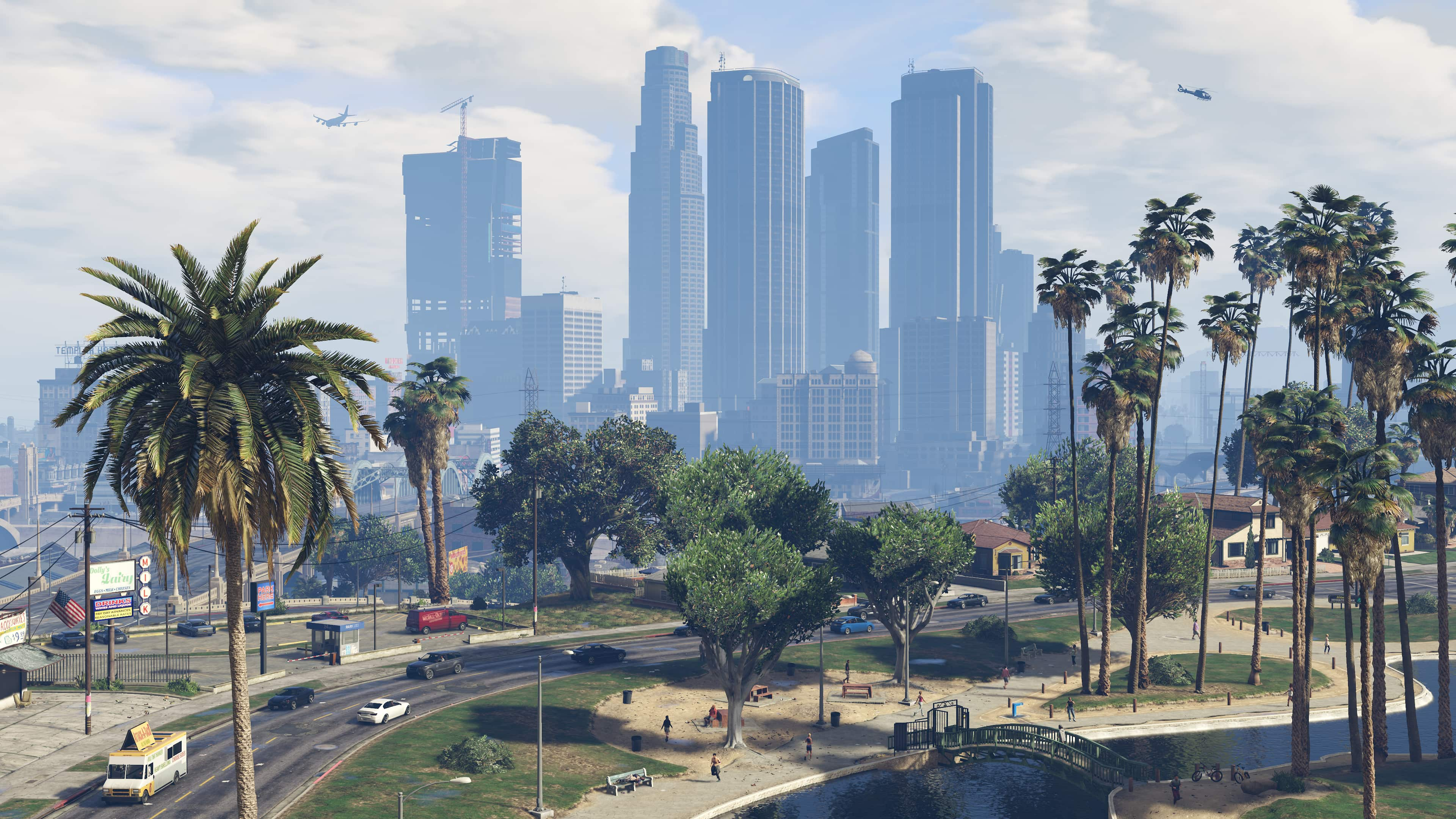
To help players understand this intertwining of destinies, the introduction following the prologue reveals an imposing Los Santos, a parody of Los Angeles made in Rockstar, in all its ambiguity. The audience discovers a Michael under the thumb of a psychiatrist only there to collect his fee, before the narrative focus shifts to a small-time gangster with dreams of grandeur, Franklin. The game’s first real mission perfectly illustrates the title of its flagship saga: it involves stealing a vehicle, a luxury car to be precise. And the game stages a cavalcade through the winding streets of different parts of the city, like a lap around the stage waiting to see the tragedy played out on its asphalt and concrete boards. Franklin is a young African-American disillusioned by the social condemnation he and his family face in Los Santos. While those closest to him make do, he wants to conquer the stars. And there’s no shortage of them on Hollywood Boulevard. The young man is tired of his friends, who are only there when they need his services, as the game repeatedly illustrates through a succession of deliberately unstimulating missions (car repairs), which at once allow you to feel the character’s profound boredom, while easily assimilating, at your own pace, the rudiments of the game’s handling once the initial excitement has passed. Franklin represents a youth whose ambitions have not yet been crushed by the weight of the world.
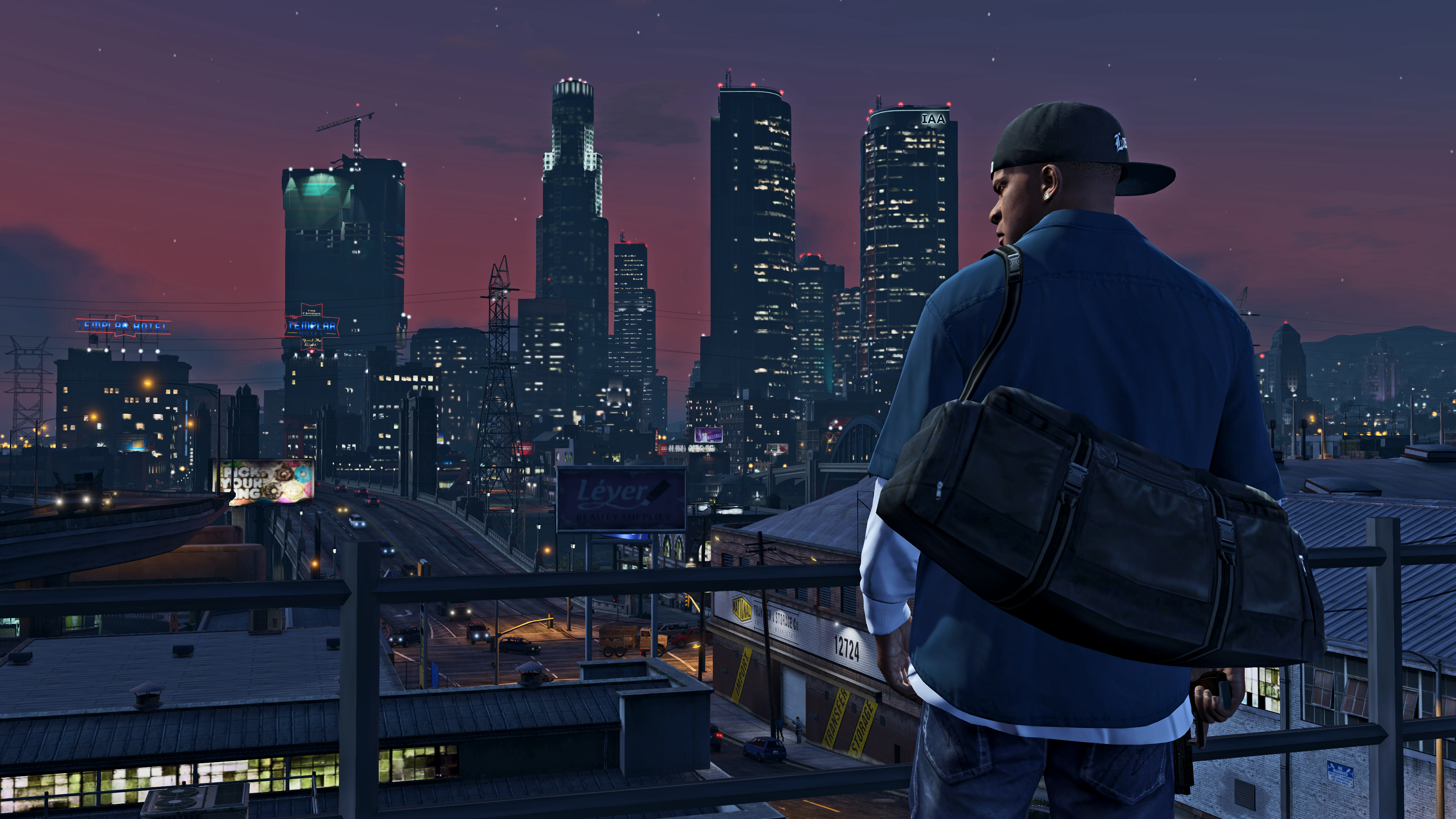
Back to Michael, just out of his ritual appointment with his psychiatrist. Back in his luxury villa, perched high up in the megalopolis, he comes face to face with his dysfunctional family, whose only bond seems to be the huge bank account that holds them together. After yet another argument, Michael can’t take it anymore and locks himself in the back of his son’s new car, just one more whim on an ever-growing list. Unfortunately, it’s Franklin’s vehicle he’s been tasked with “recovering”, and he’s actually a reluctant member of a well-established insurance scam ring. The meeting between Michael, who dreams only of a life away from strife, and Franklin, who sees Michael’s life as an ideal to be achieved, seems dictated by fate. Soon, the surrogate father takes the spiritual son under his wing, and the two of them embark on a series of adventures worthy of 90s action movies, such as a chase on the ring road after a boat, or the destruction of a car dealership’s storefront. And then of the dealership itself. The characters don’t realize it, but they’re trapped and swept along by a veritable infernal current.
The American Redeemer
This first act of the game reveals the intrinsic motivations of this budding duo, who quickly adopt a mentor/disciple relationship. The first is presented as a socially accomplished adult, father of a nuclear family whose swimming pool, boat and luxury vehicles attest to his social success. The second, on the other hand, is portrayed as the ugly duckling of a caste from which he’s trying to escape, a caste that doesn’t understand him and holds him back despite his ambitions. The first hides behind the diktat of appearances, and his dysfunctional family gives him only one desire: to fall back into his youthful ways, to shatter the American dream that so many are striving to achieve. The second believes that the only way to lift himself out of the cultural shallows in which he’s immersed is to line his pockets and make a better life for himself. In this case, money is king. Fate, in the form of mischievous screenwriters, will confront Michael (and, in turn, Franklin) with the world of organized crime.
In just a few missions, the 50-year-old finds himself owing a colossal sum to a man of power after destroying (not so accidentally) one of his second homes, high above Los Santos. It’s worth noting that this mission, like all the others, is not without meaning: metaphorically, the impulsive Michael destroys an estate that is literally above him, towering over him, dominating him, someone who not only taunts him with his mere presence, but taunts him even in his own home, by flirting with his wife (to oversimplify, the characters are more complex). In any case, the triggering of Michael’s debt brings the game’s long prologue to a close, a prologue that is necessary and mastered from start to finish in narrative terms, to the detriment of an omnipresent dirigisme throughout the game’s missions, a dirigisme regularly considered a major flaw in Rockstar productions, but nonetheless indispensable in terms of narrative mastery. The filmmakers are well aware of this fact, and that’s why there’s such an obvious dichotomy in their games: on the one hand, the player is confronted with missions, similar to real cinema sequences, played out according to a pre-established script; on the other, he or she participates in open-world wanderings, a game space in which literally EVERYTHING is possible.
So, while intimate objectives are linked to the duo of characters in order to foster players’ attachment to these bandits (i.e. debt repayment, and escape from the ghetto), the ultimate quest that the game slyly puts in place remains the dollar. It’s no coincidence that GTA V’s logo is adorned in the eminently famous color green, associated with the world’s most powerful currency, but that the Roman numeral is also covered by a band containing the famous “five”, written in a typeface that is also familiar to everyone in the USA. Behind the fresco of grandeur that the game weaves through its first reading level, it actually conceals all the cynicism imposed by a world governed by the sacrosanct $, and the way it influences individuals, quite simply. The game’s next act allows Michael and Franklin to manage their respective story arcs (Rockstar’s way of constantly reminding us that the individual is at the heart of the story), and to meet Lester Crest, who quickly becomes the group’s strategist. From this point on, the script unfolds a succession of heists with varying mechanics and concepts, supported by increasingly aberrant justifications, sending our protagonists from Charybdis to Scylla.
A parenthesis is in order here, to note the way in which the talented development studio uses its games to experiment with mechanisms that will only culminate in subsequent works. In GTA V, for example, the organization of robberies goes through preparatory phases that require the achievement of several objectives, notably through the choice of partners in crime, about whom the player ultimately knows little beyond the meagre information shared by Lester. Each individual will alter the course of the missions in question, but only slightly. GTA V thus sets up an organized gang concept, although the narrative focuses only on the hard core of the main trio (the last member soon makes his dramatic entrance). This gang concept will be at the heart of Rockstar’s next narrative experience, Red Dead Redemption II, a game that is fascinating in many ways and which, while focusing this time on the intimate, does not abandon the demons that have shaped the American dream.
So there are the De Santa’s, Michael’s family, an assumed name, a stillborn name, meant to symbolize rebirth, a new life. Every member of the family wants this new life to be as sparkling as possible. Jimmy thinks he’s a virtual trigger god and dreams of being a street kingpin driving the SUV he paid for with Dad’s credit card. His sister Tracey already sees herself as the new star of the small screen, a naive bimbo caught and rejected by a system that consumes shovelfuls a minute. And Amanda, a washed-up former stripper, is enjoying all the excesses that a life spent twerking didn’t even allow her to hope for. Finally, Michael himself drags along his old carcass whose glorious past, shaped by the gangster films he saw in his youth, never ceases to haunt him, who is now determined to produce his own films. But to do this, to do all this, you have to submit to the system, to others, to deviate. You have to give yourself and lose yourself. As the screenplay progresses, Michael Townley (real name) loses everything. His name first. His friends. His boat. His car. His family. His freedom. A corpse on borrowed time in a city that digests success by spitting fallen stars back into the gutter, Michael’s only salvation lies in his unexpected encounter with an ambitious young man, Franklin Clinton.
Franklin is the guy who deals in arms and steals crates of weapons to make money. Enough to buy a flat-screen TV and a nice car. But not enough to change his life. Yet that’s what the young gangster wants, to get out of the spiral that forces him and the others to survive through one day’s schemes, another day’s barbarities. While Michael has the good life, Franklin crystallizes the difficult everyday life of the working classes, torn between belonging to a community without which he is nothing, but a community that hangs a ball and chain at his feet. Lamar, his best buddy, always takes him on one last job, the one that will change everything. And indeed, everything changes for the worse every time. Besides, Lamar isn’t even Franklin’s best friend, that role falling instead to Chop, a rottweiler as imposing as he is benevolent. Franklin is actually a bit like Chop. He’s told what to do, what to think, where to go, who to attack. But Franklin just wants to rip off his leash and run away. So when he meets this former gangster who’s living the best life of all thanks to a witness protection program, the impulse that’s been sleeping there in his gut explodes. The fireworks can begin.
The entire beginning of the game is designed to anchor Michael and Franklin’s daily lives in the players’ minds. Nothing is hidden, no information withheld. Players literally enter the lives of Michael and Franklin, rubbing shoulders with their inner circle, visiting their homes and taking possession of their personal vehicles. Every game design choice is carefully thought through. Is Franklin’s house too small? This is to better reflect his sense of isolation and confinement. Is his job to repair broken-down vehicles? Yes, but that’s not his destiny; he’s only doing it to help a pal, it’s not his role. What about Michael? As seen above, his missions show him losing what he has accumulated. His boat, taken over by thugs. His wife, courted by every male passing through the gates of his own home. Despite the beautiful colors and evocative landscapes of Los Santos, despite the promises of advertising posters and luxury signs, nothing in Grand Theft Auto V is truly beautiful. This succession of missions serves to show the moral and psychological downfall of these two anti-heroes. That is, until Lester pulls off one of the best moves of his career, the jewelry store heist, which sounds like a way out for the bandit couple.
The American Scheme
This heist, whose game design science would require a paper in itself, turns out to be the trigger for a series of hitherto unforeseen events. Michael’s televised performance attracts the attention of his former accomplice, Trevor Philips, an aspiring psychopath with an… atypical lifestyle. Following the jewelry store robbery, the game abandons Michael and his disciple to lock down the character-changing tool: from now on, players are obliged to control Trevor, boss of Trevor Industries. For the occasion, the action is relocated to Sandy Shores, in the desert countryside adjacent to Los Santos. And as if to underline the fact that the “american dream” promised by the opening of GTA IV no longer exists, Trevor’s introductory cinematic shows him murdering Jonathan Klebitz. The latter was the main protagonist of the expansion The Lost and the Damned, and evoked a whole section of American culture, namely the biker communities that criss-crossed the USA. If Rockstar wanted to murder the father, they couldn’t have done it in a better way. Witnessing his former partner-in-crime’s acting skills being broadcast live on TV, Trevor sets out to find Michael and, after a succession of missions revealing as much narrative as new gameplay segments, the balding madman hits the road for Los Santos. And so begins one of the most important moments in the history of the game. Or, dare we say it, of video games as a whole.
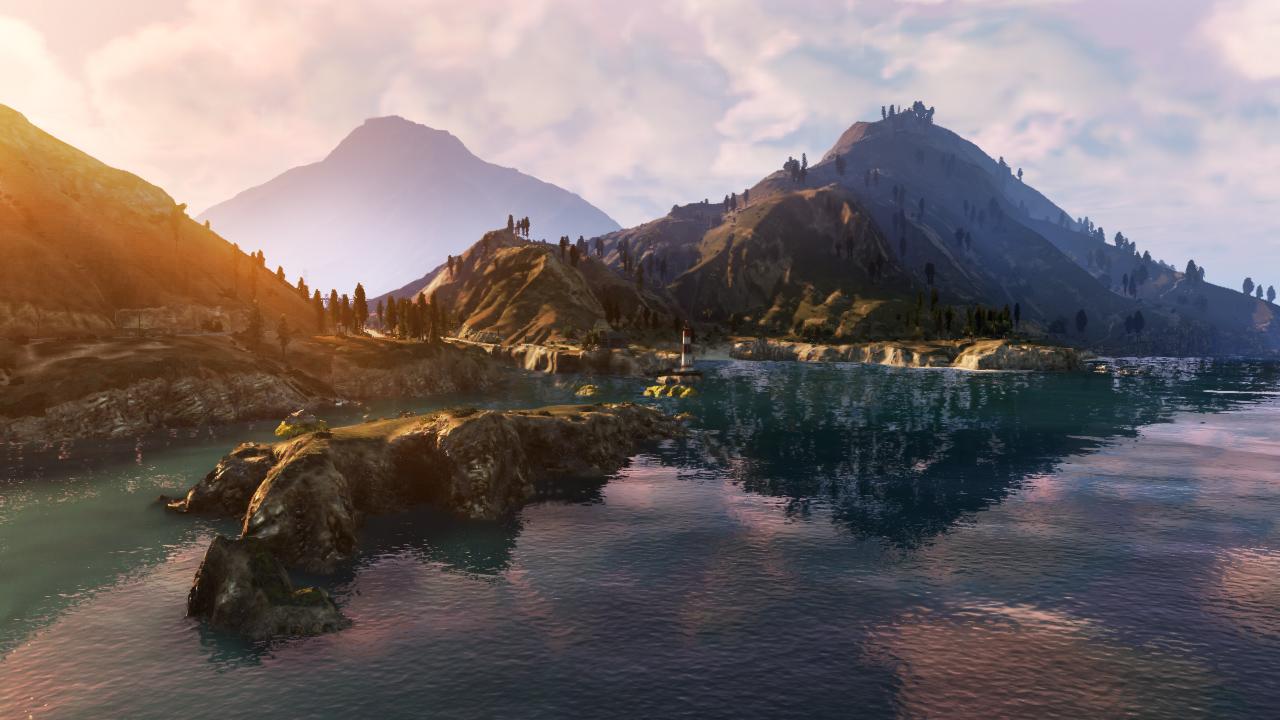
The sequence to come lasts only a handful of seconds, but this suspended, ephemeral moment encloses within it a constellation of the most brilliant flashes of everything the medium can produce. But to understand this pivotal moment, which some will certainly not grasp the first time they experience it, we need to explore its meticulous construction, fashioned in the image of a narrative cathedral. For longer than necessary, Rockstar relocates all the action to the rural areas surrounding Los Santos. Gone are the narrow arteries dotted with traffic lights, gone is the dense traffic and the suffocating pile of buildings whose summits remain forever inaccessible. Where Trevor lives, there’s nature in all its grandeur, a lake shimmering with infinity, an airplane graveyard synonymous with shattered dreams, trails gliding through forests lit only by the moon. Freedom. On the contrary, Big T’s pickup escapes the roads, skirts the ditches and disturbs the farm fields that cover the vast mountain-ringed plain. Following a series of intrigues involving local gangs, Trevor tracks down Townley, or whatever his name is now, and, accompanied by the ingenious Wade, sets off for the capital.
The characters get into Trevor’s vehicle, dressing up the scene with dialogue appropriate to the environmental situation and climate (as is the case with each of the game’s so-called transition discussions), and flee to the city. On the road, Trevor narrates his origins in an allegory as subtle as the character. As subtle as the satire that is GTA V. After the horrors accomplished since the player took control of Trevor, the character opens a door: not enough to sustain him, but enough to begin to understand him. In any case, after crossing the rural basin and joining the ring road leading to the megalopolis, the game imposes a stop during this motorized ride. The vehicle parks at the top of a cliff, Trevor climbs out of his pickup and approaches the void overlooking the city, and there, along with the players, he contemplates Los Santos. At his feet, the city teems with life, the flashing lights like the heartbeats of millions of individuals swarming in the middle of endless avenues, veins of a body whose cells love, avoid, kill and frolic with each other. Herein lies one of Grand Theft Auto V’s strokes of genius: after immersing players in this microcosm, right down to the deepest intimacy of the two characters they encounter, the point of view takes such a step back that it puts into perspective the entire perception that each of us may have felt towards the game.
Those poignant, important moments from earlier, that glass storefront smashed with a battering ram, that dumpster used as a shelter during yet another shootout, Chop’s doghouse in the backyard of a little shanty not far from the neighborhood church – all of these are now a mass of spots of color and light, a maelstrom of life. If the game had begun with Trevor’s story arc before introducing players to Los Santos with this Dantesque vision, the visual impact would certainly have been as striking as when they first discovered the most insane panoramas of Elden Ring (FromSoftware, 2022) or the celestial lands of Heavensward (Final Fantasy XIV: A Realm Reborn, Square Enix, 2015). But they would never have grasped the force of this striking contrast between the galaxy of events surrounding Michael and Franklin, and this height reducing them to two insignificant, even invisible points. Or how, in the space of a few seconds, to draw all the possibilities ever imagined, drama and laughter, loss and reunion, existence at its most sacred and profane at the same time. And above all, without forgetting to give them meaning.

The American Crime
This sense is revealed when the trio finally forms, and Trevor barges into the De Santa home for a chilling reunion. The narrative pace never slackens, and the rest of the game is nothing but a series of increasingly ambitious plans to get their hands on more money, more money, more money. Without realizing it, the characters are going in circles, lost in a labyrinth whose walls they can’t see. After all, isn’t the big central bank called MAZE BANK? As if there were no way out, and that the American dream is definitively dead, sunk with its feet tied to a block of gold bullion? The rest of the game sets out to demystify, one by one, the promises of the American way of life. After massacring the image of a once indomitable wilderness by deploying rednecks drunk on bad beer to kill wildlife out of sheer boredom, after exploding the masks of the nuclear family, after tarnishing the ambition of youth, GTA V had fun destroying the image of luxury and its miserable impact on the world (through the nature of the first store held up: a jewelry store).
Later, Merryweather, a private military company specializing in security, is taken by storm. It’s hard to put a less cryptic spin on the concept under attack by Rockstar’s scriptwriters, especially when you realize that the Houser brothers (behind this GTA) have turned Merryweather into an offshoot of the infamous Academi (a private militia linked to abuses during the Iraq war). Devin Weston is one of the game’s final antagonists. This is followed by robberies ordered by the FIB, an obvious allegory for the FBI. In English slang, the term fib defines a “little lie”, which is perhaps a reference to the fact that the FBI is legally authorized to lie to the American public in order to preserve security. Through this plot, Rockstar undermines institutions and dismantles faith in the highest American authorities, always with a view to demystifying the American dream. And finally, the final heist involves the Union Depository, symbol of the U.S. Federal Reserve. Here, the trio, the players, rob the entire system. The story comes full circle.
In this final act of the game, money rules. It drives the storyline, of course, but also the various gameplay systems, which become even more open. Now enriched, characters can buy properties and make their funds grow (which sometimes triggers exclusive missions, by the way). An entire online stock market system has been implemented in the game, with fluctuations based on events that punctuate the adventure or are triggered by players. Bank accounts can be emptied to buy increasingly unlikely vehicles, or clothes that reflect the characters’ personalities. After all, the customer is king.
nd it’s behind this maxim that the real purpose of the game lies. Because behind every customer is an individual. Yes, Michael bought five boats after losing his. Yes, Franklin now lives at the top of the city, gazing out from the bay window of his huge living room at the poor neighborhoods that saw him grow up. Yes, Trevor dominates the illicit market he set out to conquer. But now what? Michael hasn’t overcome his mid-life crisis (except by burying his psychiatrist). Franklin hasn’t won back the love of his life. Trevor hasn’t earned the respect of his mother, who’s back as soon as she’s gone. These are men with deep pockets but equally empty hearts, because their efforts were not directed in the right direction. As guilty of their own vices and crimes as they are victims of a system that doesn’t care about their dreams and illusions, Grand Theft Auto V’s central trinity is nothing but a masquerade. And while they may think they’ve conquered the world by riding off into the sunset, like those Hollywood film classics from another century, the conclusion is like those classics: phony. In truth, nobody wins in this cruel game of life except the green dollar.
The same one that decorates the game logo.