

The medium of video games, in addition to having its own identity, remains an amalgam of interconnected arts. While a masterpiece painting only responds to the viewer’s gaze, and a symphony only resonates through the ear, video games, like cinema, draw on and combine several channels, adding their own module: gameplay (whether intense, as in online shooters, or transparent, as in visual novels). A game unfolds a succession of sequences (which, incidentally, allows the experience to be spread out over time) dotted with tools that, together, form an overall rendering. Like the pigments in a painting, a game is the result of an assembly of different blocks, with varied origins and objectives, capable of sculpting a unique vision. By embedding images, sounds, movement, or even a connection between the player and the game within the same scene, the game opens up a field of possibilities that borders on the infinite. Among the immensity of sequences that make up a video game adventure, there is a recurring pattern, an incursion that appears just as often in big-budget titles as in those that favor intimacy, hidden in both three-dimensional productions and two-dimensional frescoes: panoramas.
A panorama could be described as follows: a screen displaying a setting that is central to the narrative at a specific moment in the experience. Most of the time, panoramas are highlighted by developers and may even be part of promotional campaigns (at the risk of spoiling the pleasure of discovery). These passages are only possible within the framework of this medium, as they exploit each of its elements: visuals, animation, framing, soundscape, etc., all within a framework that goes beyond the simple limits of the panorama’s appearance. Thus, unlike a painting *, which is static and only resonates with the viewer during the time of contemplation, a video game panorama responds to what has been built before it, while shaping what comes next.
* It is actually more complex than that, because the appreciation of a given work, in this case a painting, depends on a combination of personal and universal factors: the room in which it is displayed, the lighting, the viewer’s artistic background, their knowledge, their sensibilities, etc. But as things stand, we will note that the experience of discovering a painting only works in a suspended state, dissociated from the rest.
To illustrate this point and the importance of using this tool, let’s dive right in and take a look at one of the most famous and successful modern iterations of a panorama: the opening of The Legend of Zelda: Breath of the Wild. This installment of the iconic Nintendo saga is famous in part for marking the franchise’s entry into the era of open worlds. The usual structure of previous games was thus abandoned, or at least modernized, in favor of a freedom hitherto unknown to Link and his companions. After starting a new game, the player finds themselves trapped between the disembodied walls of a cave, in the heart of which they discover how to control their character. A few steps further, and without wasting any time on the promise initiated by the title, the player can venture out into the daylight, the cave exit leading to a stretch of greenery stretching out ahead. As they emerge from the earth, the camera moves away from Link and rises, revealing a vast plain dotted with points of interest. The panorama here is synonymous with promise: it reveals the playground, its beauty, its density, its richness, its expanse.
It thus becomes part of the long experience, contrasting with the “past,” i.e., the stifling, almost claustrophobic atmosphere of the previous minutes, replacing technology with nature, but also leaving a lasting mark on the “future” by showing the player the vast kingdom that is just waiting to be explored. As the first rays of natural light fall on Link’s skin, the whistling melody sung by a few birds in the surrounding area accompanies the first notes of a slender but subtle piano, marking the wonder of the sequence. Perched on invisible heights, the camera reveals a vast natural expanse, an immense valley nestled between the rocky peaks of a mountain range, all sprinkled with several visual elements that already whet the players’ impatience and imagination: here, the famous castle of Hyrule; there, a disfigured wall, witness to cataclysms lost in time; below, a dense forest hiding its secrets beneath the treetops; and, in the distance, the proud volcanic peak dominating the resigned lands at its feet. The combination of this visual abundance, the gentle music, the sweeping camera movement, and the visual composition placing Link at the bottom center of the image, elevating him to the rank of a warrior coming to challenge/commune with nature, all in this panorama sums up the ambitions of the title. Even though the game deprives the player of control over s
Thus, a first typology of panoramas has already been identified: those reflecting freedom. For Breath of the Wild, this freedom is both in terms of exploration, of course, but also in terms of genre, the open world. Not all games can promise this freedom in terms of gameplay, due to their orientation, genre, budget, or other factors. Most of the time, these games instead illustrate narrative freedom, a break with the past. At the end of the gargantuan first act of Final Fantasy VII, which takes place exclusively in the factory-prison city of Midgar, the protagonist Cloud and his companions take a highway (a symbol of progress and destiny, wonderfully exploited by the developers, but that’s another story) until they reach one of its ends, brutally fractured because it is under construction.
The characters pause on this ledge and contemplate the horizon gradually turning crimson in the sun, while the last stars fade away, synonymous with an eternal night caused by the city’s plates: for the first time, the cyberpunk scenery covered with neon signs and pipes roaring with steam gives way to the gentle caress of the hills surrounding the landscape. The panorama is divided into two roughly equal horizontal parts: the lower part contains the section of highway, the heroes looking toward the future (the upper part of the screen), the last structures of the city, and the van used for their escape, while the second half of the screen reveals the surrounding natural spaces in a pictorial sobriety enhanced exclusively by the use of warm tones that contrast with the coldness of Midgar. With the exception of the house of a character encountered earlier, this is the first natural setting in the game. This panorama, distilled onto a static screen displaying only a succession of dialogue boxes, is therefore not based on any promise of gameplay, but rather on a structural foreshadowing: the city is abandoned, relegated to the “past” behind the characters, and a chase against the game’s antagonist across the vast world now begins. Resonating both as an end-of-game screen and the beginning of an adventure, the shot crystallizes a narrative oath that marks a turning point in the story and the progression of Cloud and his allies.
So far, the uses of panoramas mentioned above only appear in scenes that deprive the player of any power, bypassing gameplay. However, this staging tool is not limited to this use and can therefore, depending on the game, serve the gameplay itself. This is the case, for example, in Journey, in which panoramas are not only used during certain key sequences, but are also exploited throughout the game with a single objective: to guide the player. An organic variation on the intrusive markers that corrupt the game interface, the mountain visible from the start of the game acts as a guide, obstructing the screen and screaming to be reached. Here, the panorama goes beyond its primary function of setting the scene (the backdrop) to transcend the gaming experience, removing the interface (and thus blurring the line between video game and immersion) while facilitating it, making it feel natural. The panorama serves the game.
This is also true in Breath of the Wild, mentioned above, which, once you get past the first cutscene and initial steps, offers a tracking system from the tops of towers scattered across the map. These pillars rising from the ground are themselves landmarks, and the panoramic views they offer once climbed facilitate progress in the game thanks to the interesting elements that can then be discerned in the landscape. More broadly, the panoramic views offered from the towers in so-called “Ubisoft-style” games fulfill exactly the same role. The panoramas thus become guides, markers of progress. However, they do not necessarily always tell a story in terms of narrative, as they remain accessible at any point during the adventure (once unlocked, these panoramas are mostly accessible via teleportation), but they can be imbued with an environmental narrative depending on the landscapes they reveal. All of this leads to a new type of panorama, one that can be discovered and contemplated in real time.
The gameplay in No Rest for the Wicked follows the level design and staging conventions typical of most games in its genre. Like Diablo IV, the game is played from a high camera angle, revealing the world through an isometric perspective. While this choice is primarily intended to improve visibility and enhance gameplay, the teams at Moon Studios have not hesitated to stretch the physical limits of their universe, not only by extending the playing area over several levels (thus promoting verticality), but also by hand-crafting expanses that stretch far into the distance, all around the player. Thus, by standing in certain locations determined by the developers, such as a pontoon jutting out over a body of water, two ruined pillars marking the entrance to an area, or even a simple terrace suspended above the rooftops of a city, the camera can rise to highlight the game’s panoramic views.

These viewpoints add virtually nothing in terms of gameplay; at most, they allow you to see a distant location or the approximate shape of a place, but these sequences offer a welcome poetic respite during the adventure. These breaks also give the world consistency, making it more concrete and dense. The player realizes the tangibility of the ecosystem around them: they are not just an avatar stuck under thick tree foliage blocking out the sunlight, they are also an integral part of this world, accessible from one end to the other without having to endure any loading times. Of course, these interludes that break up the rhythm of the adventure also allow for some aesthetic enjoyment, with most of these scenes skillfully flattering the senses, whether through the nostalgic colors covering the screen or the compositions carefully enhanced by the chosen viewpoints. The result is clear breaks that allow the player to catch their breath between two mazes dripping with enemies, breaks that also give them an extra impulse to save this world.
However, the most pragmatic uses of panoramas are often found at the beginning of an adventure. When placed in this way, they help to contextualize the setting of the adventure. Breath of the Wild does this brilliantly, but others have done it before. BioShock and BioShock: Infinite, for example, reveal the cities of Rapture and Columbia, the settings for the machinations to come, during their respective first acts. This time around, the games don’t exactly reveal a surface that can be explored, but rather weave the artistic contours of these universes, synthesizing their architecture, construction, visual style, etc. These are more like previews, playful transcriptions of covers welcoming readers ready to dive into a book. Open worlds also benefit from these staging assets, such as The Witcher III: Wild Hunt, which, after unfolding its prologue, displays the inhospitable lands of Velen, overlooked by the Hanged Tree. Here too, the panorama sets the tone for the adventure to come, a dark, cruel, and merciless journey. A world of monsters and equally monstrous men. A few years later, Elden Ring would sculpt a similar spectacle with Necrolimb, a panorama offered to the poor souls preparing to overcome the trials of the game. Each time, the appearance of these landscapes presents the terrain for the epics to come.
But this introductory nature is not the only iteration of the tool: it can also be used to set up isolated game sequences, well after the introduction of a game. This is the case, for example, in Uncharted 4: A Thief’s End, which uses this technique several times. This is the case when Libertalia is discovered, for example, showcasing a magnificent, dilapidated landscape that players will enjoy exploring. The same is true of the chapter set in Madagascar and the jeep exploration phase, which unfolds a veritable “mini open world” for the duration of a chapter, creating a bubble in the plot and narrative (and even in the approach to gameplay, which is inevitably less linear), an escapade that will be revisited a few years later in another game from the studio, The Last of Us: Part II, through the sequence of the arrival in Seattle. One of the most complex and masterful uses of the panorama in Uncharted 4 remains its execution in the legendary chase chapter. Perched in a residential neighborhood above a town built along a slope, the player suddenly sees their objective located below, at the opposite end of the area: the protagonist’s brother in dire straits.

The panorama described here not only depicts the distant (and therefore difficult to reach) and endangered (which gives the sequence a sense of urgency) objective, but also the path to it (descending). Both Naughty Dog sagas make extensive use of these panoramas as guides, combining them with other techniques to put the player on the right track: for example, by adopting a color code that contrasts sharply with the overall palette (the yellow Capitol building, a bridge, a hospital logo) or by bathing the objectives in particularly visible light. Two-dimensional compositions can also benefit from such experimentation: in Little Nightmares, each section is presented in advance through the appearance of figures acting as antagonists. For example, there is a shot in which the character Six crosses a passage marking the boundary between two areas, while the camera zooms out and moves back to reveal a disturbing scene littered with meat hooks, but also stained by the diffuse presence of a future enemy, relegated to a corner of the image. The visual thus concretely marks the change in atmosphere or, in more playful terms, the change in level, through the break between the two environments separated by a bridge that serves as a link, but also acts as a narrative nudge by reminding us of the presence of a threat. This style of panoramic staging will be at the heart of this genre of games, as seen in the essential Limbo and Inside, for example.
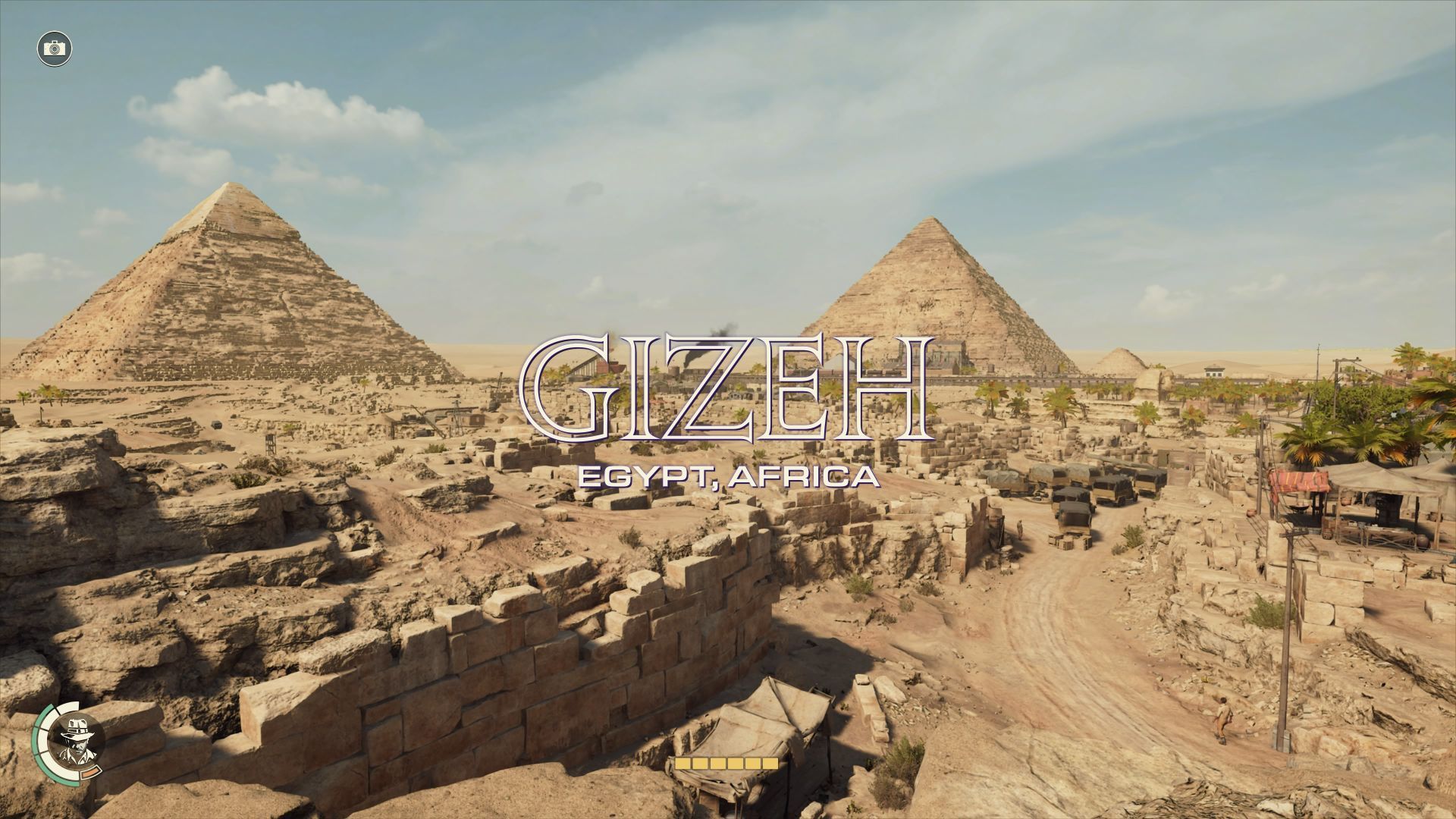
When they appear in this way, panoramas serve as both guides and narrative bookmarks. They can be used to highlight the different chapters of an adventure, giving it a more cinematic structure. This is exactly what Indiana Jones and the Great Circle does, sprinkling its world tour with a few panoramas that mark the protagonist’s progress both spatially and narratively. So, when Indiana arrives in Egypt for the first time, he has to take a few steps and walk several meters through the dunes before climbing one of them and contemplating several millennia of history: the player is rewarded with a view of a few green palm trees, a remote village, several camps, and of course the majestic stone triangles. It is at this moment that the words “Gizeh, Egypt, Africa” appear on the screen.
In this game, the developers wait until the player reaches a key point in their exploration before revealing the new playground with a panorama, which is adorned with a design evoking the beginning of a new chapter. The panoramas establish the narrative structure of the game, dividing it into segments whose landscapes become bookmarks. Control uses the same process, with each new area of the Old House welcoming the player with huge letters forming the names of the zones, which are superimposed on the scenery during exploration, without interruption. Each appearance is accompanied by a hammering sound, reinforcing the impact of the words and names and segmenting the progression in a striking way. The panoramas are particularly striking here because they only appear indoors, meaning that they deprive the player of an overall view of the area they are about to discover. However, these digital paintings remain, like the first examples in this text, promises, because they are steeped in the atmosphere associated with these new areas, offering a taste of the atmosphere the player is about to enter.
While realism, or at least its imitation, has become widely accessible following the emergence of 3D technology, this does not prevent 2D works from enjoying the pleasures of staging through their own panoramas, governed by codes that are very different from those mentioned so far. Thus, progression in Hollow Knight is regularly punctuated by welcome breaks that highlight the game’s universe, whether it be a bench (the game’s save points) moving the camera to showcase a landscape when the player sits down, or screens centered around a strong visual element (statues, ruins, carcasses, or other natural scenes). In this game, the panoramas serve the dual purpose of satisfying aesthetes and providing valuable clues about the workings and mythology of this fictional universe. Neva and Gris, for their part, offer a succession of frescoes entirely centered around pure visual pleasure, with gameplay only being added to the paintings as an afterthought. The approach here is to first propose a strong and distinctive artistic model, before adding a story, a message, and gameplay. But long before these relatively recent examples of two-dimensional games, developers regularly had to contend with the technical and structural limitations of their time: displaying a sleek, colorful, and grandiose landscape that served only to appreciate a specific moment in an adventure was not as easy a few decades ago as it is with the latest generation of tools.
The Legend of Zelda: Link’s Awakening, to use an example related to the introduction of this text, had to contend with the limited screen and processor of its platform: the incredible Game Boy. Under these conditions, it was difficult to go beyond the simple physical constraints imposed by the very form of the console. However, the developers managed to transcend these barriers by making the most of these very limitations: through composition, emphasis on various elements, the choice of which screens to animate, the way the viewpoint was guided, the representation of textures, etc. When Link picks up his trusty sword for the first time, he doesn’t retrieve it from a corner of the screen. Instead, he stands precisely in the center of the image, subtly positioned between the sand of a beach and the foam of the sea, confirming from that moment on his status as the hero and focal point of this adventure.
The enemy is cleverly placed on the left, as you have to retrace your steps to return to the village and progress to the next area. The sea mist at the bottom of the screen marks the end of the play area, but also justifies the arrival of the blade washed up on the sand, while reminding us of the foreign and isolated nature of the island (and by extension, Link himself). The image, this simple, ridiculously small image, enclosed in its postage stamp-like screen, thus forms a panorama that is just as relevant as the frescoes of triple-A games, both in its effectiveness and its symbolism. It makes an impression and has an impact, contrasting radically with other more modest screens encountered previously, which are intended to be passed through without telling us anything more than what the gameplay brilliantly narrates. Screens that, upon discovering this panorama, constitute a sketch of the “past.”
Warning: this paragraph discusses two surprises in the games Dark Souls III and Red Dead Redemption II. It is precisely this “past” that allows certain works to achieve a greatness that is conducive to the medium. While most panoramas fit into the chronology of a single game (revealing the location to be explored in the coming hours, for example), some of them blow this concept apart and take place in a setting that goes beyond the limits of the story in question. This is the case, for example, when the player discovers Anor Londo in Dark Souls III, or the entire southern part of the map in Red Dead Redemption II. The panoramas are accompanied by a technical slap in the face (the developers have once again modeled areas from previous games using more modern tools), a narrative slap in the face (this creates a link between several stories), a playful slap in the face (the areas are part of the game and can be explored), and an emotional slap in the face (by playing on nostalgia). In doing so, the developers offer a much more striking consistency to their experiences, while expanding their mythology. The scale of these discoveries goes beyond the simple temporality of the gaming experience and conjures up memories from a previous experience, thus reinforcing the impact of the enjoyment of the game. The panoramas are, in a way, a reward.
There are also sequences designed entirely as such rewards, without having to draw on an existing game catalog. Let’s skip over certain adaptation settings whose sole purpose is to reference another work, such as certain passages from the Ghostbusters game or even the Pirates of the Caribbean world in Kingdom Hearts III, to focus on self-contained experiences. In 2018’s God of War, the protagonist Kratos and his allies face a terrifying dragon in an epic and grandiose boss battle. When the creature is defeated, it collapses to the ground, its mouth gaping, falling right next to an impassive and iconic Kratos. The shot completely erases the panorama that served as the backdrop for the confrontation, a natural terrace on the side of a mountain, the horizon marked by a chain of peaks and other rocky outcrops. This panorama is erased to highlight the character and remind us of his divine status, erasing even the landscape, even the world around him.
Other times, however, the panorama tells a story and even becomes one of the main tools of narration. This is the case in another well-known diptych, Ghost of Tsushima and Ghost of Yotei. The gameplay loops of these adventures revolve around minimalist landscapes with striking, unreal colors, serving primarily as indicators. The vast expanses of golden or lilac grass highlight points of interest through a thoughtful and consistent aesthetic design. Whether it’s the famous Mount Yotei, which gives its name to the second installment and stands as the focal point of the map, or other striking visual cues, such as a tree of a different color planted in the middle of a grove, these specific features serve the same purpose as the stars that once guided travelers. What’s more, these aesthetic eccentricities feed into one of the game’s themes, a kind of symbiosis between the avatar and nature, with the latter using animals, wind, and vegetation to highlight various elements. It’s as if the biosphere and the universe are at the service of the game. The panoramas become both a visual delight and a real gameplay tool. On this subject, we can quickly mention the strategy game genre: in Frostpunk, Sim City, and others, panoramas become the main screen of the game, a veritable dashboard, the engines of the experience. Finally, how can we not mention a genre that fully embraces the grandiloquence of beautiful images by mixing them directly into the gaming experience: cinematic platformers.
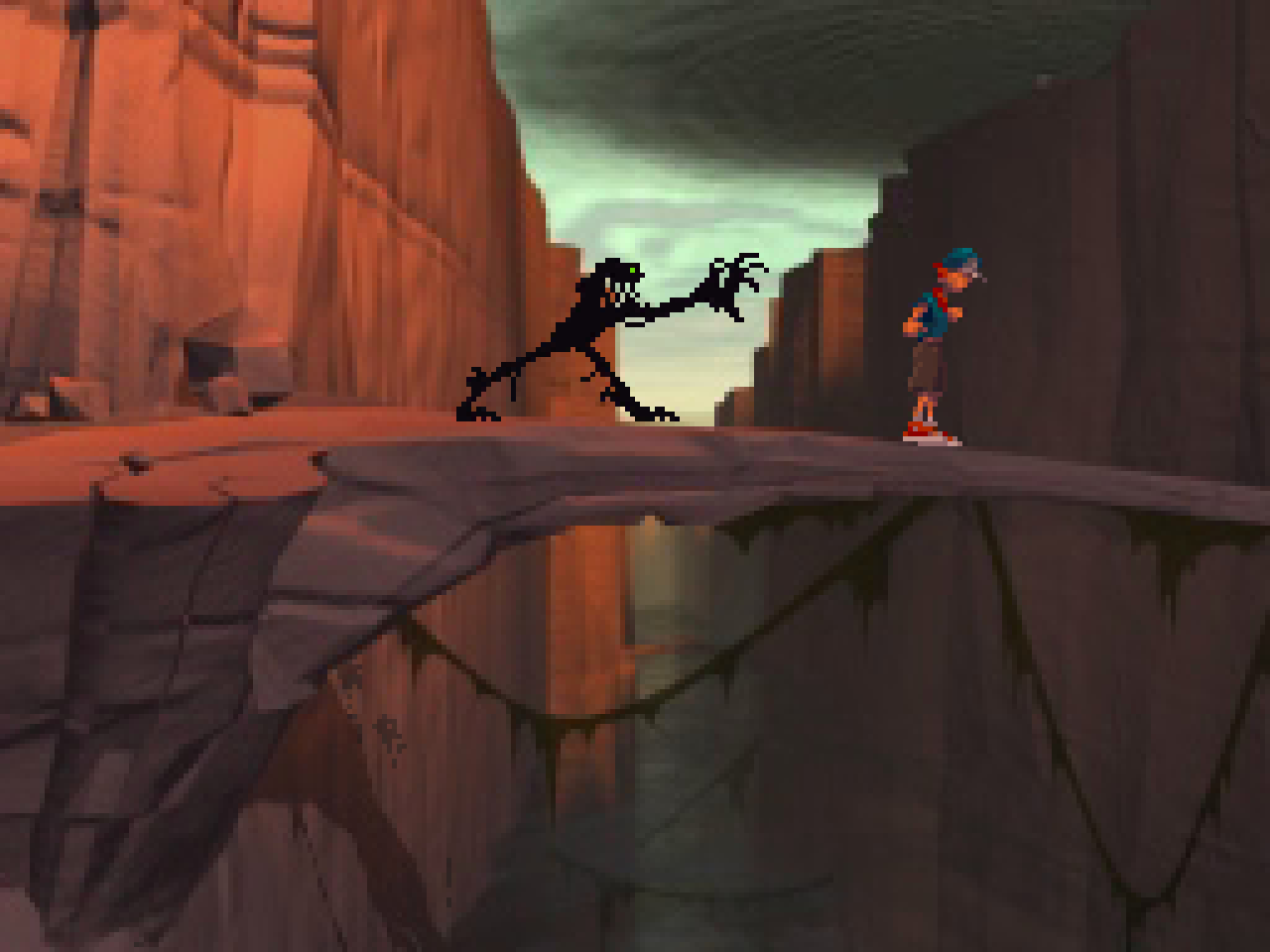
In 1991, Another World hit game stores. It’s not quite a platform game in the usual sense of the term, meaning it’s not a Mario game, nor is it a pure action game. It’s an adventure composed of scenes, or panoramas, placing the protagonist in various situations from which he must extricate himself using reflexes and reflection. Each screen becomes a real puzzle, a tiny piece of a much larger and denser world, as demonstrated by the different layers stretching out on the horizon. The panoramas serve as both frames and supports, maintaining the impact of each scene and allowing the player to immerse themselves in the surreal universe depicted. The genre would endure but prove rather sparse in terms of representation: Éric Chahi, the same creator behind Another World, would return in 1998 with the incredible Heart of Darkness, but it was mainly the independent scene that would carry on the genre’s legacy. Full Void in 2023, Lunark in 2024, Bionic Bay in 2025—these are all projects that maintain the grandeur of panoramas as tools and showcases.
And that is precisely what makes these panoramas so powerful. Whether deliberately composed by developers or captured by chance for a split second, when all the elements of the game come together in a random moment of harmony, these images alone define the evocative power of these adventures that inspire us to dream. We all have our own panoramas, Polaroids that leave a mark on us and perhaps even define us, while others, universal, are meant to be shared. Like all the tools necessary for the difficult alchemy sought by a video game, panoramas are capable of immortality or, on the contrary, can die before even reaching our retinas. They are witnesses to passion, fervor, sensitivity, and ambition; they are the legacy that creators try to share when they breathe a little of themselves into their projects. So, the next time you navigate a world of polygons and pixels, don’t forget to gaze upon these landscapes which, for a brief moment, will exist even more than reality itself.