

“I have no idea where this will take us, but I have a feeling it will be a place that’s both wonderful and strange.”
Dale Cooper
The influence of Twin Peaks looms large over many works, often subtly. Nevertheless, the series by David Lynch and Mark Frost has continued to inspire and fascinate audiences since its debut. Ask Sam Lake about his main inspiration for Alan Wake, the Duffer brothers about the first season of Stranger Things, or Alex Hirsch, the legendary creator of Gravity Falls. These iterations are proliferating slowly but surely, like so many illegitimate children gradually breaking free from the ancient tree from which they fell. They all converge in a nebulous atmosphere that the original series has largely sustained throughout its run—in 1990 and 2017—an opaque mist where faces distort, shadows fulfill their desires, and, above all, evil lurks.
Silver Pines positions itself as the latest heir to the franchise, except that the work is far more apocalyptic than its source material. Much like Remedy’s saga, Twin Peaks is merely a distant memory here, subsumed into something far more horrifying. The color palette, a few curtains, and an unfailing ambient blur will be the most enduring remnants of the series—fortunately—and while I wouldn’t go so far as to say this is a clear mark of quality, Silver Pines takes its cues from “Lynchian” aesthetics and evolves into something else entirely: a darkness just as abject. The specter of the greatest series of all time looms over Wych Elm Studio’s debut project. The ruins of television’s past manifest themselves in today’s video game.
A strange dream
Dale Cooper: “What are these beautiful trees called?”
Harry S. Truman: “Douglas pines.”
An impeccable trench coat, a troubling disappearance, and black coffee—it’s hard to tell which of the two works these words describe. And for good reason: Silver Pines never hides its connection to its parent work. The episode opens in a diner that’s practically a carbon copy of the RR, and the title card appears against the backdrop of a melancholic concert—worthy of the epilogues in The Return—shouting at the top of their lungs their love for what was once one of the greatest cultural phenomena of the 1990s. Beyond Twin Peaks, the homage is also glaringly obvious from the very first minutes, with the scene of a cart being intercepted, on which sits a strange shape—a direct reference to David Lynch’s first film, the sinister and relentless Eraserhead. Silver Pines very often embodies the very idea of the “Lynchian” style mentioned earlier—a term that’s sometimes a bit of a catch-all for describing the elusiveness of a work that, inevitably, eludes us.
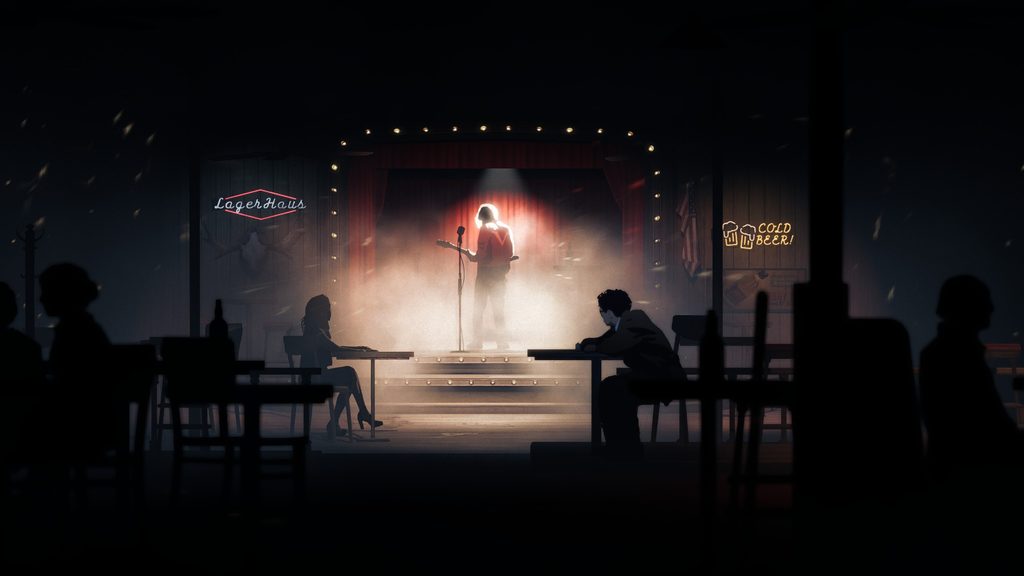
Detective Dale Cooper is succeeded by Investigator Walker
The “Lynchian” element in Silver Pines is, in this case, far from being overused; beyond its opening that begins almost in medias res—which instantly makes our presence in these mysterious surroundings feel enigmatic—Wych Elm’s performance cultivates a certain sense of mystery without ever letting up. Any reference to that question posed in 1990 through cathode-ray tube televisions: “Who killed Laura Palmer?” While the goal here is to track down a certain Eddie Velvet (well, well), the ghosts aren’t long in emerging, with Palmer giving way to Baker, and Cooper to Walker. It almost feels like a parallel storyline, another common thread. The North American town of Silver Pines is shrouded in a thick fog where the streets oscillate between hostility and an unsettling calm until a phone rings. As in Lynch’s *Lost Highway*, the supernatural comes through the receiver—a mysterious abyss from which a vocal twilight emerges, a phenomenon more intangible than ever. Eddie Velvet, a missing musician and eccentric local figure, will be our only beacon in the storm—a distant light, almost gone. A horizon that at first seems unattainable but, as in any good serial, reveals itself step by step.
Detectivania
Silver Pines’ first masterstroke lies in the fusion of its structure and narrative contours. Walker is an investigator mired in a dark quagmire, unable to foresee how far the investigation will take him or into what corners he’ll have to venture to uncover the truth. Logically, the Metroidvania format lends itself perfectly to such a journey. The genre’s motto could be summed up as “always further… but how?”, an idea that doesn’t quite fit within the framework of an investigation—a hunt that progresses from clue to clue, usually scattered to the four winds.
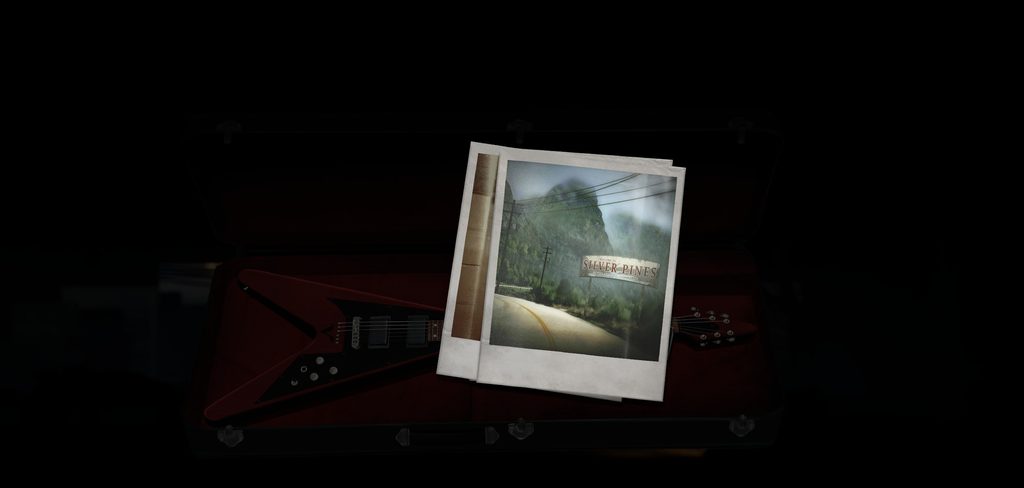
Twin…Pines ? Silver… Peaks ?
These two questions constantly linger in our minds: What happened, and how can we uncover what remains unknown? Two incentives to motivate the player—an investigator just as amateurish as Walker—to venture into the labyrinthine streets of Silver Pines. It’s no small feat to convince players to venture from level to level beyond the simple desire to move forward. Silver Pines turns clues into rewards, even though this isn’t a game mechanic in and of itself. Not knowing where to go, realizing that all leads have gone cold, is an integral part of the game’s design. Like a film noir hero, Silver Pines asks us to wander for a while, our minds filled with demons, before finally getting our hands on a new clue capable of pointing us toward another fragmented piece of this disappearance story. Genre and narrative form such a cohesive whole that one comes to believe the now all-too-familiar “Metroidvania” was born for this kind of experience, in which being lost is accepted as a necessary part of the journey.
The formula isn’t exactly revolutionary. Strictly speaking, Silver Pines employs mechanics that are widely used in the genre. An item unlocks a certain area, allowing you to go back and explore what was previously inaccessible—it’s a well-known concept. But the investigation takes center stage; it succeeds in making this structure feel more natural than usual, where hitting a roadblock prompts you to draw new connections between the clues on the investigation board. Silver Pines also capitalizes on this atmosphere to introduce some welcome innovations. The use of the camera seems trivial at first but turns out to be an excellent addition. This allows you to photograph an item whose purpose is still unknown, add its photo to the map, and have a visual reminder of the obstacle you encountered. Everything is designed to serve the investigation without ever blurring the line between frustration and curiosity. Form naturally serves function—a balance that’s sometimes too rare not to be highlighted.
Each area has a star-shaped layout, and you’ll generally need to explore every part of it to find the keys needed to progress. This exploration is sometimes rewarded with crucial resources (bullets, health items, materials, etc.) or permanent bonuses: for example, a good cup of black coffee boosts your stamina for the rest of the game. Once again, the reference is charming. Here we see the Metroidvania formula in all its glory, yet always executed with consistency and inspiration.
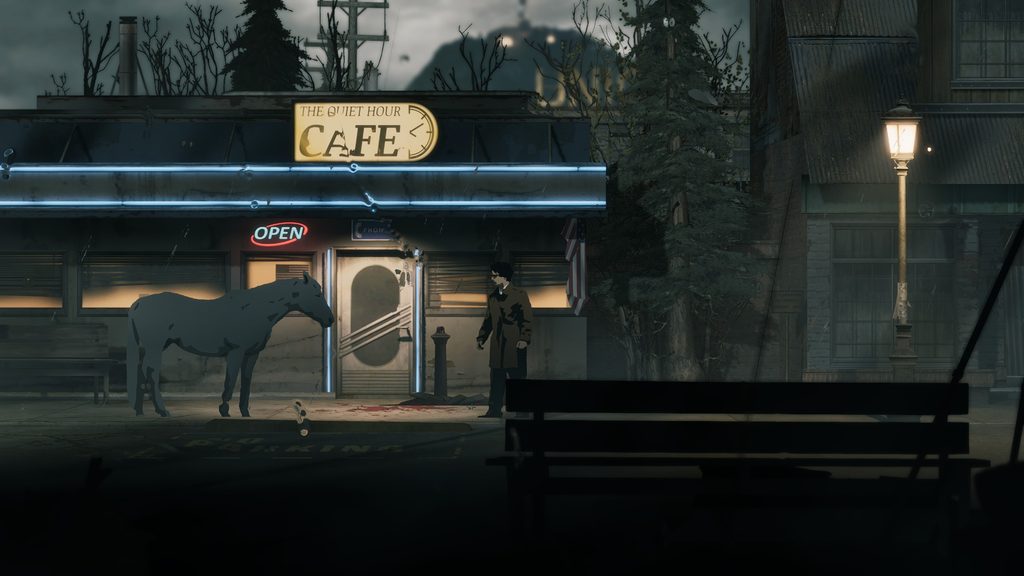
Wasn’t that guy in the Black Lodge?
While the various locations explored throughout the game don’t feature particularly different mechanics—aside from a few minor, déjà vu-like abilities (breaking through a wall, being able to swim, etc.)—they all manage to shine with their own distinct brand of horror. The indoor levels are even more horrifying, offering a deep dive into the best of survival horror—such as when Walker wanders through the Union Hotel or inside City Hall. These locations feel more claustrophobic than ever thanks to the 2D art style, where the dimly lit background conceals hostile shadows. Other sections take advantage of the ethereal atmosphere of the eerie town of Silver Pines. The downtown alleys blend dreamlike quality with panic, undergoing changes as the adventure unfolds and sometimes leading to encounters that are—to put it one last time—utterly “Lynchian.”
This deep mystery remains, the glue that holds this tortuous journey together. Silver Pines quickly promises to lead us astray, to transform its setting into something more than just a video game arena; this small North American town is on the verge of implosion, and the answers lie in its depths.
The Rabbit Hole
The Walker investigation… the investigation… Good old Mr. Jackman never stops reminding us why we’re in Silver Pines, through his numerous calls on the blue phone. Eddie Velvet, a singer on the run and accused of the murder of young Alice Baker, is a target to be found… or taken down? What do we want from this man we know nothing about? The initial premise sets the stage for a definite shift in focus. Quickly, the investigation takes a back seat as the story shifts to a deeply tormented journey. Silver Pines seems like a ghost town, not just because of the impending storm, but because of its deep-seated traumas.
This town, seemingly as dead as can be, unfolds like a sticky memory, where progress—beyond being hindered by Metroidvania clichés—is made arduous by a viscerally grueling journey. The few inhabitants you encounter won’t be of much help—stingy with words, withdrawn into their own secrets. Shadows took hold of Silver Pines long before our arrival. The humanoid silhouettes emerging from the tar are nothing more than potential hallucinations, harbingers of an evil far deeper and far more deeply rooted.

What Lies Hidden in the Darkness
Since Silver Pines reflects a certain theory of dreams (or nightmares), Walker’s pragmatism—his eagerness for tangible clues—blends with a supernatural element that appears in fleeting glimpses before becoming a constant presence. Monsters gradually devour an unstable reality; every door, ringed by a red aura, that is passed through pushes the ship of reality a little further into the waters of the intangible. Death awaits at the end of the road—whether in the past (Alice) or the future (Eddie)—and Walker cannot escape it; he is the final cog in a hellish machine, a sort of unwitting Orpheus, unaware of his own descent into hell, certain he will return even more alone than when he set out.
This absence of hope paints a picture of an inescapable fate that is quickly confirmed—a fact that Bobby, the young hothead from Twin Peaks, revealed very early on in the series: “You want to know who killed her [Laura Palmer]? You all did—we all did!” Remaining true to the spirit of the original work, *Silver Pines* does not deny that the supernatural serves as an allegory for very real traumas. Any of them could have killed Alice Baker; Eddie Velvet is merely one ideal suspect among a myriad of voracious individuals. The bosses the characters face are thus all potential killers of Alice—men so consumed by vice that they become these ravenous horrors. The few sequences from Terminal Drive, a series that exists within the work’s diegesis and is produced right in the town of Silver Pines, definitively anchor the threat. The episodes feature a psychopathic driver massacring female hitchhikers. The bogeyman, however, is far less caricatured off-screen: from the deputy sheriff to the tortured local artist, evil lurks in everyone’s footsteps.
Alice is a ghost whose presence can be sensed, but unfortunately, everything suggests it’s already too late to hope to save anyone. Mr. Jackman’s phone calls take a different turn. Obsessed with Eddie Velvet, the man on the other end of the line seems determined to hide one truth at all costs rather than uncover another. We continue to descend into the depths of the investigation; just when everything seems lost, nothing makes sense anymore. Silver Pines offers a glimpse into genuine despair—that of a town that has lost its humanity, where the only way out is a desolate highway, down which Walker will set off again without any evidence, having lost a part of himself along the way.
Shadows walks with me
Beyond its narrative atmosphere, which borders on the cryptic, the eerie charm of Silver Pines stems largely from the studio’s unconventional artistic choices. A prime example is its extravagant use of rotoscoping for character movement. While the technique has always lent a distinctly “uncanny” quality to the world of animation (a bittersweet thought when considering Bakshi’s The Lord of the Rings), its use here is particularly apt. It gives investigator Walker a range of jerky movements, revealing a certain sluggishness in his movements. Walker is a film-noir detective whose athletic build has never been a strength; rotoscoping thus allows for the depiction of all his physical flaws, as his body is much heavier and far less agile than his supernatural enemies. The eerie quality inherent in rotoscoping blends perfectly into this adventure where anything can turn out to be nightmarish. A body with unsettling movements is just one clue among many. This sluggishness can be jarring during more intense scenes; boss fights clash with the character’s sometimes clumsy style, making certain timing challenges difficult to manage: shooting, healing, reloading—so many actions that sometimes feel laborious due to a repetitive slowness.
That said, Walker’s character remains viscerally engaged in his combat sequences. His physical condition—which visibly deteriorates as his health declines—makes him as vulnerable as he is stubborn. As his steps grow heavier and he clutches his wounds, Walker leaves a piece of himself in this story—a commitment that is wonderfully captured by the magic of rotoscoping, a technique all too often dismissed as kitsch. With the right intent, the film comes into its own despite a few rough edges.
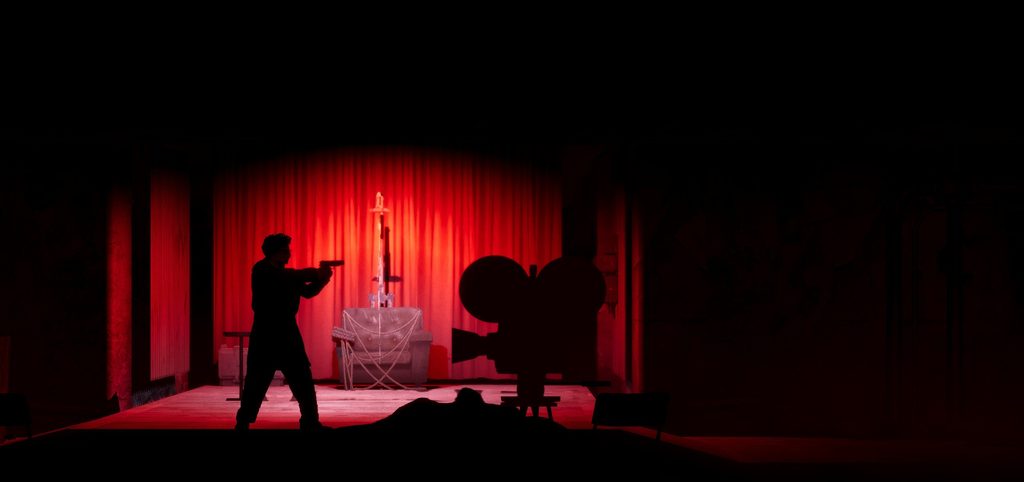
Red curtains…
Silver Pines is also all about pure visual style. The depth of the environments heightens the dread of the abyss into which the player and protagonist sink, neighborhood after neighborhood, shadow after shadow, dream after dream. The interplay of textures often proves highly effective—a sort of semi-realism exaggerated by rough pencil strokes. The overall atmosphere tends to stand in contrast (for once) to Lynch’s series. There’s no cozy or comforting aesthetic here; Silver Pines emphasizes a far more macabre tone. The pine trees are buffeted by an increasingly fierce wind, debris flies through the air, and a cold, gray gloom settles over the city’s skyline. There’s no doubt that this place repels those seeking answers, those hungry for the truth. Like the fog in Silent Hill, the town of Silver Pines uses the twilight as a vast curtain, a complete veil over what neither the eyes nor the mind are meant to see.
Not to mention that the work is all about ruins. Just like its decaying inhabitants, the city offers only one horizon: that of agony. Everything seems to be dying as you make your way through it—from the church whose congregation has been converted by chaos to the local movie studios; every stage of the journey is lined with rubble. There are the walls covered in graffiti, vessels of abject thoughts; the TVs that turn on without human intervention; and the red light that radiates from what will become a theater of violence. Silver Pines is an ode to darkness, a video game poem that turns the shadows into a twisted odyssey. It’s only when you think you’ve come to terms with the city that Silver Pines decides to fill its streets with entities even more monstrous than the ones before—a clear test of the sanity of a character teetering on the brink. The storm strikes, and a new chaos emerges—reminiscent of the pagan night in Bloodborne back in the day, yet another reference that Wych Elm studio brilliantly incorporates.
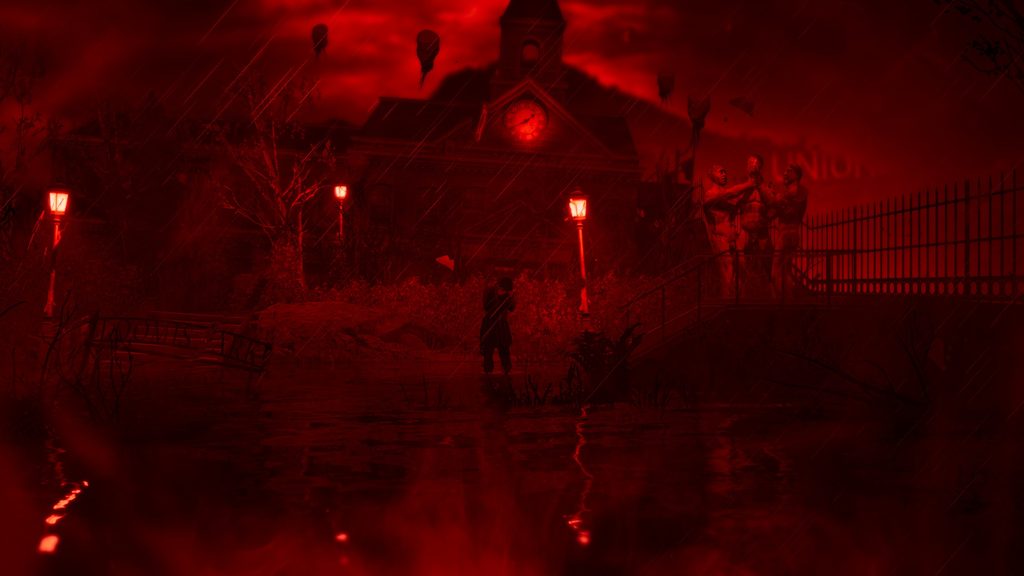
I used to exist… but the things that were usually inside me… they’re OUTSIDE now, all OUTSIDE.
Silver Pines retains its ethereal quality while fully embracing the survival-horror genre. Far from being merely an atmospheric game, the game’s settings all serve as stages for various narrative intentions, while showcasing exemplary environmental storytelling. The Union Hotel, in particular, serves as a wonderful setting for investigation and meticulous exploration, with the main mystery of the place centered on discovering the rooms once occupied by specific guests. Everything blends together beautifully to create a perfect mix that alternates between references and genuinely engaging gameplay moments, where the pervasive sense of unease combines with the desire to unravel the mysteries of a ghost town.
Traces that lead somewhere
It’s been a long time since a game has so skillfully cultivated a certain art of mystery. There’s no doubt that, like its predecessors, Silver Pines might leave a certain audience in the dust. Nothing is spelled out in a game that favors trial and error over a clear path, though once again, the mystery blends perfectly into a genre where physical progression is deliberately fragmented and complicated by gameplay elements or missing information. The game brilliantly conceals a certain linearity behind a narrative of almost impenetrable esotericism. While one might be tempted to question the game’s originality given such obvious inspirations in its tone and aesthetics, it turns out that Silver Pines is by no means “Lynch slop,” to quote the game’s few detractors, whose comments are as incomplete as they are reductive.
On the contrary, what a joy it is to see a studio that is genuinely passionate about one of cinema’s masters while successfully translating some of his qualities into another medium. Silver Pines constantly strikes a perfect balance; even its runtime of about fifteen hours seems ideal for preventing the game from becoming an overly drawn-out ordeal. You dive into Silver Pines as if into an ethereal moment; it’s hard to tear yourself away from Inspector Walker’s wanderings, as his quest is imbued with an alluring sense of mystery. Silver Pines is full of charm above all because it is a magnificent convergence of “Lynchian” aesthetics and the Metroidvania genre—an atmosphere and a genre that collide head-on to create a work that is as sensory as it is a pleasure to explore.