
Five years after Returnal, Housemarque returns with a denser object, more narrative, more openly assumed. Saros works as a dilation: it keeps the choreography of neon bullets, the atmosphere of creeping dread, the dramaturgy of repeated death, but it grafts onto them an entire civilisation and an iconographic system of a complexity unexpected from a studio that willingly defines itself as gameplay first.
What strikes you, once you start looking at Saros closely, is the thickness of its references. Behind the bullet choreography stands a tight network: the architecture of the Italian Futurists of the 1910s, a literary line running from Ambrose Bierce to H.P. Lovecraft by way of Robert W. Chambers, the multi-armed iconography of Hindu devotion, the black sands of Iceland, the biomechanical memory inherited from Giger and Beksiński. All of it placed under a watchword that art director Simone Silvestri repeats like a motto: Violent Beauty.
Saros is a Finnish game that speaks Latin, Italian, Hindi and Icelandic. It is this weave, and the art with which it was woven, that deserve to be taken seriously as a plastic object.
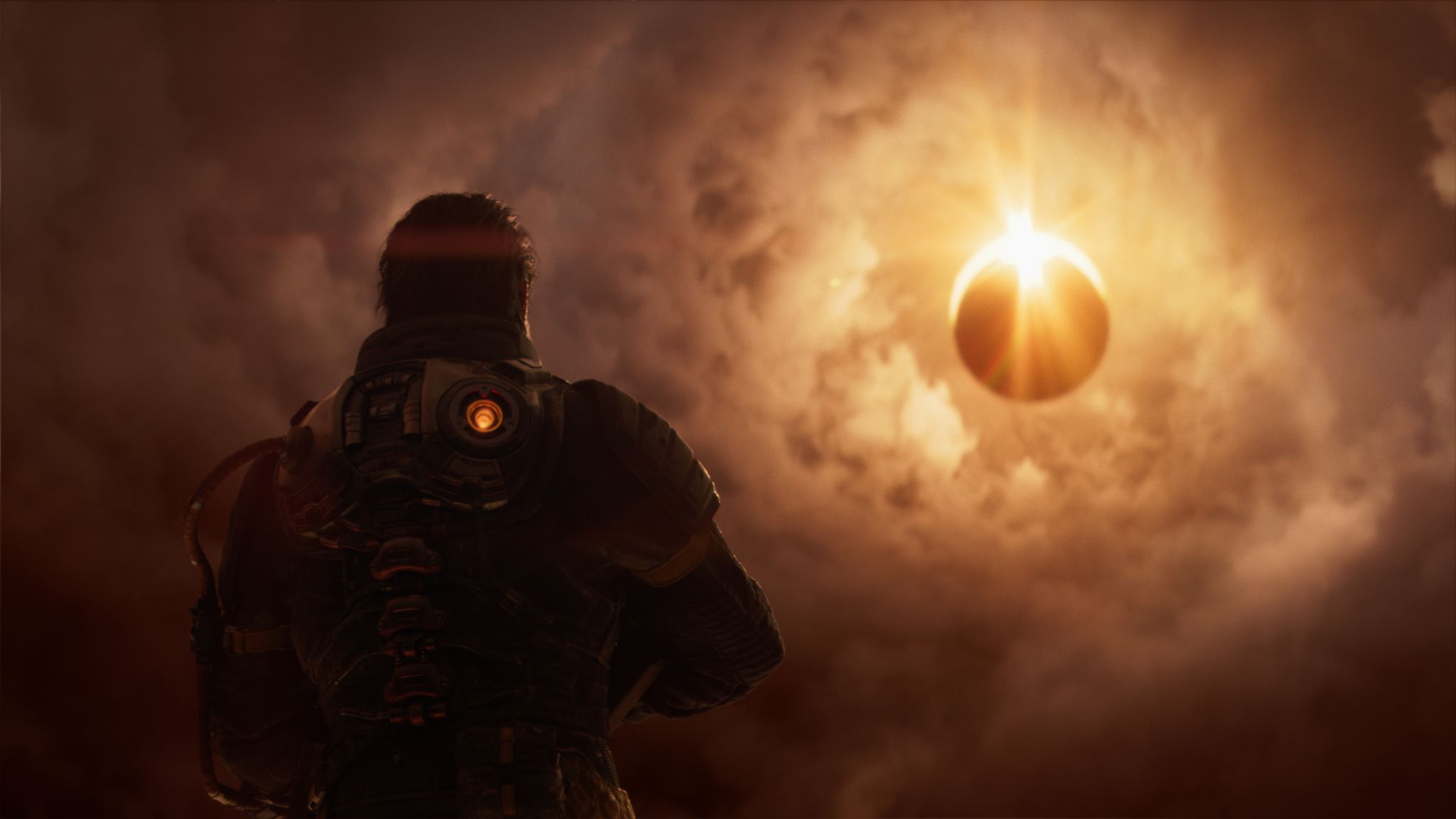
Art direction
An arcade house becomes an auteur house
Housemarque was founded in Helsinki in 1995. For twenty-five years the studio held itself apart from the race toward narrative blockbusters, defending a line inherited from arcade cabinets and Japanese shoot’em ups. Resogun (2013), Nex Machina (2017) and Matterfall (2017) are compact, mean, mathematical objects, where the legibility of the firing pattern takes precedence over any narrative. In 2017 the studio published a text titled Arcade is dead, a bitter assessment of the commercial marginalisation of that aesthetic.
In 2021, Returnal was released as a PS5 exclusive. The game was an unexpected critical success: Hugo and Sam Lake took it up, a BAFTA for game of the year, waves of converted players. Returnal did something few roguelites had attempted before it: it grafted a Lovecraftian science fiction narrative and a psychoanalytic apparatus of traumatic looping onto arcade grammar. A few months later Sony bought Housemarque, which joined the PlayStation family of studios. Saros is the first project conceived entirely inside this new production ambition.
Creative director Gregory Louden comes from Remedy, where he worked on Quantum Break and Control. He was already narrative director and cinematic director on Returnal. Art director Simone Silvestri spent five and a half years at Remedy as lead environmental artist before arriving in Helsinki in 2024. For Saros the studio surrounded itself with an expanded team: Nixxes Software (art and gameplay), PlayStation Studios Creative Arts (sound design), XDev. Composer Sam Slater, a double Grammy winner, comes out of the circle of the late Jóhann Jóhannsson and collaborates regularly with Hildur Guðnadóttir. The lead role of Arjun Devraj went to Rahul Kohli, seen in Mike Flanagan’s Midnight Mass and The Fall of the House of Usher. Jane Perry, who voiced Selene in Returnal, is part of the cast.
This genealogy is not incidental. Saros is a game made by a studio that has done everything, at a moment when it can afford almost anything it wants. The wager is to keep the arcade DNA (the bullet dance, the instant reading of the pattern, the precision) while building around it something that looks like a narrative and plastic cathedral.
The founding collision: neoclassicism against Italian Futurism
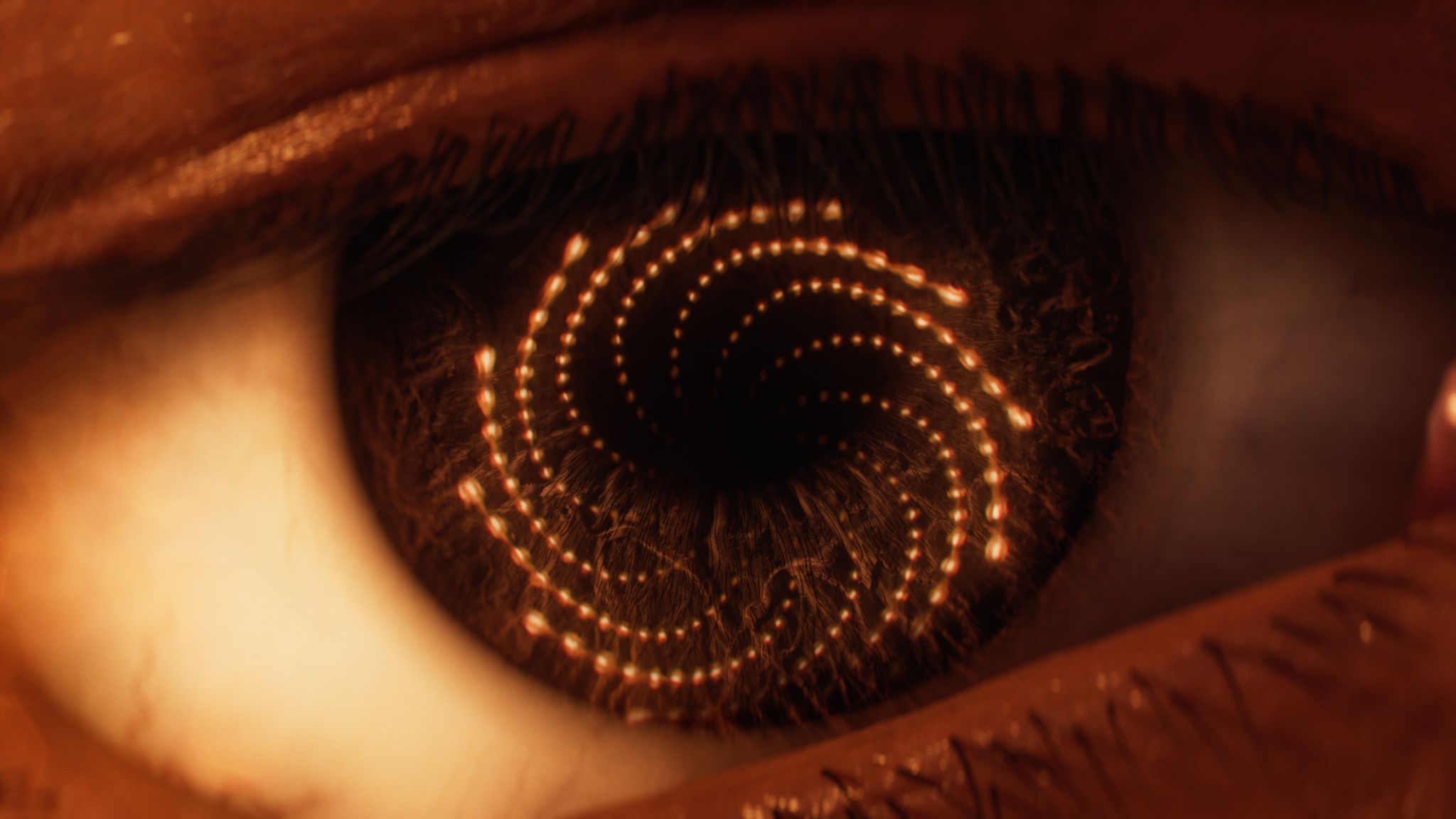
In every interview he gave at the game’s release, Simone Silvestri repeats the same formula: the art direction of Saros was born from the collision between two opposed movements, neoclassicism and Italian Futurism. There is something paradoxical, almost provocative, about this equation. The two aesthetics oppose each other term for term.
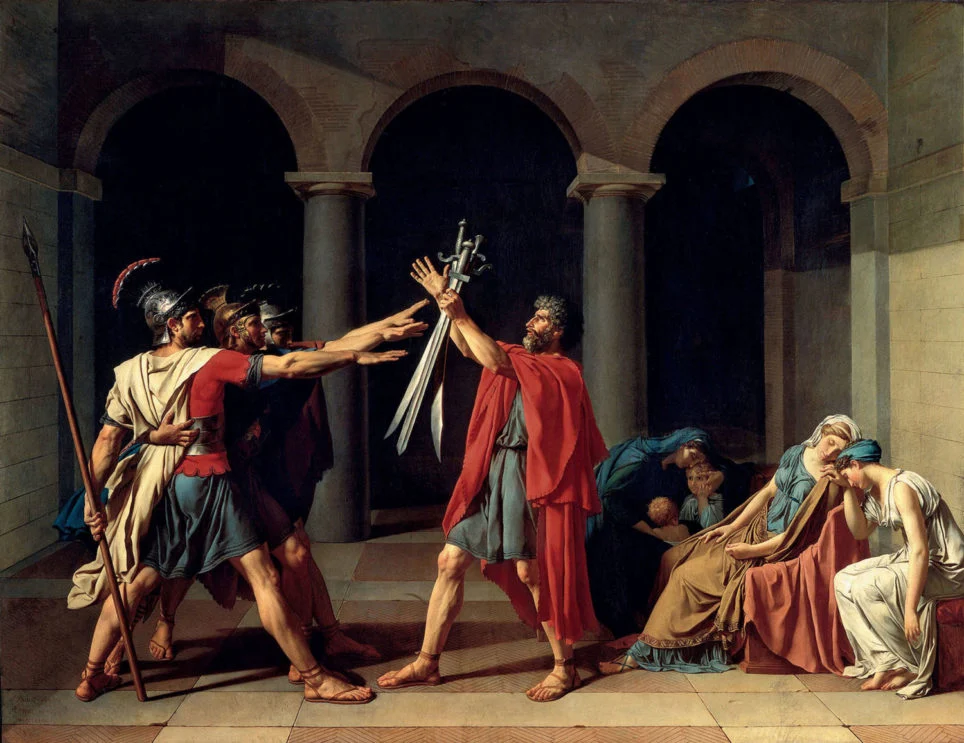
Neoclassicism flourished in Europe between the end of the eighteenth century and the beginning of the nineteenth. It draws on Greco-Roman grammar, restores the temple, the column, the pediment, the arch, the dome. Its value is permanence, stability, measure. It is the architecture of codified power, of academies, of great nations building themselves a founding narrative. Silvestri returns to it as to familiar ground. He comes from Rome, so the neoclassical is almost a geographical tropism. The pitfall is boredom. Every city with a long classical past summons this grammar. It has become a shared cultural landscape. Reproducing it without friction would have been, for the studio, an abdication.
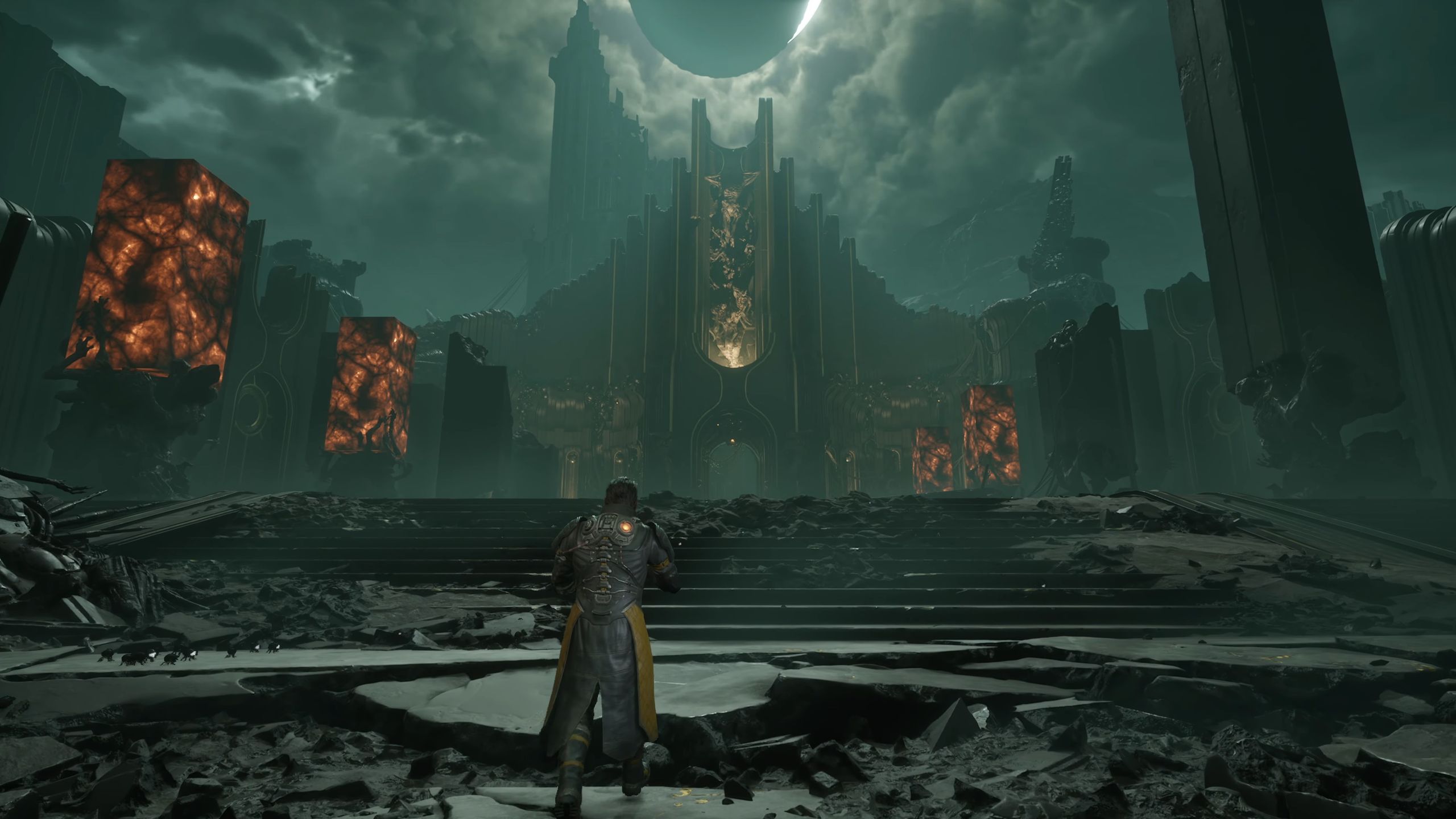
Carcosa, in Saros, is conceived as a place made for gods and monsters. The scale has to crush the player. Yet the modular assembly that characterises games with a roguelite structure (corridors, rooms, arenas) mechanically resists the epic. Neoclassicism offers a solution here: it makes it possible to mobilise, within reduced spaces, visual codes that open onto the infinite, onto the temple, onto reverence. The colossal statues of hands reaching toward an eclipsed sky, the engraved pillars, the cracked pediments, are so many shortcuts to an imaginary of ancient cult. The lost civilisation of Carcosa worshipped something. It is precisely this dimension of cult that the neoclassical installs without having to spell it out.
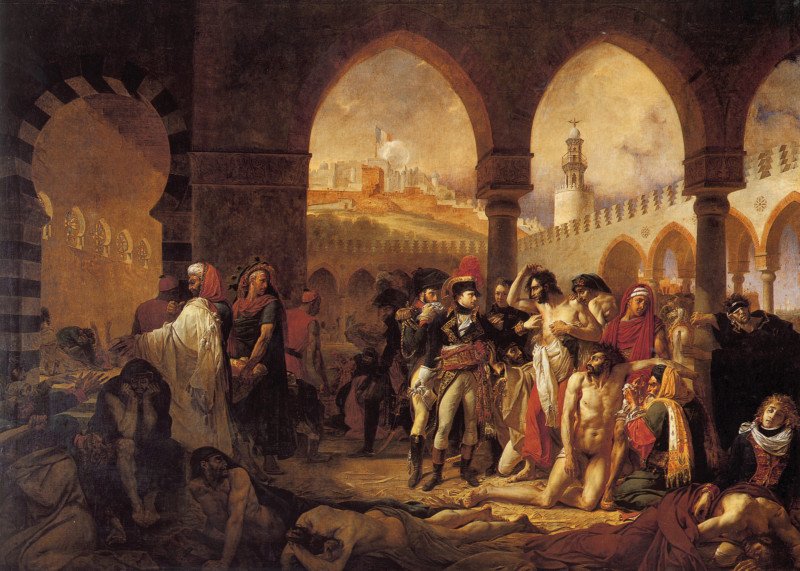
But Silvestri draws a line: no domes. For him the curve is too welcoming to the player. It turns friendly. The round dome, which characterises a large part of academic neoclassicism, is excluded from the palette. The arch remains. The arch is kept because it propels you forward. The choice is as much a gameplay decision as an iconographic one. An arch is crossed, a dome is contemplated.
Italian Futurism was officially born on 20 February 1909, with the publication of Filippo Tommaso Marinetti’s Manifesto of Futurism in Le Figaro. The text is a declaration of war. It proclaims the beauty of speed, glorifies the automobile, the machine, violence, and ridicules museums as cemeteries. Marinetti writes: “We want to exalt aggressive movement, feverish insomnia, the gymnastic pace, the perilous leap, the slap and the punch.”
Around Marinetti a constellation formed. Umberto Boccioni published his manifesto of futurist sculpture in 1913 and sculpted, the same year, Unique Forms of Continuity in Space, a human figure become trajectory, an anatomy deconstructed by kinetics. Giacomo Balla practised chronophotographic decomposition, painting multi-legged dogs like chronograms. Luigi Russolo wrote The Art of Noises in 1913 and invented the intonarumori, a noise machine that anticipates musique concrète. Antonio Sant’Elia published his Manifesto of Futurist Architecture in 1914: he drew the Città Nuova, a vertical city of tapering skyscrapers, stratified stations, external lifts, inclined planes. His line is hard, angular, prospective. He died in 1916 on the Karst front at twenty-eight, and his drawings would never be built. Sant’Elia would remain an icon of paper architecture, whose influence would irrigate Fritz Lang’s Metropolis, Ridley Scott’s Blade Runner, and later an entire visual science fiction that has never really found another vocabulary for the city to come.
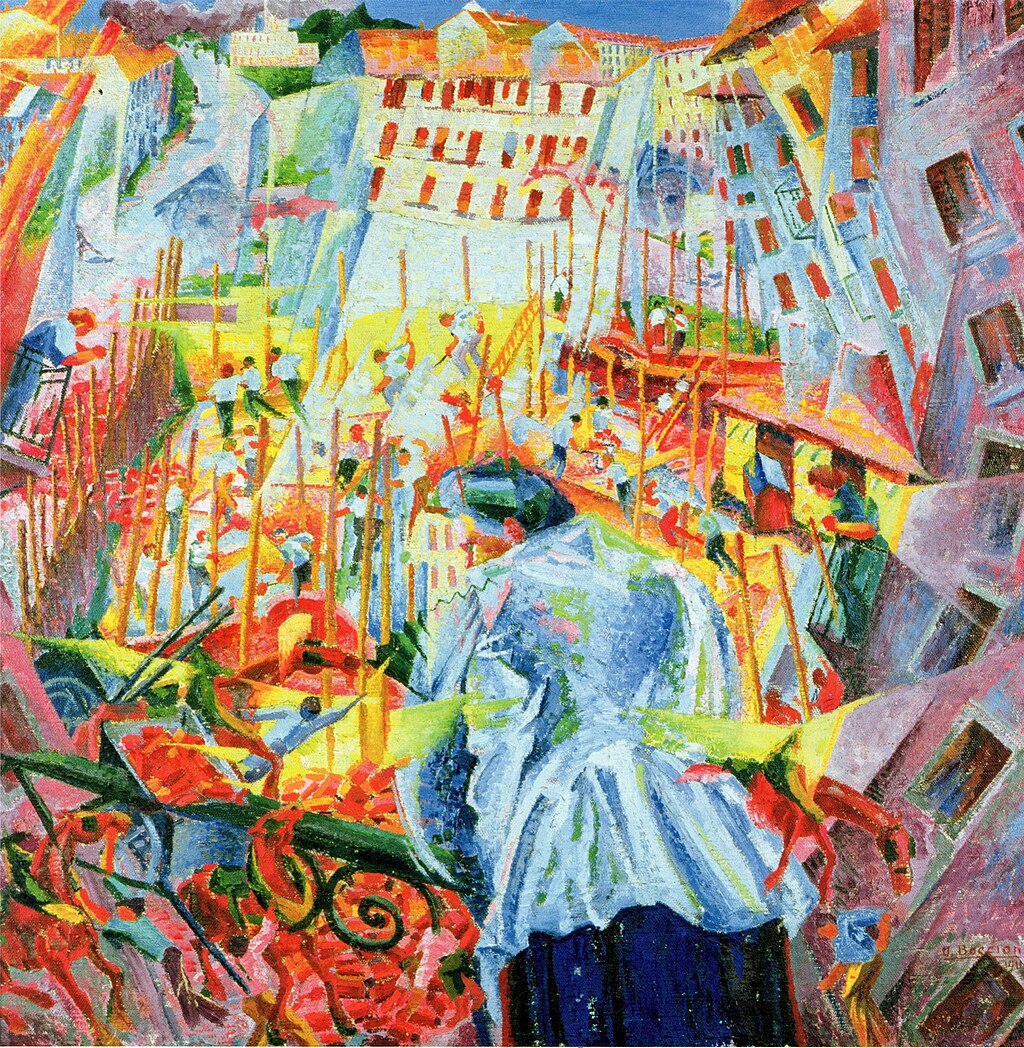
Silvestri goes looking for exactly this grammar: impermanence, dynamism, rhythm, visual aggression, diagonal lines, sharpened points. Italian Futurism was born to break with the neoclassical. The art director of Saros decides to make them cohabit. The neoclassical serves as mystical substructure. Italian Futurism supplies the violence, the rhythm, the aggressive switching of forms. The neoclassical is there for everything mystical, for epic scale. Italian Futurism is there for violence, for rhythm. In the end you get an alien civilisation that is at once eternal and in the process of tearing itself apart.
The tension is productive. The architectures of Carcosa give the impression of having been conceived by a neoclassical civilisation that had, at some point in its history, been contaminated by a prophetic futurism. Straight lines, angles, points, repetitive rhythms streak across the monumental masses. The result belongs at once to Trajan’s Forum and the Mole Antonelliana, to Sant’Elia’s drawings and Boccioni’s sculptures. If we push the analogy, Saros offers the first genuine videoludic transposition of Italian Futurism, a movement whose influence on the urban imaginary is immense but which few games had until now dared to summon head-on.
It is worth noting in passing the ambiguous place of Italian Futurism in European cultural history. Marinetti joined fascism from the 1920s onward, and the movement maintained a relationship of mutual embrace with the Mussolini regime. This is one of the reasons Italian Futurism was held at arm’s length for decades, as an embarrassing aesthetic hearth. Saros, in going to look for this legacy to describe an alien civilisation obsessed with cult and corruption, almost inadvertently reactivates its political charge. The civilisation of Carcosa worships a monstrous thing, and the Italian Futurists, fascinated by power and the machine, ended up worshipping a monstrous thing.
Carcosa, or the cartography of a buried myth
The name of the planet to which Arjun Devraj is sent was not chosen at random. Carcosa is one of the most heavily charged toponyms in Anglo-Saxon fantastic literature. Its lineage runs through three major authors and a television script that became a cult object.
The name appears for the first time in An Inhabitant of Carcosa, a short story by Ambrose Bierce published in 1886. The text, very brief, shows a man waking in a desolate landscape, understanding that he is walking on the geological remains of a vanished city, and discovering, on reading the inscription on a tomb, that the tomb is his own and that he has been dead for centuries. Bierce fixes the motif there: Carcosa is a place that survives its own destruction, where the visitor discovers he is already dead without knowing it. It is less a geographical place than an ontological threshold.
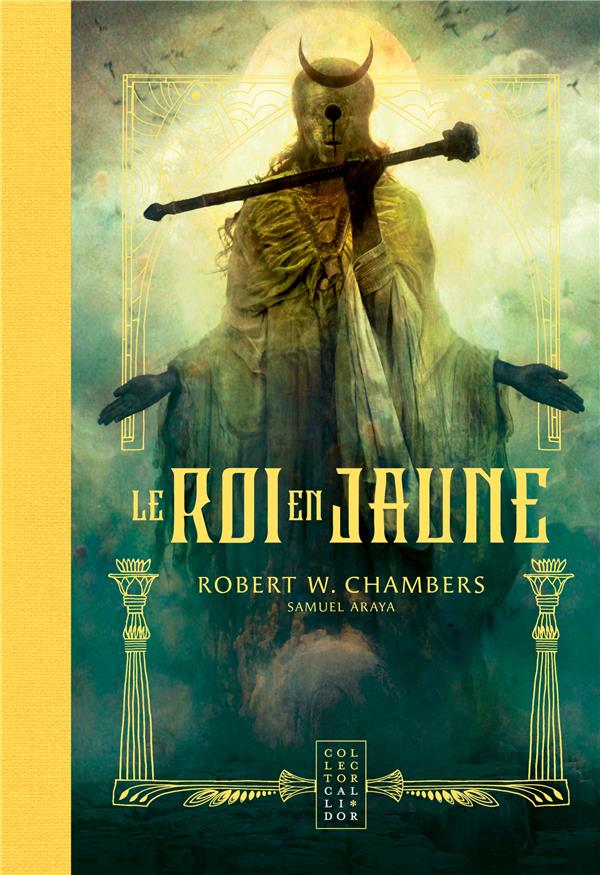
In 1895 Robert W. Chambers published The King in Yellow, a collection of ten stories, five of which share a common mythology: a play titled The King in Yellow, the mere reading of whose second act drives you mad. Chambers borrows the name Carcosa from Bierce, adding Hastur, the Lake of Hali, the Yellow Sign, the mysterious king wrapped in straw-coloured rags. He never explicitly describes the contents of the cursed play. He plays on elision: every afflicted character has read it, no reader ever will. The Repairer of Reputations, which opens the collection, presents a paranoid narrator convinced he is the heir to an American imperial dynasty, who ends up committed. The beauty of Chambers’s device is that the evil is neither shown nor named, it acts by contagion. The play circulates, the Yellow Sign is traced on walls, the faithful enter their trance.
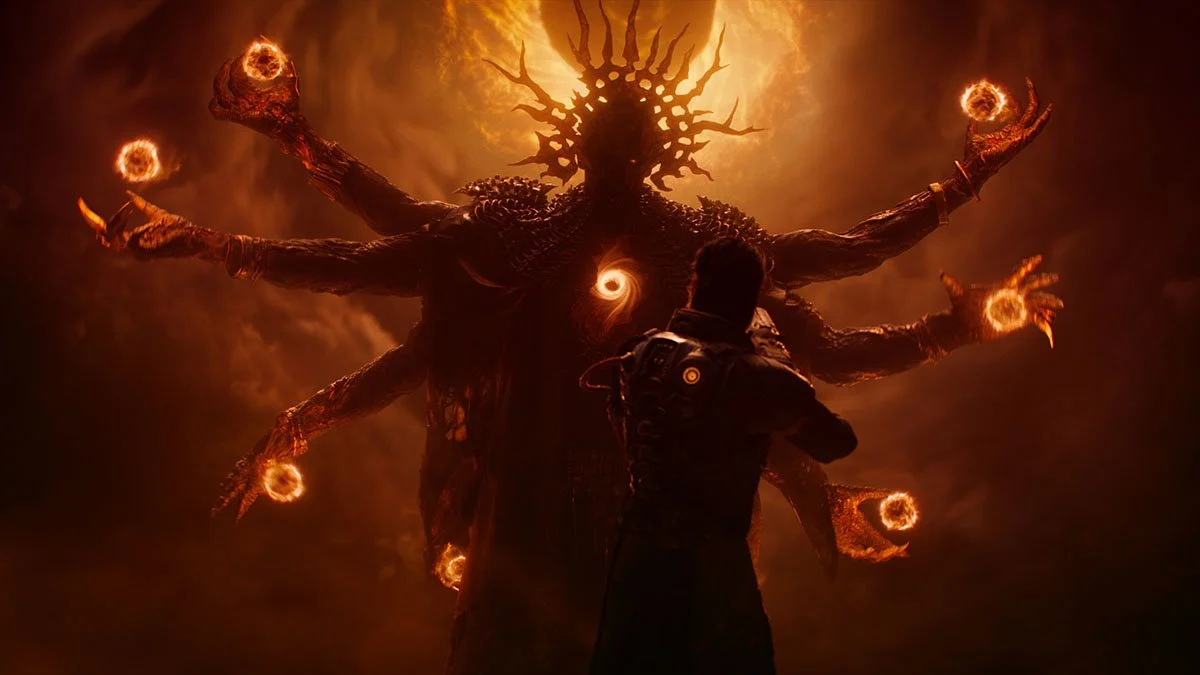
Saros takes up this vocabulary point by point. The planet is called Carcosa. The central colour is yellow. The eclipse motif functions like the cursed play: you have to resist looking at it too long. The colonel of an earlier expedition writes, in a log recovered by the player, fragments that mirror Chambers’s language, speaking of a yellow shore his men had begun to mention before going under. The vanished colonists of Carcosa are the readers of the second act. The King of the Yellow Shore, a creature that appears as early as the announcement trailer, is a direct declension of Chambers’s King in Yellow.
H.P. Lovecraft, who discovered Chambers late in his own trajectory, integrated Hastur and Carcosa into the pantheon that his successors would call the Cthulhu Mythos. The Lovecraftian gesture consists in syncretising: he places Chambers’s King in Yellow on the same footing as the deities of his own cosmos, and the whole now forms a shared mythology. It is this Lovecraftian version, extended by Derleth and codified by Chaosium in the 1980s for the roleplaying game Call of Cthulhu, that durably irrigates popular culture.
Returnal already placed itself openly within this filiation. Saros decides to go back one notch further. Gregory Louden owns it: “Returnal was inspired by Lovecraft. For Saros we wanted to go to the source of what inspired Lovecraft.” The studio therefore makes an archaeological move: return to Chambers, and behind Chambers to Bierce. This inverted genealogy is more than a rhetorical flourish. It conditions the tone of the game. Where Lovecraft practises frontal cosmic horror, Chambers cultivates a subtler disquiet, more decadent, more fin-de-siècle. His writing carries the trace of French symbolism, of Maeterlinck, of Huysmans. Carcosa, in Chambers, is less a disquieting mathematical cosmos than a place of toxic elegance. Yellow there is the colour of plague and the colour of the luxury bindings of the 1890s.
In 2014, Nic Pizzolatto and Cary Joji Fukunaga propelled Chambers’s mythology into the mainstream conversation with the first season of True Detective. The serial killer nicknamed the Yellow King operates in Louisiana, Hastur and Carcosa are regularly invoked, and the series blurs the border between occult ritual and the industrial failure of a post-Katrina America. The consequence is lasting: since 2014, any mention of Carcosa in a pop product refers as much to Chambers as to the HBO series.
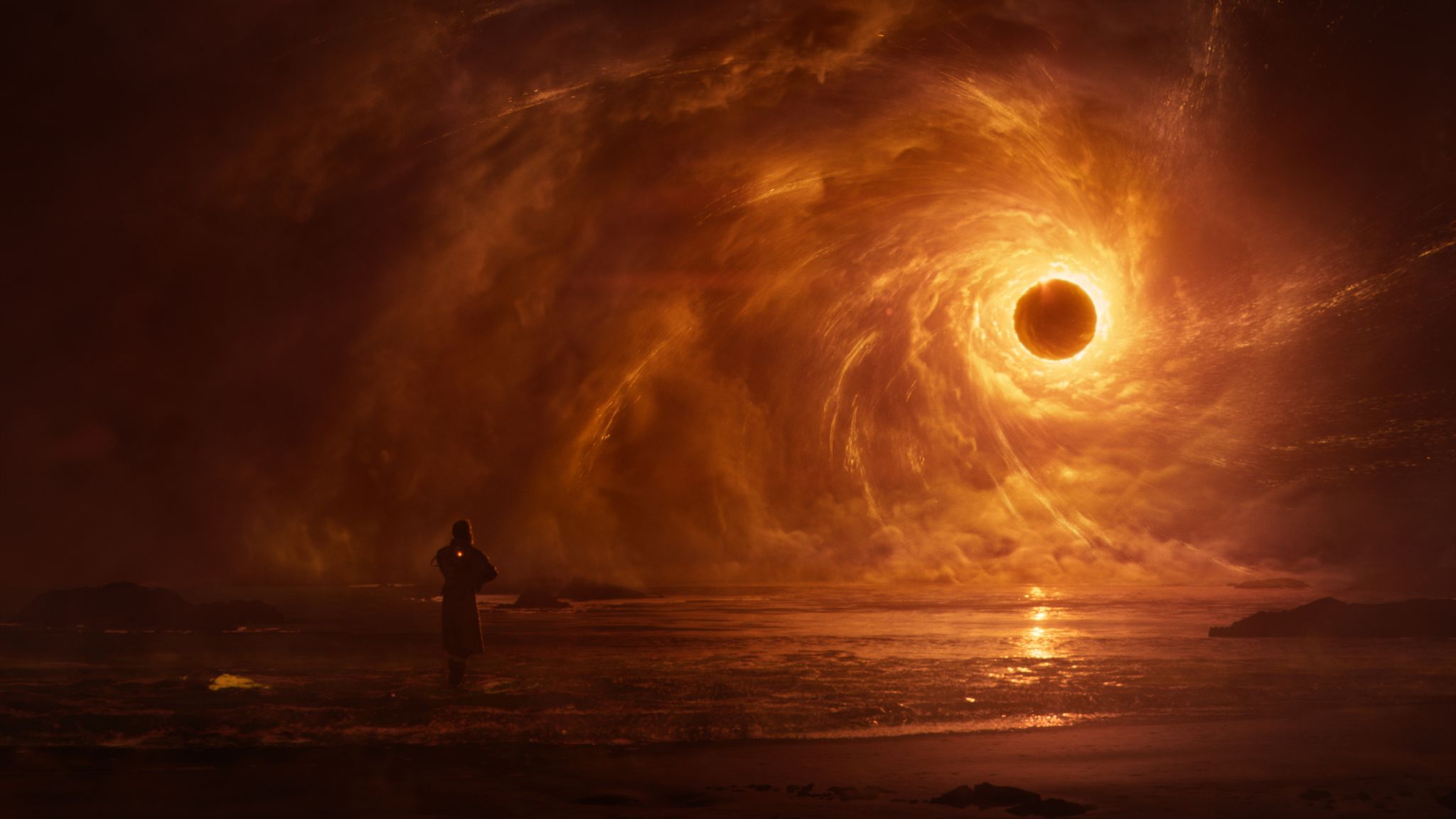
Saros enters this inheritance knowing exactly what it is doing. The studio is aware that its game will be read through both filters. The wisdom of the device lies in not trying to distinguish itself from this double reference, but in assuming it as a foundation. The player is not fooled, he knows he is in Chambers territory. What remains to be seen is what Housemarque adds to that shared grammar: industrial science fiction, the eclipse as active event, Hindu iconography.
Violent Beauty and the inversion of signs
One of the most radical decisions in the art direction of Saros, and one that deserves to be read as a strong plastic gesture, is the semantic inversion of the colour yellow and of gold.
Simone Silvestri formulates the principle in two stages. First: everything gold is corruption. Anything that ought to look attractive, as gold usually does, is made disgusting by adding that texture of corruption to it. Second: bind warm, vivid colours to the idea of greed and corruption, where games usually choose the opposite and make corruption black.
The argument is both plastic and political. Plastic, because it subverts the dominant grammar of video games, where black signifies evil and gold signifies reward. Political, because the corruption that drives the story of Saros is that of the Soltari corporation, which exploits the planet Carcosa to extract Lucenite, an energy resource. Corporate greed is the root of the evil. The golden yellow that glitters on the surface of the bullets during the eclipse is not only the mark of a Chambersian mythology, it is the reflection of precious metal and of the avidity that pushes the Soltari to drive Arjun into a trap.
The game therefore makes three yellows operate simultaneously, and that is where it becomes interesting to analyse. The Chambersian yellow (toxic, fin-de-siècle, plague), the solar yellow (the eclipse, the black sun, the ritual), and the monetary yellow (the gold of corruption, Lucenite, industrial avidity). All three overlay each other in a single palette.
The second pillar Silvestri mentions is called luminous violence. The expression does not translate exactly, but it designates the project of making violence a luminous event, and light a violent event. The bullets have an arcade neon glow that the studio turns into a through line in both the narrative and the world-building.
The kinship with the studio’s arcade DNA is claimed openly. The Japanese shoot’em up of the 1990s, from Batsugun (Toaplan, 1993) to DonPachi (Cave, 1995), had made the cloud of coloured bullets an autonomous visual event, almost a decorative motif. Saros assumes this lineage: bullets are not merely obstacles, they are the game’s plastic signature. Colour makes them legible (blue for what can be absorbed by the shield, yellow for what has to be dodged, red for what can be parried). But it also makes them beautiful.
The phrase Violent Beauty synthesises the two axes. Beauty has to wound, violence has to be luminous. Everything violent must also be beautiful. Everything gold must also be corrupted. This double equation governs every artistic decision in the game, from Arjun’s suit to the engravings of the temples, by way of the interface palette itself.
Silvestri adds a third principle, which above all informs the visual dramaturgy of the biomes: radical escalation. When in doubt, go for maximum impact. The game is conceived as a score that never stops rising in intensity. No plateau, no prolonged breathing space. Each biome has to exceed the previous one, and the eclipse, when it triggers, has to turn the scene over literally. Red invades the palette, the envelopes of the bullets metamorphose, the enemies gain in complexity, the murmurs of the soundtrack turn into screams.
This idea of radical escalation has a very concrete translation in the visual grammar: there are almost no neutral zones in Saros. Spaces of calm are preambles, never endings. The player crosses a work that refuses appeasement as an aesthetic decision.
The hidden layer: Hindu iconography and solar devotion
A quick reading of Saros might stop at the double layer of Italian Futurism plus Chambersian mythology. That would be to miss a third stratum, more discreet but meticulously laid down, that of Hindu iconography.
Arjun, Arjuna and the war of Kurukshetra
The protagonist’s name, Arjun Devraj, is not a generic science fiction soldier’s name. Arjun is the common Hindi form of Arjuna, one of the five Pandava brothers of the Mahabharata epic, the central hero of the Bhagavad Gita. In the epic it is on the battlefield of Kurukshetra that Arjuna, paralysed by doubt, receives the teaching of Krishna, who serves as his charioteer. The Bhagavad Gita is essentially a dialogue: a warrior confronted with the necessity of a violence he refuses, and a god who explains to him the cosmic duty (dharma) that compels him to strike.
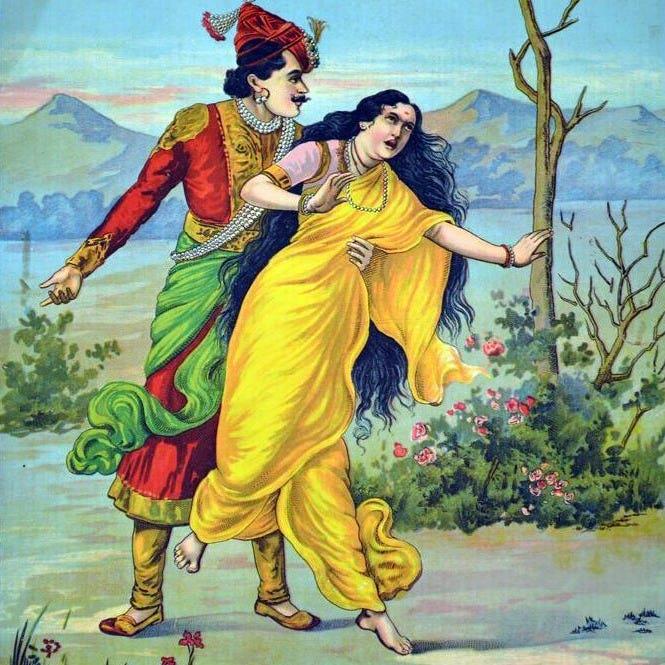
The resonance with the game is dense. Arjun Devraj is likewise on a military mission in a world beyond him, likewise confronted with a violence he ends up perpetrating without fully understanding it, likewise apparently listening to a voice that guides him through corruption. The surname, Devraj, adds a layer: Deva Raja means king of the gods in Sanskrit. The protagonist therefore carries, engraved in his full name, the destiny of a man who might become a divine king. The game, at its end, recounts precisely this corrupted ascension.
The King of the Yellow Shore: chaturbhuja and Senjū Kannon
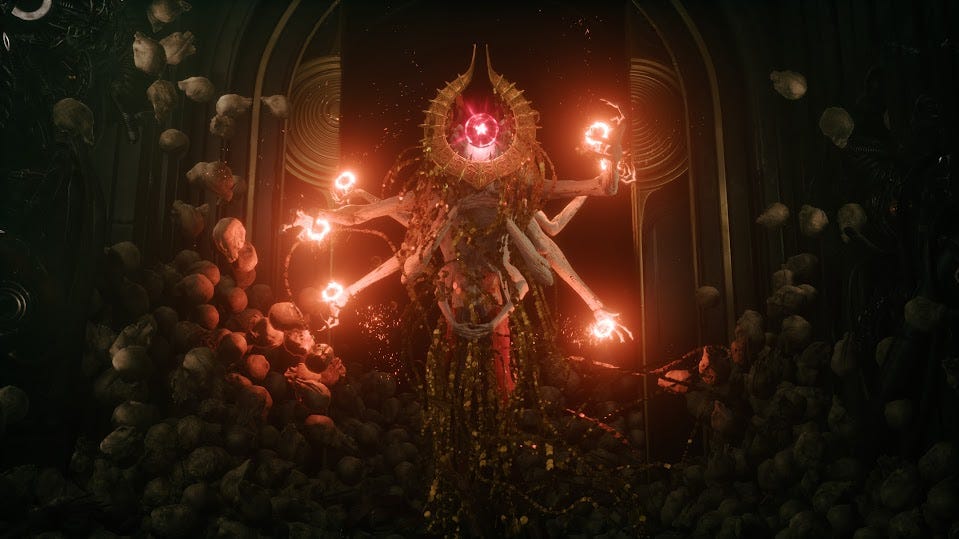
The figure that appears as early as the announcement trailer, the King of the Yellow Shore, is not drawn according to the classical codes of Western cosmic horror. It is drawn according to the codes of the chaturbhuja, the Hindu multi-armed form, which in the iconographic tradition serves to represent the cosmic power of a deity. Vishnu is traditionally represented with four arms, Durga with ten, Shiva often with four, sometimes more. Each arm carries an attribute: conch, discus, mace, lotus for Vishnu, for instance.
The King of the Yellow Shore as the game stages him has six to eight arms depending on the visual iteration, each holding a sphere of fire, and wears a golden helmet that evokes a crown. Two of his arms hide his eyes, a sign that in Hindu grammar can point to a state of higher contemplation or to a protective mudra. The king’s chest contains a swirling galaxy, a motif that recalls the cosmic representation of Vishnu Vishvarupa, in which the god manifests the entire universe within his own body. What is at play here is not decorative borrowing. It is a precise iconographic superimposition: Chambers’s King in Yellow is made visible through the codes of the Hindu pantheon.
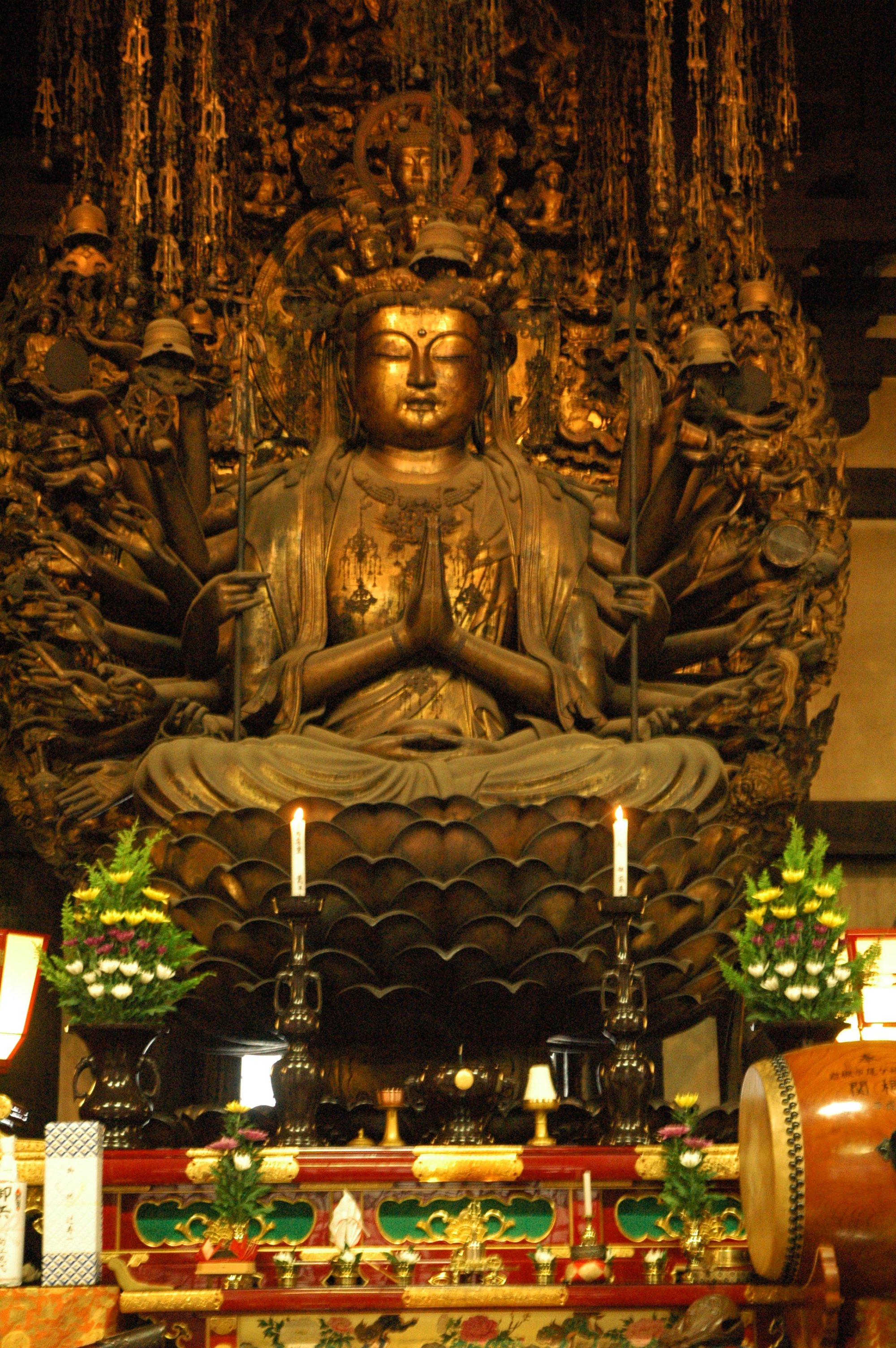
The same logic of syncretism is at work in Buddhism, where one finds the Senjū Kannon, the thousand-armed goddess, the Japanese declension of the bodhisattva Avalokiteśvara, herself inherited from Indian tantric currents. There the multiple arms express a compassion that can address everyone simultaneously. In Saros they become the expression of a power that can strike from everywhere simultaneously. The reversal is exact.
Sol, Soltari, Surya
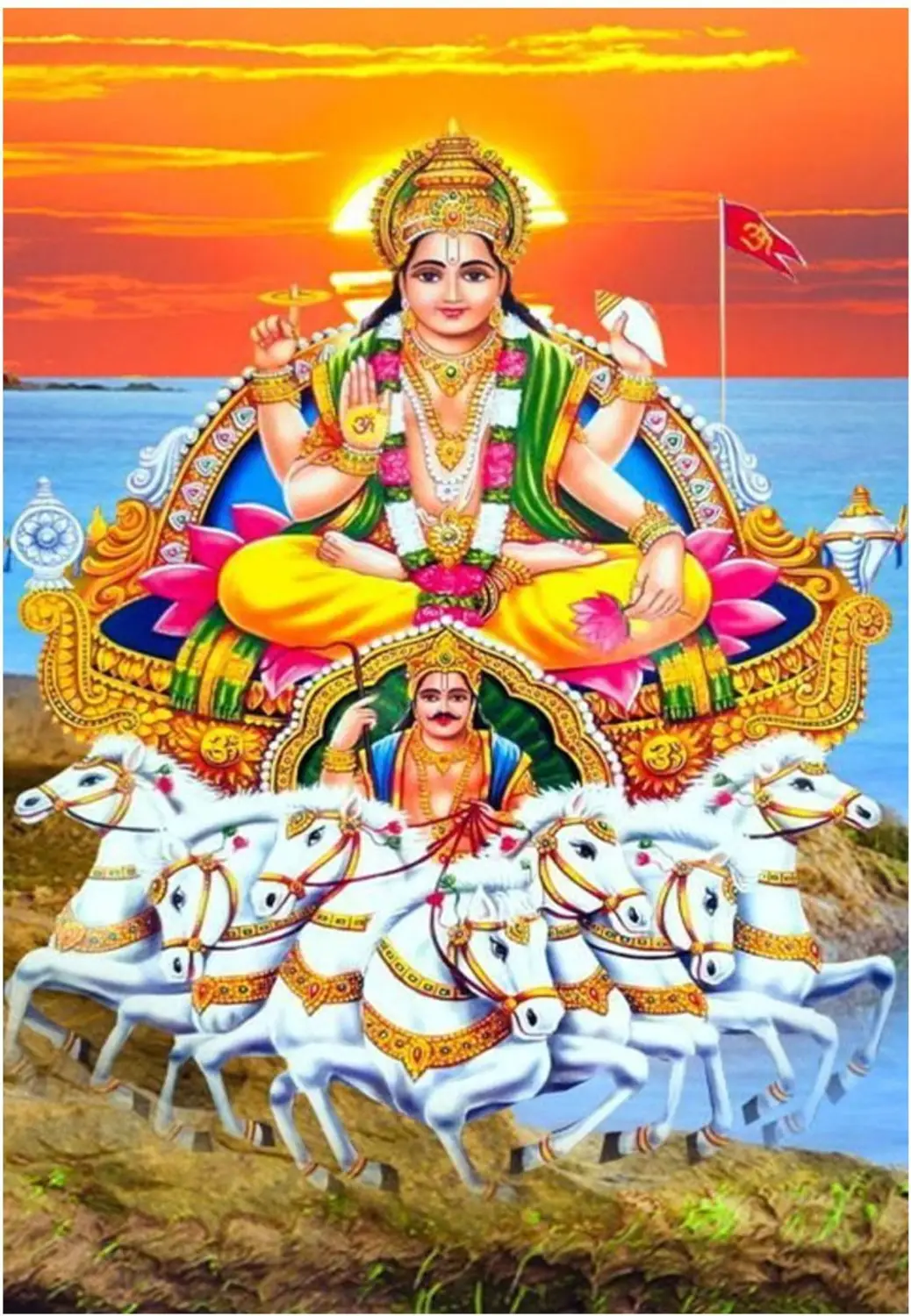
The corporation that employs Arjun is called Soltari. The prefix Sol, Latin for sun, has nothing specific about it in itself. But within the fabric of the game it joins a wider chain: the sun is the central god of Carcosa, the eclipse is an active event, the Yellow Shore refers to altered solar light. Soltari can be read as a declension of Surya, the Hindu sun god who crosses the sky on a chariot drawn by seven horses. This god plays a particular role in the Mahabharata: he is the biological father of Karna, the secret half-brother of the Pandavas, Arjuna’s adversary on the battlefield. If we take this lead seriously, Soltari, the company that sends Arjun to Carcosa, is the solar paternal figure who pushes him toward a fratricidal war. The tragedy is inscribed in the corporation’s very name.
The banyan tree in the laboratory
More discreet still, but noted by the game’s exegetes, is a detail in the laboratory of the character Sebastian: a banyan tree (Ficus benghalensis) grows among the botanical cultures. It is a detail that should not be there. The banyan is the national tree of India, sacred in Hindu cosmology, associated with Vishnu and with longevity (a banyan can live several centuries and extend its aerial roots across hectares). No economic logic justifies an industrial corporation uprooting a century-old banyan to transplant it onto an extraterrestrial planet. Its presence is a sign. Sebastian, whose name evokes the martyr pierced by arrows, keeps in his garden the tree that, in Hindu tradition, shelters the spirits of the dead.
Saros, a cycle of eclipses
The title itself is a key. Saros is a technical term from astronomy: it designates a period of 18 years, 11 days and 8 hours at the end of which solar and lunar eclipses repeat in an identical geometric configuration. The concept has been known since the Chaldeans. The Greek word saros means sweep or repetition. To choose this title is to name the game by its fundamental mechanism: the loop. Arjun dies, begins again, dies, begins again, and each cycle is a variation on the same cosmic event. The saros, in astronomy, guarantees almost exact repetition. In the game it guarantees infinite variation. But the word also echoes, by homophony, the Sanskrit śara (arrow), Arjuna’s weapon in the Mahabharata. The title therefore states both the astronomical loop and the arrow of the Indian hero.
Whether this superimposition is deliberate or fortunate matters little. What counts is that the ga

A geographical promise: Iceland as bedrock
Among the visual sources cited by the Housemarque team, one of the most unexpected is Icelandic landscape photography. The Helsinki-based studio did not have to go far for this reference: Iceland is a few hours away by plane, belongs to the same North Atlantic geological zone, and has for twenty years offered one of the most heavily worked photographic terrains in the world for landscape photographers.
Iceland is young in geological terms. Sitting on the Mid-Atlantic Ridge, at the border between the North American and Eurasian tectonic plates, it is in active formation. Volcanoes, lava fields, continental glaciers, black sand beaches, columnar basalt formations, glacial lagoons, geysers, hot springs: everything in the Icelandic landscape evokes a world prior or posterior to the one we know. Hollywood has made this peculiarity its terrain for alien planets for twenty years, from Prometheus to Interstellar.
The skill of Silvestri and his team lies in having blended this terrestrial landscape signature, perfectly identifiable and heavily charged for the contemporary viewer, with an architecture that is terrestrial nowhere. The result is an inverted strangeness: you recognise the ground, you do not recognise what grows on it. The feeling of alienation that permeates the game arises in part from this dislocation. The player has already seen these plains, these sands, these glaciers, in travel images, in films. He does not recognise the temples.
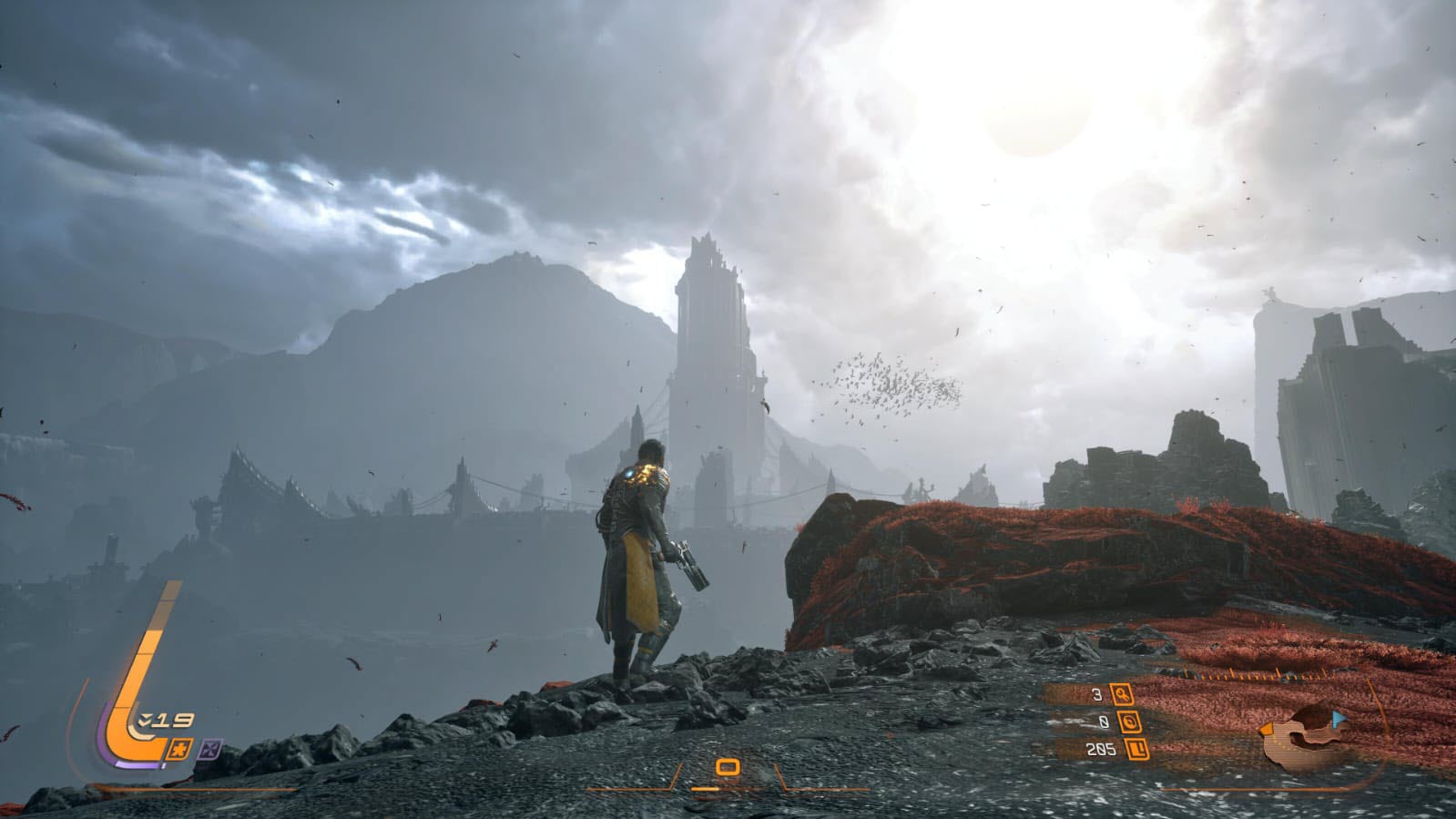
But this Icelandic grammar is not uniformly distributed. It culminates in certain biomes, absents itself from others, converses with other families of landscape. The precise cartography of the geographical borrowings of Saros, biome by biome, is the subject of the second part of this dossier. Let us say for now that Iceland serves as the primary visual bedrock, and that the traversal of the game gradually works its way up through the strata.
Biomechanics in the background: Giger, Beksiński and the flesh of cathedrals
If Returnal wore its Giger inheritance in plain view, to the point of provoking direct comparison with Scorn or with Alien, Saros performs a subtler displacement. The biomechanical is still there, but pushed beneath the skin of the architecture. The studio keeps its technological signature (the tentacle technology that animates cables, limbs and organs according to procedural rules) but now embeds it in an architectural grammar that is no longer directly Gigerian.
Hans Ruedi Giger (1940-2014), a Swiss painter, founded a singular imaginary on the fusion of the metallic and the organic. His paintings depict landscapes where humanoid skeletons, ducts and viscera extend into impossible machines. His Necronom IV (1976) would become, through Dan O’Bannon, the model for the xenomorph of Alien. Zdzisław Beksiński (1929-2005), a Polish painter, works in a neighbouring but distinct register: his landscapes of bone, his flayed cathedrals, his figures suspended in orange or ochre skies have nothing mechanical about them. They are organic to the point of nausea. The stone there seems to palpitate. Both painters have become the obligatory markers of any post-1980 horror aesthetic, from Scorn (Ebb Software, 2022) to Bloodborne (FromSoftware, 2015) by way of Alex Kozhanov’s illustrations for Prometheus.
Returnal mobilised these two artists directly, leaning on Lovecraft’s mythology to justify the crossbreeding. Saros takes another path. The biomes of Carcosa do not look like a Giger. They look like a neoclassical basilica that has been contaminated by something. The walls are veined marble. The columns are sculpted. But something pulses beneath the stone. Cables snake through the fissures like tendons. The monumental statues represent tortured humanoid figures whose missing limbs and torn muscles recall less Giger than certain bas-reliefs by Beksiński, or further still the baroque ex-votos of Andrea Pozzo and Sanmartino’s Cristo Velato. The biomechanical is integrated into a heritage of classical European sculpture.
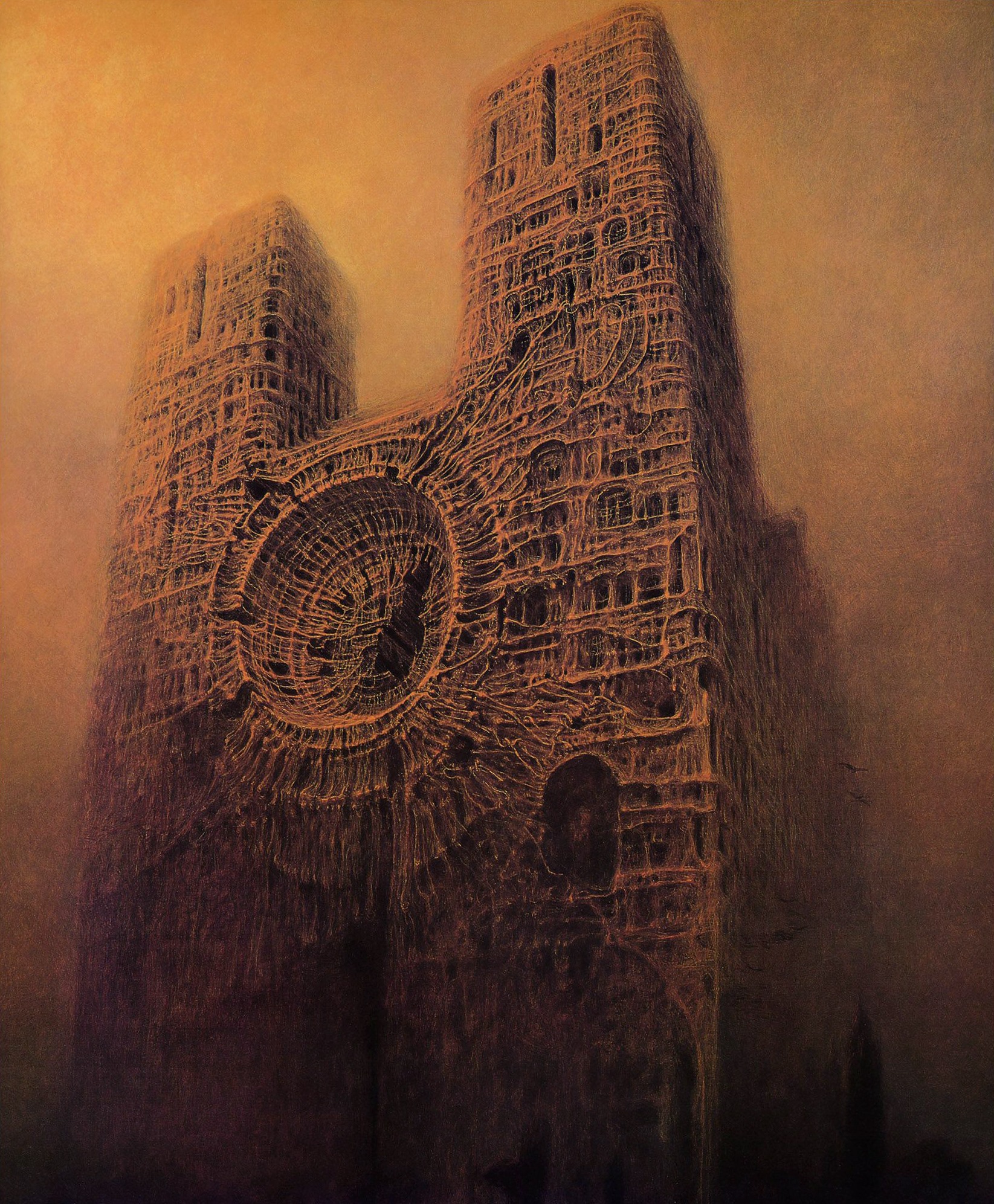
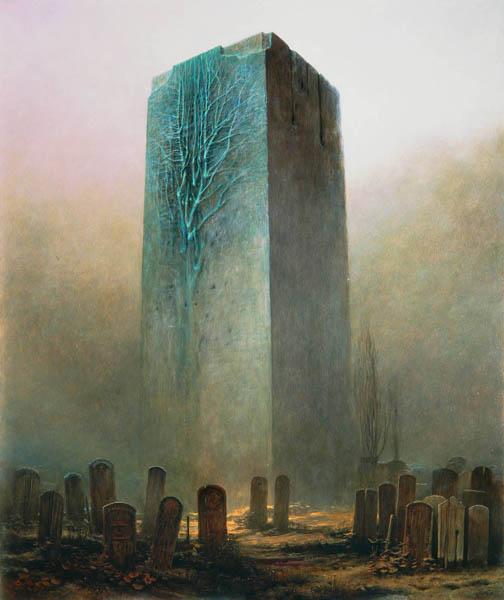
Anglophone critics have described marble reliefs of anguished humanoids with mutilated limbs and tendons. The implicit reference is clear: we are in the register of the baroque martyr, of Bernini, of the late Caravaggio, of the statues of the Counter-Reformation church that stage the ecstasy and the suffering of bodies. The Italian tradition of the seventeenth century sculpted pierced Saint Sebastians, Saint Teresas in trance, veined dead Christs. Saros borrows from this grammar to signify that on Carcosa divinity was practised in the mode of ecstatic sacrifice. The colonists, having become fanatics of the King in Yellow, sculpted their own figures in the flesh of the planet.
This baroque transposition allows a play on scales. Where Giger practises architectures that are bodies, Saros practises bodies inserted into architectures. The distinction matters: the player does not walk inside an organism, he walks inside a temple peopled with petrified organs. The sensation produced is less that of digestion (characteristic of Giger) than that of desecration (characteristic of the late baroque).
The bullet ballet as a plastic proposition
No artistic analysis of Saros can dispense with what has constituted, since Housemarque’s origins, its proper object: the composition of firing patterns. The studio speaks of bullet ballet, an expression that reformulates both bullet hell (the Japanese term of the 1990s, danmaku) and ballet (a reference to classical choreography). The phrase synthesises two inheritances.
The pattern-based shoot’em up was born in Japan at the end of the 1980s. Toaplan published Batsugun in 1993, a game that pushed the density of fire to an unprecedented level. Cave, founded by Toaplan alumni, perfected the genre with DonPachi (1995), DoDonPachi (1997), Esp.Ra.De. (1998), Mushihimesama (2004). Each game offers clouds of coloured bullets that draw ephemeral geometries on screen: spirals, rosettes, waves, meshes. The player has to identify minuscule corridors between the projectiles. This visual grammar, which the Japanese critic Akira Yamaguchi once described as kinetic ikebana, has since irrigated visual composers coming from other genres: Geometry Wars, Resogun itself, and more recently Returnal.
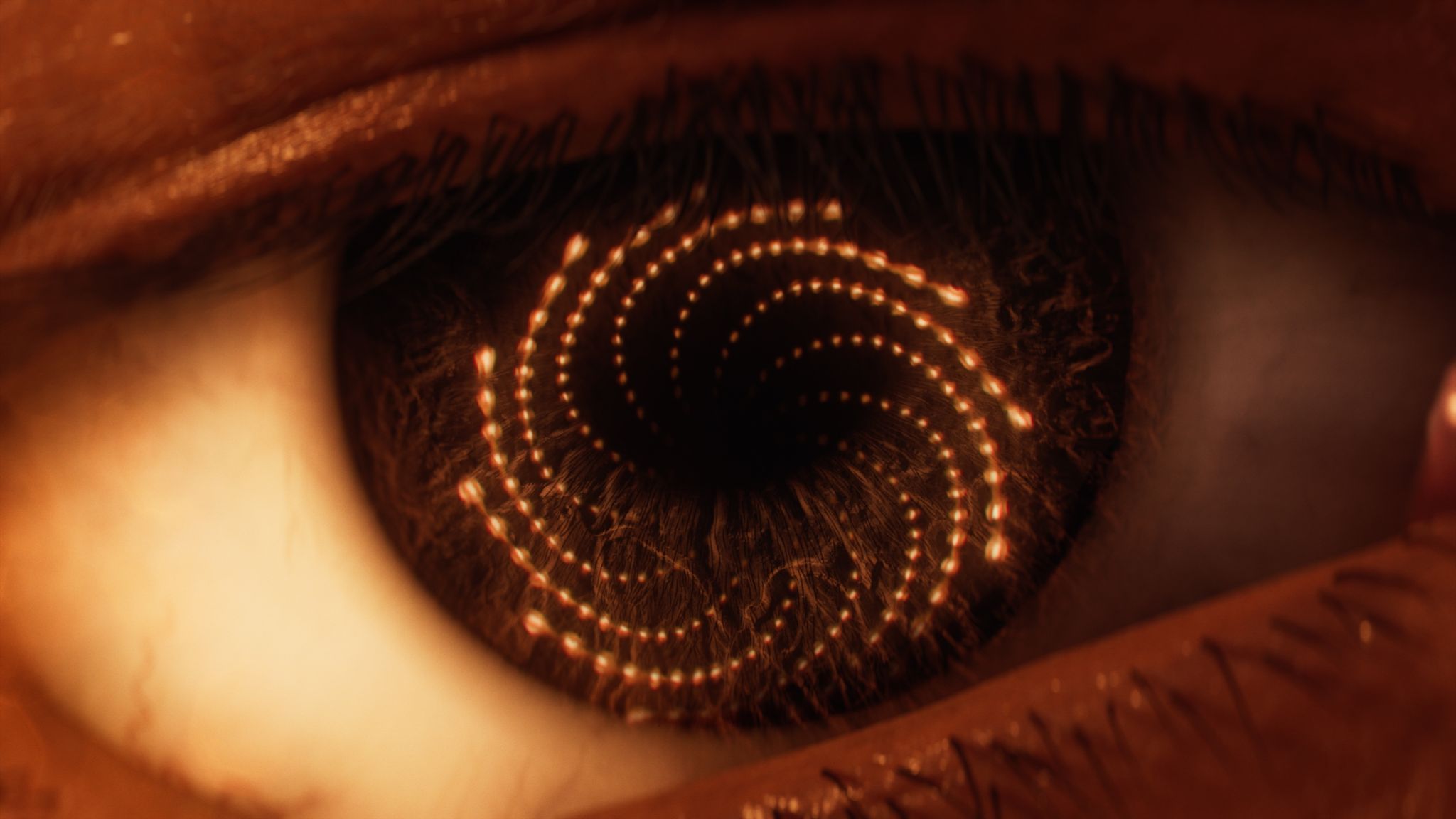
Saros mobilises this entire memory. The patterns follow precise mathematical rules (rotation, spiral, wave, radial expansion) and the studio’s designers rely on legibility constants inherited from danmaku. Colour marks the nature of the projectile (blue absorbable, yellow dodgeable, red parryable). Screen density rises with difficulty.
What Housemarque brings to this grammar, and what the phrase bullet ballet sums up, belongs to the order of bodily metaphor. The player no longer seeks to avoid the bullets, he dances with them. The Soltari shield, which absorbs blue bullets and then allows an energy projectile to be sent back at the enemy, turns the adversary’s bullet into a resource. The gesture of the parry turns the red projection into reusable energy. The bullet is no longer the obstacle you avoid, it is the dance partner. Silvestri sums it up: “We wanted to make projectiles into opportunities. Returnal was an obstacle course. Saros is more of a playground.”
On the plastic level, this displacement entails a subtle visual decision: the bullets are designed to become more active, more detailed, as they approach the player. At a distance they are simple points, instantly legible. Up close they gain a texture, a rotation, almost a face. This gradation turns the screen into a score with several depths.
Silvestri says he built his internal presentation on the bullets around hypnotic patterns. The word matters. Hypnosis presupposes a regularity that disarms vigilance. The rosettes of Japanese danmaku were already hypnotic. Saros, by playing on the regularity of the spirals and on the depth of the bullets, accentuates this dimension. The player is not only tested on his reflexes, he is held in a state of controlled trance. The pattern fascinates at the same time as it threatens. It is, once again, the formula of Violent Beauty: the beautiful object that wounds.

The sound of Carcosa: Sam Slater and the Jóhannsson school
The soundtrack of Saros is entrusted to Sam Slater, a British composer based between Berlin and New York, whose trajectory deserves unfolding if we are to understand what he brings to the game.
Sam Slater began his career as principal musical sound designer and creative engineer alongside Jóhann Jóhannsson, the Icelandic composer who died in 2018, to whom we owe the scores of Sicario, Arrival, Prisoners, The Theory of Everything, and, more discreetly, a great many experimental sound installations. Jóhannsson invented a language mixing traditional orchestra, deep electronic drones, manipulated voices, invented instruments. That language produced an entire school: Hildur Guðnadóttir (Joker, Chernobyl, Battlefield 2042), with whom Slater regularly collaborates as producer, is its most visible heir. The scores of Chernobyl (HBO, 2019) and Joker (Todd Phillips, 2019), both awarded Grammys, Emmys and BAFTAs, owe an essential part of their sonic fabric to Slater.
This filiation places Slater in a lineage recognisable by several markers: very low bass drones, infrasonic frequencies that act less on the ear than on the body, industrial sampling (Slater recorded power stations, trains, metal structures for Chernobyl), immersive spatialisation, and a mistrust of overly assertive melodic themes.
For Saros, Slater applies these principles to a universe of cosmic science fiction. The soundtrack works less through themes than through textures. Synthetic layers accumulate and crumble, whispered voices emerge from the low frequencies without their meaning ever becoming graspable, metallic percussion marks thresholds rather than beating a tempo. The result is a soundtrack that does not accompany the action but precedes it: you hear that something is going to happen before it happens.
What strikes you on listening is the coherence between the visual grammar (neoclassical and futurist, monumental and torn) and the sonic grammar (cathedral-like and dissonant, ample and anxious). Both registers seem to issue from the same method: take an ancient form (the temple, the orchestra) and run an aggressive electricity through it (futurism, the industrial drone).
The soundtrack also includes an exclusive track by Daniel Avery, the British electronic producer known for his albums Drone Logic (2013), Song for Alpha (2018) and Ultra Truth (2022). Avery practises a hypnotic techno, slow and dense, which shares with Slater’s work a taste for the drone and for long deployment. His presence on the soundtrack signals that Housemarque accepts a club dimension, almost a rave dimension, in certain combat sequences. The bullet ballet is also a bullet rave, in the lineage of the great sonic sequences of Returnal that borrowed from synthwave.
The house of Housemarque as an auteur studio
At the end of this traversal of sources, what appears is less a game than a stance. Housemarque has achieved something rare: holding together a 1990s arcade heritage (which could look like commercial nostalgia) and an auteur ambition (which exposes itself to every awkward comparison with the great works of literary and cinematic science fiction).
The studio is conscious of this double inheritance. Gregory Louden explains that the internal rule is “play, don’t show”: let the narrative pass through gesture rather than through cutscene. Characters have to be discovered rather than presented. This doctrine, in a studio that now belongs to PlayStation and could have slid toward the dominant grammar of Sony’s first parties (Naughty Dog, Santa Monica, Insomniac), is an act of fidelity to the arcade DNA. Saros is not a playable film. It is a game that contains narrative the way the sea contains salt.
Simone Silvestri, answering a question about the use of artificial intelligence tools, made a statement that sums up the studio’s position well: “I am not comfortable with AI. I am also a teacher and I hate shortcuts. Letting AI work in your place robs you of your visual library, which is an artist’s main tool for self-expression. You are supposed to look at things without shortcuts. Without fundamental colour theory, without composition theory, without studying and reading, without understanding tragedy, poetry and drama, I do not see how you could express your feelings. The main tool you should be using is your inner domain of art, feeling and understanding of the world.”
This defence of slow culture, at a moment in the industry when the pressure toward automation is massive, is not a detail. It states what Saros claims for itself: a game that has read its sources. Bierce and Chambers, Marinetti and Sant’Elia, the Mahabharata and the Bhagavad Gita, Beksiński and Giger, Jóhannsson and Guðnadóttir. The violent beauty that Carcosa produces is the result of an openly assumed work of erudition, and that, ultimately, is what distinguishes it from the dozens of cosmic roguelites that have multiplied since Returnal.
The geography of Carcosa
Saros is a geographically short game. Eight named biomes and a hub, the Passage, which serves as a fixed point between runs. The list gives, in order of traversal: Shattered Rise, Ancient Depths, Shattered Descent, Blighted Marsh, Desecrated Fortress, Acolyte’s Haven, Cathedral, Yellow Shore. None of these names is neutral. None of them simply describes an environment. All of them carry a judgement, a qualification, a moral state of the place. Shattered, ancient, blighted, desecrated, haven, cathedral, yellow shore: the toponymy of Carcosa is already an exegesis.
The artistic charter set out in the first part declines itself biome by biome. The neoclassical and Italian Futurist crossing supplies the overall architectural grammar. Iceland supplies the primary landscape bedrock. The semantic inversions of yellow and gold are activated everywhere. But each biome inflects the formula. The traversal is organised as an ascent into strangeness: from the still recognisable rock of the first biome to the spectral shore of the last, the player passes imperceptibly from a mineral world to a mental one.
These nine spaces can be read as an atlas. Each carries a dominant iconographic influence, which does not exhaust it but gives its key. Each attaches to a precise zone of the history of art, of cinema, of literature and of the videoludic medium. And each, without underlining it, marks a station on the path Arjun believes he is following to find his wife again, and which in fact leads him to the throne.
The Passage
Central hub / The intermediate sanctuary
The Passage is the only space in Saros where Arjun is never attacked. Hostile forces do not cross into it. It is a suspended structure of indeterminate morphology, floating above the void. The player returns there between attempts to speak with the three surviving members of Echelon IV, to access the Primary console that manages upgrades and the World Dial, and later to observe the banyan tree growing above the structure, which conditions the true ending of the game.
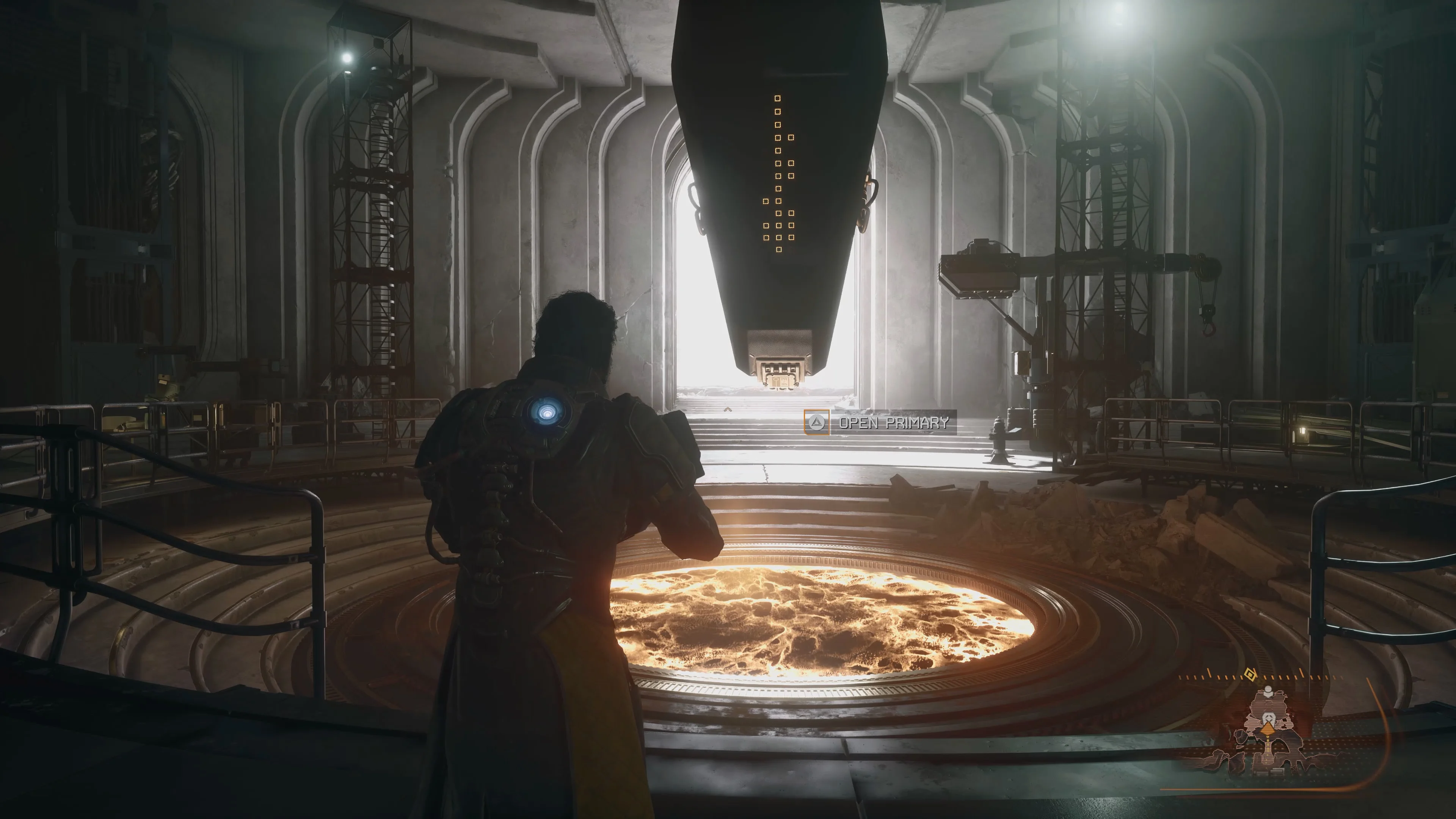
The Passage belongs to a precise spatial category, that of the threshold. Neither Carcosa nor outside Carcosa. Neither hostile nor domestic. This in-between has a long tradition. In Tibetan Buddhism, the Bardo Thödol (the Tibetan Book of the Dead, compiled in the eighth century, rediscovered in the West by Walter Evans-Wentz in 1927) describes the bardo as the intermediate space between death and rebirth: a place of visions and of encounters with wrathful deities, where consciousness has to recognise the apparitions in order to free itself. The Passage of Saros functions mechanically as a videoludic bardo: Arjun returns there after each death, encounters spectral figures there (the teammates of Echelon IV, of whom one never knows whether they are truly alive), and can only leave the cycle by making a gesture of recognition.
The banyan tree growing above the sanctuary extends the Indian grammar already identified in Sebastian’s laboratory. Ficus benghalensis is the national tree of India, sacred in Hinduism and in Buddhism. It is beneath a banyan that Krishna, in the Bhagavad Gita, instructs Arjuna. Through its aerial roots that descend and take root again, through its capacity to form a forest by itself, the banyan is a traditional figure of eternity and of the many-in-one. Placing it above the Passage therefore completes the Indian grammar underlying Arjun’s first name: the true ending of the game plays out beneath the same tree that shades Arjuna before Krishna.
The Passage is also an internal response to Housemarque’s own history. In Returnal, Selene returned to the site of her crash, a solitary and mute space where the only company was audio recordings of herself. Saros changes this solitude. The hub is now peopled with interlocutors, recurring dialogues, scenes that fill out. The model is openly that of Hades, where Zagreus returned after each failure to his father’s palace to speak with Achilles, Nyx, Hypnos. But where Hades is a court, the Passage is a sanctuary. Conversation there has the colour of liturgies held beneath the vault of a temple.
Biome I: Shattered Rise
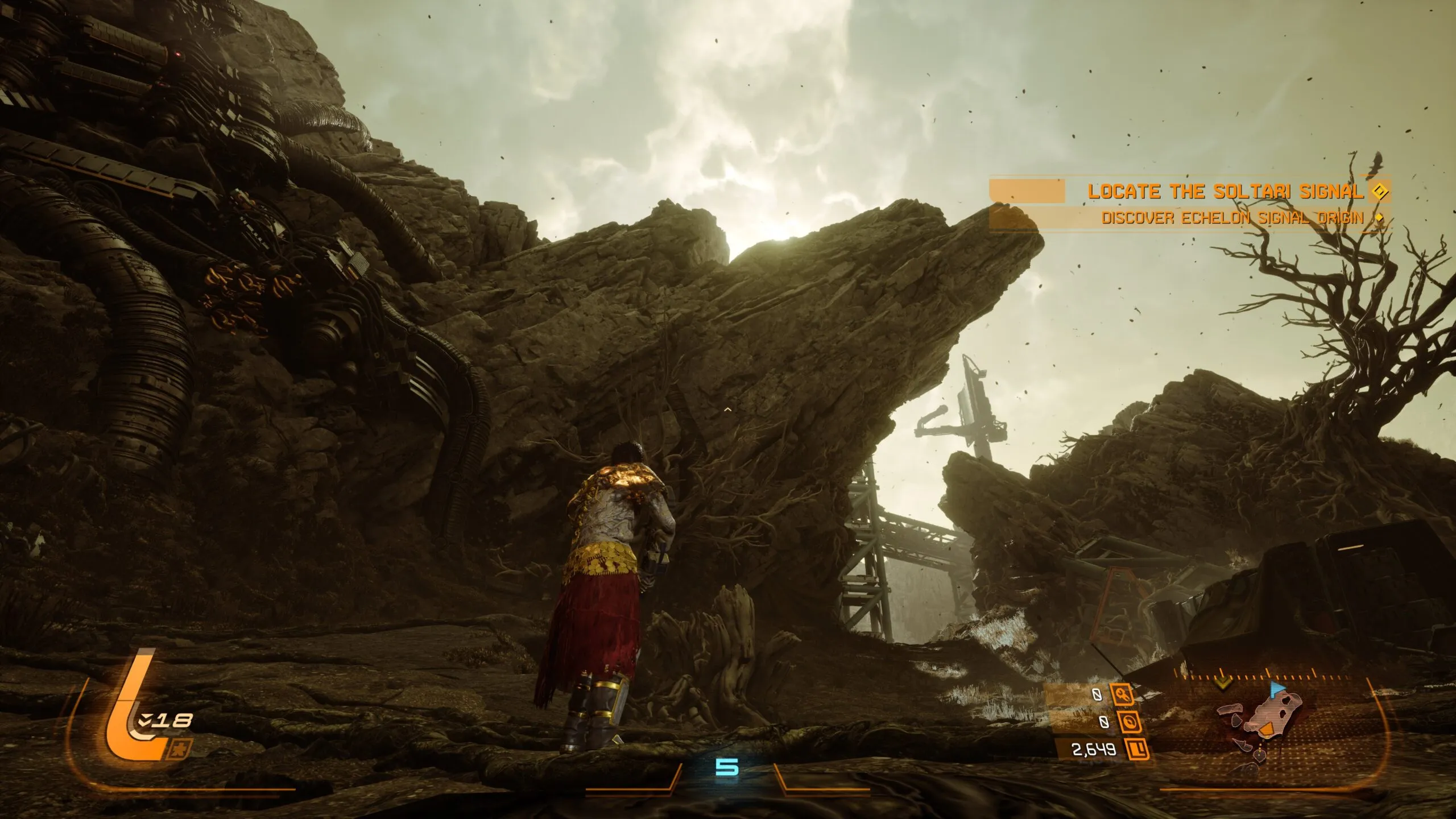
The first biome is a mountainous, rocky landscape, crossed by interconnected valleys and marked by shattered ridges. It is here that the player discovers the Eclipse, the switching mechanic that makes enemies more aggressive and changes the colour palette. A mural room, a chamber of parietal frescoes, shows ancient rituals whose meaning remains opaque.
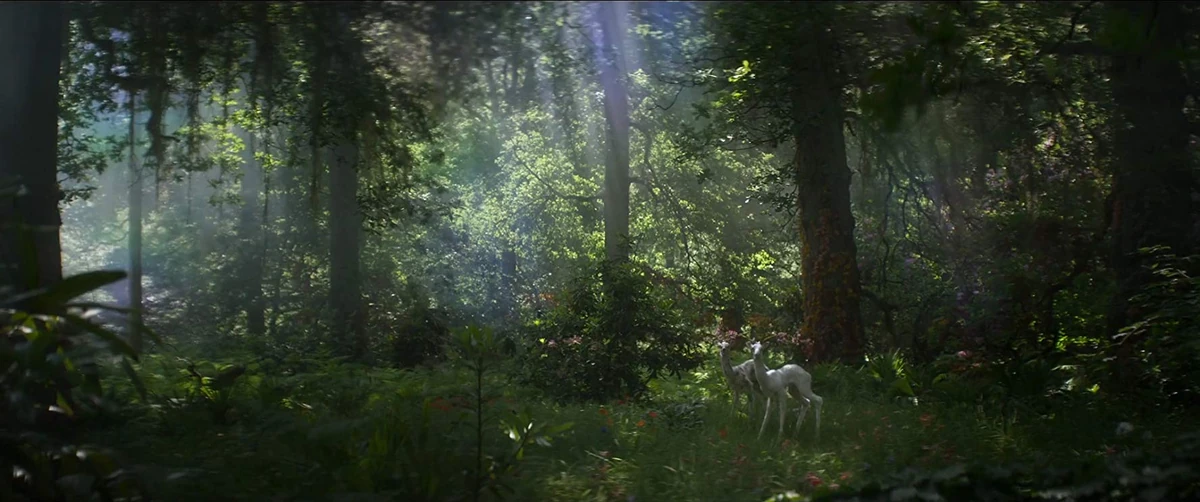
The dominant reference is Icelandic, and it is in this first biome that the landscape signature is most directly identifiable. The setting cites, without literally reproducing them, the volcanic landscapes of Vatnajökull (the largest glacier in Europe), the basalt columns of Reynisfjara, the regular pyramids of Maelifell, the dark promontories of Vestrahorn. The choice is not picturesque, it is ethical. Iceland is, in the contemporary visual imaginary, the geographical equivalent of another planet: a territory whose photography thwarts expectation.
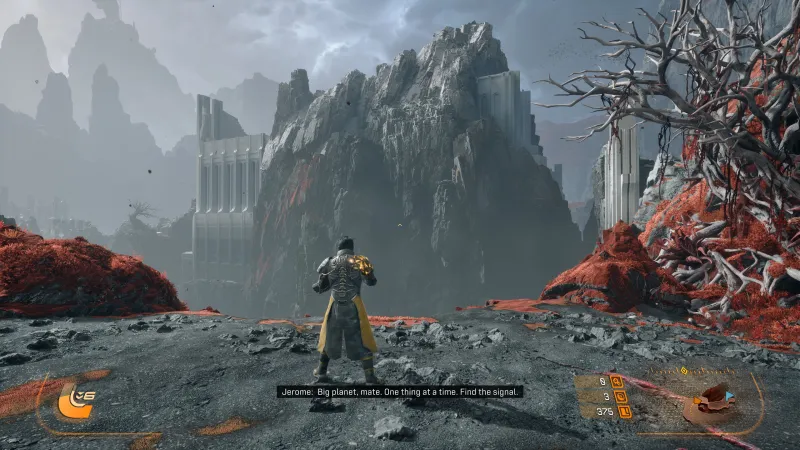
For twenty years Hollywood has made Iceland its terrain for alien planets. Ridley Scott’s Prometheus (2012) shot at Dettifoss. Christopher Nolan’s Interstellar (2014) turned the Svínafellsjökull glacier into Mann’s frozen planet. Star Wars: Rogue One (2016) placed Scarif at Maelifell. Game of Thrones shot beyond the Wall on the slopes of Þórsmörk. The grammar is now codified: black sand, conical mountain, cold light, glacial waters, drifting ice formations. Saros enters this lineage not by mimicry but by filiation: the planet Carcosa belongs to the same family of imaginary as the terrains of Scott and Nolan, those places where science fiction cinema goes to find its elsewhere without recourse to computer graphics.
The finest borrowing is that of light. The permanent eclipse that visually characterises Carcosa authorises a chromatic approach that resembles neither ordinary dusk nor night. It resembles the polar winter light of Iceland, where the grazing sun never lifts off the landscape and everything is lit by a golden band at the horizon. This quality of light exists in Iceland, in northern Norway, in Patagonia. It now exists on Carcosa.
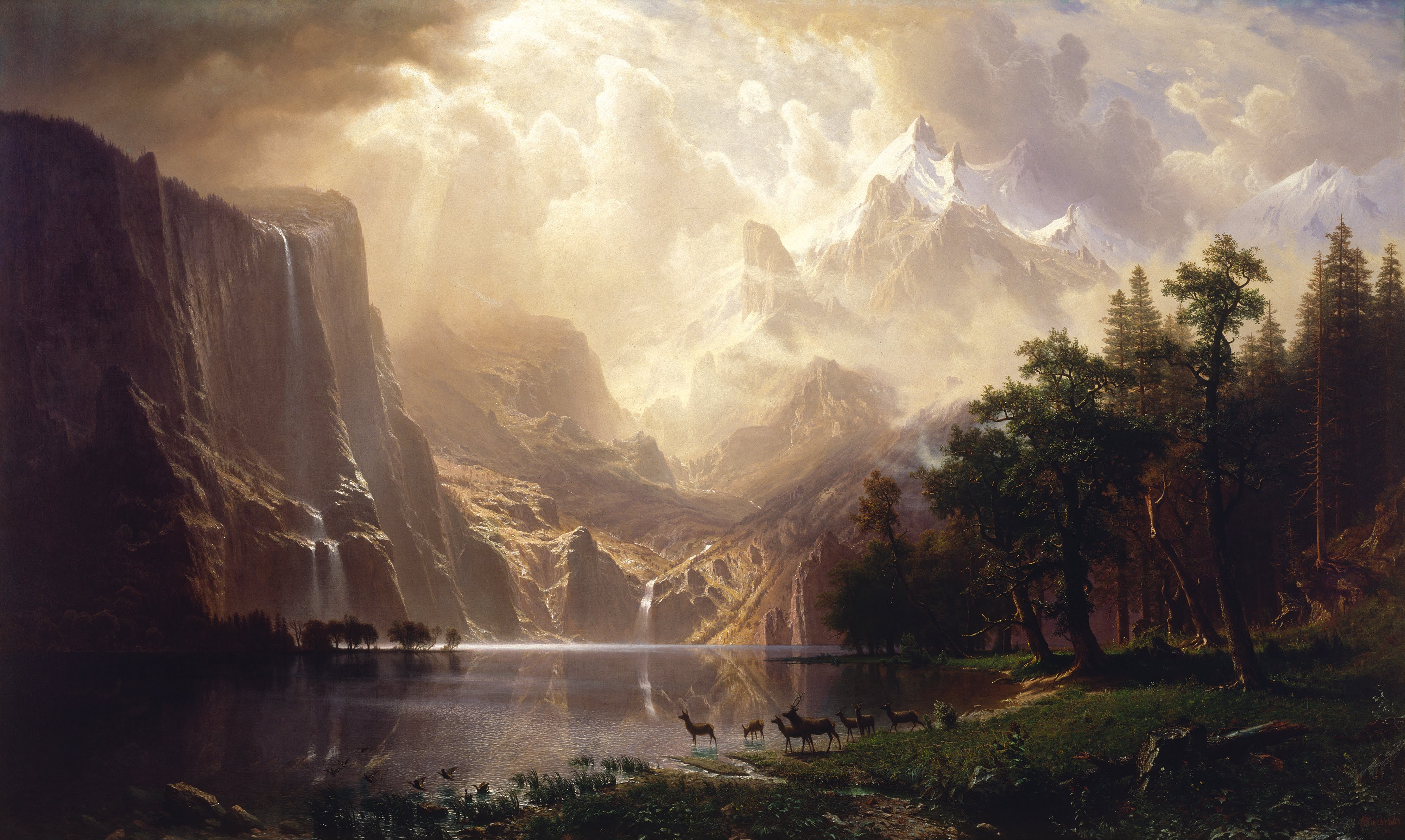
On the pictorial level, Shattered Rise summons the tradition of the Sublime as Edmund Burke formulated it in 1757. The Sublime, in Burke, is the terror born of grandeur, the crushing of scale, the impossibility of taking everything in at a single glance. Caspar David Friedrich (Wanderer above the Sea of Fog, 1818) gave it its painted icon, Albert Bierstadt (Among the Sierra Nevada, 1868) transposed it to the Rockies, Thomas Cole (The Course of Empire, 1833-1836) drew a cosmogony from it. Saros, in its first biome, invents nothing: it replays this grammar while adding the futurist tendrils of the alien structures protruding from the rock.
The parietal fresco is the element that seals the reading: Carcosa has already been painted, by faithful of whom we know nothing, and the player enters a sanctuary he believes he is crossing as a landscape.
Biome II: Ancient Depths
The second biome plunges underground. Luminous caverns, tunnels that stretch out, galleries of Lucenite mines that predate Arjun’s arrival, evidence of an earlier civilisation that had already exploited the resource. It is here that the Jump Network Pads unlock, propulsive platforms that will extend through the rest of the game. The atmosphere is more enclosed, the palette more mineral. The underground of Saros is distinguished by its paradoxical luminosity: you expected black, you find gold, and here gold is not wealth but an alarm signal.
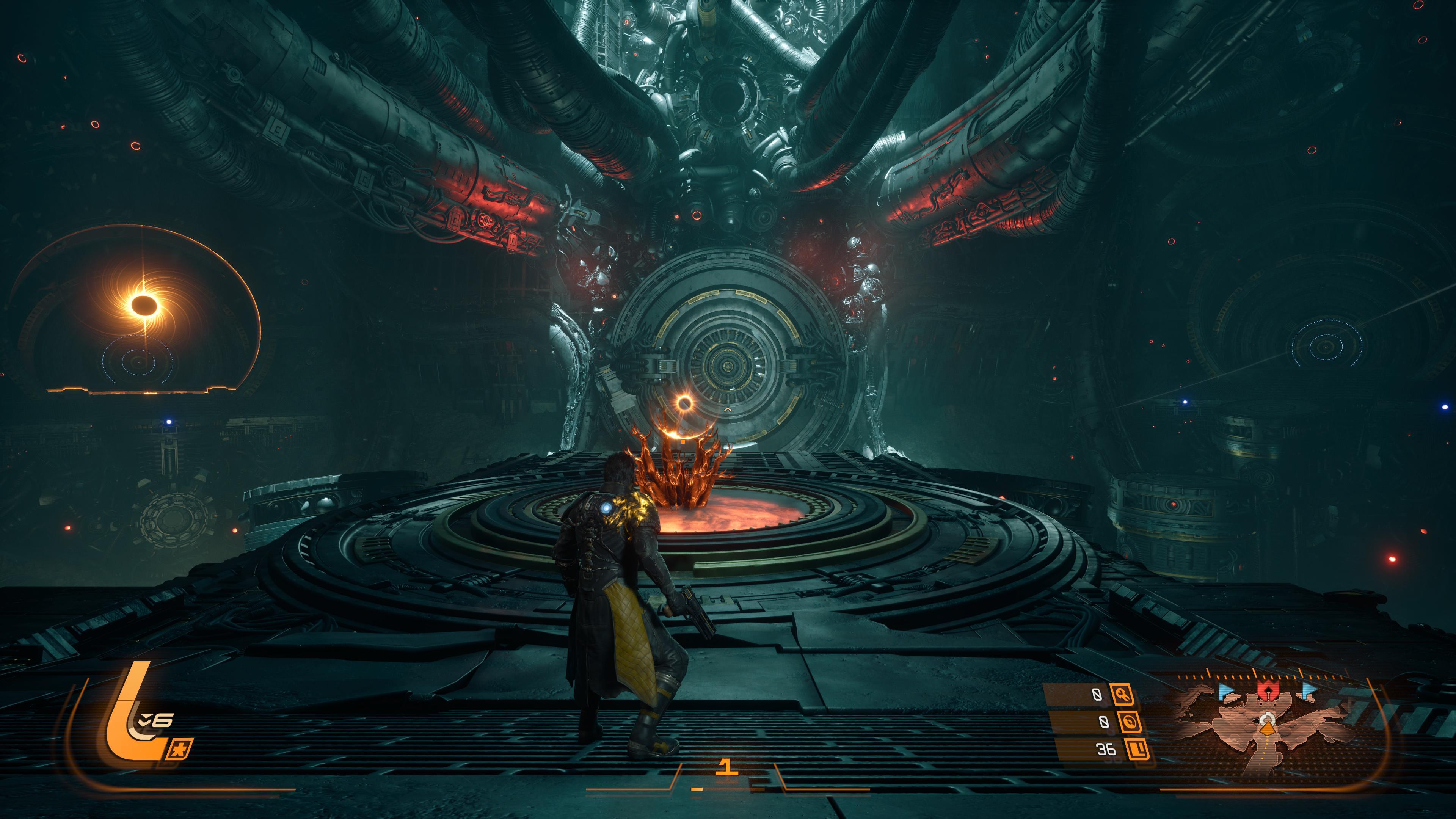
If we talk about any monumental Western underground, Giovanni Battista Piranesi and his Carceri d’invenzione (Imaginary Prisons, first edition 1745, second reworked edition 1761) is the first one to come to mind. Piranesi invented the imagery of the infinite underground, staircases leading nowhere, bridges interrupted in the void, vaults folding back on themselves. Ancient Depths does not imitate Piranesi but inherits his syntax: the perspective without an exit, the depth that reveals itself to be greater the further you enter, the detail rendered supernumerary by gloom.
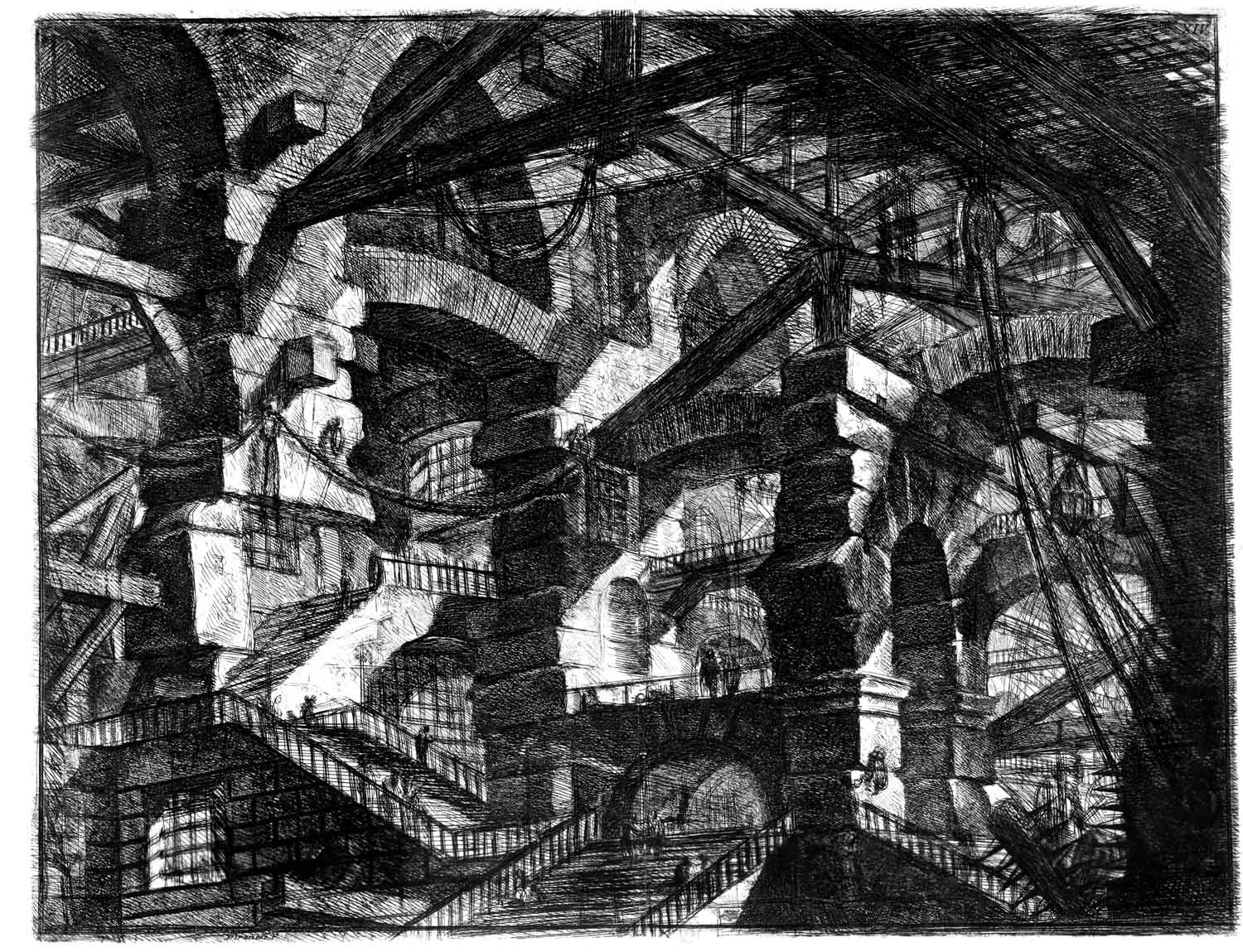
The filiation runs through the whole of modernity. Victor Hugo pursued it in Toilers of the Sea, Jorge Luis Borges turned it into an ontological figure (The Library of Babel, 1941), M. C. Escher drew from it his lithographs of impossible staircases (House of Stairs, 1951), and the videoludic medium canonised it in the catacombs of Dark Souls, the basements of Bloodborne, the undergrounds of Elden Ring. Saros attaches itself to this lineage without commenting on it, because the underground has become, for the roguelite player, an almost domestic space.
The specific find of the biome is the revelation of an earlier mining operation. Before Echelon I, unknown faithful had already dug for Lucenite. This anteriority is a recurring topos of science fiction and of weird fiction: Lovecraft’s Elder Things (At the Mountains of Madness, 1936) had built cities before humanity, Halo’s Forerunners precede the Covenant, the Precursors of Mass Effect precede the Reapers. Saros activates the motif at the precise moment when Arjun, collecting his first large quantities of Lucenite, begins to dig in his turn. The earlier civilisation is not merely a setting: it is a mirror. Arjun is doing, without knowing it, what it did before him.
Biome III: Shattered Descent
Shattered Descent is the shortest biome in the game and the most vertical. Chasms, sheer drops, suspended platforms. It is the space where the grapple unlocks, the mechanic that defines it. The Echelon III camp, old and abandoned, occupies one of the ledges. Narratively the biome works as an airlock between the organic paving of the first biome and the industrial universe of the fourth. It is the place where the player descends, literally, toward the more contaminated zones of the game.
The reference to invoke here is John Martin (1789-1854), the British painter of late Romanticism, whose apocalyptic compositions durably shaped the Western imaginary of the chasm. The Great Day of His Wrath (1851-1853) shows a city collapsing into a glowing precipice. The Plains of Heaven and The Last Judgement, from the same triptych, deploy the same grammar of the vertical abyss. Martin painted the Bible as disaster cinema avant la lettre, and the videoludic medium inherited his framings: his influence surfaces in the concept artists of The Lord of the Rings (Helm’s Deep), in the designers of Elden Ring (the Mountaintops of the Giants), in the illustrators of Warhammer 40K.
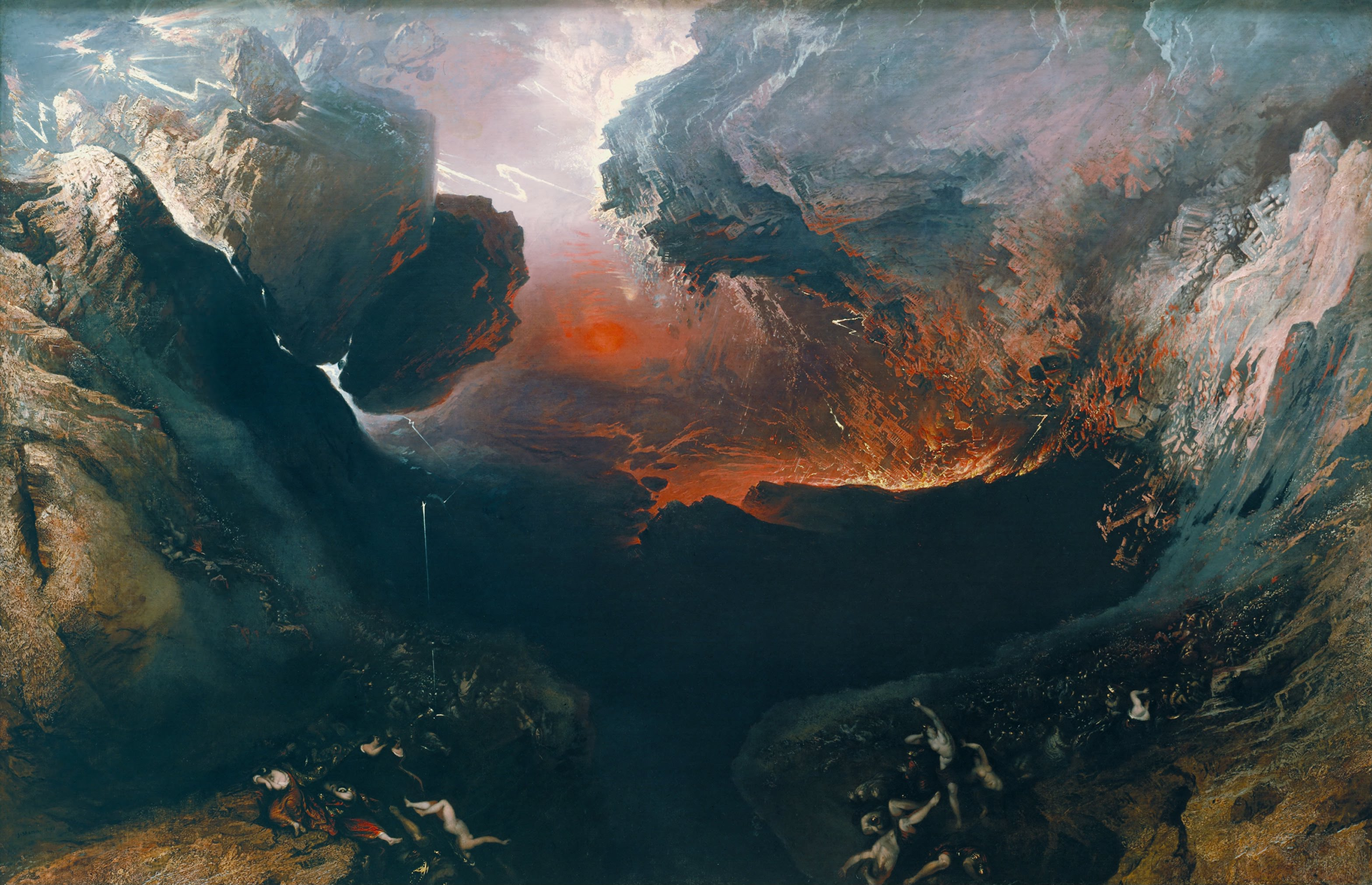
Shattered Descent, in Saros, pushes this logic with a precise technical detail: the grapple mechanic forces the player to throw himself into the void in order to cross it. The descent is played. You no longer contemplate the chasm, you inhabit it. It is the exact ludic translation of Friedrich’s Wanderer above the Sea of Fog (1818), where the figure seen from behind invites the eye to plunge into the landscape. But the step Saros takes is ludic: Arjun does not contemplate, he jumps.
In the Western tradition, vertical descent has long been associated with the initiatory journey. Dante, guided by Virgil, descends the nine circles of Hell. Orpheus descends to Hades in search of Eurydice. In the gnostic tradition the soul descends through the planetary spheres before incarnation. Shattered Descent takes up this scheme without underlining it. The biome is short because it is functional: it moves Arjun from one spiritual state to another. When he emerges, he approaches the industrial marsh as a soul that has shed one further degree of naivety.
Biome IV: Blighted Marsh
The fourth biome is a toxic wetland, strewn with blue plants that explode on contact and overlooked by a ruined dam. Abandoned industrial installations rust there. The biosphere is manifestly dead or dying. It is in this biome that Overdrive and the parry unlock, two of the most important offensive mechanics in the game. It is also where, for those who know how to see it, the red tree that conditions the true ending is found.

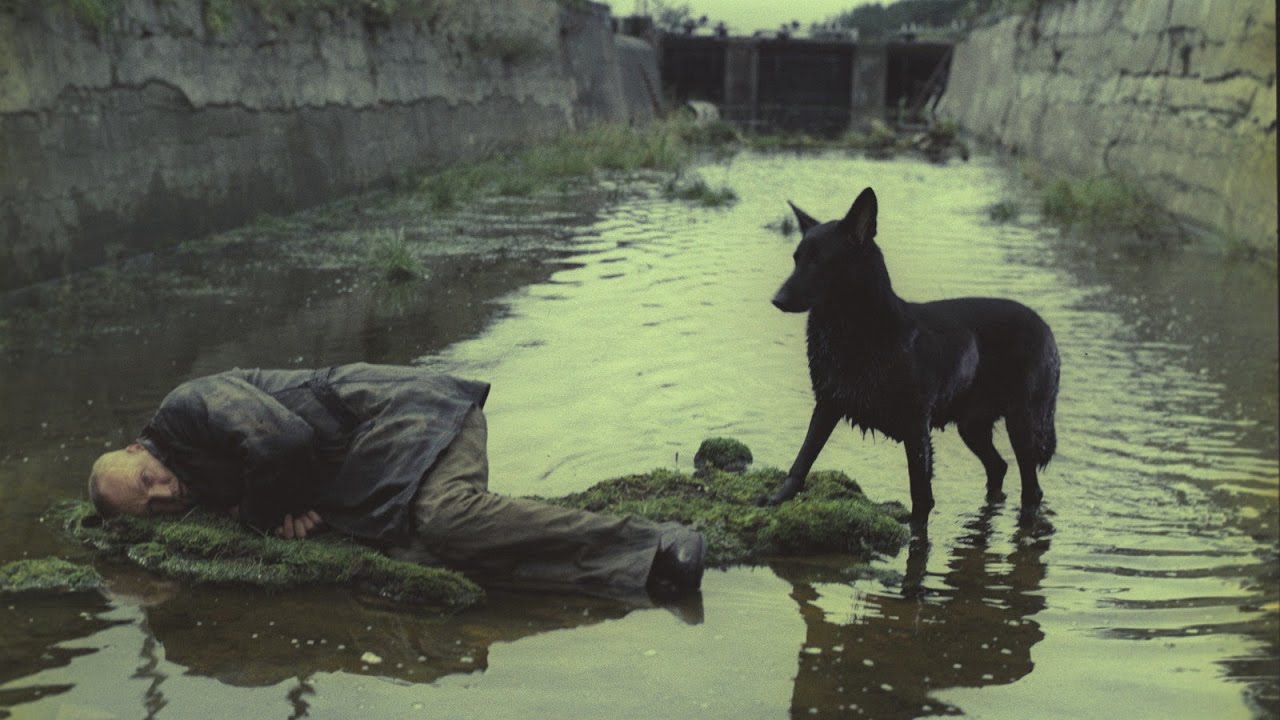
The obvious cinematic reference is Andrei Tarkovsky’s Stalker (1979), a distant adaptation of the Strugatsky brothers’ novel Roadside Picnic (1972). Tarkovsky’s Zone is a forbidden territory, crossed by a guide and two companions, whose physical laws have been altered by an unexplained event. The ground is saturated with invasive grasses, the water stagnates in pools where abandoned domestic objects float. Aleksandr Knyazhinsky’s cinematography films these spaces in contemplative long takes that have marked a whole century of post-industrial imaginary.
Saros inherits this grammar directly. Blighted Marsh is not a natural marsh: it is an industrial marsh, contaminated by an earlier human activity. The presence of the ruined dam, its grey verticality at the back of the landscape, replays the silhouette of the Chernobyl reactor buildings that Craig Mazin’s series (2019) returned to the centre of the Western imaginary. Alex Garland’s Annihilation (2018), adapted from Jeff VanderMeer’s novel, extends this genealogy by adding the biological dimension of mutation. Blighted Marsh, in Saros, is the place where Tarkovsky’s Zone meets VanderMeer’s Area X.
Beyond iconography, the marsh has a long theological history. In Dante’s Inferno the Stygian marsh is the fifth circle, that of wrath and acedia. There the damned fight eternally in the mud. Medieval Christianity made the swamp the natural habitat of the demon, the place where one cannot build, where one cannot walk. The possession of Legion by the marsh therefore finds in Blighted Marsh its natural geographical territory. Theology and topography meet: the multiple demon inhabits the ground that bears nothing.
Biome V: Desecrated Fortress
The Desecrated Fortress is the biome where Saros fully reveals the military architecture of Carcosa. It is a ruined citadel, the theatre of an internal conflict whose memory is kept by inscriptions and by the Honorarium Sigils. The Sealed Chambers, rooms whose opening is conditioned on collecting the sigils, multiply the hidden spaces. The biome unlocks the Eclipse Threads, beams of golden light through which Arjun teleports during eclipse phases. The Architect, a flying dragon, waits at the summit of the Spire.

The immediate architectural reference is that of medieval Gothic fortresses. The city of Carcassonne, restored by Viollet-le-Duc from 1853, offers the most complete European model of a double curtain wall. The Krak des Chevaliers in Syria, occupied by the Hospitallers of Jerusalem from 1142, deploys on its Syrian hill the same grammar of turrets, curtain walls and glacis. The Cathar fortress of Montségur, whose fall in 1244 is one of the founding acts of the Occitan imaginary, adds the memory of a defeated resistance. Saros aggregates these references into a single structure, adding to them the Italian Futurist verticality of Sant’Elia: the Spire that crowns the biome is less a medieval keep than a Sant’Elia tower fallen back into stone.
The grammar of ruins in this biome calls on another pictorial tradition. Hubert Robert (1733-1808), a French painter and contemporary of Diderot, made his career on Roman ruins, fictional or real, peopled with minuscule figures. He painted the Grande Galerie of the Louvre as an imaginary ruin in 1796, an exercise in pictorial uchronia, and inspired the whole European tradition of the veduta. Piranesi, already cited for the underground, recovers here his principal function: engraving monumental ruins where architecture dominates the present. Vedute di Roma (engravings from 1748 onward) is the repertoire from which Saros draws its Desecrated Fortress. The detail of the broken arches, the truncated staircases, the empty plinths missing their statues, comes line by line from that tradition.

The sigil mechanic opens another referential field. In the Western tradition the sigil is a graphic symbol charged with a magical function. The Clavicula Salomonis (Lesser Key of Solomon, a medieval Hebrew manuscript translated into Latin and French from the seventeenth century onward) contains dozens of sigils, seals for invoking or constraining demons. The Lemegeton, or Goetia, compiles seventy-two demonic seals with their names and their hierarchies. The practice spread into modern occultism (Aleister Crowley, Austin Osman Spare), into contemporary chaos magick, and into heavy metal imagery. Saros names its sigils Honorarium, a Latin formula that ties them to honorific ritual distinctions. To collect the sigils is, without knowing it, to recompose a grimoire.
The ability unlocked by this biome, teleportation along a beam of golden light during eclipse phases, deserves its own paragraph. The image frontally cites the final sequence of Stanley Kubrick’s 2001: A Space Odyssey (1968), where Bowman crosses the Star Gate in a cascade of colours and geometries. But the golden tint also refers to the Orthodox tradition of the uncreated light, theorised by Gregory Palamas in the fourteenth century: God manifests as a golden light that crosses the world without burning it. Saros mixes these two memories: the Kubrickian psychedelic hallucination and the Orthodox theophany. Arjun moves through light like a mystic, but this light is the light of corruption.
Biome VI: Acolyte’s Haven
Acolyte’s Haven is a port. Quays, wharves, floating platforms, hoists to be activated by gunfire, a Beacon Tower crowned with a giant statue, the Echelon II vessel run aground nearby. It is the only biome where the aquatic element fully structures the traversal. The player progresses above the water, knows that something is moving beneath the walkways, and ends the zone with a fight on a raft against the Shepherd risen from the sea.
The Beacon Tower is the most direct reference to the repertoire of the Seven Wonders of the ancient world. The Lighthouse of Alexandria, built on the island of Pharos around 280 BC and roughly a hundred and thirty metres high, remained for sixteen centuries the tallest building in the world after the pyramids. Destroyed by the earthquakes of the fourteenth century, it survived in every medieval and modern iconography as the very figure of signal architecture. The giant statue crowning the Beacon Tower of Saros adds the memory of the Colossus of Rhodes, another Wonder of the ancient world, a bronze sculpture thirty-three metres high that stood at the entrance to the harbour of Rhodes around 290 BC, and which Pliny the Elder describes in his Natural History.
The filiation extends as far as Percy Bysshe Shelley’s sonnet Ozymandias (1818), which makes the broken colossus the emblem of the vanity of empires. The statue of Acolyte’s Haven is not in ruins, which accentuates its strangeness: it stands, it waits, it looks at the sea. It is less a vestige than a threat. Italian Futurist grammar gives it its silhouette: square shoulders, vertical thrust, a scale designed to humiliate the player as he approaches.
The poisoned port is one of Lovecraft’s great places. The Shadow over Innsmouth (1936) sets up a coastal town south of Boston whose inhabitants have been mingling for generations with the Deep Ones of Devil Reef. The wharves of Innsmouth, the deserted shops, the half-human half-amphibian faces, defined the imaginary of the cursed port for the twentieth century. Saros activates this memory with calculated discretion. Acolyte’s Haven does not have the documentary rot of Innsmouth, it has its melancholy. The port is still operating, apparently: it is its function that is compromised. Ships arrive, but what they unload is not cargo.
Historically, the port is the site of contagion. The Black Death of 1347 entered Europe on Genoese ships returning from Caffa. The Marseille plague of 1720, the last major plague epidemic in Western Europe, came from the Grand-Saint-Antoine, a vessel arriving from Syria. Every great port city developed quarantine arrangements, lazarettos, sanitary customs posts. Acolyte’s Haven replays this anxiety: corruption arrives by sea, it is in the port that it disembarks, and the giant statue keeping watch is less a guardian than a customs officer of spirits. What the Shepherd gathers is what has transited through this port.
Biome VII: Cathedral
Cathedral is the only entirely interior biome in the game. Vertiginous ceilings, ribbed vaults, reversible gravity (through portals that flip the axis), infinite staircases, a giant central bell whose ringing opens a new space, Nitya’s Lab. The biome contains fifty Halcyons, the highest density of collectibles in the game. It is the most mathematical space in Saros, and it is in its folds that the central revelation hides: Nitya, Arjun’s wife, had her laboratory here.
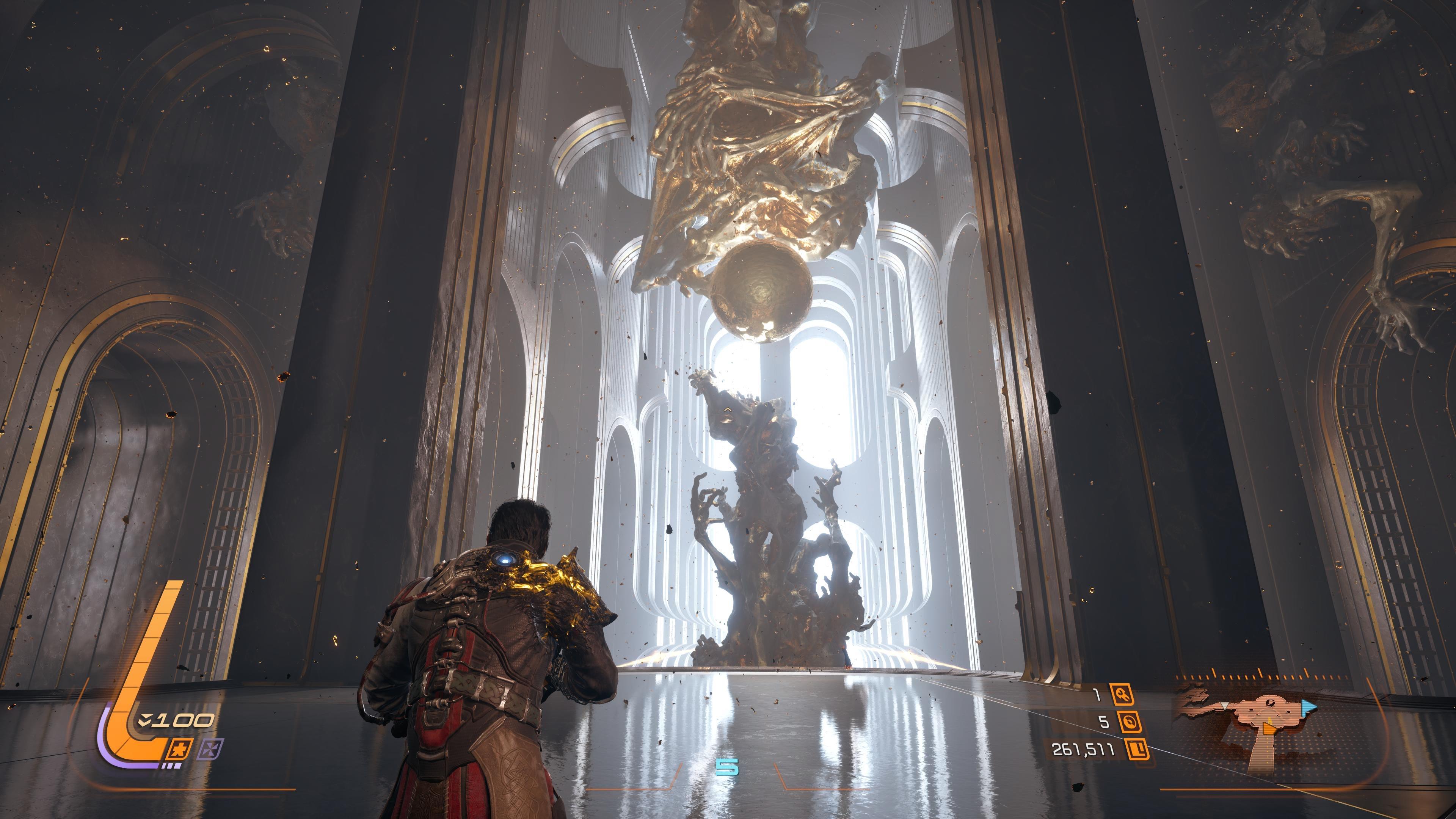
How not to think to Maurits Cornelis Escher (1898-1972), Dutch engraver. Relativity (1953) shows sixteen figures moving through a space where three gravities coexist, staircases that ascend and descend simultaneously depending on the point of view. Ascending and Descending (1960) takes up Lionel and Roger Penrose’s impossible illusion and embodies it in a monastic scene: monks in file climb or descend a staircase that returns to its starting point. House of Stairs (1951) deploys the same principle on an entirely abstract scene. Cathedral, in Saros, does not cite Escher: it inhabits him. The player executes, controller in hand, the paradoxes Escher had engraved on lithograph.
This filiation has a precise videoludic posterity. Antichamber (Alexander Bruce, 2013) had made non-Euclidean space the entire engine of an experience. Manifold Garden (William Chyr, 2019) had pushed the thing toward a cosmogony. Monument Valley (Ustwo Games, 2014) had made the Penrose staircases mobile on tablet. Saros, in Cathedral, reworks this tradition by adding the grammar of combat: you do not merely walk in impossible space, you fight in it. The parry and Overdrive have to be executed on a floor that folds back on itself.
The other reference is European Gothic architecture. Notre-Dame de Reims (thirteenth century), the cathedral of Beauvais (choir from 1272, forty-eight metres high, the tallest Gothic choir in Europe), the cathedral of Chartres (around 1220): all these structures are conceived as optical machines, whose stained glass modulates light according to the hours and the seasons. Elevation is a theological act, coloured glass is a catechism in images, the vault refers back to the sky. Cathedral, in Saros, operates this grammar in the register of play: the light shifts from amber to purple according to the phases of combat, the stained glass filters the eclipse, the central bell is the liturgical element that scans the passage between sections.
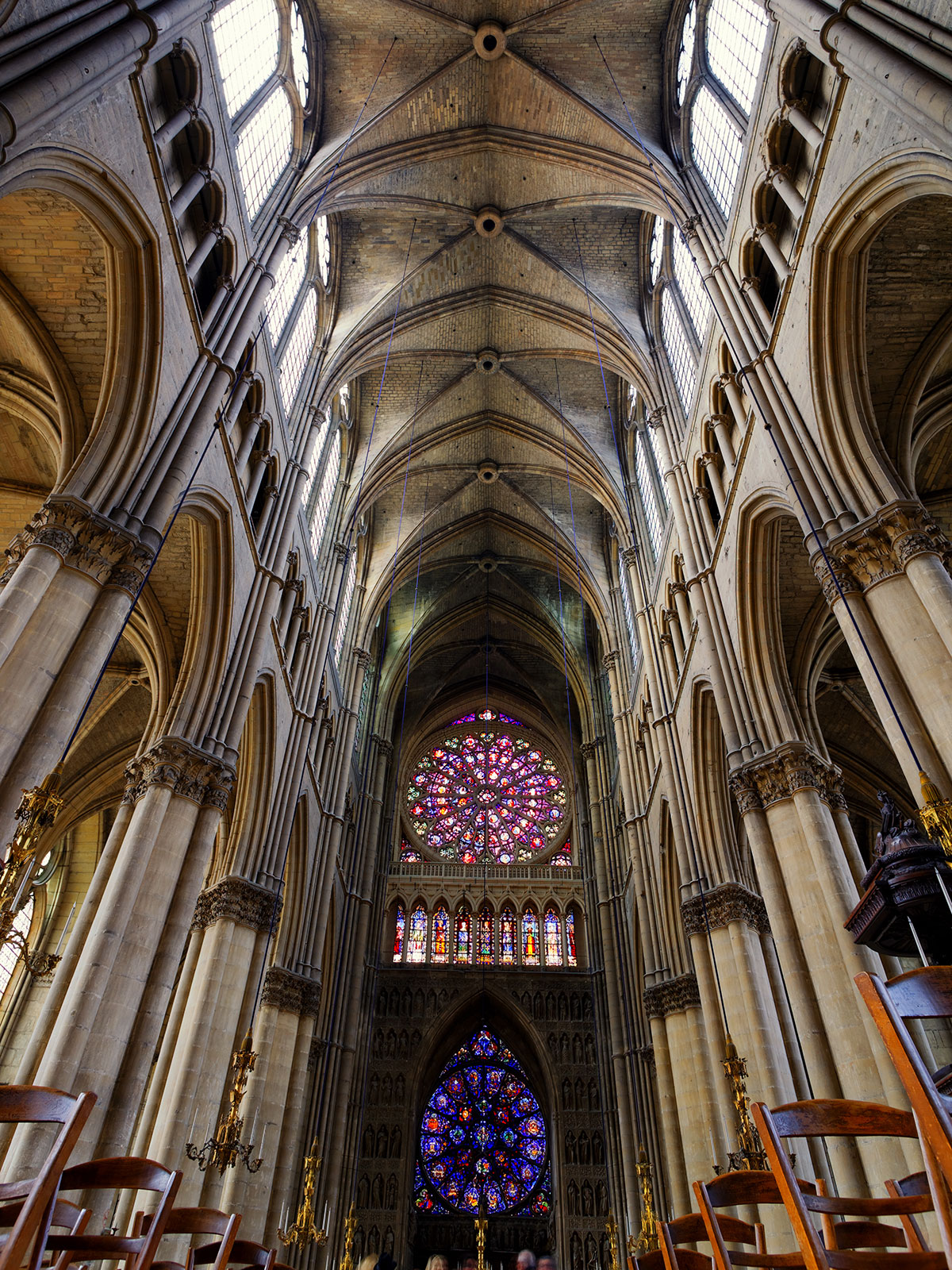
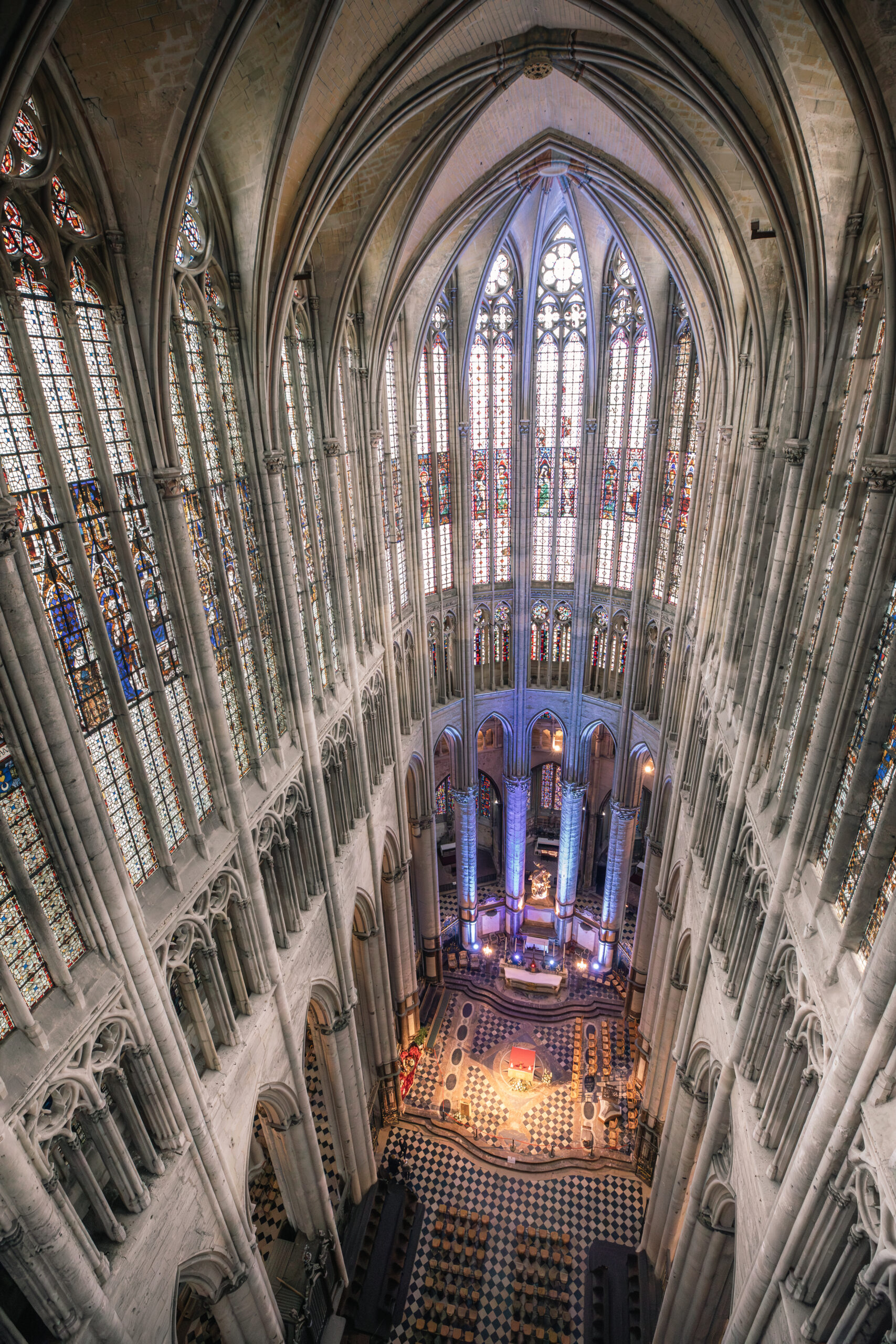
A third source deserves to be added: Antoni Gaudí’s Sagrada Família, under construction in Barcelona since 1882. Gaudí invented an organic Gothic grammar, arborescent columns imitating the forest, vaults that seem to grow rather than to be masoned. Cathedral retains this principle: its pillars, in certain views, open out into branches that meet the vault. The alien cathedral of Saros is closer to Gaudí than to Reims, but it inherits from both.
In 1928, in The Call of Cthulhu, Howard Phillips Lovecraft laid down the formula that would define a century of cosmic horror: the city of R’lyeh, where Cthulhu sleeps, presents a non-Euclidean geometry whose mere perception alters the sanity of the sailors who land there. The formula would be taken up in At the Mountains of Madness (1936) for the city of the Elder Things. The term non-Euclidean became, in Lovecraftian culture, the marker of architectural horror. Saros, by making Cathedral the only biome where gravity stops obeying, performs an exact ludic translation of the concept.
Biome VIII: Yellow Shore
The last biome is the most stripped down. A golden sea as far as the eye can see, a beach that never ends, scattered Solar Cages holding mini-bosses, a solar medallion serving as a central portal, all of it beneath an eclipsed black sun. The biome unlocks the Blazing Strike, the final ability that allows the yellow barriers left sealed in the earlier biomes to be broken. It contains no Halcyon tracker. Yellow Shore is not a place where you collect, it is a place where you finish.
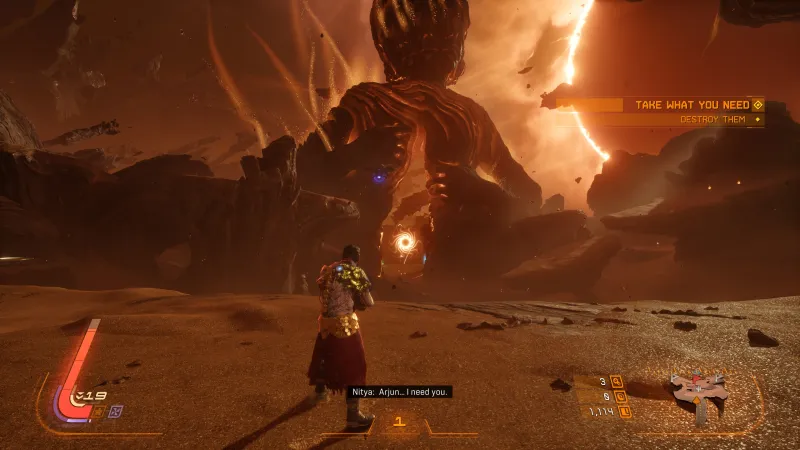
Robert W. Chambers, in The King in Yellow (1895), includes a poem attributed to Cassilda, one of the characters in the cursed play. The stanza has become iconic: “Along the shore the cloud waves break, / The twin suns sink behind the lake, / The shadows lengthen / In Carcosa”. The Lake of Hali, beyond which Carcosa rises, is the primary horizon of the Mythos. It is on this shore that the faithful go to contemplate the city from the other bank. Yellow Shore, in Saros, is that shore given over to be inhabited. The single sun of an eclipse has replaced the twin suns of the poem, but the grammar is preserved: a golden shore, an immobile sea, a sun that does not rise.
The saturated yellow light of the terminal shots of the first season of True Detective is manifestly present in the palette of Yellow Shore. The comparison is not innocent: Pizzolatto took the atmosphere from Chambers, and Saros gives it back to Chambers while adding the visual thickness of the 2014 series.
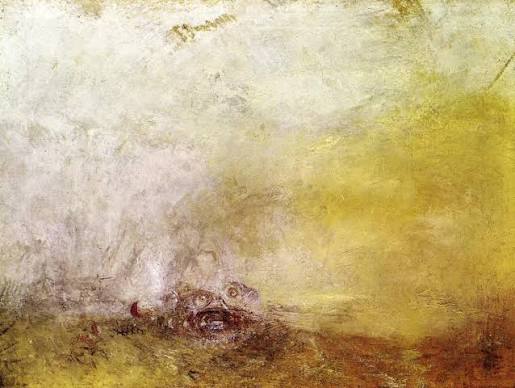
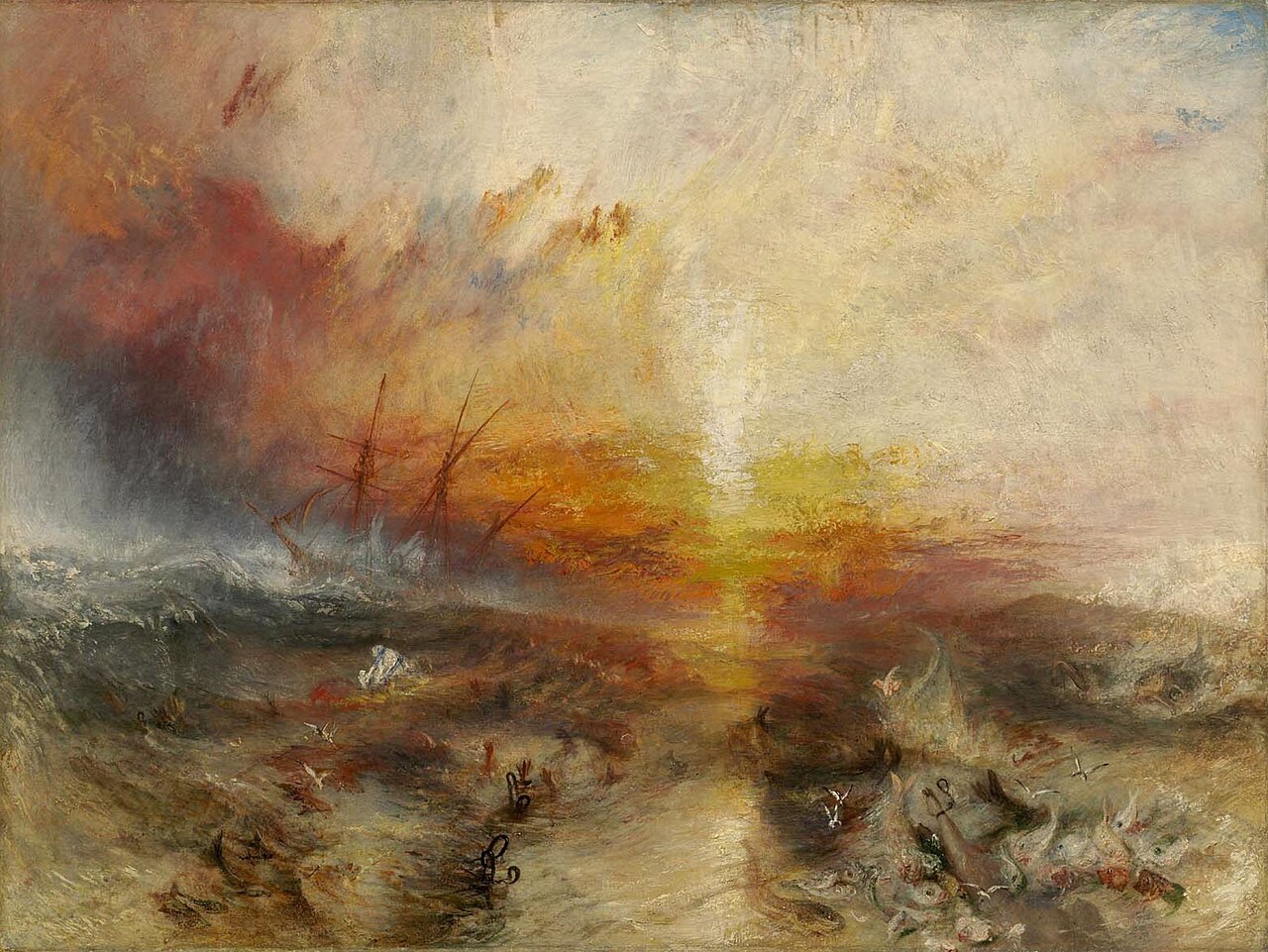
Pictorially, the great painter of the golden shore is J. M. W. Turner (1775-1851). His late marines, from 1835 onward, abandon topographical precision for pure light. Sunrise with Sea Monsters (around 1845), unfinished, shows a pink sea crossed by vaguely organic forms. The Slave Ship (1840) drowns a historical crime in the incandescent light of the sunset. Turner was then inventing what the moderns would call lyrical abstraction, and he was doing it on the motif of the sea. The Yellow Shore of Saros borrows directly from this palette: the golden sea is not metal, it is light, and the light vibrates as it does in Turner’s last canvases.
A second pictorial source works the biome: the pittura metafisica of Giorgio de Chirico, in the 1910s and 1920s. Italian Piazza at Sunset (1913), The Mystery and Melancholy of a Street (1914), The Seer (1915) deploy empty perspectives, elongated shadows, arcades leading nowhere, statues staring into the void. De Chirico invented the iconography of architectural solitude bathed in a golden, anguished light. Yellow Shore, in its terrestrial part, functions as one of his piazzas. The Solar Cages, those enclosures of light that hold the mini-bosses, are as much de Chirican elements as Lovecraftian ones: solitary arches that punctuate space without ever closing it.
The name of the game takes on its geographical meaning in this last biome. The saros, the eclipse cycle discovered by Chaldean astronomers, does not designate just any repetition. Its duration is eighteen years, eleven days and eight hours. At the end of this cycle an identical eclipse recurs, but slightly displaced geographically, which means that a given eclipse only returns to the same place roughly every fifty-four years. Yellow Shore is the place where Arjun understands that he is himself inside a saros: his history with Nitya, his quest, his death, his return, are not linear but cyclical. The canonical ending of the game, in which he becomes the King in Yellow, confirms this device: Arjun has already been this King, he will be again, he is this King at this precise moment. The geography of Yellow Shore is circular.
The figures of the cult
Saros counts nine boss encounters: a tutorial Consort that serves as an introduction to the system of death and return, and eight Overlords, each of which seals the end of a biome. The eight are named Prophet, Bastion, Rhabdom, Legion, Architect, Shepherd, Priestess and King. All of them bear names borrowed from priestly, military or royal vocabulary. Not one has a neutral name. This choice is already a reading: the lost civilisation of Carcosa was a theocracy, and the player, through Arjun, works his way back up its clergy.
Five of the eight Overlords compose a coherent hierarchy, in which each ecclesial rank converses with a precise iconography. They can be read as five stations of an inverted initiation, one that leads less to revelation than to corruption. The progression follows the order of the game, but it also follows a theological order.
Boss I: Prophet
The first Overlord pushes up out of the ground. It does not walk, fly or swim. It is rooted, run through with long tendrils, girdled with yellow buds that have to be destroyed before its central eye opens. The arena is carpeted with corrupted red grass that slows Arjun, as if the vegetal itself had taken sides against him. At each phase, walls of vines close in and reduce the space.

Prophet inscribes the first law of Carcosa: here, speech does not come out of a human body. It comes out of a plant. This is the oldest return in the Western imaginary, that of the Pythia of Delphi seated on her fissure, inhaling the vapours of the earth to speak in Apollo’s name. The Greek tradition never forgot that the oracle was a geological event before it was a religious one. The Pythia did not think, she transmitted.
The visual grammar of the boss draws on this memory. The central bud, which opens only once the peripheral buds are destroyed, functions as an oracular flower that reveals its heart only on condition of an approach ritual. The single eye that appears at the centre is the classical figure of the eye of God, but also that of the vegetal gaze of John Wyndham’s Triffids (The Day of the Triffids, 1951), of Frank Herbert’s sandworm, and further still of the oracular fruit of Babylonian cosmogonies.
On the art history side, we are in the lineage of the monstrous vegetables of Hieronymus Bosch, whose Garden of Earthly Delights (around 1490) shelters giant buds in which mouths, eyes and passages open. The Boschian flower is always a membrane between the organic and the diabolical. More contemporary, the vegetal pavilion of Carcosa cites fairly directly Rafflesia arnoldii, the largest flower in the world, discovered in Sumatra in 1818, which smells of decomposing flesh, measures up to a metre across, and has fascinated naturalists for two centuries precisely because it thwarts the expectations of the vegetal kingdom. Carnivorous plant, parasitic plant, prophetic plant: all of this settles into the opening biome.
Finally, Prophet settles accounts with a precise lineage within the medium. A plant boss that requires peripheral nodes to be destroyed before exposing its central eye is the grammar of the vegetal bosses of the Dark Souls series (the Bed of Chaos), of Hollow Knight (the Traitor Lord and his vegetal arena), and further off of the deadly botany of Resident Evil. Housemarque does not point to these works head-on, but the motif is familiar. The first Overlord is familiar precisely so that the player understands that Saros is playing in a court he knows, before subverting it.
Boss II: Legion
Legion does not fight alone. The boss flies at the heart of a swarm of small tentacled creatures that orbit around it and shelter it. The player identifies the true target by its central red glow, the rest of the swarm respawning indefinitely.

The name is a citation. Gospel of Mark, chapter 5, verse 9: “Jesus asked him: What is your name? He replied: My name is Legion, for we are many.” The episode is one of the most famous exorcisms in the New Testament. A possessed man wanders among the tombs of the country of the Gerasenes, breaking every chain put on him. Jesus expels the demons, which ask to enter a herd of pigs, which then throw themselves into the sea. Legion here designates a paradoxical singularity: a being that is multiple, a voice that is a swarm.
The Saros boss enacts this paradox to the letter. It is not plural for decoration, it is plural for precise theological reasons. The crown of smaller entities protecting it is the memory of the Gerasene pigs, the sacrificial shield on which Arjun’s bullets exhaust themselves. To reach the heart, you have to cross the herd. The marsh surrounding it replays the evangelical topography: borderland, intermediate place, where madmen hide among the tombs.
Beyond the New Testament, the motif of the hostile swarm works through the whole of twentieth-century culture. Hitchcock’s The Birds (1963) is its major cinematic iconisation: the threat is no longer the singular adversary, it is the number that overwhelms. More recently the motif has spread through the manga of Junji Ito (Uzumaki, Tomie) and through the culture of swarm enemies in videoludic horror (Dead Space, Resident Evil 5). Legion belongs to this grammar. The boss is not frightening because it is large, it is frightening because it is several.
On the plastic level, the swarm is also a reference to the motif of baroque demonic iconography, where minor demons surround the major demon in procession (the Temptations of Saint Anthony, treated by Bosch, Schongauer, Cézanne, Dalí). Legion summons this tradition in order to set it in motion, and adds to it the grammar of the Japanese bullet hells: the swarm itself opens fire, the swarm is also an emitter of projectiles.
Boss III: Shepherd
Shepherd emerges from the sea. The arena is a boat, the player set upon it as on a besieged platform. The first phase does not oppose the body of the boss, which remains invisible beneath the water, but a series of tentacles that crash down on the deck. They have to be destroyed to make the head surface. Once exposed, it fires alternating waves of blue, yellow and red projectiles. The fight moves from hunting a creature to defending a raft.
The name Shepherd is an internal reference to Chambersian mythology. In The King in Yellow, Hastur is designated by Robert W. Chambers as Hastur of the Hyades, tutelary deity of the Hyades (a star cluster in the constellation of Taurus), and some commentators attribute to him the epithet Shepherd of Shepherds, a reading proposed by August Derleth in his own Cthulhu Mythos stories. Hastur is bound to the Yellow Sign. He is, in the lineage, the one who gathers the faithful around the King. The Shepherd is therefore the priestly rank that precedes the King.
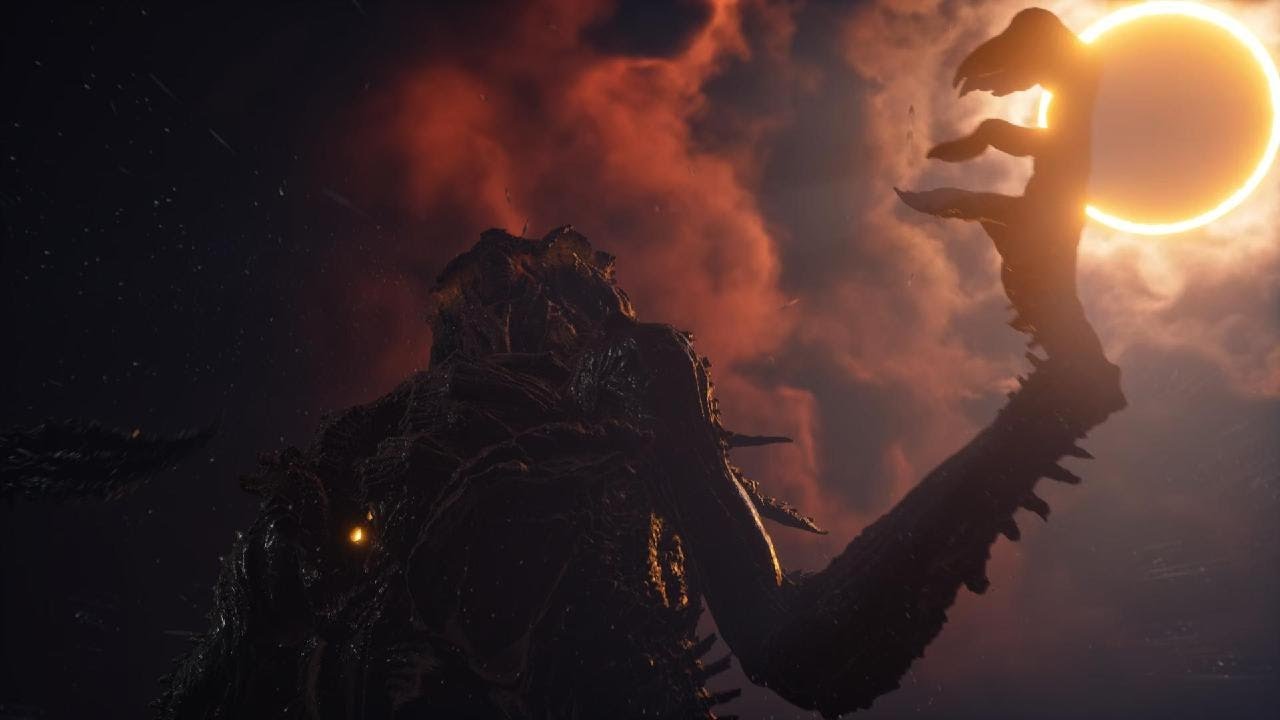
That this Shepherd is aquatic is not neutral. Hastur, in the Lovecraftian tradition, is less clearly marine than Dagon or Cthulhu, but his kinship with the sea is regularly noted. Carcosa, in Cassilda’s poem included by Chambers in his collection, is described as mirroring itself in the Lake of Hali. The Shepherd therefore comes out of that black water. He keeps a flock made not of men but of aquatic shadows.
The most obvious visual reference is the Kraken, the legendary creature of the northern seas. The Kraken appears in Icelandic and Norwegian texts from the thirteenth century onward (Örvar-Oddr saga, Konungs skuggsjá), reaches its popular formulation in Erik Pontoppidan’s Natural History of Norway (1752), and receives its poetic canonisation in Tennyson’s sonnet (The Kraken, 1830). Its morphology, a creature of colossal size, peripheral tentacles, a central body rarely visible, is exactly what Shepherd takes up.
The filiation has since crossed the modern imaginary, from Verne’s Twenty Thousand Leagues Under the Seas to Hokusai’s sea gods (The Dream of the Fisherman’s Wife, 1814), from Lovecraft’s octopuses to the Krakens of the Pirates of the Caribbean saga. Saros takes up this grammar and sacralises it: here the Kraken is not a beast, it is a shepherd, a pastor of invisible flocks. It fights from beneath the water, like a god who never shows himself whole.
One can push further. Christian tradition makes Christ the Good Shepherd (John 10:11: “I am the good shepherd”), a figure returned to visual memory by so many early Christian mosaics, from the catacombs of Saint Callixtus to the frescoes of Ravenna. The Shepherd carries the lamb on his shoulders, leads the sheep out of danger. Saros performs an exact reversal: Shepherd is not the pastor who saves, he is the one who devours. He gathers the colonists of Carcosa in order to push them into madness, not to protect them. The biome he commands is called Acolyte’s Haven, but the haven is a trap. It is a typology found throughout the twentieth-century literature of sects, from the Lovecraftian cults to Pizzolatto’s True Detective.
Boss IV: Priestess
Priestess is the most stylised Overlord in the game. An ethereal four-armed creature, dressed in vaporous drapery, who splits into three copies at the start of the fight. The player has to strike down two of them for the true one to surge up at the centre.
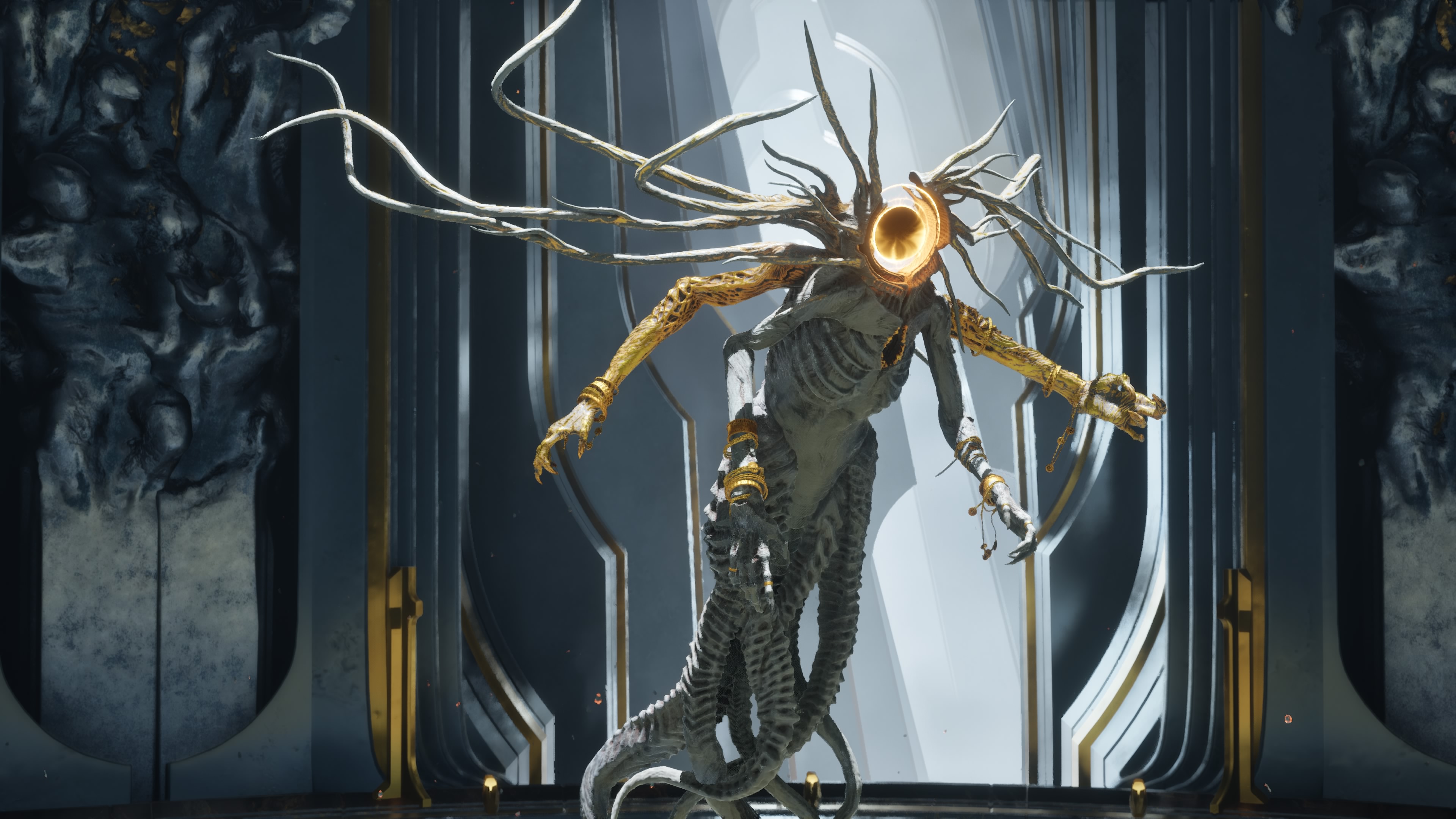
The quaternity of Priestess’s arms is a declension of the Hindu chaturbhuja already identified for the King in Yellow in the first part of this dossier. What is at play here is not a repetition, it is a visual preparation. Priestess has four arms, the King will have six to eight in the final fight. The goddess of the cathedral prepares the player for the iconography of the final boss, as the penultimate degree of a cult prepares for the supreme degree. She is, in the hierarchy, the one who officiates before the icon, before the icon breaks loose.
The iconographic grammar of Priestess is not only Hindu. The doubling of the priestess into three figures and her subsequent reconvergence replays the motif of the triple goddess dear to neo-paganism and to Robert Graves (The White Goddess, 1948): the goddess as Maiden, Mother, Crone, three figures that are one. Hecate, in the Greek pantheon, is herself triple (trivia, that is, of the three roads) and presides over crossroads. The copies of Priestess teleport all together, as if the cathedral space followed a logic of crossroads.
The triptych blossoms in several traditions. The three Roman Parcae, the three Greek Moirai (Clotho, Lachesis, Atropos), the three Witches of Macbeth, the three Gorgons. An entire Western tradition of the triple female divinity is at work. Saros grafts onto it the mechanic of the red chimes, which recall the summoning bells of Orthodox masses or Tibetan singing bowls, ritual instruments that modify the rhythm of the ceremony.
The biome that contains Priestess has already been analysed for its architectural sources (the Gothic cathedral, Gaudí, Escher, the Lovecraftian non-Euclidean). The fight against Priestess pushes this system to its most extreme ludic point: the inverted portals, the platforms that give way, the walls that change axis during the confrontation, turn the fight into a dance on an Escher lithograph set in motion. The priestess is not merely the deity of the cathedral. She is the cathedral in operation.
Boss V: King
The last Overlord is the crowning of the whole Carcosan mythology. The boss does not appear with a horde, nor with doubles. He comes alone, at the end of Yellow Shore, in an arena open onto a golden sea that never stops extending. Three phases. In the first he uses only blue projectiles, absorbable attacks, and between volleys raises a yellow shield the player has to break with bare hands. In the second he moves to Nova red, to be parried, and reveals two new attacks: a laser that tracks Arjun and two punches of lightning speed. In the third, red gives way to corrupted yellow, and the whole battlefield becomes a single golden pulsation.

The iconography of the King, as the first part of this dossier established, crosses Chambers (the King in Yellow never clearly described) and the Hindu chaturbhuja (the galaxy in the chest as a citation of Vishnu Vishvarupa). One element remains that the two sources are not enough to explain, and that deserves its own development: the absolute concentration of the royal attribute on the hands.
The pillars of Carcosa, from the first biome onward, are sculpted as hands reaching toward the sky. The bas-reliefs of the temples show tortured fingers. The final arena makes these hands the centre of the fight. The King is essentially a divine hand. This concentration on the hands has a genealogy: the Hand of Fatima in Islamic tradition, the Jewish and North African hamsa, the mudras of tantric Buddhism, the Roman ex-votos representing the hand of Sabazios. The divine hand is the organ by which power touches the world without compromising itself in a face. The King in Yellow of Saros chooses this universal grammar in order not to have to show himself.
The canonical ending of the game confirms the device this dossier has announced since its first pages. Once the King is defeated, Arjun crosses the golden barrier, his hands catch fire, his eyes mutate, he takes his place on the throne. The boss was not an enemy. It was a stage of transformation. The mythology of Hastur joins that of Krishna: you do not kill the King in Yellow, you become the King in Yellow. The saros cycle finds its narrative meaning here: the hero begins a cycle again, but this time occupying the place of the god he has replaced.
The hierarchy you climb
Read together, the five Overlords compose a hierarchy that Arjun climbs without knowing it. The Prophet announces, the Legion possesses, the Shepherd gathers, the Priestess officiates, the King reigns. Saros thus offers a complete ecclesiology of the lost civilisation of Carcosa, in which each rank corresponds to a precise theological function and to an articulated iconography. The player does not fight disordered alien monsters. He unrolls, without being able to name it during the first traversal, an ecclesial org chart. It is only at the end, when Arjun takes the King’s place, that he understands he has just been promoted within a cult that was preparing him to supplant it.
The three Overlords set aside in this analysis, Bastion, Rhabdom and Architect, are not off topic. Bastion is the military counterpart of the Prophet (the fortress against the sermon), Rhabdom is a Greek lexical drift (rhabdos, the staff, instrument of the priest and of the magistrate), and Architect is the demiurge in chief, the Great Architect of freemasonry displaced into a dragon imaginary. But their logic is ancillary: they extend the grid without composing it. It is in the pentagon of Prophet, Legion, Shepherd, Priestess and King that Carcosa gives its true structure. Five figures, five grades, five stages of a corruption that presents itself as a promotion.

Carcosa, memory palace
Three movements, then, for a single object. The art direction laid out the sources Housemarque mobilised, from the Italian Futurists to the Bhagavad Gita, by way of Chambers and the Jóhannsson school. The geography unfolded, biome by biome, the way these sources take shape in spaces the player crosses. The figures of the cult identified, in the hierarchy of the Overlords, the ecclesiology of a theocratic civilisation. Taken separately, each of these angles illuminates a part of the game. Taken together, they reveal what none of them says on its own.
Saros is a memory palace. The term comes from medieval rhetoric, inherited from the artes memoriae of Aristotle and Cicero, and popularised by Frances Yates in The Art of Memory (1966). The method consisted, for orators and theologians, in memorising long speeches by associating each idea with a place in an imagined architecture. You walked mentally through your palace, stopped at each room, and found there the thought you had deposited. Carcosa functions as such a palace. Each biome is a room, each room houses an Overlord, each Overlord crystallises a layer of the mythology. The player believes he is crossing a planet. He is in fact walking through a memory device whose function is to transmit, without ever making it explicit, a complete cosmology.
This cosmology has a coherence that deserves naming. It articulates three source traditions: Chambersian mythology (Carcosa, Hastur, the King in Yellow, the golden shore), which supplies the atmosphere and the vocabulary; Hindu iconography (Arjun, Vishnu, the banyan, the Vishvarupa), which supplies the deep structure of the hero’s destiny; and European architecture (neoclassical, futurist, Gothic, baroque), which supplies the grammar of the spaces. None of these traditions is cited to no purpose. All are mobilised with a precision that suggests sustained documentary work, and that Silvestri himself claims in his defence of slow culture against the shortcuts of artificial intelligence. Saros is a game that has read its sources, and that asks the player to read them in turn.
It is worth taking seriously the fact that this work is carried out by a studio that inherits from the arcade. Housemarque is not a prestige studio seeking to legitimise itself through citation. It is a studio whose signature is the neon bullet dance, the millimetric precision of the gesture, the hypnosis of the pattern. That this particular studio should choose to graft onto its arcade grammar a layer of erudition this dense is an event inside the medium. Saros is perhaps the first game to propose holding together, without hierarchy, the ballet of bullets and the Bhagavad Gita. This wager is the post-Sony Housemarque event: an arcade studio become an auteur studio without renouncing anything that made it singular.
There remains, as always in the medium, the question of what is not immediately visible. Hindu iconography reveals its logic only to those who come back. The log fragments of the earlier expeditions compose a Chambersian mythology that will take several hundred hours of play, cumulated across players, to reconstitute. Like The King in Yellow, Saros is designed to resist a single reading. That is perhaps, for a game presenting itself as an arcade shooter, its finest homage to the literature that gave it its name. Carcosa had been waiting since 1886. In 2026 it found a form that suits it.
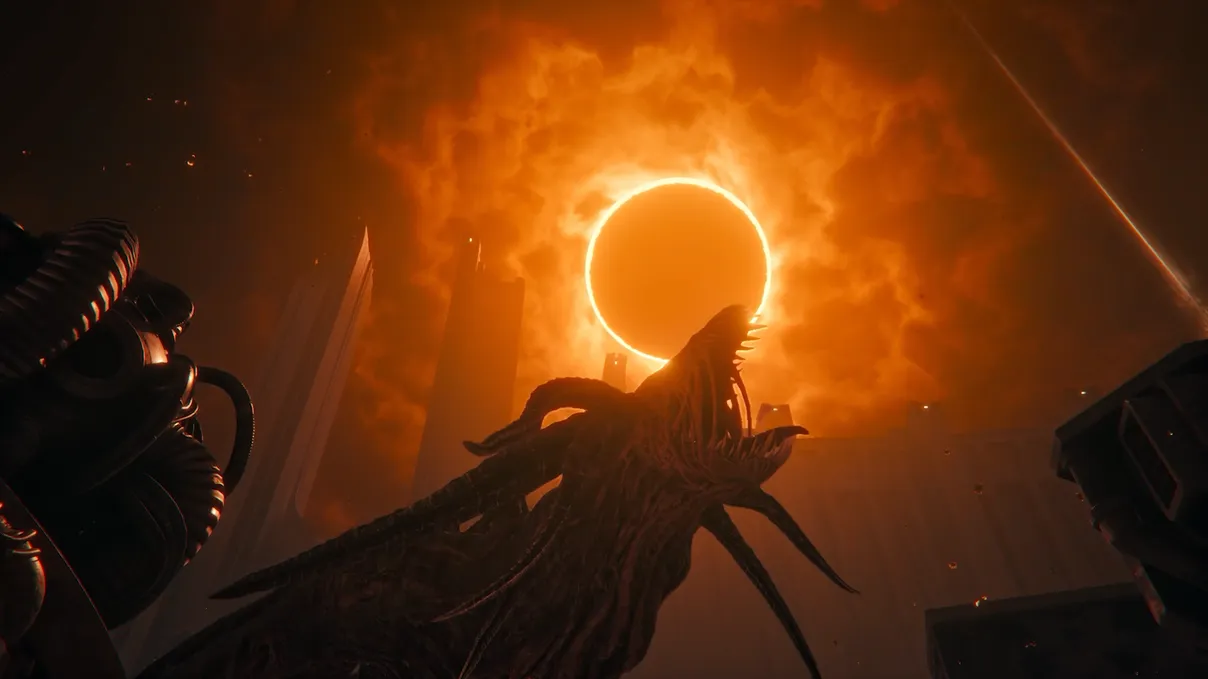
Sources
Entretiens et communication studio
Books
- Ambrose Bierce, « An Inhabitant of Carcosa », San Francisco Newsletter, 1886.
- Robert W. Chambers, Le Roi en Jaune, F. Tennyson Neely, 1895.
- H.P. Lovecraft, Celui qui chuchotait dans les ténèbres, Weird Tales, 1931.
- Mahābhārata, attribué à Vyāsa, avec attention particulière à la Bhagavad-Gītā (chant XI, la Vishvarupa Darshana).
Movies / TV Shows
- Danny Boyle, Sunshine, 2007.
- Paul W.S. Anderson, Event Horizon, 1997.
- Andreï Tarkovski, Solaris, 1972, et Stalker, 1979.
- James Cameron, Aliens, 1986.
- Ridley Scott, Prometheus, 2012.
- Christopher Nolan, Interstellar, 2014.
- Alex Garland, Annihilation, 2018.
- Nic Pizzolatto, True Detective, saison 1, HBO, 2014.
Paintings
- Antonio Sant’Elia, La Città Nuova, 1914.
- Umberto Boccioni, Formes uniques de la continuité dans l’espace, 1913.
- Filippo Tommaso Marinetti, Manifeste du futurisme, Le Figaro, 20 février 1909.
- Giacomo Balla, œuvres futuristes (1909-1915).
- Edmund Burke, Recherche philosophique sur l’origine de nos idées du sublime et du beau, 1757.
- Michel Foucault, Surveiller et punir : naissance de la prison, Gallimard, 1975.
- Frances Yates, L’Art de la mémoire, Gallimard, 1975 (édition originale anglaise : 1966).