
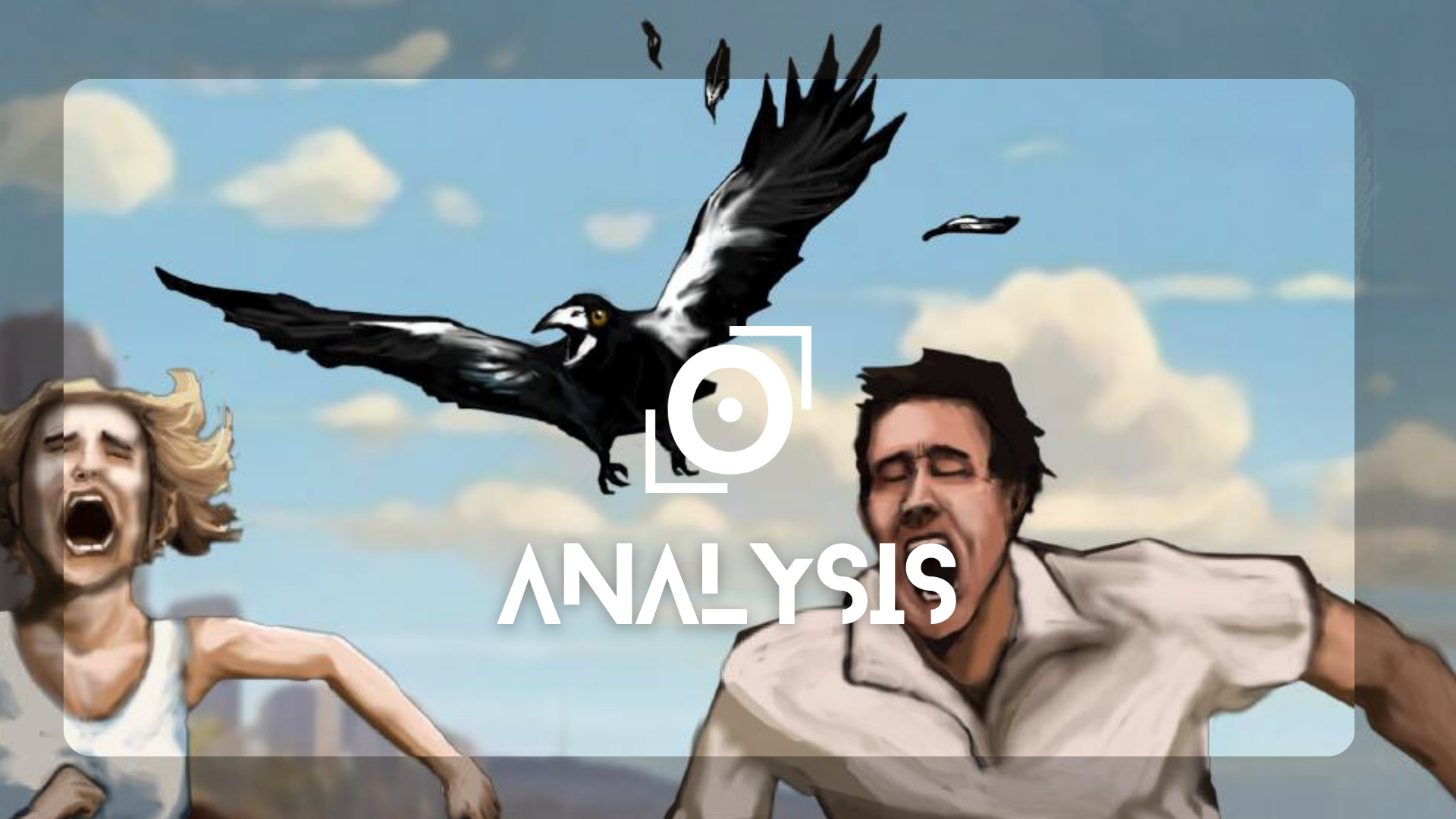
He’s running. For his life. He pedals faster and faster, taking every risk to shake off his pursuer. Behind him, a strange shadow stirs and swirls, then darts at him before vanishing. But this disappearance is only a ruse. For the shadow returns. And he pedals faster and faster. Across the countryside, he has no refuge. He is doomed to pedal, again and again, to escape the shadow. But it returns. Like a flash of lightning, it slices through the air to strike him at the back of the head before pulling away and pouncing on its prey once more. Again, and again. And the torment continues. Continues. Until finally, the shadow decides to vanish. He has succeeded. Exhausted, he gets off his bike to catch his breath. He will never forget this day. The day he became a true Australian.

GAME OF FAUNE – EPISODE 6
Generally, in video games, animal representation involves a wide variety of species, and game mechanics interact with each of them. But sometimes developers focus on one or two specific animals. This focus is often justified by mechanical requirements that are both dependent on and independent of the chosen animal. Since this duality can be complex to understand, let me illustrate it with an example.
In Banjo Kazooie, a 3D platformer released in 1998 on the Nintendo 64 and developed by Rareware, the player controls both Banjo, a bear, and Kazooie, a female bird. One of this bird’s powers is to fly from predefined platforms within the level, something Banjo cannot do. Thus, the mechanical necessity is dependent on a specific group of animals—birds—but also independent within that group, as Kazooie’s design has no influence on her ability to fly. Whether Kazooie were an eagle, a giant hummingbird (a species that actually exists, by the way), or an imaginary species named Breegull (which she is in the game), Kazooie would have been endowed with this ability to fly regardless.

Rare (Rare, Rare, Banjo-Kazooie, haha) are thus games that take advantage of animals’ unique characteristics, particularly their behavior. And it was while watching birds circling in the sky on his way home from work that Mark Smith, an Australian indie developer and founder of Monster Lab Games, got the idea to create a game centered around a bird with such unique behavior: the Australian Magpie. This extremely intelligent bird, about 40 centimeters long and belonging to the starling family (even if its name pretending the opposite), is, in fact, responsible for a veritable frenzy when its breeding season arrives.

To defend their young, Magpies do not hesitate to attack any intruder that crosses a certain boundary, and this is why, every year, several thousand—or even tens of thousands—of Australians fall victim to “Swooping.” The Magpie Alert website, which tracks all these attacks, recorded no fewer than 5,000 in 2025—a figure that is constantly rising but likely significantly underreported, as the database is undoubtedly incomplete. About one-tenth of these attacks result in injuries, which, fortunately, are almost always superficial. Nevertheless, tragedies can occur, as was the case in 2021 when a woman fell to the ground with her infant. Swooping is not unique to the Magpies, as other birds engage in it, often among themselves. It is, however, exceptional in terms of its frequency and prevalence within this population, even if the numbers are, according to ornithologists, greatly exaggerated.
In 2024, Mark Smith set out to create a game based on the Australian Magpie. While he handled the game’s graphics, design, and programming himself, he enlisted the help of a friend for the music and the indie publisher indie.io for marketing and QA. “I looked to see if anyone else had made a Magpie game before and only one existed but it was a 2D game, so I decided to evolve the concept into a 3D action sports style game.,” he tells me in a surprising conversation. In fact, when I launched Pie in the Sky, I expected to find inspiration from Untitled Goose Game or Just Crow Things, to name a few of these “simulators” of avian mayhem. Mark was actually largely inspired by… Tony Hawk: Pro Skater, which may seem strange at first, but makes perfect sense once you think about it.


In each level of Pie in the Sky, you have three minutes to complete as many wacky objectives as possible and achieve the highest score before time runs out. To do this, you’ll need to bump into people and cause massive chaos, ranging from a crash on the highway to flooding a park. Completing a certain number of these objectives will boost your score and even let you move on to the next level. These objectives lied into two categories: The first consists of missions present in every level, such as collecting the letters S W O O P, teaching certain brats a lesson by covering them in bird droppings, and even feeding your little ones by picking up fries and sandwiches scattered throughout your territory. The other missions, however, depend on where you are. In the first one, the residential neighborhood, you’ll be asked to destroy mailboxes or knock over trash cans. On the coast, you’ll have to destroy sandcastles or surf the waves. As you can see, the game never takes itself seriously, especially since you can “Pimp Magpie” with hats and sunglasses or boost your stats by finding skill points that are pretty well hidden.
While some of the objectives are downright absurd, Mark also drew a great deal of inspiration from real-life events. The third level, the footy match—that surprising indigenous sport that’s a cross between American football and rugby (at least to me, as a French person, that’s what it looks like)—is inspired by people who were actually attacked during games. The same goes for the advanced level in the skatepark. To add a touch of folklore, Mark also included a shiny object to find in each level. This references the bird’s curiosity, likely drawn to anything that glitters—much like the behavior of the Eurasian Magpie found in Europe, which inspired Hergé (creator of Tintin) and Rossini. It wasn’t until 2014 and a study by the University of Exeter that it was demonstrated that the bird was more neophobic (meaning it was afraid to approach, touch, or handle unfamiliar objects) rather than curious about shiny things. The belief remains stubbornly persistent, however, and the various accounts claiming the opposite will not be enough to change that.
Finally, if you pay close attention to the game’s details, you’ll notice cyclists wearing spiked helmets. This is actually one of the methods that has been devised to scare birds away. Other tricks, such as using an umbrella (without spinning it), wearing sunglasses at the back of the head, or drawing eyes to simulate a person’s gaze, are also used to try to scare the birds away. Cyclists are indeed among the Australian Magpies favorite targets. The birds are indeed more aggressive depending on the speed of their target, which is why it is recommended to get off the bike to reduce the chances of attacks in areas where the birds could be dangerous. Cyclist Remco Evenpoel, for example, was targeted by a Magpie in September 2022 while training for the Road World Championships held in the Australian city of Wollongong. History does not say whether this attack galvanized him, but he went on to win the championship ahead of France’s Christophe Laporte.
 A Footy game where the goal is to destroy the opposing team.


Also, one of the best pieces of advice is to remain calm in the face of the bird’s actions and not make any sudden movements, as Mark pointed out: “I think people forget though that if you’re nice to them and whistle to them, they remember your face and won’t attack you”. As an Australian, I’ve been swooped many, many times. I see my kids get swooped on the way to school and most of my family and friends have likely been swooped too. Depending on where you live, it is quite common “Another unofficial tip would be to have… hair, as Emma Glenfield reported in a very serious “study” she conducted at the age of… eight. She discovered that bald or very thin-haired characters were more likely to be attacked than others…”
However, despite the terror this time of year can instill in Australians, the Australian Magpie is a deeply beloved bird. It was even voted Bird of the Year in 2017 by those same Australians who, to an outsider, seem to be suffering from Stockholm syndrome. “They may be aggressive during swooping season but they’re just being protective of their nests. As I said above, if you’re nice to them, they remember you and leave you alone. They’re super smart, inquisitive and friendly birds most of the time and they have a beautiful song too.. ” A song—or rather a whistle—that you too can enjoy, since a dedicated button lets you make your bird chirp. Here, there’s no sound clip taken from the internet, but a human: Mark Muscat, known as “The Magpie Man,” renowned for his mimicry skills. “He saw the game on social media and asked if he could do some cross promotional content. I figured it would be good to get his vocal samples in the game and he and I have remained in touch.”
Finally, Pie in the Sky isn’t just about Australian Magpie, since other birds will join the fun to give you little tips or help you complete certain missions. For example, you can chat with an Australian Pelican or the infamous serial trash-can opener (yes, really!), the Sulphur-crested Cockatoo. These are very unique, handpicked birds, though Mark does have a few regrets: “I wanted to include a Cassowary too, but that may have turned it into a horror game.”

Thank you for reading this new episode of Game of Faune! Please feel free to share it if you enjoyed it, and a big thank you to Mark Smith for his time and kindness! Be sure to pick up or add Pie in the Sky to your wishlist !
1 Comment
Join the discussion and tell us your opinion.
Pourquoi les pies attaquent-elles les intrus qui franchissent certaines limites de leur territoire ?