
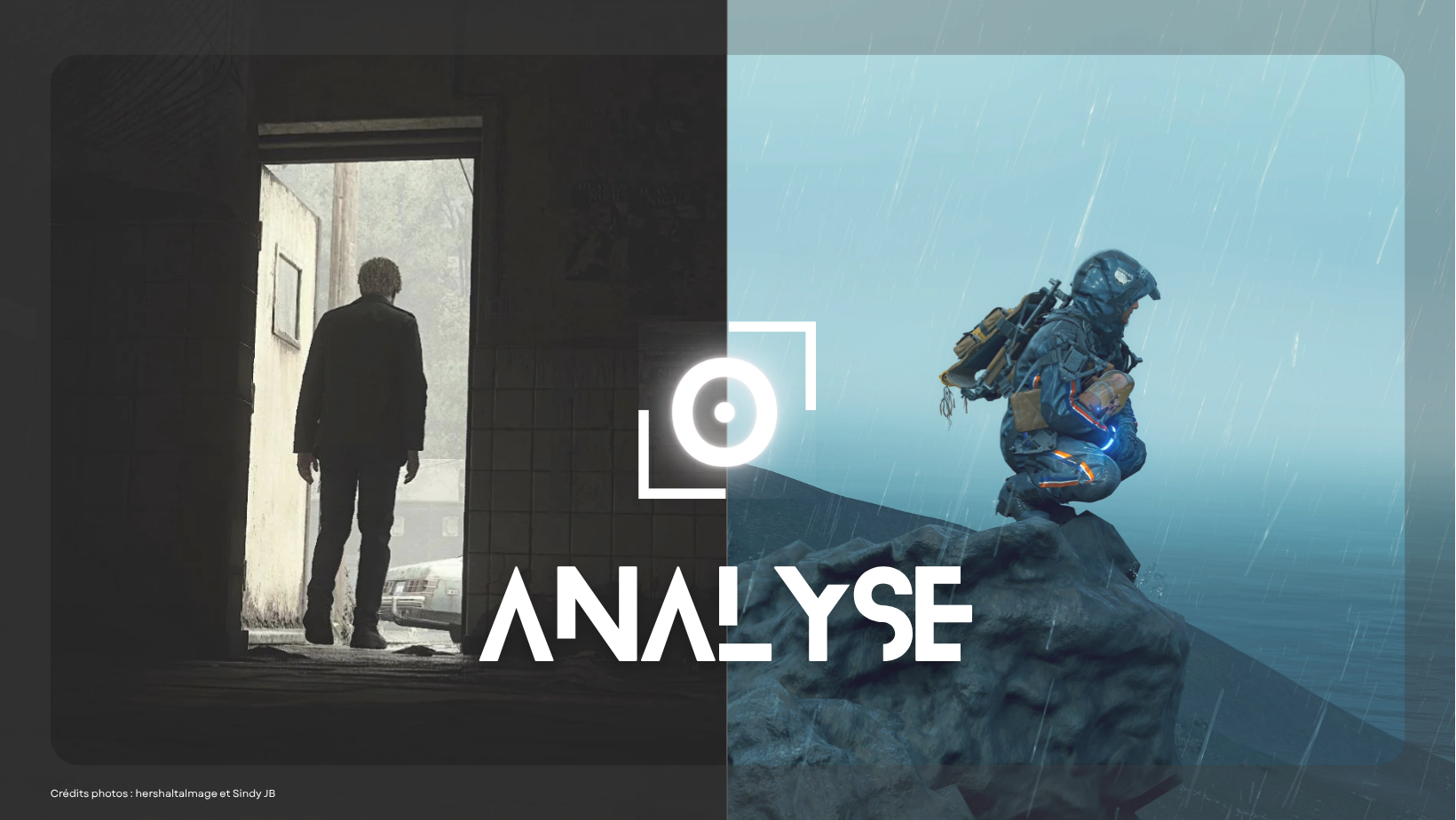
Solitude. A state—whether chosen or imposed—in which silence can act as a catalyst for conflicting, sometimes contradictory emotions. Whether redemptive, destructive, or liberating, it can lead us toward contemplation, introspection, and creativity, or toward isolation, a confrontation with our inner demons, and sometimes the acceptance of our deepest selves.
Omnipresent in art and a recurring theme for countless authors, filmmakers, and painters, solitude is inspiring, to say the least. A vehicle for complex emotions, it is as much a mirror of the soul as it is a personal perspective on the world.
At the heart of video game worlds, a sense of isolation can arise—or even be powerfully felt by the player. Through its avatar/conscious being interface, this naturally introspective bridge unique to video games allows it to evoke subtle emotional states. Solitude is one of them.
During moments suspended in time, the feeling of solitude can blossom and strike the player with its dreamlike, metaphorical, and philosophical power. This is what I experienced in Death Stranding and Silent Hill 2, for diametrically opposed reasons. The loneliness of a few key moments—vague, uncertain, reminiscent of strange emotions—reminds me of the beauty of life, but also of its fragility.
Death Stranding: a reconnection with oneself and the simple joy of contemplation
In the first episode of Death Stranding, released on November 8, 2019, for PlayStation 4, Hideo Kojima and his teams deliver a unique experience that goes against the grain of so-called more conventional open-world games. Confusing to some, bold to others, the adventure reveals, to say the least, a desire to approach the open-world map through a new lens.
To summarize the plot very briefly, the game places us in the heart of a fantastical-futuristic narrative, where a supernatural catastrophe, Death Stranding, regularly causes massive explosions and the appearance of dangerous entities. As these recurring phenomena have caused extensive damage, the survivors have taken up residence in converted bunkers or in large buildings serving as dormitory towns.
Just as an extreme climate upheaval might cause—and which, incidentally, strangely foreshadowed Covid a year before its spread—it will be essential here to try to restore hope by doing our part to rebuild the fragile bonds between human beings.

In this anxiety-inducing setting, the player takes on the role of Sam Porter Bridges, a courier transporting supplies from one bunker to another. These include food, survival gear, and various equipment needed to begin rebuilding while waiting to find a lasting solution for the planet. Using specialized gear, players must traverse the fictional equivalent of part of the United States, known here as the UCA, or United Cities of America.
Much of the gameplay’s originality stems from the fact that goods are transported primarily on foot and alone. Using a reinforced suit and an exoskeleton to assist his movements, Sam loads the packages onto his back or belt, often stacking them.
Steep mountains, rolling hills and small valleys, winding paths, damaged roads, snowy and rocky terrain, and changing weather… The ruggedness and harshness of the areas you explore will put Sam’s body to the test, but above all, they’ll help you get familiar with the topography of the surrounding landscape.
Through this simple approach, the game design forces you to take your time studying the obstacles around you and to demonstrate ingenuity and patience. The term “exploration” then takes on its full meaning, inviting you to savor moments of pure contemplation, in harmony with nature, which has gradually reclaimed its rights over the human world.

In a more structured open world, players’ eyes tend to be fixed on the GPS route that marks our path from point A to point B, or on the overwhelming amount of information displayed in-game or on the map. The scenery we pass through gradually fades away, becoming nothing more than a collection of landscapes that ultimately play only a secondary role in our journey.
By controlling Sam, the environment regains a central place within the gaming experience, gradually revealing its grammar and structural mechanics. The minimalism of a map that at first glance seems rudimentary actually conceals a game design concept of incredible richness, where curiosity and experimentation are constantly rewarded.
Through Sam, we rediscover simple Newtonian laws that govern our real world, such as the movements of the body subject to gravitational force. Sam stumbles over natural obstacles, loses his balance, falls backward under the weight of his packages…
So we adapt, we make the space our own. We learn through our interaction with the world depicted by the game, we explore the geometry of its landscapes, one step at a time, playing the score of a divinely orchestrated scenography.
The soundscape, meanwhile, will become more subdued and understated. The player will gradually become one with their avatar as they make their way to their next destination. All that will remain is the rustling of the wind, the gentle patter of rain, the trickling of a stream or waterfall, Sam’s labored breathing, and the sound of their footsteps on rock, earth, or the concrete of human infrastructure.
The ambient silence of these moments, coupled with the long stretches of walking, sometimes fosters moments of grace, suspended in time. Meditative, introspective moments, for both the player and their avatar. We begin to reflect on the noble quest Sam has undertaken across the United Cities of America. A necessary quest, sometimes literal but above all symbolic of the restoration of the social bond severed by the emergence of Death Stranding.
As if to emphasize the beginning of a key moment in the game’s story, or the end of a grueling stage—such as a dizzying ascent through snow-capped mountains and steep paths—certain pieces of music will only play during these predefined moments. A moment of relief for Sam and the player, underscored by the haunting melancholy of musical themes composed by a collective of artists, including Swedish composer Ludvig Forssell.
In Death Stranding, the destination fades into the background, giving way to the journey itself. You rediscover the simple pleasure of walking. Taking your time, planning every move. Then stopping to marvel at a sunset or a snow-capped mountain range fading into the horizon.

In natural settings, solitude represents one of the purest forms of intimacy, allowing for personal reflection and emotional relaxation that can sometimes be intense. Our ability to achieve this form of intimacy also depends on our relationship with the space around us.
For Paul-Henry Chombart de Lauwe, a French sociologist, appropriating a built space—that is, a space created by humans—tends to evoke a sense of cognitive and emotional familiarity. The objects that make up this space, through frequent use, become imbued with symbols, facilitating our sense of ownership.
In a sense, a natural space—and in this case, the fictional one of Death Stranding—will also depend on a certain environmental psychology. Or, how players will behave in this fictional environment that is nonetheless akin to a natural one.
This sense of immersion will be enhanced by the level’s symbolism. The depiction of rivers, mountains, flora, and weather, along with the harmony of their shapes and colors and the interplay of their sounds, will contribute to a sense of wholeness.
The natural setting will serve as a protective psychological refuge, amplifying both the cognitive and emotional engagement with the level design.
As a player, the moments of walking and solitude spent in Sam’s virtual body, coupled with the gentle reconnection to an elemental environment, will allow powerful creative catalysts—such as concentration and contemplation—to emerge. A poetic dimension emerges during these suspended moments, thanks in particular to the game design and intelligently crafted structural mechanics.
Silent Hill 2: a chilling confrontation with the avatar’s paralyzing fears
In Silent Hill 2, released in 2001 and re-released on October 8, 2024, Konami Tokyo and Bloober Team immerse us in a survival horror game with complex and sometimes divisive themes.
Through the maturity of its themes—centered on grief, harassment, rape, suicide, depression, guilt, and a deep exploration of its characters’ psychology—the experience caused a profound disruption in the gaming world at the dawn of the 21st century. Until then, only cinema had been able to probe the human psyche with such accuracy.
At the heart of a classic gameplay loop alternating between moments of survival and tension, Silent Hill 2 tells the story of a man, James Sunderland, whose wife Mary was violently taken from him by an illness. Three years after her death, James receives a strange letter bearing his wife’s signature, inviting him to join her in the town of Silent Hill, and more specifically at “their special place.” James then hurries back within the walls of this mysterious town, which we sense was once the setting for a part of the couple’s history.

Upon arriving on the scene, you quickly realize that the town is practically deserted, except for humanoid creatures you’ll have to fight and a few wandering characters whose stories seem obscure and unfinished. The goal is to uncover the truth about Mary and survive the monstrosities that inhabit the town of Silent Hill. Since James is no fighter, he’ll battle using whatever he finds along his journey: a spiked wooden plank torn from a windowsill, a steel pipe…
Later in the adventure, the player will come to understand that these humanoid figures and other monstrosities with their uncertain, jerky gait are manifestations of James’s tortured mind. Much like Lewis Carroll’s Alice, James will be constantly buffeted by strange events—such as initiation rituals—that will gradually lead him toward a form of deliverance. The end of a powerful self-conditioning and the beginning of a liberation from imprisoning post-traumatic fears.
In itself, the town of Silent Hill will act as an emotional catalyst for James, forcing him to reconnect with his reality and fully confront his past actions.
Although the exploration of the town in its Mephistophelean dimension is intended to be allegorical, it is by traversing its every nook and cranny that James will finally be able to confront his mental prison.

James’s body and mind wander through the streets of Silent Hill, and all the events the player experiences through this avatar serve merely as a pretext for awakening the psyche of the character they control.
If Silent Hill 2 succeeds so well in gradually immersing us in the meanderings of its protagonist’s mind and in his profound loneliness, it is thanks to the ingenuity of its game design and its coherence with the integration of the narrative, whether environmental or plot-driven.
The use of persistent fog, for example, can be seen as a contextual element of game design that invites us to walk cautiously, but also as a metaphor for the mental fog in which James finds himself lost.
What lies off-screen is also crucial, since what we don’t see plays on our senses and plunges us into an increasingly intense state of paranoia.
Exploring buildings—whether an abandoned hospital or hotel—takes place in two different versions, as if to underscore James’s mental dissociation.
Your first encounter with the locations will mostly take place in complete darkness. A deep, indomitable blackness—the embodiment of the surrounding darkness—where your flashlight will have little effect on your overall vision. A cold, icy version of James’s vision, yet born of a tangible reality, echoing a devastated and abandoned city.
The second encounter with the location will take place in an altered form. Much grittier, this time you’ll be dealing with a nightmarish vision of the same place. In these alternate dimensions, everything is distorted, soiled, tainted—as if corrupted by the vision of an evil being. Cracks have formed, with huge holes in the ground, rendering entire corridors impassable. Like nightmarish flashbacks, James relives traumatic situations or memories, distorted by his deepest fears.

Following the same logic, the absence of music and the use of silence are of paramount importance during moments of exploration. Only the sounds surrounding our character remain. The wind rustling through the leaves of a tree, our character’s footsteps echoing off the tiles of a dilapidated kitchen, James’s labored breathing, sometimes gasping in fear…
Skillfully arranged throughout the adventure, the orchestration of music, sounds, and silences reinforces the player’s sense of loneliness, lost in the labyrinthine streets of Silent Hill.
Each of James’s steps, confused and uncertain, condemns the player to share in their avatar’s mental wandering.
Through its morgue-like setting, Silent Hill 2 evokes the specter of mental illness, from which one can sometimes find no escape.
In the case of certain conditions, such as James’s post-traumatic stress disorder, thought patterns can become persistent and obsessive, causing significant distress and influencing the patient’s perception of the world around them.
Through its skillfully crafted structure—including its visual artistry, game design, music, and gameplay—the game plunges us into the same state of fear and anxiety as James, but also into a profound sense of loneliness.
A forced loneliness, where the player’s actions reflect the mental state of the controlled avatar.
When he runs, James will try to flee his demons, personified by grotesque monstrosities, evoking the stylistic excess of the surrealist painter Francis Bacon.
When he stumbles forward, James’s mind will be on high alert. The slightest sound, the slightest visual sensation will plunge the avatar into a state of mental dissociation, causing him to relive nightmarish scenes.

Warning: the end of this paragraph contains spoilers for the ending of Silent Hill 2. Back to normal in “The Quest for Meaning in Video Games.”
Finally, before facing the final boss—and ultimately his deepest fears—James will finally remember his despicable act.
During a long climb up the stairs, his steps will grow more confident, a gait that is unsteady yet deliberate. James no longer runs, no longer walks with extreme caution; he is finally ready to confront the horrific femicide he committed.
Unable to bear seeing Mary suffer any longer, he will eventually suffocate her on her hospital bed with a pillow.
A dark, grim reality that will fill the player with disgust and outrage. A sickening, uncompromising epilogue.
The player will realize that the entire game takes place within James’s subconscious. Imprisoned by a gnawing, unyielding guilt, James will draw us into the depths of his psyche, pulling us into his most intimate trauma.
For Jean Morval, a professor in the Department of Psychology at the University of Montreal, intimacy is one of the steps toward achieving psychological balance, fostering emotional release.
Through enforced solitude, James will take us on a tour of the contours of his diseased mind, placing the player in a state of temporary psychological confinement—an allegory for a severe pathological and mental condition.
The search for meaning in video games
Whether in Death Stranding or Silent Hill 2—two gaming experiences with such vastly different themes—the motifs of solitude, silence, walking, and introspection converge to form a narrative centered on confronting one’s inner self and emotional states. Whether contemplative or visceral, moments of pure grace emerge from the inner self the moment the avatar resonates with its environment—or directly with the player’s emotions.
The initiatory and often solitary journey undertaken by Sam will allow him to rediscover hope within a wounded and fractured society, while the player, in symbiosis with their avatar, must break the codes of the standardized open worlds established by major video game productions in recent years. The pace is often slow, with the gameplay forcing us to rediscover the meaning of walking and observing, and to take the time to focus on a single objective at a time.
For his part, James will embark on a quest that seems supernatural at first glance—or at least enigmatic—and that will ultimately grant him access to his innermost truth. A part of him buried deep within his psyche, awakened by his anxieties and guilt. The player will, despite themselves, be a passive spectator. Initially leaning toward empathy, our emotions will gradually evolve as the story unfolds. Fear will mingle with anger, sadness, but also, at times, with disgust and indignation.
In both cases, the stories of Sam and James managed to move me. The immediate closeness to their respective avatars drew me into a metaphysical and philosophical reflection on solitude and silence—their benefits, their drawbacks, and the insights they offer about oneself, others, and the world around us.
An example of the embodiment of yin and yang in the world of video games, as they are opposites yet complementary in their approach to a quest for meaning—sometimes individual, sometimes collective.
Loneliness in visual art : a reflective gaze upon others, a mirror of the self
If we step back for a moment from the two video games mentioned above, we can see that introspective visual art is not the most accessible.
In the realm of modern audiovisual fiction, for example, a trend seems to be emerging in which the editing breaks down into countless, almost instantaneous cuts, each lasting a millisecond. This echoes a society of ultra-speed, ultra-consumption, and instant digestion.
Our brains have gradually grown accustomed to this relentless succession of easy-to-decipher shots, unfolding a narrative that includes only the bare minimum, so that we can enjoy the spectacle without thinking too much.
Themes of loneliness, introspection, or self-reflection thus become difficult to reconcile with the very making of the work.
However, some recent productions do manage to touch upon this state of grace, transcending their narrative or creative process.
This is particularly true of Pluribus (2025), which places the fear of loneliness at the very heart of its production.
We follow the story of Carol Sturka, who is immune to an alien virus that transforms the global population into a collective of individuals whose consciousness becomes shared and collective. Carol is one of the few to retain her individuality—the uniqueness that defines us as human beings.

The storytelling is slow, heavy, and at times sarcastic, supported by an intelligent use of camera work. Each shot is meticulously constructed to tell a tiny part of the story. The camera gradually merges with the viewer’s eye, allowing for a deeper understanding of Carol’s distress. Ultimately, the film’s direction helps place us at the very heart of the character’s thoughts. Through reflections, doubts, fears, but also hope, the narrative becomes intimate and introspective.
Through Carol’s character, we feel the weight of individual loneliness within a reconceptualization of human nature. Reduced to a single thought, humanity—thus transformed—clashes with our definition of a sentient being: one who lives through the sum of their subjective experiences, feeling them in their innermost being. With Pluribus, the reflection on loneliness becomes metaphysical, calling into question one of the fundamental principles of conscious being: its singularity.
If we look to cinematic productions, both recent and older, direction and storytelling can contribute to the emergence of intimate and personal themes.
Stanley Kubrick’s film The Shining (1980) is a striking example. A work that, moreover, echoes chronic mental disorders and, in my view, touches on some of the themes evoked by Silent Hill 2.
The Shining tells the story of Jack Torrance, a writer suffering from writer’s block, who retreats with his wife Wendy and his son Danny to the remote Overlook Hotel. Hired as the caretaker for the winter, the three of them find themselves cut off from the outside world. Jack begins to lose his mind and gradually descends into schizophrenia.

Shrouded in a veil of the supernatural, the narrative of The Shining will put Jack, Wendy, and Danny’s senses to the test. Each character will experience isolation through their own perceptions, which are inherent in their engagement with the vast, labyrinthine space that is the Overlook Hotel.
A tangible, cold, and terrifying place that seems to come to life when the human soul unwittingly connects with it. Much like the town of Silent Hill, the Overlook Hotel appears to possess a will of its own, drawing in a cast of characters plagued by their fears, their doubts, and sometimes their mental turmoil.
This is the case for Jack, Wendy, and Danny, who, during their wanderings, are confronted with ghostly apparitions. Engulfed by the hotel’s icy surroundings, they are hit head-on by physical and psychological loneliness.
The Shining is one of the first films to make brilliant use of the Steadicam, a camera system that stabilizes the shot. By opting for this technique, the camera gives the impression of floating above the ground, without any jolts, embodying the spectral nature of one or more entities stalking the characters.
Or is it simply meant to embody the manifestation of Jack’s distorted thoughts as he gradually loses touch with reality? As his psyche slowly and insidiously fades away, it plays tricks on his wife, his child, and even himself.
The camera then becomes a vehicle for collective hallucinations, a powerful symbol of a neurotic and alienating loneliness.
In his unfinished work Pensées, Blaise Pascal wrote :
« Nothing is more unbearable to man than to be in a state of complete rest, without passions, without business, without entertainment, without occupation. He then feels his nothingness, his abandonment, his inadequacy, his dependence, his powerlessness, his emptiness. Immediately, boredom, gloom, sadness, grief, resentment, and despair will rise from the depths of his soul ».
This is what Jack’s character experiences during the self-imposed retreat he undertakes. Hoping to reconnect with the creative power of his deepest emotions, he gradually allows himself to be consumed by the darkness of his thoughts and his soul.
Other visual art forms that depict notions of isolation and introspection include painting and photography.
Through his paintings, for example, the American painter Edward Hopper illustrates urban isolation and the paradox of loneliness.

German photographer Andreas Gursky, for his part, captures the alienation of our modern world through large-scale, digitally manipulated images. Amidst vast landscapes, a single, metaphorical object sometimes appears, symbolizing the deviations of human nature.

Throughout the ages, solitude has always inspired all forms of visual art, such as painting, photography, video, film, and, more recently, video games.
A recurring theme that evokes complex emotions, it can depict contradictory states, such as pain or liberation.
The isolation inherent in solitude allows artists, regardless of their chosen medium, to engage with and explore complex themes such as introspection, intimacy, the search for self, reflective thought, and the madness of the human condition…
Through the lens of a vision that is at times subjective, at times turned toward others, introspective visual art reflects our anxieties, but also our most subtle desires.
A reflective gaze upon others, a mirror upon oneself.
Epilogue : the creative power of solitude
« One can only truly be oneself when one is alone; therefore, anyone who does not love solitude does not love freedom, for one is free only when alone. »
Arthur Schopenhauer, german philosopher.
Through visual art—whether in video games, film, or other media—the concept of solitude resonates with me. In its contemporary philosophical sense, rather than its literal one.
Self-imposed isolation.
The moments of silence that writing promises, alone with one’s own thoughts…
Creative thoughts during solitary walks in nature, driven by deep introspection…
For those who seek to explore it, its lexical field, in its authentic dimension, extends to infinity.

Often depicted by many artists, the concept of solitude cannot be fully captured.
It can, however, be briefly embodied in fleeting moments—
sort of ephemeral snapshots, subtle glimpses of its essence. Indomitable, fascinating.
I love finding it everywhere.
In artistic expression as well as in the quest for my true self.
Far from any social constraints, it infuses my thoughts, reorders them, and then intoxicates my senses until I reach that microdose of lucidity.
Sometimes overwhelming, sometimes ambivalent, but never taken for granted. It cannot be claimed in any way.
So we let go, we protect ourselves, we move forward.
We let ourselves be carried by these fleeting moments. These moments of grace.
Out of a desire for freedom.
Out of the awareness that we simply want to be ourselves.
Sources
La psychologie environnementale, Jean Morval
https://books.openedition.org/pum/10099
Appropriation de l’espace et changement social
https://topophile.net/savoir/appropriation-de-lespace-et-changement-social/
La théorie de la réalisation de soi : la clé du potentiel humain
https://nospensees.fr/la-theorie-de-la-realisation-de-soi-la-cle-du-potentiel-humain/
Vidéo « Silent hill 2 et la psychiatrie : analyse et théorie/KOT0V »
https://www.youtube.com/watch?v=sEmFCsMrdGQ
Trouble de stress post-traumatique
https://www.psycom.org/sinformer/la-sante-mentale/les-troubles-psy/trouble-de-stress-post-traumatique/#des-symptomes-caracteristiques-694b805d6521e
Santé mentale : Apprendre à vivre seul(e) avec soi-même
https://labeautaniste.fr/2019/08/12/sante-mentale-apprendre-a-vivre-seule-avec-soi-meme/
La solitude dans l’art :
https://www.instagram.com/p/DCMbx12hm19/
Littérature, culture & l’art de la solitude
https://hermity.com/fr/magazine-explorez-les-tendances-mondiales-des-retraites-spirituelles/litterature-culture-art-de-la-solitude/
La solitude des artistes dans leur atelier
https://leshangart.com/la-solitude-des-artistes-dans-leur-atelier/#:~:text=Chaque%20artiste%20doit%20pouvoir%20choisir%20%C2%AB%20sa%20%C2%BB%20solitude&text=Il%20n’y%20a%20donc,Yayoi%20Kusama%20ou%20de%20Donatello.
Analyses de séquences, Shining, Stanley KUBRICK, 1980
http://analysesdesequences.com/2007/11/27/shining-stanley-kubrick-1980/
La construction de l’angoisse: des représentations de l’enfermement et de l’Enfer dans The Shining de Stanley Kubrick, Quentin Charpentier
https://dumas.ccsd.cnrs.fr/dumas-01110016/file/2014-CHARPENTIER%20%20Construction%20de%20l%27angoisse….pdf
Transmettre le cinéma
https://transmettrelecinema.com/film/shining/#experiences