
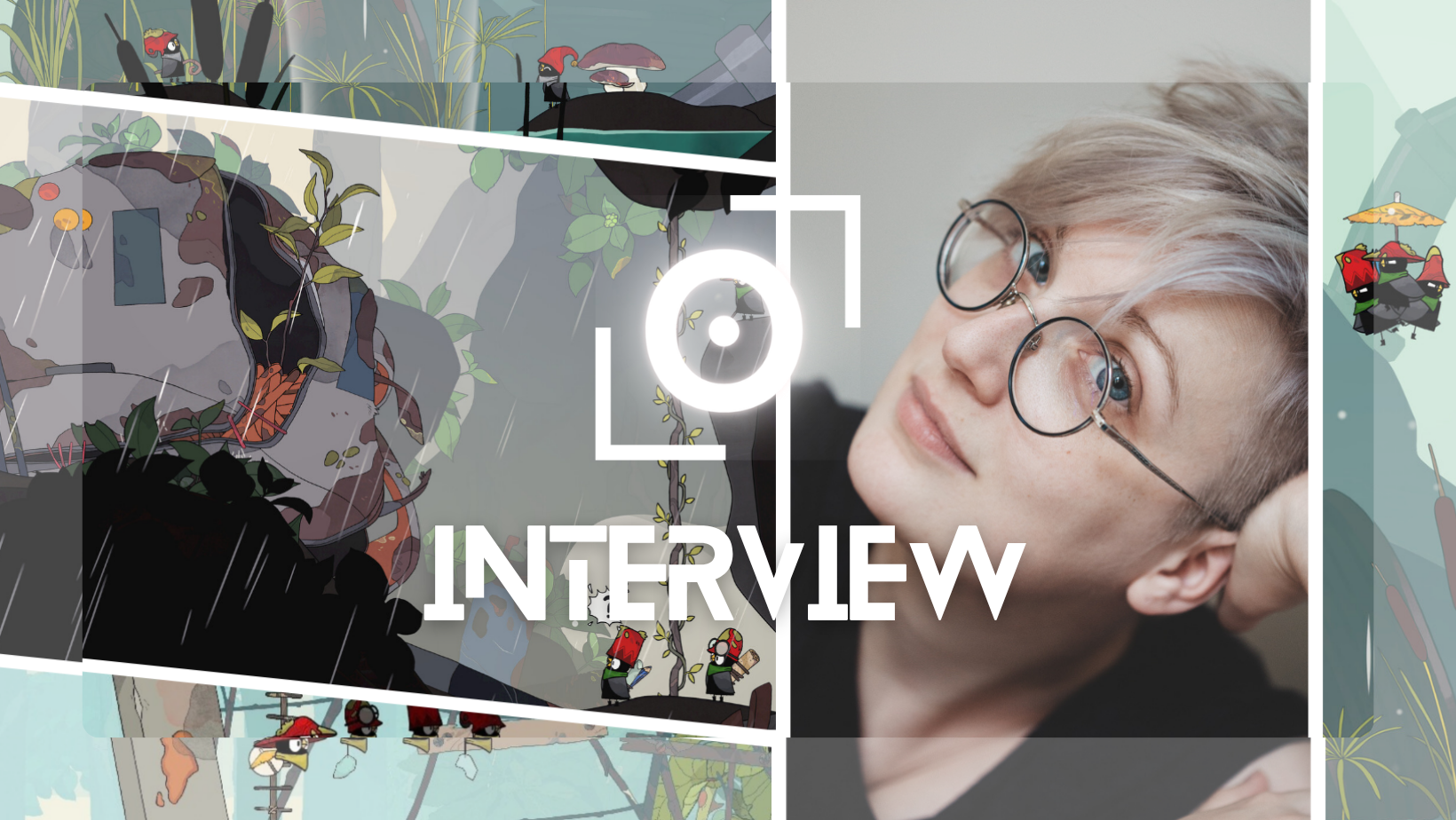
Author, scriptwriter and narrative designer Flo Rivières has spent the last few months working on the game The Merlies, developed by Darjeeling Studio and published by Arte. From the epic tale of these adorable little birds to their whole career, they agreed to answer our questions!
PnT: Could you introduce yourself in a few words?
My name is Florence Rivières. I tell stories using whatever comes to hand. I love tea and travelling by hitchhiking. There’s a rumour that I refuse to work on the same genre or medium more than once; it’s not true, but it is true that I’ve worked on quite a few projects that are very different from one another. I’m a Game Writer and Narrative Designer with a background in literature (novels, comics, poetry…) and, before that, the performing arts. I’ve been working in video games for just over three years alongside my literary work.
PnT: You’re part of the team that worked on the game The Merlies, which is due out at the end of September. What was your role? How did you come to be involved in the project?
On The Merlies, I was Narrative Designer, but I also wrote the vast majority of the text featured in the game. My very first contract with a studio was about to come to an end. At that time, Raquel de Miranda – who would go on to become my lead on the project – was the entire narrative department, and they needed some extra help. Raquel was familiar with my work through the literary side of our projects, and she felt that my ‘forest brain’ (her words, which I’ve cherished ever since) would fit well with the project’s atmosphere. My contract was renewed several times, and my responsibilities evolved in line with the production’s needs and its restructuring. So, when I joined the team, my initial tasks centred on Quest Design; I then quickly moved on to broader areas of Narrative Design and environmental storytelling, and ultimately I was the best-placed person to write almost everything, which is what I spent the majority of my time doing towards the end of production.

PnT: What exactly does a narrative designer do?
There are as many answers to this question as there are studios – or even projects! It is a fairly recent category, and the consensus on its definition is still rather vague. Broadly speaking, Narrative Design is a branch of game design that focuses on thematic coherence – in other words, ensuring that the game design mechanics (what players are asked or encouraged to do) align with the story being told and the way it is presented (the world we show players, the characters we introduce, the scenes we witness, the emotional journey we take players on, and many other elements). The idea is that creating a game means presenting a narrative—and therefore a vision of the world—whether we’re aware of it or not: implicitly, we’re addressing a subject—the theme—and we’re saying something about that subject; that’s the treatment. If I present a story about pacifism (and my treatment is to suggest that pacifism is generally a good thing) but, throughout the game, the behaviour I reward in the player is shooting everyone with the biggest gun possible, I am creating what is known as a narrative-gameplay dissonance. Narrative Designers will use every tool available in a video game (and therefore not just dialogue and cutscenes) to create as much consistency as possible, to convey the team’s intentions as effectively as possible. Potentially, this could mean literally everything in the game, from the colour palette of the environments to the quest objectives. In practice, this means that, as every game is different, our tasks can vary completely from one game to the next. Perhaps it’s my philosophy studies speaking, but I get the impression that a narrative designer’s first task is to determine what the right questions to ask are. And then to answer them.
PnT: How is the collaboration with the other team members going? In terms of world-building, character development, and so on?
Once again, it all depends very much on the project, in terms of direction, deadlines and the organisational structure. On The Merlies, after a short onboarding period, my lead (that is, Raquel de Miranda and then Léonard Bertos) and I divided the tasks between us: one of us would work on the synopsis (macro level) whilst the other made progress on the dialogue (micro level), or sometimes we’d divide up entire story arcs between us (I’ll handle everything to do with the desert, you take care of the marsh, and so on). In such cases, we had to coordinate with the Level Design/Game Design team: ‘I need a location that meets such-and-such criteria; is it possible to incorporate this into the map? For this particular moment, I’d like this to happen; can we arrange that? And, if it requires us to create a feature, an animation or a visual asset for the occasion, to what extent can we reuse it elsewhere in the game? And so on.’ As for the quest design aspect of my role, I was sort of straddling the two departments; I’d prepare my proposals and present them, and a brainstorming session would follow. Later in production, once aspects such as the dialogue and recruitment systems had been finalised more firmly, there was less need for group meetings, but the relationship with the game designers (notably Thomas Sandmeier, Lucile Thierry and, later, Andrew Jacques, who were the game designers I collaborated with most closely) remained strong and fruitful. Each department contributes its part, and the others work out how to make it fit together with the rest. Sometimes, visions clash or are too ambitious in terms of scope, and a decision has to be made, but on the whole, the more respect and willingness to listen there is, the better the game turns out.

PnT: The Merlies is about resilience, building a nest and ecology too. These themes come through in both the text and the visual style. How do you balance these elements?
I’d say, mainly through iteration. In fact, when you’re developing a video game, you tend to work in successive versions: you come up with an idea, give it a go, see what works and what doesn’t, make changes, and test it again.
Of course, there are choices to be made at the outset: what do I want the text to convey, what must the players ABSOLUTELY understand, and what can be left to intuition – or even serve as a reward for the most attentive players. Typically, the ecological narrative never really features in the text: the scenery and the music are enough to convey that sense of melancholy and the inkling of a past catastrophe, as well as the fact that nature is reclaiming its rightful place. The Merlies, for their part, never speak of it: they accept this world as it is at any given moment, in its entirety, and make the best of it. Building one’s nest is central: it is, after all, one of the game’s main mechanics, and our quest to bring this small community together only reinforces this centrality, even during exploration phases. Encountering other ways of forming a community also adds different perspectives on this theme. So, although the birds also touch on this (it makes sense that it’s at the forefront of their minds in this situation – after all, their old home has been flooded), we didn’t need to dwell on it too much in the dialogue, which freed us up to tackle other subjects and explore other aspects.
And sometimes, you realise that you’ve emphasised something more than necessary in one place, or, conversely, that an element needs to be clarified through ‘tell’ (saying or explaining) rather than ‘show’ (demonstrating or making it understood). The thing is, every element of the game contributes to the narrative and influences the others, and no matter how many creative meetings you have, at some point you have to get into the engine, put everything together and see how it turns out. And show it to several people! Not everyone picks up on the same kinds of clues in the same way, and the idea is to ensure that the message gets across to as many people as possible, not just those whose brains are exactly like ours.

PnT: Were there any things that inspired you whilst working on this game? Things you wanted to convey through the epic tale of these little birds?
Right from the very first discussions with the team, when I heard about this desire to create an ecological fable – one that wasn’t prescriptive – and about this village built from human waste, I thought of Becky Chambers’ work, and in particular her descriptions of urban buildings in A Psalm for the Wild Recyclers. Generally speaking, this cosy atmosphere combined with a post-apocalyptic setting resonates quite well with the solarpunk movement, which I’d summarise as: proposing desirable futures without sweeping problems under the carpet. We tried to adopt a similar approach. We wanted to talk about ecology, solidarity and living together. I was also greatly inspired by accounts of life and organisation within the ZAD, and by the notion that, in order to sustain the movement in the broadest sense (in this case, the exploration of the world) we must pay close attention to the bonds between people (in this case, the birds), and cultivate our empathy; even if this ‘individual’ level may seem insignificant in the grand scheme of things, it is precisely this that enables us to build a collective. And empathy isn’t a quality or a character trait: it’s a practice. At one point in The Merlies, the group of adventurers returns to La Souche after helping to resolve a major problem affecting another Merlies community. They’re very pleased with themselves – and rightly so – but find their village damaged by a landslide: I wanted to include a moment like this, one that reminds us that the call of adventure shouldn’t make us forget the need to care for others or, to quote the title of a book recently published by Blast, to ‘render care’. The issue of care is less obvious than other themes in The Merlies, but it is no less central: it is because we have shown care that the village’s happiness level rises, granting us more opportunities to revive our little companions whilst out exploring. It is because we care for the personality and needs of every Merlie we encounter outside the village that they join us there, and in turn contribute their own unique strengths to the community. It is because we have collectively looked after their vulnerabilities that the artist Merlie (re)gains confidence in their creativity and follows us, where the encouragement of their sculptor friend had not been enough.
Another point that struck us as important right from the start was the importance of focusing on telling the story of a group rather than that of a hero belonging to that group. To ground this idea in theoretical references, I refer to Ursula K. Le Guin’s essay ‘The Theory of the Basket-Fiction’, which calls for a move away from an individualised approach to storytelling—one that also relates to a certain way of presenting historical events through the lens of ‘Great Men™’—and which tends to erase the role and importance of the collective. We have tried to move towards a structure in which we tell the story of a group of characters, each of whom is equally important to the plot, and whose powers carry equal weight. ‘Stronger together’ also means that no one is above the others.
PnT: In many ways, The Merlies also incorporates the visual and narrative elements of a fairy tale or picture book. How did that idea come about? How did you develop it?
I think the concept of a fairy tale or picture book was there in its infancy right from the very start of the project. Initially, Cosmografik, who came up with the original idea of these little birds emerging from the ground, drew a great deal of inspiration from books such as The Big Book of Gnomes and The Mouse Family by Kazuo Iwamura. It was practically the first reference material I was given to read, even before the GDDs (game design documents). And before you ask, my favourite is The Mouse Family Moves House, which is hardly surprising given that, as a child, I loved building treehouses. As we went through the iterations, it became clear that we wanted to embrace this inspiration more fully, to bring it to life. That’s when we decided to use cutscenes featuring the storyteller, with artwork in these moments that was closer to illustration, and to make the player the protagonist of the tale being told. For my part, when I’m not making video games, I mainly write fantasy – and I particularly enjoy writing for young people – so the storytelling aspect came quite naturally to me. In fact, even within the broader narrative, in the dialogue, we see this motif of storytelling and oral tradition with the Bard, who also recounts the stories of his people from his own perspective as a Merlie.
PnT: You have many skills – narrative designer, environment storyteller, and so on. Could you tell us a bit more about that?
Environmental storytelling is one of the tools at our disposal for establishing the history of a world or a location. We’ll draw on the broader structures of level design, but also on the details of the scenery, sound design and AI behaviour (which doesn’t refer to generative AI, but to our good old state machines that manage the inputs and outputs driving non-player characters to act: NPCs who are more or less wary or at ease, for example), to help players understand what has happened in a particular place. This can relate to long-term events or dynamics—for example, through the architecture—as well as very recent occurrences (a well-known example being a house that’s been abandoned but where the meal is still warm on the table). Essentially, designing an environment involves, in part, deciding what happened to bring that environment to its current, specific state. For The Merlies, this is a device we used extensively for the post-apocalyptic aspect: humans do not exist in the eyes of the Merlies, except in the form of the myth of the ‘giants’ that is told to the young Merlies to impress them – and even then, it’s only a half-baked idea. It would have been contradictory to convey an understanding of this storyline through the eyes of the Merlies, who do not set out to investigate the origins of the artefacts they collect or the rubbish littering the various biomes: we therefore had to rely almost entirely on environmental storytelling. It would have been contradictory to convey an understanding of this particular arc through the eyes of the Merlies, who do not set out to investigate the origins of the artefacts they collect or the rubbish littering the various biomes: we therefore had to rely almost entirely on environmental storytelling. It was Raquel de Miranda, the head of the narrative team, who laid the foundations for this work: each biome was ‘imbued’ with a dominant theme and emotional tone, which served as our compass for determining the gameplay elements, collectables and dialogue that would feature within it. During this process, we drew up a separate document describing the early stages of this ‘slow apocalypse’, how people coped with it, what resources they had, how prepared—or unprepared—they were, and how they eventually came to leave… which also enabled us to establish certain things: which biomes they had spent the most time in, why, and how this was shown on screen. Of course, this involved working with the Game Design team: as the biomes are unlocked in a relatively fixed order, this order determined the sequence in which players would be exposed to the various clues. There was no question of turning up at a meeting and demanding that we change the entire flow just so the tip could be unlocked first! I’d done similar work for the underground areas, in case we were able to visit the old Merlie underground passages, but the scope of the production didn’t allow us to include that part of the map.

PnT: If I remember correctly, for The Merlies, you wrote the lyrics in English but not in French. Was that your decision? Or the studio’s? Did it have an impact on your approach to the game? As you’re also a translator, I was wondering.
I think that when you write for video games, you inevitably have to let go to a certain extent: once your work has been translated into multiple languages, there will be some that you don’t have a firm grasp of. It’s a bit like the saying that once your book is published, it no longer belongs to you – it belongs to its readers. It just so happens that, for reasons of habit and workflow, we generally write the first draft of a game in English, then entrust the translation to localisation agencies that work with a variety of translators and centralise all the target languages. I could have done the French translation myself, but the question didn’t really arise: in my view, it was more practical for production to treat this language like any other. I did, of course, produce guidelines for the translators to inform them of certain things—the choices we’d made regarding colours, and how to avoid gendering the Merlies. I know that Léonard Bertos, who joined the production team as lead narrator towards the end, speaks German and so made his own suggestions in that language; I did the same for the first drafts of the French text, but to be honest, even after handing over all the game’s text to the localisation team, we still had a lot of work left to do, so it wouldn’t have been very practical to act like control freaks any more than we already were. That inevitably means I prefer it when people perform in English, as then they’re experiencing my work directly rather than an interpretation of it; but on the other hand, it’s not as if I’m standing over every performer’s shoulder explaining, ‘So in this line, I’m referring to this and that, and I’m using such-and-such a technique to achieve such-and-such a result, do you understand? Do you understand?”
PnT: You’ve also worked on Anno and Ghost Recon. Do you find that the game’s genre (management, adventure, etc.) affects the way you work? If so, how?
So, to put it simply: yes.
To elaborate a little: first of all, every game has its own toolkit that we can draw on to a greater or lesser extent to enrich the narrative. If I’m working on an extremely fast-paced action or racing game and I suggest including a ten-minute cutscene, I’ll need a bloody good reason – otherwise people will laugh in my face. Productions also have their own specific objectives: whilst every game inevitably features a narrative, it doesn’t automatically follow that the narrative should be prioritised. Sometimes, game design adapts to strong narrative directions; at other times, it’s the other way round; and in other cases, the game is based on a strong aesthetic vision that informs the other areas… In short, my tasks and the creative scope I had available have always varied from one contract to the next.
Then, of course, there are the worlds we’re working in. Obviously, I spent far more time with my nose buried in history books for Anno than for the latest Ghost Recon Wildlands DLC, and not just because the latter is set closer to our own time: the foundations of Ghost Recon’s framework had already been laid a decade ago; we were working on a very old engine with fairly tight deadlines, so the whole team worked within a fairly strict framework and managed to find room to express themselves within the gaps in that framework.
PnT: For you, what are the best ways to tell stories? Is there a game whose narrative design really made an impression on you?
I think that for every story, there are countless ways to tell it. And each of these ways will highlight a particular aspect of its theme, a different angle, a key idea – in short, a particular approach. I also believe that a story that’s been told is better than a work-in-progress that remains in the planning stages for ten, twenty or thirty years. When I’m working on my own, I like to explore these potential angles, but also the way in which different formats impose constraints and open up new possibilities: if this novel were a video game, what would I have to give up, but also, what else could I explore? If this game were a comic, what would I focus on? In production, we have tighter deadlines and people are relying on our work, so there’s rarely room to indulge in this sort of experimentation, which I regret, but well, as long as capitalism hasn’t been abolished, we’ll just have to make do.
Video games whose storytelling really made an impression on me… well, if I don’t talk about the thematic subtext in Ocarina of Time at least once a week, I’ll catch fire – but everyone already knows that. I really liked the use of sound in A Plague Tale (Asobo), and the way the theme of reconciling trauma and parenthood was handled in the second instalment, Requiem, struck me as both highly effective and nuanced. But today, I want to talk about a smaller-scale game (spoiler alert) that I’ve had the chance to play recently.
In Harmony: The Fall of Reverie (Don’t Nod), you play as Harmony, an oracle capable of perceiving different future paths – not perfectly or comprehensively, but enough to make her feel immense pressure regarding the choices she makes. This ability is reflected in the UI: you can quite literally see the different moments in the story (notes) and the links connecting them. So you find yourself faced with this labyrinth of possible paths, and you try to work out how to navigate your way to where you want to go, without necessarily getting there. At one point in the game, a character dear to her – one you’ve grown attached to – dies. Everyone is shocked; naturally, Harmony feels guilty. And, for an entire act, this tree structure disappears. There is only a straight line leading from node to node; there are no choices. We move from a scene where Harmony cannot get out of bed to the next, and whilst this moment does not last too long, it lasts long enough for us, too, to feel that sensation of being stuck on a path we have no control over. What’s the point of seeing the future if we can’t even prevent the death of a loved one? What’s the point of choosing when we’re not even in a position to act? Well, there’s a joke that goes that almost all indie games are, in fact, about grief. But I found that this particular moment in the game captured that feeling and process with great accuracy, and with a rather fascinating economy of means, whilst—for the duration of a single act—completely calling into question everything we thought we knew about the rules of the game and how to play it. There’s no way of knowing how long it’s going to last. Just as grief can strip us of everything we thought we knew about the world.
And it’s really well written.

PnT: That’s just one of your skill; you’re also a translator and an author (among other things). How do these other ways of creating and approaching a work influence your work? Have there been instances where you’ve wanted to explore something from one medium in another, for example?
Well, I touched on this point a little in my answer to the previous question, so I’ll approach this one from a different angle. I think a fundamental difference between my activities, beyond the obvious difference in profession – the techniques involved in writing a novel are not the same as those used in writing for video games, the constraints and possibilities aren’t the same, even if there are some tools that overlap – is that one is primarily a solitary endeavour (which becomes less so once you’ve signed with a publisher, but even then, there are only a few of us working on the text), whilst in the other, you’re part of a collective. My work in video games is inevitably bound to interact with that of a whole host of people, and to be just a small part of a whole. Each situation has its pros and cons, and I think having both in my life helps me strike a balance in my approach to creativity, to find the right distance. Of course, everything I know in one field inevitably influences what I know in the other. For example, translating is not simply a matter of replacing one word with another: very often, it involves making choices regarding interpretation, form and tone, and this requires a particularly analytical reading of the work being translated so as not to betray its spirit; in this sense, it is both the work of an author and a collaborative endeavour. The same applies to film: just because I write the screenplay doesn’t mean the director will do exactly what I had in mind, and even then, the editor will add yet another layer of interpretation to both their vision and mine.
I’m quite passionate about the subject of adaptations. When I go to see or play an adaptation, I’m often frustrated that I haven’t had time to reread, rewatch or replay the original – not because I want to assess how faithful the adaptation is; I don’t really care about that. But I like to see the choices that have been made to ensure the story works well in its new medium. I also believe that the whole point of an adaptation lies in the moment when someone, somewhere, said to themselves, ‘I have something to add; I think there’s something to be said about this story that hasn’t been said yet.’ ’ Then, as with any stance taken, the result may not be universally accepted; it might fall flat, and people might strongly disagree with the added subtext. But that’s what I want to see, and I hope that, when the day comes that I work on an adaptation project, that’s what I’ll manage to achieve.”
PnT: The Merlies was released at the end of September. Do you have any advice or recommendations on how to get the most out of the experience?
I’m going to be a bit old-fashioned here, but wrap yourself up in a blanket to prevent or treat seasonal colds, make yourself a nice cup of tea, and, above all, take the time to just take your time. The Merlies isn’t a frantic adventure; it’s more our way (the devs’) of giving you a bit of a ‘pebbling’ experience. Yes, just like a group of penguins.
PnT: And finally, one last question – this might be a bit of a sensitive one – but is there a question you haven’t been asked but would still like to answer? Any final words or advice for our readers?
“But tell me, Florence Rivières, what would this underground biome that’s been cut off have looked like?”
In fact, it was part of a whole ‘back-to-the-roots’ storyline: we were passing through the old tunnel-houses of the Merlies, which had been flooded at the start of the story, and the further down we went, the more ancient dwellings we came across, all of which had long since been abandoned. It was a bit like stratigraphy, a discipline derived from geology that enables archaeologists to study the relationships between different layers of earth. However, we realised that the Merlies of yesteryear had, themselves, used human remains to build their homes: we found objects dating from the Industrial Revolution, then, even further down, medieval artefacts… until we reached a cave, a sort of ancient Merlie city, built on and within stalactites which themselves rested on ancient objects such as a hoplite’s helmet, that sort of thing. We wanted to show that the events within the game’s timeline weren’t an anomaly, that a sort of cycle was unfolding and had always unfolded: humans leave a place, the Merlies salvage their rubbish and invent a new life for themselves from it, then the humans return and the Merlies burrow away. Does that mean humans are still out there somewhere, just too far away? We’ll leave that up to the players to interpret as they wish!
Thanks you so much !