
SPOILER ALERT
You may recognize yourself in these words, but I find that the sense of melancholy we feel when we feel tiny is both distressing, you’ll agree, and yet comforting… An extremely unsettling mix that I’m sure I’m not the only one to feel. A strange sensation, hovering between wonder and terror, that takes hold of us the very moment we look up at an infinite night sky, when we watch a wave crash violently against the white rock of a cliff, or when our gaze soars at the sight of a tower, a bridge, or any structure, human or otherwise, and we realize its immensity. Faced with all these moments when the sheer scale of things overwhelms us (yes, that makes sense), a door can open in our perception of the world. In these moments, we cease to be the center of the universe and become merely fragile, fleeting witnesses to it, and this experience, this sensation, bears a theoretical name forged by centuries of philosophy and art theory : the Sublime. From Longinus to Immanuel Kant, including numerous Romantic painters, artists have ceaselessly sought out that breaking point where beauty tips over into immensity, where a sense of security fades before a force of uncontrollable magnitude, and where the admirable converses with the terrifying. The Sublime in video games is that feeling that seeks to dazzle you, to throw you off balance, to remind you of your condition as a human being, as a mere spectator, and of the fundamental precariousness of your existence.
Yet, in the digital age, one medium has reclaimed this fascination with the infinitely vast and the indecipherable with remarkable power: video games. This development may seem paradoxical. For decades, the medium of video games has accustomed us to embodying demigods in Hades, mapping worlds in Minecraft, conquering territories in Civilization, and subduing complex systems through the sheer force of our reflexes or logic in Dark Souls. And yet, within this nearly infinite catalog, there are works that leave a deep imprint on our memories, aesthetics that reject this promise of omnipotence and, on the contrary, deliberately choose to overwhelm us.
Whether it’s wandering at the foot of impossible structures erected by forgotten civilizations, traversing landscapes dominated by cosmic forces indifferent to our existence, or confronting religious dogmas whose oppressive weight suffocates every shred of our humanity, video games know how to orchestrate the staging of our own insignificance. So why do we actively seek out this feeling of powerlessness ? How do video game creators manage to translate philosophical concepts, once reserved for Romantic painting or cosmic horror literature, into gameplay systems and visual compositions ? By exploring the intersections of art history, the philosophy of vertigo, and game design, we will seek to understand how video games transform our sense of insignificance into a poetic and cathartic experience. For ultimately, surrendering to what is beyond our grasp may not be an admission of weakness, but rather the essential prerequisite for perceiving the beauty of the world.
I – Gigantism
Let’s begin our journey in Germany, specifically in the early 19th century. If we have to decide on our first stop, the land that gave birth to one of the leading figures of Romanticism is undoubtedly the best option, since, to understand how our favorite video games slowly instill in us that sense of helplessness, we’ll need to discover why Romanticism emerged. And who better than Caspar David Friedrich to show us this ?
During the pre-Romantic period, Neoclassicism was very popular, if not one of the only artistic movements in vogue. The fact is that landscape paintings, where the setting serves merely as a backdrop to highlight the actions of men, gods, or heroes, are magnificent to observe and analyze, but they do not make us feel that “Sublime” we seek, that overwhelming grandeur that looks down on us and crushes us with its power. This is where Friedrich’s paintings come into play. Suddenly, nature is depicted not as a backdrop, but as an unstoppable force. Sometimes dangerous, sometimes calm, occasionally devoid of human presence, but always alive. Let’s take two of the German painter’s best-known works as examples: Monk by the Sea (painted in 1810) and the iconic Wanderer Above the Sea of Fog (painted in 1818).
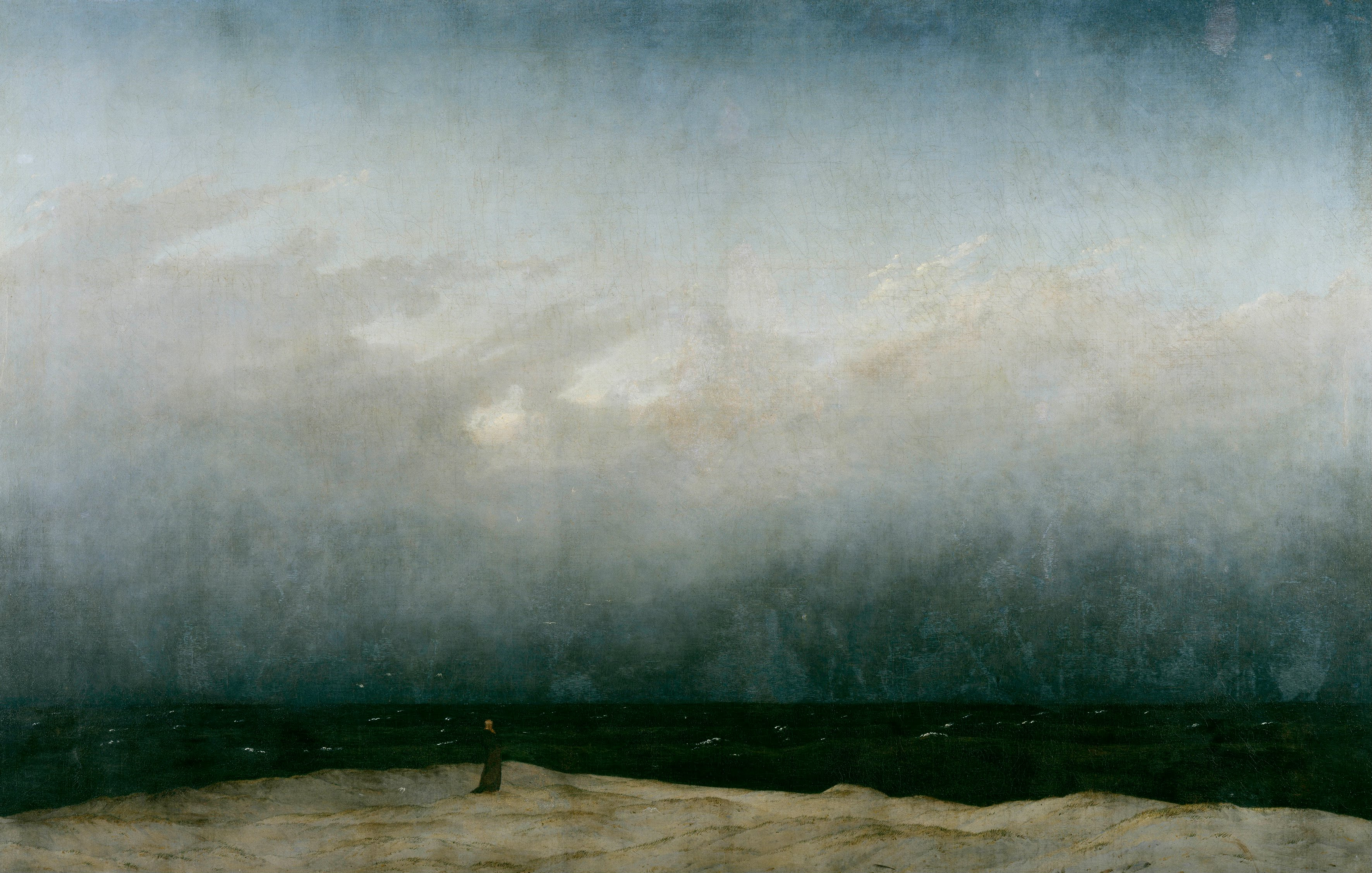
Monk by the Sea
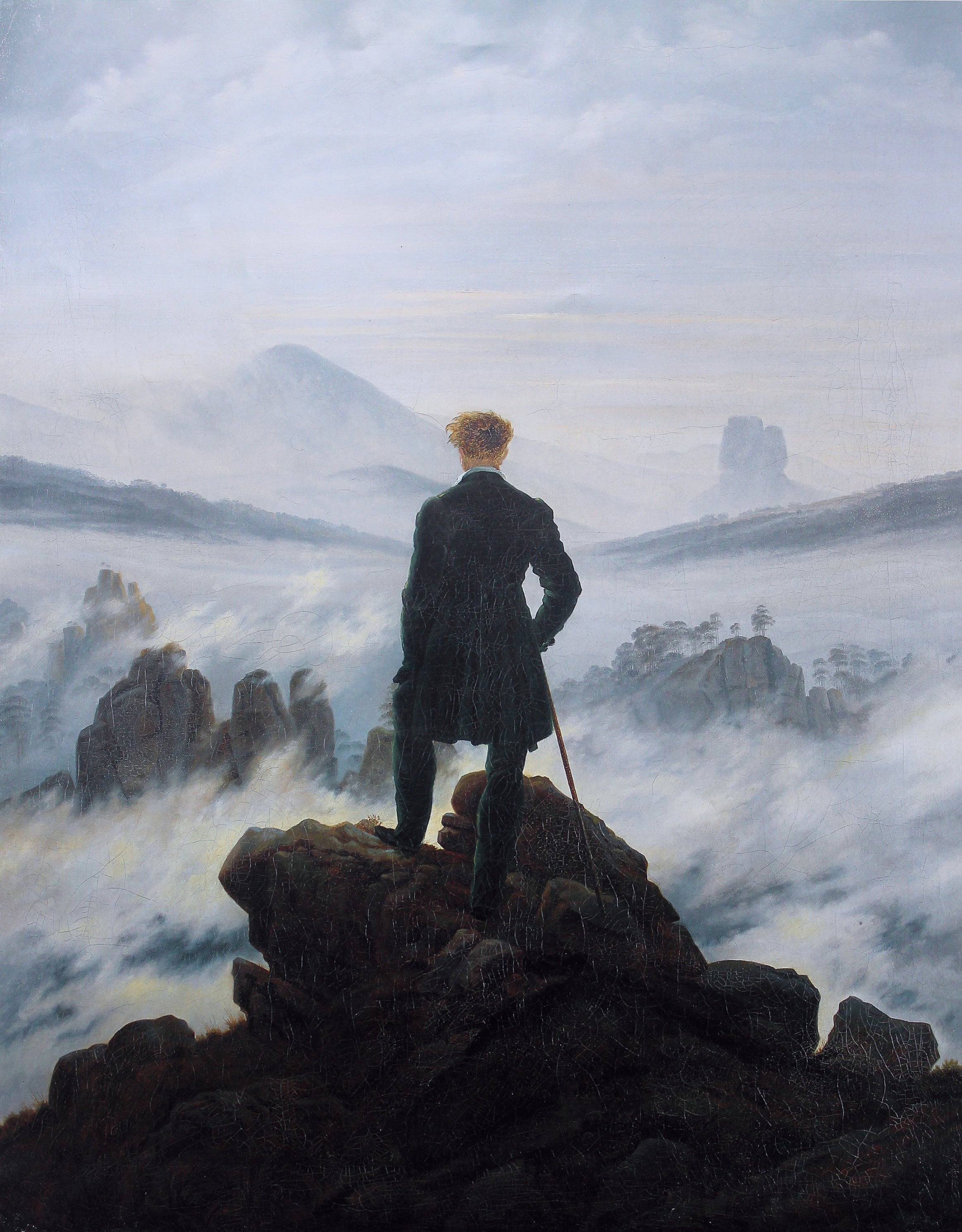
Wanderer Above the Sea of Fog
The composition of the first painting is understated, but perhaps you, too, sense that there is something unsettling about this scene. Is it the apparent calm of the water ? Its dark color ? The storm that seems to be approaching? Or perhaps the loneliness of the poor man in the foreground? The painting is divided horizontally by three distinct bands: the dark land, a leaden sea, and a pristine sky that occupies four-fifths of the space. And at the bottom, barely visible, is our monk, so out of proportion that our eye as a mere spectator has trouble locating the figure at first. Why ? Danger. We tend to look first at what might put us in a precarious situation, and in this case, the horizon offers no reassurance. The human being tiny, insignificant, crushed by the power of nature. In the second painting, Friedrich introduces us more concretely to a concept found not only in many works of art but also extensively in video games : the Rückenfigur (which means “figure seen from behind” in German). To illustrate this magnificent word, remarkably simple to pronounce, Friedrich paints a man with his back to the viewer, whom we understand to be gazing at the horizon before him. A horizon shrouded in mist, from which emerge mountainous reliefs, each one unique. Some are immense and triangular; others are smaller, closer, more rectangular, and more original. The fact that we cannot see the emotions of the central figure in this painting allows us to project our own very personal feelings onto it. Of course, seeing the joy or horror of the figures in a painting can sometimes guide our emotions, but in the case of The Wanderer, he remains mysterious, and like us, he cannot tear his gaze away from this sea of clouds. He thus serves as a screen; the viewer is invited to slip their own gaze into his, to identify with this silhouette and experience, vicariously, the same metaphysical vertigo. This composition gives us the first key to continuing this journey, a key that countless artists before us have discovered and that has opened the door to the Sublime for them. Among them is a video game developer who will help a whole bunch of players, both male and female, understand that the Sublime also has its place on a screen or at the end of a controller : Hidetaka Miyazaki.
Who in today’s video game world doesn’t know Miyazaki and his Souls series? Or, more recently, Sekiro and Elden Ring? Whether you love them or hate them, whether their aesthetic resonates with you or leaves you cold, these games have, over time, become true classics of the genre, notably because of their difficulty, their particularly demanding storytelling, and their visuals. All these titles, from Dark Souls to Elden Ring, with a detour through Bloodborne (which we’ll discuss in more detail later), are masterclasses in game design, but also, and above all, works of art in their own right. So today, it is the studio From Software that will serve as our mirror to German Romanticism, and more specifically, Elden Ring, the publisher’s most recent game, and you’ll quickly understand why. Through environments that can be drastically different, the Betweenlands offer us a journey that is at once poetic, melancholic, oppressive, and mysterious. Whereas, in my opinion, video games tend to sell their worlds to us as a form of conquest, or at the very least, appropriation, Elden Ring turns this philosophy on its head, right from the very first minutes of the game, at the very end of the tutorial. Your character lifts that heavy stone door, and before them unfolds a breathtaking landscape: Necrolimbe. If you look closely, players can already make out Voilorage Castle, the World Tree, and Elleh’s Church (which houses NPCs who will help you at the start of your adventure), as well as, in the distance, hidden behind the mist, the Giants’ Forge. This is the place where you’ll make a choice of paramount importance, but you still have many hours ahead of you. Your character takes exactly the same stance as Friedrich’s Traveler; though you aren’t gazing out at a sea of clouds, you’re facing a landscape that doesn’t really give you any answers, but makes you ask yourself a thousand questions.
Where From Software succeeds wonderfully in capturing the Sublime is in these underground spaces. Logically, we might be tempted to associate artistic awe with outdoor structures, titanic cities, edifices that dominate the landscape, and are therefore free from any kind of enclosure. The fact is that Elden Ring features a world beneath the Between-Worlds that is just as fascinating as the first. Among these various hidden layers, the one surrounding the Siofra River is simply mesmerizing. To begin with, access to it is similar to that in the first BioShock, a long descent in an elevator, this time made of stone, and then comes the discovery of the city of Nokron: the eternal city. A necropolis isolated from everything, bathed in light by what we come to understand is a ceiling of stars. The sight seems impossible. Understand that while discovering a new part of an already rich and vast world is one thing, it’s above all the story it tells that overwhelms us. This world we’re awakening has existed for hundreds of years; beyond the visuals, it’s the narrative weight that settles on the already frail shoulders of our character, the one through whom we experience this adventure. His shoulders are our own, and discovering this “hidden” level, as it were, adds that sense of realism, a sensation that could be likened to Stendhal syndrome, the one that triggers that famous dizziness at the sight of a work of art, that moment when trying to comprehend the immensity standing before us becomes too much.
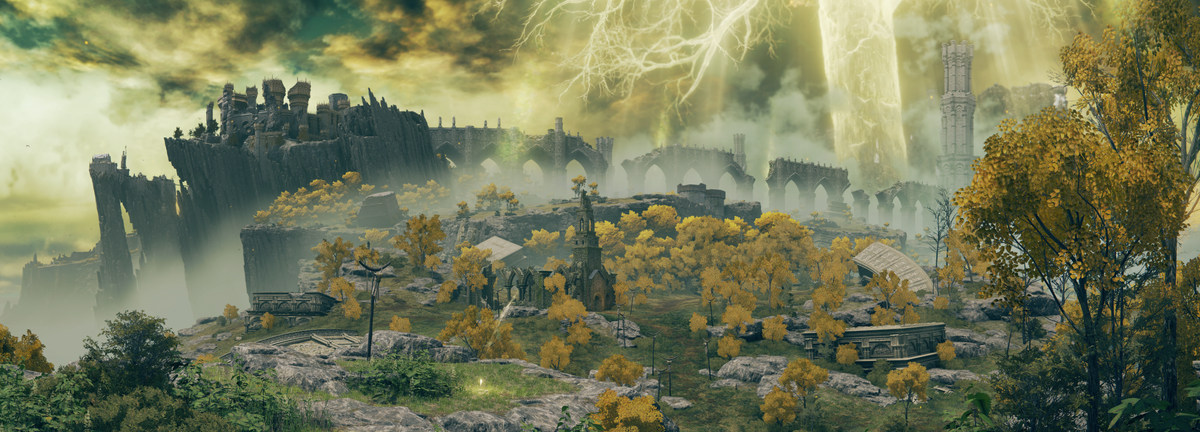
Stunning view of Limgrave
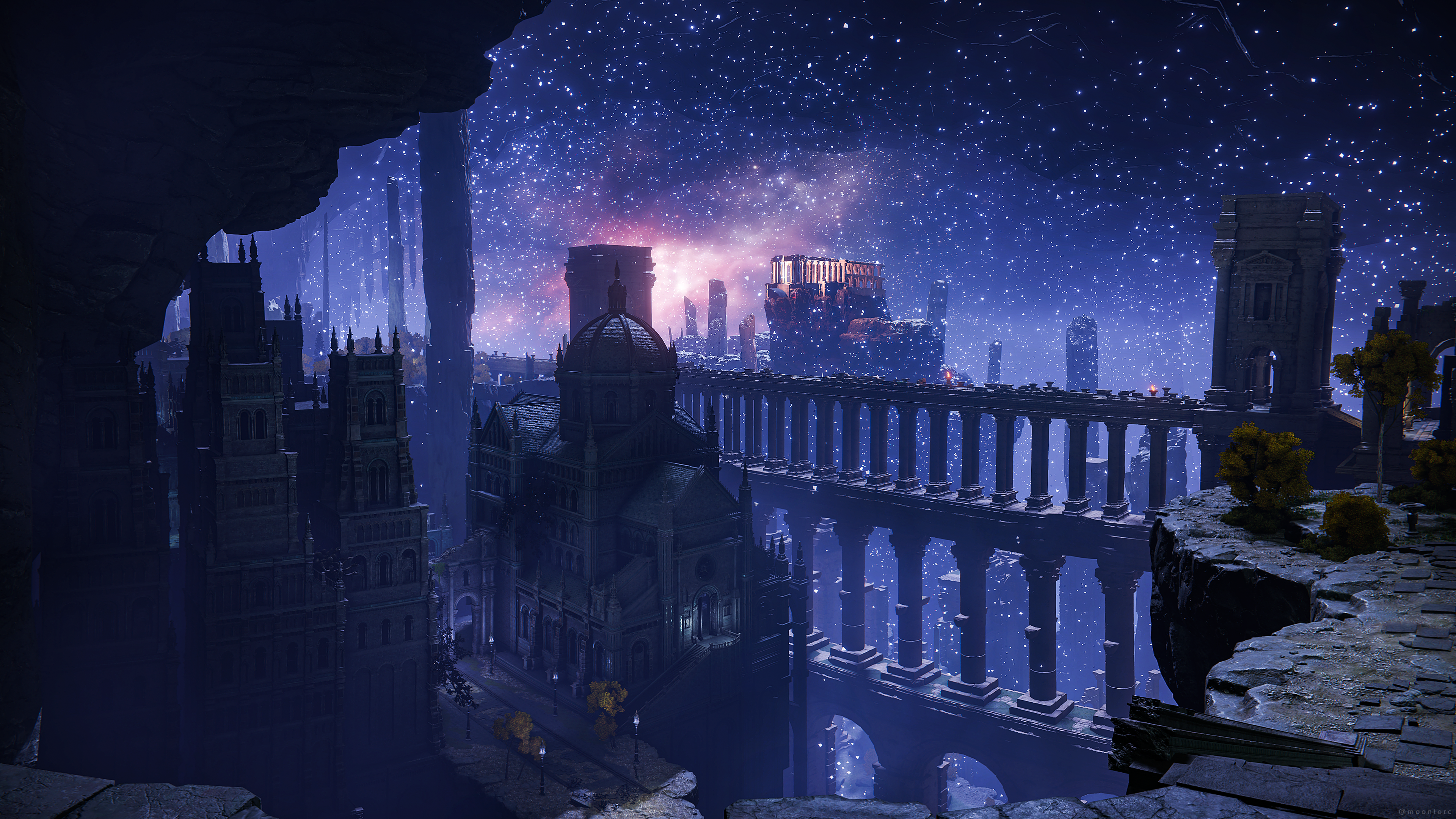
Nokron, the eternal city
But where I believe Elden Ring succeeds in surpassing Friedrich’s paintings is in how it conveys its relationship to the landscape. When faced with a painting, we can only be spectators; even if our feelings are diverse and varied, none of our actions can influence what we perceive. The fact is that video games place us just as much in the role of the spectator as in that of the actor. Feeling the monk’s vulnerability as he faces an inky sea is one thing; controlling a frail character and surviving hostile creatures—whose slightest swipe of a claw could set us back 30 minutes—is quite another. Elden Ring—and, more broadly, all of From Software’s games—are skillfully designed to make us feel this realism in every move we make, all with the aim of conveying our hero’s fragility in the face of the world around him—or through the screen. The camera work also plays a crucial role in creating that sense of vertigo. When facing a colossal creature or approaching the ruins of Farum Azula, for example, you get the sense that the camera struggles to frame the opponent’s entire body or even just the area. And this is yet another extremely clever way of making us realize the grandeur of things. This is also where one—if not the greatest—strength of the game lies: its game design. Through Elden Ring, From Software teaches us to love our own insignificance. Instead of causing frustration, this disparity creates a kind of melancholic fascination—such as when you traverse the devastated region of Caelid under a blood-red sky, observe the giant skeletons embedded in the cliff faces, or contemplate the solemn majesty of the Royal Capital of Leyndell. All of this evokes a rare poetic emotion—one to be cherished—and every moment of it should be savored to the fullest. It’s a privilege to experience games like Dark Souls, Bloodborne, or, in this case, Elden Ring for the first time.
II – The Incomprehensible
While Caspar David Friedrich’s marvelous, awe-inspiring, or simply unsettling landscapes show us how humans can be confronted with their own physical insignificance, it is interesting to look beyond the realm of visual art and turn our attention to words—or should I say, to what lies behind the descriptions that the sometimes incoherent arrangements of letters can offer—particularly in a genre that diverges from Friedrich’s inspirations: science fiction. And within this already well-established branch of literature, there exists a subgenre that still sends shivers down the spines of readers who discover it: cosmic horror, one of whose pioneers is none other than Howard Phillips Lovecraft. By creating the concept of cosmic horror, the writer from Providence articulated a terrifying insight: the oldest and most powerful emotion of mankind is fear, and the oldest and most powerful of fears is the fear of the unknown. In Lovecraft’s work, the sources of dread are not covered in claws, sharp fangs, or an insatiable hunger for human flesh. No, absolutely not. He prefers to imagine cyclopean deities like Cthulhu, a monster slumbering beneath the oceans, awaiting its awakening. The dimensions from which these kinds of creatures originate are quite simply indescribable, and the recurring use of terms like “non-Euclidean geometry” or “impossible forms” in these texts quickly makes us realize the scope of these descriptions… Things that are sometimes impossible to imagine or visualize. Many artists have attempted to reproduce as faithfully as possible the creatures and environments conceived by Lovecraft, and I can’t help but think about the difference between these artists’ visions and those that took shape in the American writer’s mind. And it is, in fact, this aspect of these stories that has made them so popular, in my opinion; the true drama of Lovecraftian tales lies not so much in physical death as in the collapse of sanity. Even the slightest bit of obscure knowledge becomes a poison, and the deeper one delves down this rabbit hole, the more one realizes that our existence is nothing but an accident—a mistake in the vastness of the cosmos, which is itself governed by blind entities beyond our comprehension.
On a more visual level, this anxiety about a disembodied, abandoned universe can be found in the paintings of Zdzisław Beksiński. In the works of this famous Polish painter, we see his own traumas from World War II, though depicted in a way that is difficult to describe. Beksiński calls this his “fantastic period,” but what clearly emerges from his paintings is the scent of certain death, nightmarish visions, and bodies that are torn, compressed, tortured, and altered—everything seems to exude unbearable pain. In what could be considered Beksinski’s universe, the line between humanity and madness is as thin as tracing paper. The architecture there is gigantic, yet constructed from a grotesque assemblage of fossilized bones. The fact is, there is no consensus on the meaning of his paintings, since the painter himself admitted to hiding no message behind these brushstrokes. He paints what he sees in his dreams, and there is nothing more to it. He even goes so far as to leave these canvases nameless and untitled, as if they were merely fragments of something greater—or perhaps not. There is this echo of the grandiose, of the wildly tortured, somewhere between Lovecraft and Beksinski. Incomprehensible visions, ideas we struggle to attribute to human minds. By depriving us of points of reference, the painter places us in the exact position of the Lovecraftian scholar : at a loss in the face of a poisonous beauty whose underlying logic eludes us irrevocably.
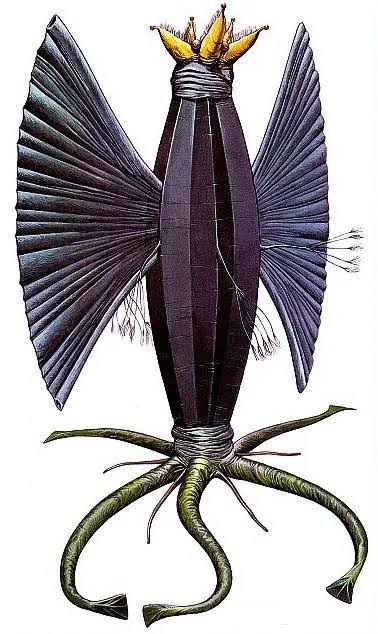
Old One drawn by Wayne Barlow
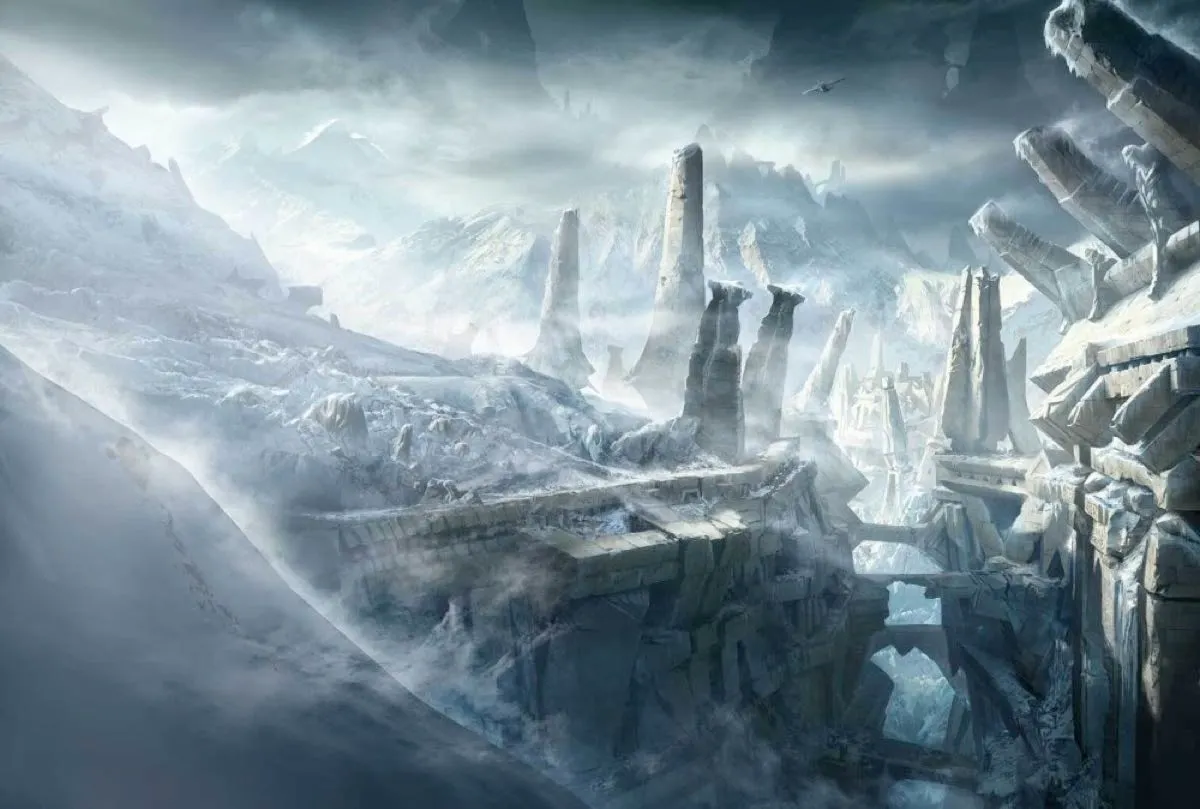
At the Mountains of Madness, drawn by François Baranger
And if there’s one video game that, in my opinion, has managed to capture this dual literary and visual heritage to create an experience that’s as eerie as it is unique, it’s undoubtedly Bloodborne.
Many aspects of this game are fascinating, but the way its story and aesthetic evolve over the course of hours—and as the night progresses—is a remarkable concept. It all begins as a game with an unapologetically gothic vibe, drawing much of its inspiration from Bram Stoker’s Dracula or, more broadly, from 19th-century Romantic literature. The player takes on the role of a hunter in the dark city of Yharnam (directly inspired by the city of Arkham from H.P. Lovecraft’s writings), a dizzying neo-Gothic metropolis populated by bloodthirsty beasts, infected humans, and those who have gone mad. Beyond that, the player can accumulate and choose to preserve a specific resource throughout the adventure: Lucidity. This resource, which lives up to its name, allows the character to see the invisible—namely, entities straight out of Lovecraft’s darkest short stories. No one knows from which cosmic dimension they originate. It is then that the true nature of our quest becomes clear. Understanding the source of the epidemic is merely the tip of the iceberg—and the superficial consequence of a far greater heresy: the attempt by scholars at the Byrgenwerth Academy to communicate with the Great Old Ones (Lovecraft again)—extra-dimensional celestial entities nestled in the invisible strata of reality.
It is then that, little by little, the game blends Beksiński’s artistic style with everything that defines Lovecraftian mythology. First, there is the city of Yahar’gul, which looks as though it came straight from a painting by the artist from Sanok. Whether it’s the stone facades—which this time are covered in frozen corpses, still tormented by the immense pain etched on their faces—or the atmosphere as oppressive as certain death, watching you invisibly from the sky and lurking in every corner of the rooms you pass through. Yahar’gul is nothing more than a gigantic sarcophagus that pretends to be a city to make itself seem less terrible than it really is. Also, as we mentioned earlier, there’s the Lucidity stat. Once it reaches a certain threshold, it allows the surroundings to reveal their true nature. From the very beginning, monstrous creatures—the Amygdala—have been silently watching you from the tops of bell towers, clinging to walls, and hiding in the ceilings. These cosmic-looking monsters, with long, dark limbs covered in eyes, are a perfect blend of the best of Lovecraftian and Beksinski horror. The first time I saw the “real world” of Bloodborne, I felt the same way the explorers of the Hallucinatory Mountains did when they first discovered the origin of the Elder Gods. Their own inner worlds were crumbling as they struggled desperately to make sense of this new reality that was being forced upon them. There are two paths: fascination or madness. This is where Yharnam serves as a true lesson in aesthetics and narrative. This city, which we’ve been traversing for so many hours and which has already seen us die time and time again, tells us only part of its story, waiting for us to reach a certain stage of lucidity before revealing its most incomprehensible horror. There is undoubtedly nothing more “Lovecraftian” than painstakingly acquiring knowledge, awareness, lucidity—whatever you choose to call it—and then being crushed by the immensity of a new reality. Bloodborne masterfully captures the concept of knowledge as desecration.
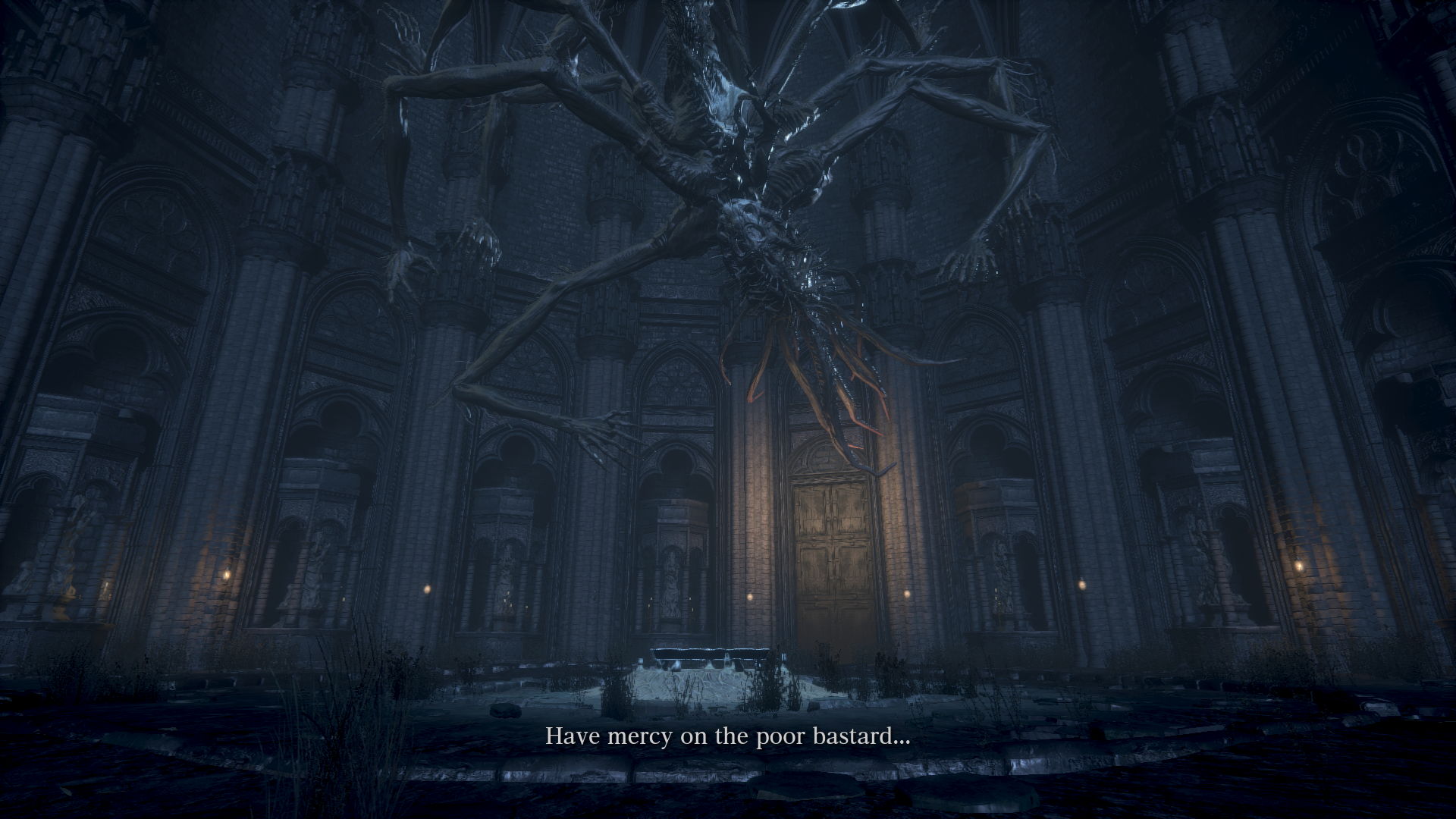
First Encounter with an Amygdala
In almost all role-playing games (RPGs), accumulating experience or knowledge points allows the character to become stronger, more resilient, and better able to dominate their environment—but not here, not in Yharnam. In terms of gameplay, Lucidity accumulates as the player makes unsettling discoveries: by entering the arena of a terrifying boss, discovering a new forgotten area, or consuming the “Madness” scattered throughout the world. The higher your Lucidity, the more you understand the true nature of the Nightmare—but understanding that very nightmare comes at an extremely heavy mechanical cost. For one thing, your character becomes weaker due to a very specific penalty: madness. It sounds so logical it might make you smile, but indeed, the more “lucid” you are, the more dangerous enemies that inflict madness will become. They won’t deal you more damage, but your madness gauge will fill up much faster, which will eventually lead to your death. Charming. On top of that, enemies that were once passive or relatively easy to defeat may now have new magical abilities to target you. But if there’s one thing Lucidity robs you of, it’s the illusion of safety. The more you know, the less at ease you’ll be.
That said, the real turning point comes after the battle against Rom, the vacuous spider (I’m not making this up, I swear). Even though the fight itself isn’t anything crazy, it’s the first time you battle an entity in an abstract zone. This infinite expanse of water is your arena, and as strange as it may seem, Rom doesn’t attack you until you strike first, which, in my opinion, makes this boss fight one of the most unique in the game. Once your prey is defeated, the game takes a major turn and enters its final phase, both in terms of what’s at stake and visually. All entities become visible, even with low Lucidity, and the sky… My God, that sky still gives me chills when I think back on it. The reddish-orange moon, the violet and crimson reflections on the clouds. You can feel both the end of the night and the possible end of the world approaching, all while lulled by the cries of a newborn that follow your every step. A joyful blend of horror. It’s here that you truly realize the horror and narrative power of Bloodborne. Even though the player doesn’t really have a choice but to face Rom, and thus to tear away the veil of reality at a certain point, they still have the freedom to increase their Lucidity early in the night and gradually bring to light the manifestations of their deepest fears. The game makes us feel exactly the sheer vertigo of possessing knowledge that is beyond our grasp, or of having a capacity for understanding and analysis that is far too limited in the face of the vastness of reality.
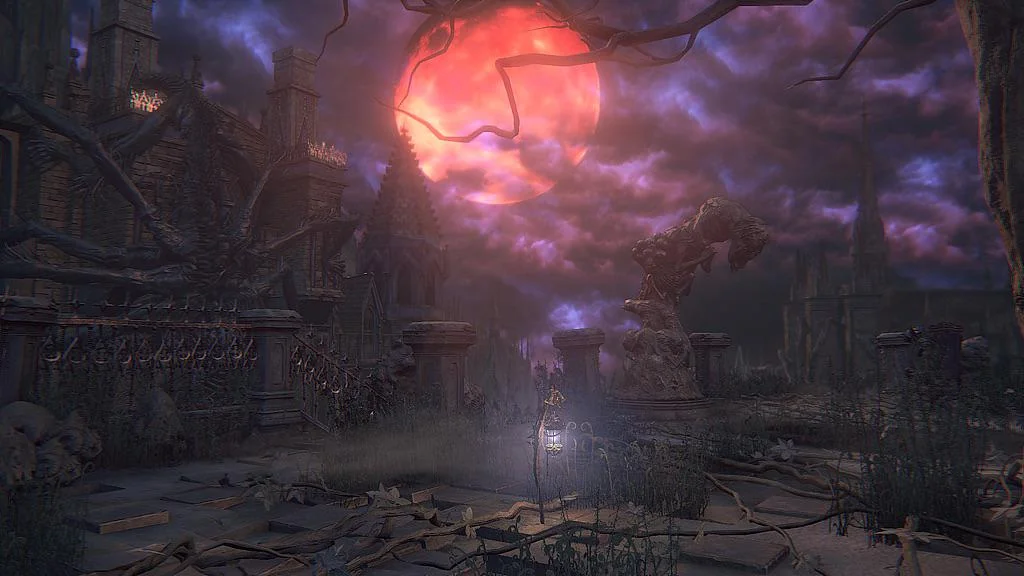
The Red Moon in the Sky Above Yahar’gul
III – Metaphysical Vertigo
When we are confronted with spaces that defy our understanding, when we struggle to make sense of the incomprehensible, a question naturally arises: Why doesn’t the experience of powerlessness plunge us into the deepest despair? Why is this despair replaced by an abstract form of pleasure—an aesthetic pleasure, a higher pleasure—specifically when we are confronted with what should logically bring our psyche to its lowest point? Well, it would seem that the answer—or at least part of the answer—lies in a truly unique work: Immanuel Kant’s Critique of Judgment. And in this work—which I strongly recommend you read if you are sensitive souls (which should be the case if I’ve managed to hold your attention this far)—the reflections Kant explores are extremely relevant and, above all, offer a fresh perspective on how we approach art, beauty, and even the sublime. But we’ll get to that. In this work, then, the Prussian philosopher develops and refines the theory of the Sublime by proposing a distinction between the so-called “mathematical” Sublime and the “dynamic” Sublime.
According to Kant, the mathematical sublime is primarily associated with infinite yet conceivable grandeur. For example, observing the immensity of the universe—those billions of stars twinkling in the sky—and yet being unable to see it in its entirety. This resonates deeply with mathematical concepts. It is impossible for us to comprehend or imagine a million, or even a billion. On the other hand, accepting it is entirely feasible. This version of the sublime does not prevent the human mind from feeling humbled or acknowledging its own smallness, but reason allows it to understand this feeling and accept it. Here, then, it’s all about physical grandeur—in every sense of the word: the values are immense, the scales are vast, and the image overwhelms the intellect in this way. On the other hand, Kant theorizes the dynamic Sublime, which functions in a way that is both different and similar—as you’ll come to understand. This vision is much more closely tied to the question of power, particularly the powers of nature. Imagine for a moment that you are observing the raging waves of an ocean in the midst of a storm, or the monstrous eruption of a volcano. Feel that the forces of the universe could crush you at any moment. As we realize that our physical form can be crushed in an instant, our mind becomes aware of something extraordinary: the fact that we possess the capacity to comprehend this immensity. Our reason transcends the material world, and the initial dread then gives way to a form of spiritual elevation. The Dynamic Sublime is this paradoxical victory of the mind over matter. We are physically tiny, but morally and intellectually greater than the brute force that seeks to destroy us. That is the Dynamic Sublime—the power you feel when faced with an event whose true magnitude you simply cannot grasp. The difference here is that you must feel safe when witnessing such things. As you can imagine, the inhabitants of Pompeii probably did not experience the Sublime when Vesuvius erupted before their eyes—no. Now that you’ve grasped these key concepts, let’s get started.
As you might expect, the concept of security that Kant discusses in his theory is embodied in this article by the controller, the keyboard, and—above all—the screen. And what contributes to the power of the Sublime in a video game context is interactivity. This interactivity allows us to experience our own ruin, our own defeat in the face of immensity, in a very intimate—even poetic—way, depending on the context. These experiences in front of our screens thus become a new kind of catharsis, offering us the opportunity to transform existential anxiety into an aesthetic material that can be manipulated and tamed thanks to the protective barrier of fiction.
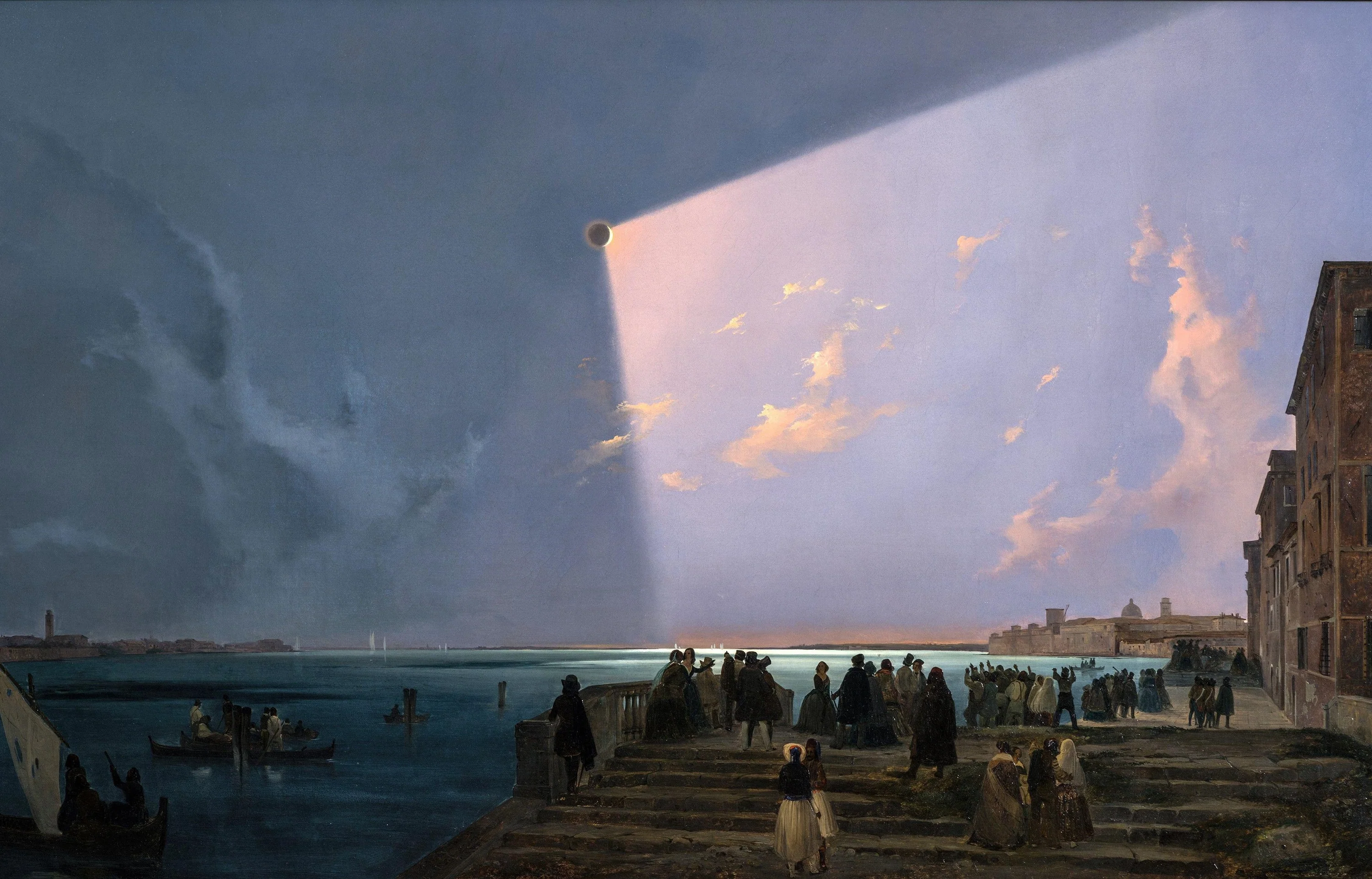
The Solar Eclipse in Venice, by Ippolito Caffi
Many games invite us to have this experience, and I’d be lying if I said that all experiences are equal, since the Sublime is, above all, the result of our own sensitivity to the world—or to art. That said, I’ve chosen to use two games that are diametrically opposed in this regard as examples: Blasphemous and Outer Wilds.
In the first of these games, you play as a young alien astronomer whose goal is to explore his solar system using his spaceship and tools, which will serve as his guides in this vast void that is now within his reach. The twist in this adventure—which seems cute at first glance—is that after 22 minutes, if you haven’t died before then, the star at the center of your system explodes, obliterating everything in its path—including you. The second twist isn’t that your character respawns—as in any good game—but rather that your respawn is the central element of your experience, since you have the ability to retain your memories with each death, and thus to respawn at the end of each “loop.” Indeed, since the game follows a cycle of exploration, explosion, and repair, it’s common to refer to your attempts as “time loops.” In Outer Wilds, the force beyond your control is none other than the entropy of the universe itself, and what seems very frustrating at the start of the game—namely, the lack of weapons or fast-travel mechanics—actually becomes the driving force behind the sense of the Sublime for players. The further you progress, the harder you struggle to understand what’s happening as you travel from planet to planet, repeating loop after loop, and the more you grow attached to this dying world—this universe that will ultimately prove impossible to save. The game design deliberately rejects the traditional “save the world” structure and reduces players to the status of pure Kantian spectators. And yet, Outer Wilds evokes neither nihilism nor despair. Its fascination stems from the beauty of learning for the sheer pleasure of knowing. Sitting on the edge of a planet falling apart, listening to the gentle melody of a banjo, and gazing at the blue shockwave of the supernova as it advances toward us becomes an experience of extraordinary grace.
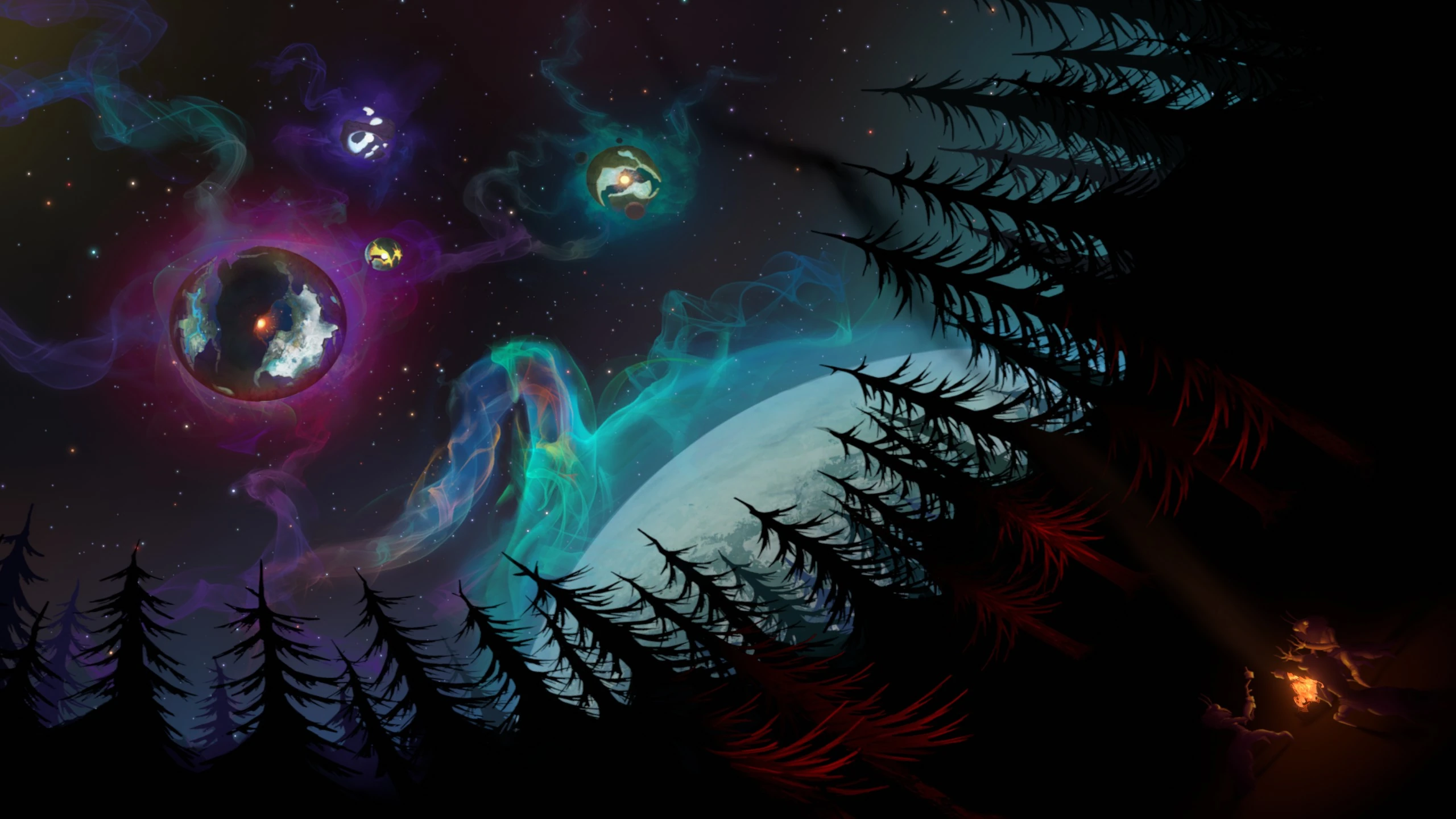
All the splendor of a universe in decline
On the other end of the aesthetic spectrum, we find Blasphemous, a Metroidvania heavily inspired by the Baroque movement, Spanish painting (Goya, Caravaggio), and the Catholic folklore of the era. In this universe, you play as the Penitent, the sole survivor of the massacre at his church, as he journeys through the cruel and tortured world of Cvstodia. A world subject to the divine power of an entity known as The Miracle—a sort of absolute power that transforms people according to their sins and creates utterly hideous and impossible visions… Visions that will, of course, try to tear you apart to prevent you from moving forward and taking revenge on Escribar, the final boss of the first game and the instigator of the massacre from which you alone managed to survive (thanks to The Miracle). In Blasphemous, what overwhelms us is a masterful blend of architecture, gravity, and religious dogma. Every environment exudes a cursed vision of religion—a version so painful, so blasphemous, that you may very quickly feel uncomfortable around certain NPCs or bosses. But while that unease is an immediate reaction, it’s quickly replaced by the sublime. At first glance, the use of suffering as a narrative driver seems rather grim, especially coming from a pixel-art game that, on the surface, doesn’t seem particularly scary. But unlike the melancholy one feels during each loop of Outer Wilds, Blasphemous conveys the dynamic Sublime through a kind of carnal obstinacy. Faced with a silent, omnipresent deity who punishes humans for their own prayers, your character decides to embark on a pilgrimage against The Miracle, but also against the horror of the human condition. This entire bloody spectacle is then sublimated by the victories you earn through the sweat of your brow, the red tears streaming from your iron helmet, and the screams of your enemies who had the misfortune of standing in your way. What is just as sublime in Outer Wilds, as in Blasphemous, is the resolution of their stories. Here, there’s no happy ending, but rather a coherent—and sadly realistic—final curtain call. While in Outer Wilds the key to the story is accepting that the universe, too, has reached the end of its own loop and that we must now accept that it is coming to an end, Blasphemous offers a short-lived victory over The Miracle and his minions, leading the Penitent (depending on the ending) to his own death—or to a respite lasting a few decades. These works thus offer us the opportunity not to change the nature of the world, but to evolve the way we view it.
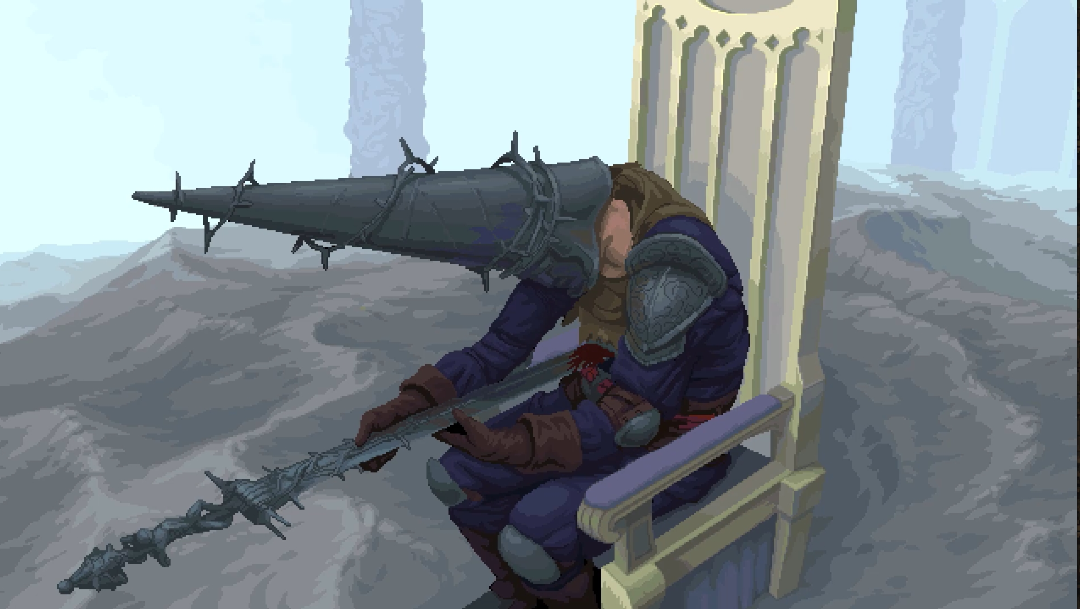
The Tragic Fate of the Penitent One
Whether it’s the seemingly peaceful end of the universe or the ordeal of penance, these two games ultimately share a common definition, as well as a strong echo of Kant: interactivity manages to reconcile the smallness of our condition—in the face of the universe or of inaccessible divine powers—with the grandeur of our consciousness. When we play such games, we come to accept a form of defeat: our character and/or their world will eventually fall, and the truth that emerges from this fall will surely be beyond our grasp. Failure, which is normally punitive, is here an organic component of the narrative—and irrefutable proof of the immeasurable that stands before us. We manage to overcome fear through action, and we come to understand that beauty can also be found in finitude or in decline.
In my view, this is where the true cathartic magic of video games lies. It offers us a chance to touch the infinitely vast, the infinitely dark, the infinitely incomprehensible—or even infinity itself. It allows us to transform the vertigo we might feel when faced with the absurdity of the world or the stupidity of everyday life into a symphony. Our falls become lessons in humility, and our gazes toward the horizon translate into a victory of the spirit—a victory over the grandiose and the breathtaking. By confronting us in this way with scales that transcend us, this interactive immersion defuses a certain kind of contemporary self-absorption and offers players a new understanding of the value of mystery; the unknown once again becomes a space of wonder rather than a threat to be eliminated. We no longer seek to conquer the stars or subdue monsters; we simply prefer to inhabit the void with dignity, accepting that our passage through the universe is as brief as it is dazzling.
We are coming to the end of this journey through the various levels of vertigo, and it is clear that our attraction—even our fascination—with what overwhelms and transcends us is neither morbid nor masochistic. Rather, I believe it is the manifestation of something more vital—this need to rediscover a sense of proportion in an age when we are overwhelmed by the fanaticism of total control and immediacy. Video games may have become the most accomplished stage for the quest for the Sublime, though they are not the only mechanism capable of creating wonder. By highlighting our smallness within monumental architectures, by depriving our minds of reference points when faced with knowledge too heavy for them to bear, and by forcing us to inhabit worlds indifferent to our existence, the medium of video games fulfills an essential philosophical promise—one that may even ring with stark truth. It reminds us that beauty does not necessarily lie in conquest, but also—and above all—in contemplation. Not in the sense of power we feel when bending the world to our will, but in the courage to stand up to its excess. That said, once the controller is set aside, the screen turned off, and our eyes still dazzled by the color of the World Tree or the soft glow of the starry sky in a dying universe, our reality remains unchanged. The nights remain dark. But thanks to the experience of the immeasurable, and after having felt the true vertigo of the abyss, it seems we no longer view the void in the same way; we have learned to see in it a poetry, a melancholy, an infinite grandeur—both terrifying and comforting—precisely because we contemplate its immensity. In this immense world that sometimes forces us to step back, we have learned to recognize our own smallness. And perhaps this is the most sublime way to exist.
Sources
https://www.wikiart.org/fr/caspar-david-friedrich
https://misterprepa.net/sublime-kant
https://major-prepa.com/culture-generale/kant-violence-sublime
Videos :
Books :
At The Mountains of Madness – H. P. Lovecraft
The Shadow Out of Time – H. P. Lovecraft