

Kid Katana wasn’t born in video games. The label started out in hip-hop and electro, and it’s by breaking into VGM sideways, first with Streets of Rage 4 and then the Teenage Mutant Ninja Turtles, that it carved out a place of its own: an intermediary between two worlds that cross paths regularly without always understanding each other. On Denshattack!, the outfit doesn’t just distribute the record. It produced the soundtrack, and negotiated and secured around twenty guest artists, including Shoji Meguro and Takenobu Mitsuyoshi, whom they met in person at TGS 2025 to build the trust needed before working remotely. An executive producer role that, in video games, was close to nonexistent ten years ago, reserved for studios large enough to have their own in-house music supervision.
We wanted to understand what this position lets you see: how you go about approaching a legend for a Spanish indie game, what makes a VGM vinyl pressing irreplaceable rather than merely a collector’s item, whether VGM is still a niche or has already tipped into mainstream recognition, and what Kid Katana dreams of producing from the other end of the chain, initiating a game built outward from its musical direction.
Point’n Think: Kid Katana grew out of Mutant Ninja, a hip-hop and electro label. What did you bring over from “classic” music into VGM, and what simply doesn’t transpose at all?
Rémy Dahi: Kid Katana grew out of what we were doing as a label, but also out of our passion for pop culture and video games. From the very start of our adventure in video games (with Streets of Rage 4), we had it in mind to build bridges between mainstream music and VGM, because we noticed these two worlds cross paths regularly but don’t always understand each other. So we wanted to play that role of intermediary, bringing our knowledge of the specifics of music, creative, legal, business, to studios and publishers who have ambitions for their games but don’t always dare reach out to artists outside VGM, thinking it’s too expensive, too complicated, or whatever. We also wanted to show that a VGM album could be defended just like any more conventional release, with the same quality in the products and the same distribution channels.
The big difference for us as a label is that we don’t have signed artists we’re building a career trajectory around. We really operate project by project, which makes our catalog very diverse, and that’s also something we really enjoy!

PnT: On Denshattack!, you’re not just distributors: you produced the soundtrack, secured the guests. That’s an executive producer role that barely existed in video games ten years ago. How would you describe it to a studio that’s never worked with a label before?
Rémy Dahi: Indeed, that role barely existed, except at the very biggest studios or publishers with their own music supervision teams. On our end, we really enjoy doing both executive production and distribution, because it lets us build a close relationship with the studio and publisher, making the soundtrack’s release even more impactful. Coming back to executive production, I’d say our role is to translate the game creators’ ambitions, editorial, economic, marketing, into artist choices, and then handle the negotiation, contracting, and follow-through on the music’s production.
PnT: Concretely, how do you go about approaching Shoji Meguro or Takenobu Mitsuyoshi for a Spanish indie game? Is it a matter of contacts, budget, the project itself?
Rémy Dahi: It’s a mix of all of that, yes! When we’re after a specific artist, we work several angles at once to make contact. Typically, for the two artists you mention, we did everything we could to meet them in person in Japan at TGS 2025 to win them over, because we know it’s important to build a personal relationship before working remotely. Talking with them, we realized they weren’t actually approached that often for interesting projects; for Denshattack!, we were lucky to have a pitch that was very clear and fun on paper, which helped break the ice.
PnT: You work with SEGA, Take-Two, Dotemu, but also on indie projects. Does the economics of an indie soundtrack like Denshattack! stand on its own, or are the big licenses what’s really funding the rest?
Rémy Dahi: That’s THE question we ask ourselves every day: what actually makes a soundtrack succeed? Obviously there’s no ready-made answer, and we’re always surprised, because the license guarantees absolutely nothing. The main factors are the game’s success, of course, how central the music is to the experience, and the reputation of the artists involved. It’s still too early to draw conclusions on Denshattack!, but for now we’re thrilled with the response to the music, which gets cited in nearly every review as a central part of what makes the game fun. I’ll take the chance to thank Undercoders and Fireshine Games, who trusted us and worked hand in hand with us from start to finish.

PnT: VGM vinyl has gone, over ten years, from a niche market to an entire section at record stores. Where would you place the tipping point? And aren’t we already in a bubble, with limited editions selling for 60 bucks that end up on eBay at 200?
Rémy Dahi: I don’t think there’s an easy way to pin down a single tipping point, I think it’s more generational, with all the kids who grew up with a controller in hand who are now adults (myself included), plus younger generations who are immersed even more deeply in gaming culture. Add to that gamers’ interest in physical objects, illustrated by the reactions to Sony’s recent announcements, for instance, and that explains this enthusiasm, in my view.
As for the bubble question, I don’t think that’s what’s happening, because this isn’t a passing trend. VGM has earned recognition from a wider audience and from the music industry at every level (sales volume, a Grammy category, concerts…), probably because it’s a genuinely growing market. Of course there’s the scalper problem, which affects any somewhat limited goods, but it’s also on us as labels to fight that, for example by capping how many copies a customer can pre-order, or by being transparent about vinyl pressing runs.
PnT: A physical Denshattack! soundtrack, what would the ideal object look like? What makes a VGM pressing irreplaceable rather than just a collector’s item?
Rémy Dahi: The ideal object for Denshattack! (as for any game) is, to me, one that best captures the spirit of the game and its music. We’re always trying to preserve that coherence. That also means choosing products that match the game’s price range. We never force ourselves to do a physical edition of a soundtrack, but what pushes us to do it is when we sense a clear demand and a community genuinely interested in it.
PnT: Your whole thesis is bringing VGM closer to the general public. But does the general public actually listen to game music outside its context, or are we really talking about an audience of players who grew up and now have purchasing power?
Rémy Dahi: We’re convinced that games are already a very powerful vector for musical discovery, and that’s only going to grow. We’ve had plenty of examples, like on Lost Records: Bloom & Rage, where a fan came to get their vinyl signed by Ruth Radelet (former singer of Chromatics) and told us she’d become their most-listened-to artist, so outside the context of that game’s soundtrack, we later ran into them at one of her concerts.
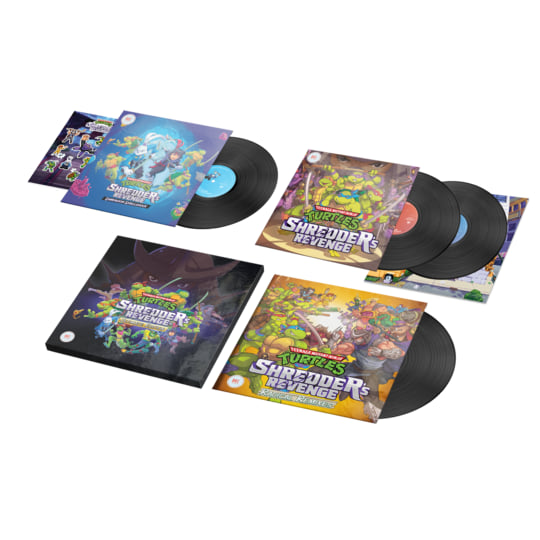
And conversely, we’ve had Wu-Tang or Mike Patton fans discover those artists’ contributions on TMNT: Shredder’s Revenge and discover the game itself, when they never would have been reached by a standard marketing campaign for it. When we put together collaborations that fit the game and are genuinely high quality, it works both ways!
PnT: What’s still missing for VGM to be treated as music in its own right: media coverage, awards, venues, criticism?
Rémy Dahi: At this point, I think we have almost all the pieces in place to say VGM has earned its stripes; there’s the Grammys, the exhibition at the Philharmonie de Paris, and concerts happening all over the world. It’s worth remembering VGM isn’t really a genre in the strict sense the way rock, rap, or folk are (and even those boundaries are pretty porous now), it can cover very different aesthetics. What might still be missing to cross a threshold is an artist actually going mainstream because of their work on a game, I don’t think that’s happened yet.
PnT: We’re seeing more and more in-venue events, often with classical orchestras, I’m thinking of the Nier, Final Fantasy, Clair Obscur: Expedition 33 tours. Do you think that’s one more step toward legitimizing VGM with the general public?
Rémy Dahi: Absolutely, it’s hugely important because it brings this culture into prestigious venues, in front of programming teams who don’t necessarily know its full history and who’ll be inclined to repeat the experience (assuming the concerts go well, of course!). It’s also a way for fans to show the people around them that what they listen to is just as “respectable” as any other genre. Right now, these concerts are reserved for the very biggest franchises that have endured across eras and have well-established fan communities, or for hugely successful, genuinely strong soundtracks like Expedition 33’s. I’m hoping this opens up further to other kinds of projects.
PnT: Can you picture other kinds of events that would help spread and introduce VGM beyond the circle of gaming? Could we one day imagine real popular music festivals featuring composers and musicians who work on video game music?
Rémy Dahi: Absolutely, alongside concerts inherited from the classical tradition, there’s definitely room for different formats that would reach a wider audience. That would also help reflect the diversity of VGM, which originally comes from electronic and very DIY roots (chiptune, for instance); there are already a few dedicated festivals out there (like Game Music Festival, MAGfest and its offshoots), but that remains fairly niche and still limited to a hardcore VGM audience. The Philharmonie also programmed a concert series as part of its Video Games & Music exhibition, but that’s still fairly experimental. There are still very few mainstream clubs or festivals booking artists known for their video game work, but that’s the direction things are heading. We have a very fresh example with Mick Gordon (the legendary DOOM composer, who we brought on for Absolum) being announced as a headliner for the RADAR 2027 festival in Manchester. We’re also working on our end to bring VGM into unexpected places!
PnT: What’s the project Kid Katana dreams of doing that nobody’s let you do yet?
Rémy Dahi: We got pretty spoiled starting out with franchises like Streets of Rage and the Ninja Turtles, so the bar is genuinely high. In that sense, Denshattack! is a project we’re incredibly proud of, because it puts the music on equal footing with the gameplay and the visual direction, and we worked hard to get there. The dream for us would be to go even further, meaning initiating a game project starting from its musical direction, and producing it in collaboration with a studio or publisher, but that’s not happening just yet…
Kid Katana’s website : https://kidkatana.com