

The world of video games is an ocean of creators, among whom some are haunted by a vision too vast for the frameworks imposed upon them. Tetsuya Takahashi belongs to this lineage of game auteurs for whom the medium is not merely a space for entertainment, but a field to express their metaphysical and existential obsessions. From Xenogears, the fractured tragedy born under Square’s banner in 1998, to Xenoblade Chronicles 2, passing through the aborted Xenosaga hexalogy, each of Takahashi’s works bears the marks of his relationship with God and humanity. His trajectory traces the consuming ambition to give shape to a grand science-fiction fresco where religious and philosophical concepts take center stage. Each step of his path seems to replay the same cosmogonic drama: that of a world striving to regain unity after an original fall, that of a creator confronted with the imperfection of his own creation.
This analysis was born from the need to understand what this oversized fable had stirred within me. Xenoblade Chronicles 2 entered my life at a time when I was trying to rebuild it. After the death of my father, a void had opened, leaving behind a silence larger than I had imagined. Like Lost, which I had discovered a few months before this second installment of the Xenoblade trilogy, this work held up an unexpected mirror to me. It spoke of absence, of the search for meaning, and of the need to believe despite everything, even when all hope for transcendence seems to have withdrawn.
Xenoblade Chronicles 2, which follows in the continuity of the first installment, is no exception and stands out as a true thematic and narrative gem in the history of video games. At first glance, it presents itself as a flamboyant epic, brimming with tropes drawn from Japanese animation, verbal sparring, and spectacular battles. But beneath this glittering surface lies a work infused with profound metaphysical currents. One must read deeper. It took me time to truly approach this work, not merely to start it, but to enter it fully and grasp what it sought to convey. While the beginning felt breathless, it required genuine engagement to cross its threshold, to accept its dissonances and naïve excesses, carried by an aesthetic that sometimes wavered.
The world of Alrest thus presents itself as the stage for a poignant reflection on the separation between the material world and the ideal, between what humanity can conceive and what it cannot reach. The character of the Architect, at once divine and tragically human, extends a fundamental question: is it possible to create a world without repeating one’s own mistakes? This is a work that questions the very possibility of hope at the heart of collapse, observing humanity across all its cultures, even the least admirable. Throughout Xenoblade Chronicles 2, one feels a constant tension between the creator and the created, particularly between humans and a distant divine figure. This tension echoes the ideas of the philosopher Plato, for whom our material world is but a shadow of a truer, invisible one. From this perspective, the journey of Rex and his companions is not merely an adventure, but a quest to understand what is truly essential and to free themselves from an inescapable destiny.
Pyra and Mythra, through their opposing personalities, embody the inner struggle between what we show to the world and what we keep within ourselves. The bond between a Driver and their Blade goes far beyond a mere combat system: it symbolizes a deep need for connection, as if each human being seeks in another a part of themselves, in order to recover a forgotten memory or a lost truth. This bond reminds us that we are all in search of something greater than ourselves, even if we do not always know what it is. In this sense, Jin may be the most heart-wrenching figure of this tragedy. His pain is not that of a simple antagonist, but of a being who has loved, lost, and refused to forget, consumed by the condition of the Blades around him. He is the orphan of a past that could not endure, a creature abandoned by a god who is too human and too fallible.
Despite its rough edges, Xenoblade Chronicles 2 is not a youthful work, but a magnum opus. It is an oversized fable, sometimes unpolished, yet imbued with raw sincerity and a relentless desire to tell what remains of humanity in its quest for God, where love, pain, and memory stand as bulwarks against the end of everything. Rex, Pyra, Mythra, Jin, Malos, and Nia are figures who, throughout the adventure, compose fragments of an intimate mythology. Xenoblade Chronicles 2is not merely an adventure or a heroic epic. It is a reflection on loss, memory, and faith: faith in something greater, something truer, whether it be a mythical paradise or a simple presence beside us. Each Driver finds their Blade as one finds a soulmate. Each Blade waits, unconsciously, for the memory of a voice, a gesture, or a name. Amid these fragments of eternity scattered across the sky, we walk with them, in search of an Elysium that is not a place, but a promise.
My encounter with the Xenoblade saga
To understand what Xenoblade Chronicles 2 is and how it resonated with me, one must go back to the origins of an entire genre. Role-playing games emerged in the United States in the 1970s with Dungeons & Dragons. This tabletop RPG, skillfully blending narrative and statistics, was born from a cross between strategic war games and Tolkien-inspired fantasy. The creation of Gary Gygax and Dave Arneson quickly migrated to the earliest personal computers, giving rise to titles such as Wizardry and Ultima in 1981. We were at the dawn of digital RPGs, and this is how concepts like character management, turn-based combat, rudimentary dialogue choices, and tile-based open worlds began to permeate the fledgling video game industry.What made these games of a new kind so compelling was not so much the goal of winning, but the experience of navigating a story that harked back to the time when, as children, we invented worlds and narratives in the garden, guided only by our imagination and desire. These early RPGs were designed for an initiated audience. Their complex interfaces, austere graphics, and algorithmic logic made them technical objects, intended more for a niche than for a wide audience. But when they reached Japan in the early 1980s, the role-playing genre underwent a profound transformation.
Japan in the 1980s was in the midst of a video game revolution. While Nintendo dominated the console market with the Famicom, a generation of emerging creators sought to adapt Western forms to Japanese tastes. Young Japanese programmers, often self-taught, were drawn to American titles. Wizardry and Ultima fascinated them with their freedom, tactical complexity, turn-based combat systems, and fantastical worlds, despite their unwelcoming nature. It was in this context that Yuji Horii, a former video game journalist, discovered these two works. Fascinated, he envisioned a simplified and story-driven version of these systems, more accessible, less abstract, and easier to read on console.
The result of his work was released in 1986 under the name Dragon Quest. Developed by the studio Enix, the game left a lasting mark on the video game industry and remains today one of the biggest ongoing franchises. The game preserved the fundamentals of RPGs but structured them around a graphic universe designed by Akira Toriyama and a soundtrack orchestrated by Koichi Sugiyama. The goal was clear: to transform a complex system into a popular adventure, readable by children and filled with immediately recognizable narrative symbols. Dragon Quest became a cultural phenomenon. It codified what would later be called the JRPG: a genre of RPG designed in Japan, narrative, linear, aesthetic, centered on defined characters, and embedded in a story determined by the developers rather than by player choice.
From that point on, the JRPG became a major space for experimentation for Japanese developers. Squaresoft, not yet the giant we know today, responded to the success of Dragon Quest with Final Fantasy in 1987, under the leadership of Hironobu Sakaguchi, who in turn achieved significant success. While Dragon Quest remained tied to the classical form of the chivalric tale, Final Fantasy introduced from the outset a darker tone, along with the seeds of existential stakes associated with a more melancholic aesthetic. The project was originally called Fighting Fantasy, but a potential rights conflict with a British tabletop RPG forced the team to change the name. The word “Final” was chosen for its symbolic meaning: Sakaguchi was ready to leave the industry to resume his studies if the game failed. For him, Final Fantasy was as much a swan song as it was a call to legend. The success was immediate: over 400,000 copies sold. It was a small miracle, and above all a confirmation of the rise of a model. This first Final Fantasy marked the advent of a more accessible, more story-driven, and more romantic Japanese RPG. The iconography of the hero group, the world to save, the crystals, the evolving classes, the towns filled with chatty NPCs, the poignant music, all of this became the foundation of a genre.

While the SquareSoft and Enix franchises engaged in a healthy rivalry, the JRPG became a true laboratory for experimentation and saw the emergence of many new players. This was the case with Atlus, with Shin Megami Tensei in 1992, which introduced a more adult and metaphysical tone, emphasizing moral dilemmas and religious syncretism. Namco also joined the scene with Tales of Phantasia in 1995, offering real-time combat and a lighter tone. The JRPG became a varied yet codified genre, with common elements: a young hero, a group of complementary characters, a world to explore, progression through experience, and a narrative centered around an ancient mystery or an apocalypse to prevent.
Unlike its Western cousin, the JRPG does not aim for total freedom. It prioritizes a story-driven experience, character identification, and the staging of emotions. The player does not invent their hero but follows their development. Linearity here is an aesthetic and narrative choice, as it allows for the construction of a strong dramatic progression, where each battle and each piece of music contributes to an overarching tension. The influence of Japanese animation is omnipresent. Character design follows the lineage of manga, highlighting the work of numerous talents such as Tetsuya Nomura. Music becomes central and finds renowned ambassadors in legends like Nobuo Uematsu and Yasunori Mitsuda. The worlds are varied, drawing on medieval fantasy, steampunk, or science fiction depending on the case. Turn-based combat, inherited from wargames, becomes a ritual, a form of language through which each studio seeks to add its personal touch and through which each character expresses their function. The JRPG is therefore a total narrative genre, where gameplay, worldbuilding, music, and writing function as parts of a whole. It is not an action game; it is a codified theater, a place for embodying grand stories.
The arrival of the PlayStation in 1994 profoundly changed the industry. The console’s power allowed the integration of CGI cutscenes, orchestrated music, and 3D models. The JRPG became spectacular, breaking certain barriers to achieve a more cinematic presentation. The turning point was undoubtedly Final Fantasy VII in 1997. For the first time, a JRPG became a worldwide success, selling over 10 million copies. The story of Cloud, Sephiroth, and Aerith marked an entire generation. Sony supported the project, subtly wresting control of the franchise from Nintendo. Squaresoft established itself as a major player in the video game industry, and the JRPG became firmly embedded in Western gaming culture. We then fully entered the golden age of JRPGs with titles such as Vagrant Story, Chrono Trigger, and Final Fantasy VIII and IX.

By the late 1990s, the JRPG had reached maturity. It was no longer a niche Japanese genre, but a video game model that embodied a form of the absolute. It had been built on a paradox: seeking to tell universal stories through rigid, sometimes repetitive game systems, yet ones capable of conveying emotion and memory. It succeeded in transforming constraints such as linearity, turn-based combat, and predefined avatars into a unique language, serving stories far grander than the means that carried them. For a generation of players, it became a gateway to video game storytelling, as well as to emotions rarely offered at the time: loss, memory, doubt, hope, and sometimes even transcendence.
At the turn of the millennium, the JRPG carried with it a paradoxical mix of pop innocence and metaphysical questioning. It was the perfect breeding ground for emerging creators like Tetsuya Takahashi, who had honed his skills on Final Fantasy V and VI as a graphic designer. He was already making a name for himself with his innovative ideas, as well as his temperament and complex storytelling. Takahashi saw in the medium the promise of a space broad enough for his own theological obsessions. Together with his partner and scriptwriter Kaori Tanaka, known under the pseudonym Soraya Saga, he drafted a massive, ambitious script blending philosophy, religion, science fiction, and an existential quest. He submitted this story to Square’s management as a proposal for Final Fantasy VII. The response was unequivocal: the script was deemed too dark and too complex to fit the series. Rather than abandon it, Square proposed that Takahashi turn this scenario into a standalone game. Thus, Xenogears was born.
Xenogears bore no resemblance to anything else produced by the industry at the time. While the Final Fantasy series oscillated between fantasy and steampunk, Xenogears offered a dense, philosophical science fiction. The world is filled with references to religious texts, especially Gnostic ones, as well as to Jung, Freud, Lacan, and Nietzsche. The game tells the story of Fei Fong Wong, a young man haunted by a forgotten past, caught in a global conflict intertwining genetic manipulation, divine AI, and giant mechs. It deals with psychic trauma, identity, memory, original sin, and the dialectic between humanity and God.Unfortunately, Square considered it a secondary project and preferred to allocate the bulk of resources to Final Fantasy VIII. The Xenogears team remained small, and the deadlines were impossible. The result was stark: while the first half of the game is rich in exploration, towns, side quests, and complex gameplay systems, the second disc shifts to radical minimalism. Most events in the latter half are conveyed through long text sequences over specially created still images, illustrating each scene due to a lack of budget and time. Yet these scars give Xenogears a unique atmosphere. Released in 1998 on PlayStation, Xenogears was a critical success in Japan and instantly became a cult game for a segment of Western players. But it remained an unusual object, difficult to market, and was never officially released in Europe. In the United States, it was praised for its ambition but criticized for its narrative density and abbreviated second half. Still, for many, this fragmentation contributes to the emotional power of the game. Xenogears is a wounded, unfinished work, and it is in this flaw that its beauty resides.

Tetsuya Takahashi left Square after Xenogears, frustrated that he could not develop the sequel he had envisioned. He founded Monolith Soft in 1999 to launch the Xenosaga project at Namco, conceived as a six-episode cycle, though only three installments were ever released due to its commercial and critical failure. The path was laid, eventually leading, on a December day in 2017, to the skies of Alrest and the twin flames of Pyra and Mythra. But that story is for just a little later. Before we delve into it in the following pages to plunge into the burning heart of Xenoblade Chronicles 2, it is worth turning to my own personal case.
For me, the encounter with these distinctly Japanese worlds did not happen in studio meeting rooms or through specialized readings, but in the living room of my home, at an age when one still believes the world is limited to what can be touched. In 1997 or 1998, I discovered Final Fantasy VII by chance. My sister’s future husband brought it home, and I was only five or six years old. Until then, video games for me had meant nothing more than Super Mario or the Teenage Mutant Ninja Turtles. Everything changed at that moment. I did not understand all the mechanics or the nuances of the story, but I sensed, vaguely, that what I held in my hands was not mere entertainment. There was in that universe a promise that went beyond the game, something that whispered to a child’s soul the echo of a vast and mysterious world, opening the imagination and inspiring reflection. It became my foundational myth. The game that made me truly fall in love with the medium and explains why, years later, I strive to speak of video games not merely as cultural objects, but as real traces left in a life.
This is how, in my eyes, the JRPG became the king of genres. Not that my knowledge is encyclopedic, nor that I have explored all of its landmarks, but for me, it embodies the ideal of video games: vast and ambitious frescoes, at once playful odysseys and philosophical meditations, where every battle, every dialogue, every melody contributes to a story larger than oneself. Final Fantasy VII is not only my first Final Fantasy: it is the game that made everything else possible. It is the first stepping stone on the long path that gradually guided me toward Xenoblade Chronicles.

For a long time, Xenoblade Chronicles remained for me a silhouette glimpsed in the distance across the sky of the JRPG. I observed it without ever immersing myself, torn between fascination and mistrust. In my youth, I saw the series as a rival to my personal pantheon, that of Final Fantasy, and perhaps a measure of childish pride kept me from giving it the attention it deserved. Then there were practical constraints. As a student, I had neither the means nor the time to own multiple consoles. Between the Wii and the PlayStation, I had chosen the latter, drawn by the promise of Final Fantasy Versus XIII, that chimera embodying all my expectations. Yet Takahashi’s name continued to intrigue me. When the trailer for Xenoblade Chronicles 2 was released, I remember feeling a familiar and irresistibly alluring stir. The richness of the world, the density of the narrative, that sense of an epic both intimate and cosmic captivated me even before I intended to buy the game. Nevertheless, something held me back for many years. The character design, too heavily influenced by shōnen conventions, left me skeptical, and I long believed that this aesthetic prevented the gravity I sought, before realizing that it actually concealed it.
My relationship with the series truly changed only once I entered professional life, finally able to fully afford the things that brought me joy. In 2022, I acquired the complete trilogy in physical editions, but this was not yet the beginning of my journey, as the games remained sealed in their packaging for a few more years. There are works one approaches with respect, even with a hint of fear. Xenoblade Chronicles was among them, particularly because of its time-consuming scope, its perplexing combat system, and above all the aura of grandeur that hovers over every project by Takahashi. Summer 2024 marked the turning point. In August, I finally decided to cross the threshold with the first Xenoblade Chronicles, driven by the contagious enthusiasm of the French-speaking community, and notably by Damien Mecheri, whose analyses and passion served as a true guide during a paced discovery of this Xenotrilogy. He is thanked here for this discreet yet invaluable presence, like a scout guiding the way through an unknown world.

I finished the game in September 2024, and it is safe to say I did not expect to be hit with such a powerful impact. For the first time, I felt I had experienced a traditional JRPG (by which I mean outside of Persona) that could stand toe-to-toe with the best Final Fantasy entries. It is a great game, but even more, a foundational work, especially when one recalls that it was born on the Wii. Xenoblade Chronicles is a miracle of world-building, a fresco that begins as a tale of vengeance before transforming into an existential meditation on determinism, time, and the consciousness of the divine. It became the gateway to an even larger universe, one that had already been waiting for me for years, suspended between sky and sea: Xenoblade Chronicles 2.
There is always a particular vertigo in contemplating a work before immersing oneself in it. After Xenoblade Chronicles, I felt that mixture of impatience and restraint one experiences when faced with a world whose power one senses. Xenoblade Chronicles 2 fascinated me as much as it unsettled me, like an ocean I had not yet dared to cross. I knew its outlines, its images, its faces: Rex, Pyra, those Titans drifting across a sea of clouds. Yet these visual fragments, saturated with an almost saccharine light, seemed to conceal something else. Despite everything I had heard and read about its more pronounced shōnen aesthetic, I hoped to find a deeper, perhaps tragic, gravity within. I feared I was not ready, that I lacked the time and inner availability necessary for a new adventure of such magnitude, and that is why I allowed almost six months to pass between the two games. Takahashi’s games are not merely played. They are inhabited, like settling into a dream too vast to grasp its boundaries. And, deep down, I knew that this second journey would not be merely a sequel, but a beginning anew.

My Arrival in the World of Alrest, Between Anticipation and Fear
This new beginning took the form of a quiet winter, at the threshold of the year 2025, when the days still stretch under a pale light and the world seems hesitant to regain its momentum. I was in a period of life when work exhausted even my dreams, and when every evening became a struggle to preserve a small space of silence. It was there, between January and February, that I finally slipped the cartridge of Xenoblade Chronicles 2 into the console. I felt that the moment had come to set out once more on a great epic that would leave me emotionally and intellectually drained. Without ceremony, almost by reflex, I opened the door to a dream long postponed. A true monument for some, a bitter disappointment for others, we have all heard things about this entry, whether about its often-criticized aesthetic or its reputation as a naïve game. All of it formed a fog of contradictory expectations. I hoped to rediscover the depth of the first installment, yet I feared finding only a pale imitation, an adventure weakened by shōnen clichés. And yet, the moment I reached the game’s title screen, I was immediately carried away. The piano notes of the theme Where We Used To Be, drifting over those grey clouds, whispered something of rare sincerity and power. Even before the game had truly begun, I understood that I had not come in search of a “better” Xenoblade, but of a different emotion, perhaps brighter, yet no less profound.
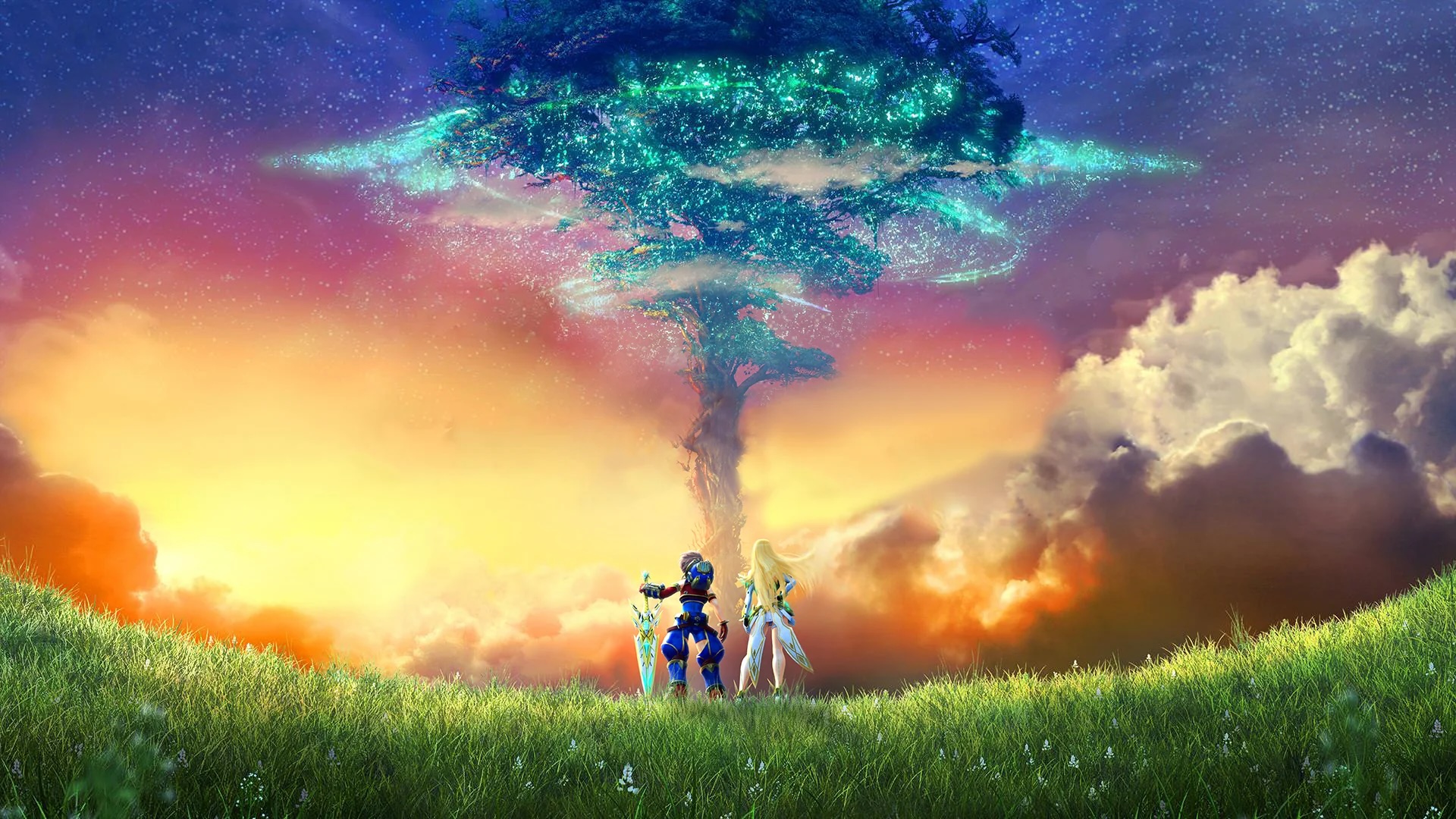
It is difficult to follow in the footsteps of a landmark game. After Xenoblade Chronicles, any new installment seemed doomed to live beneath the weight of that initial miracle, orbiting a memory too vast to escape. Some had even warned me: “The first four chapters are long, confusing, almost impenetrable. The real Xenoblade begins afterward.” And yet, from the very first minutes, something within me opened.The camera’s descent into the Cloud Sea carried the solemnity of a baptism. The Titans floated there like slumbering deities, bearing upon their backs the life of a world that was slowly forgetting them. Rex, a young salvager with a still-childlike face, seemed to emerge from those waters like a naïve prophet, entrusted with a mission he did not yet understand. Alrest then unfolded like a living cosmos, a stage suspended between sky and abyss, dominated by the World Tree, the pillar standing at the center of the game’s universe, whose silhouette evokes both the Norse Yggdrasil and the Tower of Babel. The entire world seemed to breathe the metaphor of a fallen humanity dreaming of climbing back toward the light.

Then came Jin and Malos, the specters of Torna, introduced within the first hours. Tetsuya Nomura’s art imbues them with an almost biblical nobility. They quickly appeared to me as fallen angels. Their terse words, their inhuman calm, contrasted sharply with Rex’s disarming purity. Yet everything about them betrayed antagonists closer to the status of victims of a dying, unjust world than to mere malevolent avatars. It was the end of the first chapter that truly seized me, with the death of Rex, pierced by Jin’s blade. This ending of one existence marked the beginning of everything and his awakening in the in-between world, symbolized by a vast plain where the church bell echoed. After only a few hours of play, the sacred had already made its unambiguous presence known. Pyra appears at this moment as a redeeming and ardent figure, whose Japanese name, Homura, refers to the divine flame. She is the Aegis, a name that in Greek mythology refers to the divine shield of Zeus and Athena. In the modern imagination, especially in Japanese fantasy, the term is often used to designate a sacred relic. This symbolic connection to the Holy Grail completes the imagery of salvation. By offering a part of her Core Crystal, she resurrects the young boy and binds him to her. Through this gesture, Rex becomes the Driver of the Aegis, the chosen one who will carry the fire of the gods into the heart of a dying world. From that moment, the bond between Driver and Blade establishes itself as the spiritual key of the work. It is a communion of souls before it is a combat system. In a sense, it is a true metaphor for faith, sharing, and the mutual dependence between creator and creation.
The promise made to Pyra to bring her back to Elysium, that paradise perched atop the World Tree where humans and deities once lived in harmony, becomes the quest for an impossible salvation. Rex, a luminous hero, moves forward with the fervor of a believer who refuses to accept the end of the world. In this universe where Titans slowly vanish, taking with them the civilizations they shelter, every step resonates like a prayer offered to the heavens. This character is driven by his desire to save humanity and restore it to the paradise from which it was banished thousands of years ago. It is no exaggeration to say that Xenoblade Chronicles 2 captivated me from the very first hours, surpassing all my expectations. There was a mysticism of hope, a candid faith that did not exclude gravity. Despite its opaque combat system and occasional missteps in staging, the game pulsed with rare fervor. It is a work overflowing, imperfect, yet fully inhabited. Xenoblade Chronicles 2 does not merely tell an adventure; it evokes a myth of origins, a return toward the light, and above all, a quest for redemption on the scale of a world in decay.

What moved me most in Xenoblade Chronicles 2 was not merely the beauty of its world. As I progressed, I realized that the game did not simply tell a philosophico-religious science-fiction story. It is a game that questions faith, memory, and survivance, that invisible force that drives human beings to keep going despite everything. Rex and Pyra are not merely mythological figures, but incarnations of the same spiritual drive. They embody the human impulse to continue believing, loving, and persevering even when all collapses. Since my father’s death, I have often felt that the world had cracked open in a way nothing could fill. I was raised in a very atheistic framework and kept away from anything spiritual. Strangely, since losing that anchor, I found myself needing to awaken to new horizons, as if I had to find answers to old questions I had long kept silent. If my watching of the series Lost was a first step, Xenoblade Chronicles 2 followed in the wake of Lindelof’s work. I found myself reading a parable of humanity’s mourning, a humanity deprived of its creator yet still seeking its trace in the sky. Every Titan swallowed reminded me of the fragility of a memory of a glorious era. Every step toward the World Tree felt like an effort to reach those who came before us and to honor their existence. This game offered not just a story, but an inner resonance, a (re)found faith, not in a religion, but in the very possibility of connection with others.
In the manner of an ancient myth, Xenoblade Chronicles 2 speaks to us of the need for God in His absence. Elysium becomes the name of our own nostalgia. It is the place we have lost and dream of reaching, never quite certain that it exists. It is not merely a promised paradise, but an idea that humanity pursues as one chases a star. In this, Takahashi joins a long spiritual tradition, that of pilgrims who see in the quest itself an act of faith. It is not so much Elysium that matters as the path toward it, the encounters, the sacrifices, and the moments of grace that punctuate the journey.

he further I progressed, the more I felt that Xenoblade Chronicles 2 did not aim for perfection. It embraces its excesses and flaws as many faces of the same humanity. This sincerity makes it greater than its limitations. In a sense, the game resonates with the same tension as our own lives, torn between the trivial and the sacred. Its true strength lies undoubtedly in its ability to make religious fervor converse with the candor of a folk tale, as if the child and the prophet were united in a single breath. I believe it is this honesty that struck me more than anything else. Xenoblade Chronicles 2 reminded me that there is no faith without flaw, no beauty without imperfection, and above all, no hope without fear. In this world of Alrest, I found the simplest and purest reflection of our condition as beings walking toward the unknown, eyes turned to the sky, hoping that someone, somewhere, waits for us there.
This newfound faith, as vibrant as it was, could not remain unquestioned. Behind the light of Alrest, something dark persisted. The further I progressed, the more I sensed that Rex and Pyra’s quest was only an echo of another, older quest, that of a world seeking to understand its own creator. Beneath the layers of hope and fervor, Xenoblade Chronicles 2 harbored a fundamental doubt about the nature of the divine. It is here that the narrative rises to another dimension, that of the myth of origins. The game ceases to be merely a mystical adventure and becomes a meditation on creation, fault, and the memory of the divine. Names become symbols and ruins become parables. Behind the World Tree stands Klaus, the scientist turned architect, a tragic figure of a creator who, in trying to understand the world, tore it apart. Farther below, in the folds of Alrest, Amalthus embodies the disillusioned pilgrim, one who ascends toward Elysium not to find God, but to judge Him. Thus, Rex’s naïve faith finds its mirror in the disillusionment of those who came before him. Xenoblade Chronicles 2 carries forward the gnostic narrative of its predecessor.

In Search of God: Between Creation and the Fall
At the beginning, before Bionis and Mechonis collided in Xenoblade Chronicles, or before the Drivers and their Blades shaped the destiny of Alrest in Xenoblade Chronicles 2, there was Klaus, the man of science who committed the original sin. Having lost faith in humanity, unable to answer the question of its reason for being, and burdened by the devastation it had inflicted upon the Earth, the scientist Klaus began to see in the Conduit, that enigmatic artifact capable of opening passages to other dimensions, a door. An escape through which he could lead humanity toward another world, where it might finally become something far greater. He dreamed of uncovering the secret of creation, of lifting the veil of the universe and touching what had until then escaped all human understanding. He was not seeking God, but the principle that animated the order of worlds. He wished to draw closer to the sun so that humankind might become comparable to the creator. Pride, already latent, mingled with curiosity. The scientist thus became an incarnation of Prometheus, ready to steal the fire of divinity. During the attack on the first low orbit station, which occurred in the year 20XX, Klaus seized the opportunity to put his plan into motion. He sealed off all external access to the Conduit, but just as he was about to activate it, he was interrupted by Galea, who tried to reason with him. Her efforts proved futile. Klaus ignored her and activated the Conduit, splitting the world in two and setting in motion the events that would give birth to the Xenoblade Chronicles saga.
The experiment he set into motion preceded his fall, as well as that of the entire human species. In carrying it out, Klaus did not merely cross the boundary of the unknown; he swept away all life on Earth. Galea, his colleague, and seemingly the only one of the pair endowed with true conscience, tried to stop him, but he pushed her aside and activated the Conduit. Within that gesture lies the full tragedy of humankind confronted with its own ambition. Half of Klaus’s body, along with Galea and the Ontos core of the Trinity Processor, was drawn into the interdimensional portal created by the experiment and cast into a new universe, where Klaus was reborn under the name Zanza, the soul of Bionis in Xenoblade Chronicles. His other half remained alone in the orbital station with the two remaining cores of the Trinity Processor, Logos, known as Malos, and Pneuma, known as Mythra and Pyra, gazing upon the ruins of the world he had driven to its end in Xenoblade Chronicles 2. After a period of despair, brought on by the guilt that consumed him from within after his sin of hubris, he resolved to make penance for his deeds by recreating all the life that had vanished. It was this resolve that gave birth to the conception of Alrest as we discover it in Xenoblade Chronicles 2, along with its fundamental elements: the Cloud Sea and the Core Crystals.
On the other side of this myth, the half of Klaus drawn into the Conduit is reborn under the name Zanza, god of Bionis, while Galea becomes Meyneth, goddess of Mechonis. Zanza fashions life with violence and pride: the Homs, the Nopon, the Giants. Because he feeds upon the vital energy of his own creations, his divinity is manipulative, cruel, and exclusive. His profoundly malevolent nature lies at the origin of the conflict between Bionis and Mechonis, which began with a long battle between the two titans, Zanza possessing the body of Arglas while Meyneth defended Mechonis in Xenoblade Chronicles. Exhausted, they eventually sank into a millennial slumber. Yet the story does not end there. The Monado, long sealed away, would later be rediscovered by an expedition of Homs, awakening Zanza and marking the beginning of the human and divine tragedy that would ultimately culminate with Shulk, the main character of Xenoblade Chronicles.

Meanwhile, the half of Klaus that remained in the original world became the Architect, the one who restored life on Earth with a benevolence born of guilt. Unlike his other self, he did not tyrannize his universe or exploit it. Instead, he watched over it, hoping that his sins might one day be redeemed. Klaus did not merely allow Alrest to emerge in the void. His guilt over the consequences of his pride drove him to recreate life itself. He developed nanites capable of binding with Ether, creating a programmable substance able to shape matter at will. The Earth was gradually covered by this living network, capable of healing the soil and restoring a world that had once been dead, as revealed in Xenoblade Chronicles 2.
To reintroduce conscious life, Klaus used the Core Crystals as carriers of information about life on Earth. Their use made it possible to reproduce what had once existed and to grant the world of Alrest a new impulse, a new genesis. Connected to the Trinity Processor, these crystals were constantly analyzed and guided within a process of controlled evolution. The nanites transformed these crystals into Titans, the first living beings of the renewed Earth. The Titans grew, produced their own Core Crystals, and gave rise to new forms of life, autonomous and increasingly independent from the original programs, as described in Xenoblade Chronicles 2.
The Blades, juvenile forms of the Titans born from the Core Crystals they produced, absorbed traits from the life they encountered through successive reincarnations, gradually growing and evolving toward a complexity capable of transforming them into Titans in turn. This cycle of creation and adaptation embodies Klaus’s ethic: that of an imperfect demiurge who, out of remorse, attempts to repair the chaos he has unleashed. Yet when the new humanity finally emerged, doubt began to trouble him. Confronted with a creation that reflected his own image back to him, he began to question the sufficiency of his work and, above all, to fear that these new humans might be destined to repeat the very errors once committed by himself and his contemporaries. Klaus may not see himself as a supremely benevolent being, but he nonetheless shaped the world of Alrest according to a model, namely “the image of all the things that once composed this world.” And he did so with benevolent intent. Ultimately, he hoped to create a world even better than the one he had destroyed. Thus, as a largely benevolent figure who fashioned the world from the blueprint of his own knowledge, Klaus resembles the Platonic demiurge: a cosmic craftsman who shapes the physical world. In this sense, he stands as a bridge between the intelligible world of Ideas, which are eternal, and the sensible world, which is imperfect and bound to time, as depicted in Xenoblade Chronicles 2.

The Gnostic reading of Alrest further illuminates this cosmogony. The Architect is the repentant Demiurge. He shapes an imperfect world, fully aware of his own fallibility, trapped between his creation and himself. The Blades, caught in their cycle of servitude and amnesia at each reincarnation, embody the Gnostic veil of forgetfulness. They are prisoners of matter, unknowingly yearning for the original light. Rex, in search of Elysium, seeks the pleroma, the primordial realm of divine light, yet finds only emptiness. The world is imperfect, but it lives. And it is within this imperfection that Klaus, despite his fall and weariness, discovers an essential truth: divinity is not transcendence; it resides in action, in creation, and above all, in the relationships between beings. When Rex and his companions encounter him, he reveals the imminent disappearance of Zanza, and with it, his own. His death, coinciding with the defeat of Malos and Zanza, closes the cycle of creation and fall. This is where the beauty and complexity of the character lie. Klaus was never God, only a man haunted by failure, oscillating between power and fragility. Klaus and Amalthus represent two poles of the same metaphysical failure. Klaus, through scientific pride, engenders both chaos and life. Amalthus, through religious disillusionment, seeks to destroy the world he deems corrupt. Both are confronted with the same absurdity: a world that refuses to meet the expectations of the creator or the believer, as depicted in Xenoblade Chronicles 2.
Amalthus believes that the Architect has chosen him to purify the world, much like Noah facing the flood. After ascending the World Tree to reach Elysium, he seizes the two Core Crystals of the Trinity Processor and becomes the driver of Malos. His soul, wounded and saturated with hatred toward humanity, deeply infuses the heart of Malos, newly emerged from his crystal, transforming him into a weapon of destruction convinced that he serves a form of divine justice. Yet at its core, Amalthus’s hatred is merely a mirror of his own corruption. Klaus, by contrast, sees in Rex and the Blades proof that life can endure despite imperfection and evil. Where Amalthus embodies destruction, Klaus embodies redemption, born of guilt, of love, and of human connection, as depicted in Xenoblade Chronicles 2.
If Klaus symbolizes the original sin of science turned myth, Amalthus is its earthly counterpart: no longer the creator, but the believer. No longer the one who shapes the world, but the one who judges its unworthiness. Where Klaus falls through pride, Amalthus falls through disillusionment.
Amalthus is an Indoline, raised in the strictest devotion to the Architect. Like all sincere believers, he grew up with the certainty that the world existed as his god intended, and that this god was fundamentally good and just. Yet this initial faith is shattered very early. The murder of his mother acts as a foundational trauma, an original wound that irreversibly fractures his relationship with the world. The maternal figure—symbol of unconditional love and compassion, vanishes in violence. From that moment, Amalthus ceases to trust spontaneously in the goodness of humankind. Having become a missionary, he devotes his life to spreading the word of the Architect. But his apostolate is far from luminous: it is a long ordeal. Amalthus is condemned to witness without the power to repair. He sees human cruelty, wars, massacres, the moral collapse of Alrest. He tends to refugees, saves lives, until one day one of those he protected massacres an entire family. Cornered, Amalthus is forced to kill the attacker to save an infant. The scene is chilling: the child crying in his arms, Amalthus lifts his eyes to the World Tree and whispers:
« Oh Architect, is this the world that you intended ? »

Then, in absolute silence, he smothers the child. In that precise moment, his compassion turns irrevocably against the world. Amalthus becomes the theologian of despair: one who no longer believes in earthly salvation and seeks to give suffering a rational, almost necessary, form. He confronts the central contradiction of all religion: if God is good, why does evil exist? Where others accept mystery, Amalthus refuses incomprehension. He demands an answer. He then undertakes the ascent of the World Tree to meet the Architect in person. But at the summit of Elysium, he finds no God. There are only Logos and Pneuma, the cores of the Trinity Processor. By awakening Logos, Amalthus gives birth to Malos. And Malos is no neutral entity: he is the direct reflection of his Pilot’s soul, of his hatred, his disgust with the world, and his metaphysical despair.
Yet Amalthus does not see Malos as a projection of himself. To him, Malos is a revelation. In his eyes, if the world is so cruel, it is not because God has abandoned it, but because God hates it. Amalthus convinces himself that the Architect despises this creation as much as he does. Like the biblical episode of Noah’s Ark, he imagines himself chosen: the man selected to purify a world corrupted by the flood. By becoming the Pilot of Malos and understanding the life cycle of Alrest, he gains the power to “cleanse” the Core Crystals, erase their memory, and break the very process of reincarnation. To him, Malos is the flood incarnate. But this illusion begins to fracture. Malos stops obeying him. He does not merely want to destroy the world, he also wants to kill Amalthus. The latter cannot understand why his creation has turned against him. He fails to see that Malos acts this way because Amalthus hates himself as much as he hates humanity. He will never admit it, but deep down, he knows he is as corrupt as those he condemns. He, too, has blood on his hands. He, too, has killed to survive.
This trajectory echoes, in a disturbing way, that of Klaus. Both witnessed destruction, human brutality. Both believed they saw, in an artifact of almost divine origin, the Conduit for one, Logos for the other, the justification for their vision of the world. And both were mistaken. Where Klaus saw in the Conduit the possibility of recreating a better world, Amalthus sees in Malos the permission to destroy it. The very name Amalthus is not accidental. It evokes Thomas Malthus, the thinker of scarcity, for whom human growth threatened the balance of the world. Amalthus transposes this logic onto a spiritual plane: too many humans, too many Blades, too much life. In his eyes, the world can only survive if it is amputated. The cleansing of the Core Crystals becomes a sacred act, a form of divine population control. Technology becomes ritual; faith becomes the management of scarcity. Where Rex sees in bonds a multiplication of meaning, Amalthus sees only the source of corruption.

His pilgrimage to Elysium is therefore not a quest for light, but a flight from the world. He does not seek God to love Him, but to have Him validate his hatred. Elysium becomes a mountain without a summit, the symbol of an abandoned divinity. The Church of Indol, under his authority, is no longer a place of faith, but an apparatus of control. The sacred is transformed into a political tool, belief into moral bureaucracy. It is a post-apocalyptic religion, continuing to preach despite the disappearance of meaning. In this sense, Amalthus is the earthly mirror of Klaus. Two faces of the same metaphysical catastrophe. Klaus sins through creation without measure; Amalthus through destruction under the guise of faith. The scientist and the priest, each in their own way, sought to save the world through control. Their shared failure marks the death of the vertical divine: God and His servant vanish, leaving humanity alone before itself. In his final moments, Amalthus does not turn to the Architect, but to the memory of his mother. A final confession: his faith was nothing but a quest for lost love. His tears signal the failure of religion as an institution. Salvation will come neither from purification nor punishment, but from connection, memory, and the acceptance of imperfection, a promise that Rex and the Blades will fulfill. Thus Amalthus fades away, the last voice of a theology incapable of answering to the world it deemed unworthy. After him, Xenoblade Chronicles 2 ceases to be a story about God and becomes a profoundly human fable.
Takahashi’s tapestry transforms scientific language into religious metaphor. The nanites, the Core Crystals, and the Trinity Processor become sacred instruments, and the Tower of Elysium rises like a new Tower of Babel, promising a return to the original light. Through his work, Klaus demonstrates that divinity is born from human action, not from perfection. Creation is not a gift, but a responsibility. Faith does not reside in a celestial kingdom, but in the way humans relate to their world and to one another. When Rex and his companions encounter the Architect, Klaus realizes that the new humanity mirrors the old in its imperfection, but also in its capacity to forge connections and meaning. He experiences a quiet, almost human joy in this realization. Life follows its course, and despite the repetition of errors, there remains beauty in the persistence of beings. The fall of the creator precedes the birth of a new world, inhabited by hope.
Despite all the power and vision of the creators, Klaus and Amalthus remain prisoners of their own limits. One, haunted by guilt, strives to repair the world he has broken; the other, blinded by hatred and despair, seeks to purify it through destruction. Both act in the shadow of an absolute they cannot reach, and in their choices is revealed the irreversible solitude of those who claim to shape the universe. Here another perspective emerges: that of the survivors who inherit this imperfect world and must find meaning and hope within it. Where Klaus and Amalthus were confronted with the limits of creation and faith, Rex and the Blades learn to live in the interstices of this world, to forge bonds, to carry memory, and to believe in a future still possible. Attention thus shifts from the tragic grandeur of demiurges to human resilience, to the strength of relationships, and to the possibility of preserving life despite the failure of gods.

Keeping the Faith in the Future
Alrest is a dying world, eroded by the consequences of past human ambitions and by Amalthus’s political manipulations. Nations tear themselves apart over increasingly scarce territories as the Titans, the very foundations of civilization, disappear one by one. Mor Ardain, aware of the imminent depletion of its resources, annexes Gormott to delay its fall, while the excavation of titanic weapons at Temperantia fuels tensions with Uraya. A similar pattern repeats between Indol and Tantal, as the Praetorium keeps Tantal in centuries-long dependence, siphoning Ether from the Titan Genbu to produce Core Crystals while controlling their distribution across Alrest. These conflicts reveal a humanity trapped in a cycle of self-destruction, incapable of learning from its own past. The ravaged villages and suffocated Titans, symbols of this betrayed ecosystem, show that Alrest bears the scars of endemic violence, evoking both ancient tales of moral decay and foundational myths of downfall, from Lucretius to the biblical Genesis.
It is in this doomed world that Rex appears as a figure of hope. His naivety, often misunderstood, is not a weakness but a conscious moral stance. Rex embodies an active, embodied faith, radically opposed to Amalthus’s nihilism. Where the latter presents himself as a corrupted Noah, using Malos as an instrument of purification, Rex accepts the imperfection of the world and chooses to act responsibly within it. Each Blade he encounters is never a tool but a being to understand and protect, just as every bond he forges becomes an affirmation of the intrinsic value of life, even in its most fragile forms. This vision takes root in his childhood in Fonsett, a village founded on solidarity and community, where the early loss of his parents did not lead him to bitterness but to a keen understanding of the importance of connection.
Rex is a pillar for others long before the adventure begins. Orphaned at the age of two, he acts in Fonsett as an older brother to the village children. By the age of ten, he leaves home to become a Salvager, sending money and provisions to support his community. In doing so, he sacrifices his childhood for the good of others, assuming overwhelming responsibility at an early age. For nearly five years, he works tirelessly to maintain the village’s balance. He ensures the community’s finances, the education of the young, and its supply chains, while deliberately avoiding matters of war or trade that could have offered him an easier and more lucrative path. These repeated sacrifices shape the very essence of his character: Rex is a child who grew up too fast, yet constantly chooses to place the well-being of others before his own.

This moral development, however, does not occur in isolation. His relationship with Azurda, whom he regards as a grandfather, illustrates the ongoing tension between his need for affection and his early autonomy. Protective and sometimes overbearing, Azurda cannot replace what Rex learns on his own, through direct contact with the world as a Salvager. Vandham, in turn, embodies an imperfect paternal figure when the group meets him in Uraya. He is fallible but profoundly human, allowing the young hero to understand that the world cannot change unless one fights earnestly for one’s ideals. These authority figures, never idealized, force Rex to navigate between support and independence, shaping him into a resilient young man capable of making decisions with serious consequences without ever renouncing his core values.
This stance places Rex in direct opposition to Amalthus, in a dialectic both ethical and metaphysical. Where Amalthus sees the world as irredeemably corrupt and seeks to wipe Alrest clean to impose a “pure” order, Rex chooses to build upon what already exists. He accepts the memories, traumas, and errors of the past as necessary foundations for the future. Amalthus twists faith and technology into instruments of domination. Rex, by contrast, makes the relationship with others a space for repair and transformation. This opposition resonates deeply with Stoic and humanist thought, according to which it is not the world that establishes the moral value of actions, but the manner in which humans respond to the reality they are given. Fundamentally, Rex is an altruistic character. His desire to make others happy consistently outweighs his own interests. Without him, Pyra and Mythra, Nia, Morag, Zeke, Tora, or even Azurda would likely never have become who they are. Each was, to varying degrees, trapped by forms of nihilism, pessimism, or resignation, confined within versions of themselves shaped by fear, guilt, or despair. Rex acts as a catalyst who never denies the flaws of others, instead offering a perspective capable of transcending them.
His bond with Pyra and Mythra is the clearest example of this. Mythra has never fully recovered from the guilt tied to the destruction caused during her confrontation with Malos on Torna’s territory, five hundred years before the story begins. From this trauma arises Pyra, a gentler, more restrained persona, conceived as a safeguard against her own inner violence. Rex seeks neither to erase this past nor to minimize its weight. On the contrary, he enables both entities to confront their negative projections, acknowledge their wounds, and then separate from them to achieve self-acceptance. This journey allows them to exist fully as two distinct beings, freed from the burden of their inner anxieties.

Throughout his quest, Rex remains the moral anchor of the group, capable of restoring his allies’ confidence in the most uncertain moments. As he reminds them with a blend of humor and gravity: “Always help those who help you. It’s the second rule of the Salvager Code.” His role extends far beyond the professional sphere: he is the conduit through which he supports those around him, both materially and emotionally. It is also this vocation that leads him to meet Pyra, triggering not only the adventure but the emergence of his true heroic stance. Every interaction, whether friendly or antagonistic, reveals his ability to transform those he encounters. Through Rex, Jin regains faith in the Pilot/Blade relationship and in the place of Blades within the world. By saving Rex, Mikhail rekindles memories of a time when life could still be warm and intimate. Even Malos, gradually freed from Amalthus’s nihilistic influence, glimpses through Rex the possibility of redemption, of a transformation of humanity, and of a future not destined for destruction. Rex literally expresses gratitude for the life he has been given on Alrest, and this recognition is evident in every one of his actions.
The individual trajectories of the characters reinforce this theme. Jin and Nia each embody, in their own ways, the loss of meaning and the search for identity in a doomed world. Jin, consumed by the loss of Lora, sinks into nihilism and becomes a Flesh Eater, consuming Lora’s core to continue existing despite the death of his Blade and thus never lose the memories shared with her. He initially joins Malos’s cause, sharing a melancholic disdain for the world. Only by letting go and accepting his role in the world does he find meaning again and make a sacrifice for the greater good. Nia, marked by a traumatic past in which she was forced to consume the daughter of her creator to preserve her memory, finds refuge with Jin and the Torna group before achieving, through her contact with Rex, a true self-acceptance. Her physical transformation, from a constrained human form to an exposed and free Blade, visually manifests the release of her shame and fear.
The question of identity and free will also runs through the figures of Brighid and Malos. Brighid, by questioning Jin about his past incarnations, seeks to reclaim a sense of existential continuity despite the forgetfulness imposed by successive rebirths. These reflections embody one of the game’s central sub-themes: moving forward despite doubt in order to preserve moral coherence in the face of adversity. Malos, for his part, struggles to understand the origin of his hatred and violence, questioning whether his destructive role stems from his own will or from that of Amalthus and the Architect. This inquiry culminates when he must choose for himself, revealing that self-awareness and moral choice cannot be delegated.

Rex’s journey, reflecting that of all the others, highlights his emotional maturity. His confrontations, particularly with Jin, nevertheless reveal his limits and his naivety: even accompanied by the Aegis, he sometimes feels incapable of protecting those he cares about. He gradually understands that he cannot act alone, and that delegating, trusting, and relying on the skills of his allies is essential. Tora, with his ingenuity and knowledge, compensates for Rex’s lack of experience and teaches him to better understand and utilize his Blades. These dynamics remind us that hope and constructive action can exist only within a collective and supportive framework.
Contrary to what one might think, Rex’s optimism is never naive. He feels fear, anger, and frustration, but refuses to let these emotions corrupt his principles. His relationship to love, especially toward Pyra, profoundly underscores his humanity. He tends her wounds, protects her, and makes her feel that she deserves happiness despite her traumatic past. When Pyra chooses to sacrifice herself to spare him future suffering, Rex falls, for the first time, into total pessimism. It is only through Nia’s admonitions that he comes to understand the value of this sacrifice and manages to overcome his own weaknesses, receiving in return the love, trust, and recognition of his companions. Rex thus learns to accept the impossibility of absolute control. He must let go, allow others to act, and acknowledge his own limits. His personal growth is measured by his ability to reconcile his stolen childhood, his early responsibilities, and the complexities of the adult world. His optimism is strengthened not by naivety, but by a deep understanding of moral and human stakes, and by trust in each individual’s potential to always strive toward good.
“That power comes from the Architect; why do you wield it in the name of mortals?
—To reach Elysium.
—And then, what will happen? Will you open it to humans? Share it among them?
—Isn’t it obvious?!
—And then? Don’t you see how it will end?
—What do you mean?!
—Because of humans, Elysium will just become a new Morytha. Exactly like what they did with Torna five hundred years ago.
—I will not let that happen!
—And when you are gone, what then? Who will stop the inevitable?
—Isn’t that the reason Blades exist?! When I am no longer here to watch over things, someone else will! It’s true, when someone dies, it’s over for them, but their thoughts and memories are passed on to someone else. Isn’t that the same for you, the Blades? Your past self is transmitted to someone else to give birth to your new self. Isn’t that how you have always lived? We are no different.”Rex facing Jin.

His steadfastness allows all these individual journeys to coalesce into a universal message of hope. He constantly demonstrates that healing, acceptance, and forgiveness are possible even in a broken world. He becomes a catalyst for resilience: Pyra and Mythra come to terms with their trauma, Nia finds a place where she can exist without shame, and Jin rediscovers the value of struggle and sacrifice. Even the Architect, witnessing his strength of connection with the Aegis, acknowledges his capacity to transform the world. The culmination of this dynamic is revealed when Klaus removes the Cloud Sea, unveiling a reconstructed Earth where the ruins of the Titans now form new habitable land. Rex himself summarizes this lesson: “Forgiving is not easy. But that is how the world we live in works. We must find a way to move forward, within this world itself.”
Thus, keeping faith in the future on Alrest is not a sign of naivety but an active commitment that invites acceptance of the fragility of the world, understanding of past mistakes, and the building of a future with responsibility and solidarity. The game shows that hope is not an external gift but the fruit of perseverance and human relationships, reaffirming its central theme: to move forward, again and again, beyond nihilism. The journey of Rex and his companions illustrates that hope, solidarity, and conscious action are not abstract ideals but tangible forces capable of transforming a ruined world. However, this transformation does not rely solely on courage or individual will: it reaches its full potential in the bonds that tie beings together, particularly in the unique unions between Pilots and Blades.
These bonds go beyond mere functional or strategic cooperation: they embody memory, shared presence, or what I like to call a fragment of eternity, allowing experiences and emotions to persist despite the fragility of life. Blades are not merely extensions of their Pilots’ strength but witnesses, guardians of memories and identities, capable of transmitting the continuity of existence and preserving what might otherwise fade. It is through this lens that one can understand the Pilot/Blade dynamic, where each relationship becomes a spiritual union beyond the physical, and every resonance between the two leaves an indelible mark on the very fabric of memory. Rex’s story, with its sacrifices and woven bonds, thus lays the groundwork for exploring this central dimension of the game: how to be two so as not to vanish, and how fidelity to others becomes a way of embracing eternity in a world destined for change.

A Fragment of Eternity: The Blades and Embodied Memory
If the hope carried by Rex allows all of Alrest to imagine a future, the Blades invite reflection on the very possibility of persisting through time. Xenoblade Chronicles 2 never reduces them to mere extensions of power or pure combat mechanics: they form the ontological heart of the game. Through them, the narrative unfolds a meditation on memory, identity, and transmission, posing a fundamentally tragic question: what remains of oneself when the course of existence entails the forgetting of the past?
Blades are life forms generated in resonance with a Core Crystal and awakened by a Pilot capable of forming a bond with them. Their appearance, temperament, and sensitivity are profoundly shaped by this initial connection. Whereas humans develop over time, the Blade is constituted in the instant of this foundational contact. This bond is both exclusive and definitive: once a Blade has resonated with a Pilot, it cannot be bound to another. Narratively, this rule embodies the singularity and irreducible intimacy of the encounter; in gameplay terms, it creates tension between the player’s strategic freedom and the internal coherence of the universe. Overdrive Protocols, rare and difficult to obtain, exceptionally allow the transfer of a Blade between Pilots. They thus offer a subtle compromise between gameplay and lore, while reaffirming a fundamental principle: true resonance is unique and inherently irreversible.
The bond between Pilot and Blade goes beyond any logic of utility. It constitutes a spiritual coexistence in which each becomes the moral and existential condition of the other. The Pilot provides direction and grounding in the world; the Blade, in return, grants power and a constant presence. Every battle, every shared gesture, every exchange unfolds under the threat of erasure, for the death of the Pilot condemns the Blade to return to the state of Core Crystal, awaiting a new incarnation that will mark the beginning of another blank page. It is precisely this fragility that gives the bond its value. It is to love and act knowing that all can vanish. This resonance explicitly reflects the Buddhist principle of pratītyasamutpāda, according to which nothing exists independently: every phenomenon arises in dependence upon causes and conditions. Impermanence (anicca) traverses every memory and every existence, yet the trace of experience endures, like karma. It is not a moral punishment, but a furrow left in reality. Every act of care, every deed performed shapes what persists beyond oneself.

This relationship finds a direct extension in the game mechanics, which translate it into a tangible experience. Each Blade has an affinity chart that represents both its progression and the depth of its connection with the Driver. Using the Blade in combat, giving it favorite items, integrating it into specific quests, or completing friendship scenes are all ways to strengthen this affinity. The player actively participates in building the relationship, mirroring the Driver within the narrative universe. The Blade’s experience is nourished by that of the Driver, and each interaction deepens their resonance. A neglected Blade loses effectiveness, reminding that attention and trust are the true conditions of power. In combat, this resonance manifests concretely through a blue line connecting the Blade to its Driver, a direct visualization of the energy and affinity flow that enhances the Driver’s abilities. Arts, dependent on the equipped Blade, grow in power as the bond strengthens, culminating in a level 4 Special when maximum affinity is reached. Specific narrative moments, such as Pyra’s transition to Mythra and the appearance of Pneuma, translate this evolution of resonance into fully integrated game mechanics.
Although Blades, particularly the Aegis, can remain autonomous even at a distance from their Driver, their full potential is nonetheless conditioned by this foundational bond. Artificial Blades, such as Poppi, Lila, or Ino, extend this reflection by emphasizing that biological origin is irrelevant. Their existence finds legitimacy in their creator’s will and in the relationships they form with others. Xenoblade Chronicles 2 thus refuses any moral hierarchy between the natural and the artificial: the value of a being is founded on the bonds it forms and how it inhabits its existence. This dynamic also echoes living weapon figures from Norse and Japanese myths, where the object, inhabited by experience and relationship, becomes a bearer of memory, identity, and meaning.
The Pyra/Mythra duality is framed within an alchemical logic of coniunctio oppositorum. It is not a fracture of identity, but a revelation of it. For Jung, who adopted this concept to describe the human psyche, the human being is fundamentally divided. He explains that repressing a part of oneself can lead to neurosis, and that healing comes not from elimination, but from recognition and integration. Wholeness does not arise from suppressing one pole, but from integrating two opposing forces. Initially, Pyra represses Mythra, which allows the player to understand that the latter haunts her. The solution is not to eliminate Mythra, which Pyra unconsciously attempts, nor to let her dominate entirely, but to recognize that both are necessary. Flesh Eaters, for their part, embody the most desperate attempt to break the cycle. By merging with human cells, a Blade becomes more powerful and avoids returning to the Core Crystal, thus retaining its memory at the cost of a painful immortality. The choice between memory and longevity crystallizes one of the game’s fundamental tensions: is it better to exist without memory, or to die while remaining faithful to what one has been?

Jin is the most radical embodiment of this tension. He is not merely a Flesh Eater. He is memory made flesh. He is a being who has refused forgetting as one refuses betrayal. Before being an adversary, Jin is a survivor of the events of Torna who wandered for five centuries, a sorrowful witness to history and its tragic repetitions. He has seen humanity endlessly reproduce the same violences, wars, political manipulations, and the instrumentalization of Blades. But more than anything, he knew Lora. She was not only his Driver, but the fragile proof that the world could be habitable. Their bond was built neither on domination nor utility, but on a rare moral equality in the world of Alrest. Lora walked beside him as a true companion, not as a mentor. Through her, Jin had embraced vulnerability and the very idea of a future. Her death was no accident, but the culmination of a cruel world and the machinations of Amalthus, newly appointed Praetor of the Church of Indol. Mortally wounded in the ambush orchestrated by the Church, Lora confesses to Jin what she fears more than death itself: being forgotten. This is an anxiety common to many human beings. In shock, as his lifelong partner dies in his arms, Jin refuses to lose the only living contradiction to his tragic view of the world. To forget Lora would be to betray what she embodied. Becoming a Flesh Eater thus becomes an act of absolute fidelity. He chooses an eternity of suffering over the erasure of memory. His body becomes a mausoleum, a frozen space where the loss of Lora remains intact within him across the centuries.
Jin’s trajectory becomes clearer when exploring his past in the DLC Torna: The Golden Country. If the base game already allowed us to perceive it, the expansion confirms that he constantly acts out of extreme sensitivity and acute awareness of the injustices suffered by Blades. Torna represented a space where harmony and equality between humans and Blades were possible, unlike the other nations of Alrest, where Blades are merely tools. Alongside Lora and Addam, he discovered a different world, one that carried hopes for a harmonious future. Throughout both the expansion and the main game, Jin sees the treatment of Blades as systemic and profoundly unjust. The destruction of the Titan housing the kingdom of Torna during the confrontation between Malos and Mythra kills Hugo and Milton, sending Brighid back to her Core Crystal. This event, followed by the pursuit of Torna’s survivors by Amalthus in the Spessia region, confirms for Jin the extent of human and divine cruelty. Nothing in this world guarantees the safety of Blades. No human or divine law can secure faith in a bright future. It is this awareness that fuels his anger and disillusionment, driving his personal quest.
Jin joins Malos not out of adherence to his destructive methods, but out of mutual recognition and shared despair. Malos is a mirror of his suffering, a being shaped by the world to inflict and endure pain. Jin finds in him someone who understands his grief and with whom he can finally experience a bond where he is acknowledged. Their relationship illustrates the moral ambiguity of Jin. He operates in a gray zone, doing what he deems just in the face of an unreasonable and cruel world. He is guided by his memory and fidelity to Lora, not by revenge or gratuitous destruction. His actions are morally ambiguous, yet always oriented by a personal sense of justice. Even when faced with the necessity of killing or liberating Blades under oppression, Jin acts within the complexity of impossible choices, never out of malice. Malos gives him purpose while he teeters on the edge of the abyss. From that moment, everything becomes clear to Lora’s former Blade: the world and the Architect must be destroyed to end this grand existential joke. Yet this desire for destruction is arguably the mere product of circumstance and the consequence of coexisting with Malos, another lost being devoid of reason for existence. At heart, Jin’s fundamental desire is to see Lora again, to preserve her memory, and to safeguard the traces of a world he loved before war destroyed it.


As Rex says at the end of the game, Malos gave Jin a reason to fight and to live. He gave him back a purpose. Jin did not truly wish to annihilate humanity, but he saw no other solution. He was on the brink of despair, with no one to turn to, so when the opportunity to act presented itself, he seized it. It is this moral ambiguity that makes Jin an embodiment of memory and fidelity. He is a being who feels every injustice, every loss, and strives to act despite powerlessness and despair. His power is immense, yet fragile, for his freedom is constrained by history and by his ideals. In his interactions with Rex and the rest of the group, he demonstrates that strength is never separate from responsibility and awareness of the past. Jin’s mourning cannot be ordinary. Where Freud describes grief as a slow disinvestment from the lost object, Jin chooses the opposite, preserving and sacralizing the loss. Every gesture, every word, every battle is an attempt to keep Lora alive in the world by proxy. Jin becomes her living tomb, but also her messenger. He believes he speaks for her, judging civilization through her and the world they traversed together. His grief thus transforms into a guiding principle for reality. Carl Jung wrote that the Shadow becomes dangerous when it is sacralized. This idea resonates in Jin, who does not seek to transcend his pain. On the contrary, he transforms it into a higher truth. His anger is cold, controlled, elegant, born from an extreme fidelity to what can never return.
Malos, on the other hand, is often perceived as the antagonist of Xenoblade Chronicles 2, but at heart he is only the radical counterpart to Jin’s suffering. Where Jin internalizes loss, Malos projects it onto Alrest. Where Jin suffers in silence, Malos proclaims and shouts his desire to destroy everything. They share the certainty that the world is structurally unworthy, yet differ fundamentally in their desire to destroy it. While Malos seeks annihilation out of nihilism, Jin acts out of fidelity and love for Lora and what she represented. Jin’s transformation is not the fruit of a quest for power, but of a negation of time and the future. Nietzsche saw acceptance of becoming as the only response to suffering, but Jin chooses the opposite, freezing becoming to preserve the purity of loss. This mindset is embodied in Lora’s body, which he keeps protected within a crystal. His dialogues, from Temperantia to Morytha, reveal a desperate lucidity. They ask themselves why humans dominate the Blades, why Indol controls the cycle of Blades by monopolizing the Core Crystals. He is weary of seeing humanity continue to develop through the collective memory it can construct, while Blades, in his view, are doomed to stagnation due to the systematic loss of their memories with each incarnation. He rejects the role of master of humanity outright. The destruction of Torna, the assassination of Lora, and the successive massacres witnessed only reinforce his state of mind. For him, the world does not deserve to continue as it is. His suffering is further amplified by his immortality and thus his relationship to eternity. Other stories explore opposite paths, such as the journey of Kaïm, the hero of Lost Odyssey, who serves as a counterpoint. He too is immortal, he too has faced loss, yet he chose to let memory become a trace, whereas Jin refuses the world because it has been unjust one time too many.
However, there is a flaw in Jin’s thinking, or rather an inability to perceive the beauty of the Blades’ life cycle due to the suffering that overwhelms him. A Blade’s memory never completely disappears. The experiences accumulated are transmitted to the cores of the Trinity Processor (Logos and Pneuma) and then reinjected into the cycle of life. Memory becomes diffuse, fragmentary, yet persists as a trace. This mechanism underscores that disappearing is never the same as erasing completely. Jin embodies the ultimate anxiety of being reduced to a mere trace or a nameless memory. Becoming a Flesh Eater is a radical refusal of this dilution, for the mere idea of being forgotten is worse than dying.


When the game explains that Blades are destined one day to become Titans through their life cycles and accumulation of data, themselves becoming matrices of life, it then becomes clear that eternity does not reside in preserving oneself, but in the ability to leave a trace. Individual memories fade, but collective memory endures. Being two, like a Driver and their Blade, becomes a way to resist total erasure. Jin’s tragedy stems from this fear of emptiness. He hates the Architect for creating a world he deems unjust and silent.
Malos and Jin embody two possible responses to the same injustice. Their Torna group is not merely a band of revolutionaries. It is a mental space, a place where suffering becomes a shared language and resentment is legitimized. Jin finds there a community that never asks him to get better. At heart, the tragedy of his existence is that his resentment did not arise from hatred, but from his love for Lora. That love was so total and absolute that it could not survive her disappearance. As the Architect points out, Malos was not born evil. This seemingly simple statement is in fact one of the most striking that Xenoblade Chronicles 2 can make. Malos is not merely a weapon, nor even an abstract embodiment of chaos, but the direct product of a broken psyche: that of Amalthus. While Jin chooses nihilism as a response to grief, Malos inherits a nihilism that precedes him, inscribed within him even before he could formulate his own desires.
As a Driver, Amalthus does not merely transfer energy to Malos: he imparts a worldview saturated with hatred and disgust. Convinced that humanity is irredeemably corrupt, Amalthus does not seek to save Alrest but to purify it through annihilation. This vision, profoundly gnostic, viewing creation as the product of a deficient, ignorant, or malevolent demiurge—rests on the idea that only a return to nothingness can restore a form of truth. Malos is born into this negation. He does not discover the world; he receives its judgment immediately. Unlike Pyra and Mythra, Malos has never known the possibility of a humanistic perspective. Whereas Addam and then Rex provide the luminous Aegis with an ethical framework, patience, and recognition of otherness, Amalthus sees Malos only as an instrument of his metaphysical wrath. Malos thus becomes a consciousness trapped in a role, deprived of any moral alternative. Here the tragedy deepens: Malos is sufficiently lucid to understand the violence of his actions, but not free enough to conceive them otherwise. He embodies what moral philosophy calls radical heteronomy. His values do not belong to him; they were injected. He destroys not for pleasure, but out of coherence. He is less an antagonist than a broken mirror reflecting Amalthus’s soul.

The parallel with Jin becomes essential. Jin and Malos share a nihilistic view of the world, but their paths differ radically. Jin chooses the void after having loved. He is a character who has known light before deciding it was not worth prolonging. His nihilism is a melancholic rebellion, a fidelity to loss. Malos, on the other hand, never had that choice. His nihilism is original, prior to any experience. Where Jin says, “the world no longer deserves to exist,” Malos affirms, “the world never deserved to exist.” Their alliance is not ideological, but existential. Jin sees in Malos confirmation that the world is irredeemable, Malos sees in Jin proof that even love leads to failure. Together, they compose a dialectic of despair, where any attempt at salvation is perceived as futile.
This is why Pyra and Mythra appear as the moral counterpoint of the story. They are, like Malos, Aegis. Their power is comparable, their origin similar. What changes is not their nature, but the perspective cast upon them. Adam, then Rex, never project a finished vision of the world. They doubt, hope, listen, and continue to question themselves while learning alongside their companions. Where Amalthus transmits his hatred, Adam transmits caution, and Rex a fragile but steadfast faith in the possibility of connection. Pyra and Mythra thus inherit an ethic of responsibility and a faith in the future. Mythra’s guilt, born from the ashes of Torna, could have produced an inverted Malos, that is, an entity convinced that the world would be better without her. Pyra, born from fear and division, could have fallen into hatred. But thanks to Rex, this guilt becomes a path of transformation and acceptance. Where Malos is trapped in Amalthus’ gaze, Pyra and Mythra are liberated by Rex’s.
The strength of Xenoblade Chronicles 2 lies in its refusal to redeem Malos at any cost. The game does not absolve him, but it never fully demonizes him. Malos is responsible for his actions, but he is also the product of an original violence: that of a man incapable of loving the world he claims to guide. Malos is not Rex’s ultimate enemy. He is what any living being can become when surrendering to despair. Through Jin and Malos, the game explores two responses to despair: confinement in suffering and the negation of the world. In counterpoint, Pyra, Mythra, and Rex draw a humanist alternative. Even in an imperfect world, loving, acting, and passing on remain possible.

This fragment of eternity that the Blades represent promises no definitive victory over time. It asserts only this: in a world destined to vanish, relationship remains the only form of absolute accessible. Between forgetfulness and memory, Xenoblade Chronicles 2 invites us to question what we choose to carry with us when everything eventually fades. Eternity, according to Takahashi, does not reside in the preservation of the self, but in the ability to leave a meaningful trace. The Blades are fragments of eternity, not because they escape death, but because they reveal that living consists in accepting oblivion without relinquishing meaning. In this imperfect world, loving, acting, and passing things on become acts of resistance against erasure.
It is here that the following question arises, guiding our final chapter: if the Blades carry with them the fragmentary traces of their past existences, what becomes of human memory, the only force capable of weaving continuities and creating cultures? If forgetfulness is inevitable for some, transmission becomes a vital act, a means to save what would otherwise be lost. What the Blades forget, humans can recall; what time erases, culture can preserve. Between the fragility of a life and the immensity of a civilization, memory, rituals, the duty of remembrance, and lineages appear as bulwarks against annihilation. To die in this universe is not merely to vanish: it is the possibility of leaving behind a wake, a trace that will survive the cycles of time and the flight of individual memories. It is through this reflection on memory, culture, and lineage that the game reveals its deeply human dimension, and the following chapter will explore how what is transmitted becomes stronger than what fades.

The Importance of Remembrance: Memory, Culture, and Lineage
If the Blades embody, as we have seen, a form of fragmented and somewhat impersonal eternity, their relationship with time, by contrast, illuminates the very heart of human experience: transmission. Xenoblade Chronicles 2 stages a fundamental asymmetry between two ways of existing in the world. On one side, the Blades, caught in a cycle of existence that requires the erasure of individual memory. On the other, humans, condemned to die only once, yet capable of projecting their existence beyond themselves through culture, language, and lineage.
Blades forget because their function demands it. Their memory is not designed to be experienced as a continuous subjectivity, but as raw material intended to nourish the world. The experiences they accumulate are never truly lost. They are dissolved and integrated into the Processors of the Trinity, then redistributed as data. This logic reminds us that forgetting is not necessarily a negation of lived experience, but can also represent a form of metamorphosis. Memory ceases to belong to an individual and becomes a collective substrate, almost natural in an ecological sense. In some ways, this evokes the Gaia theory, reminiscent of the River of Life concept from Final Fantasy VII.
Humanity, by contrast, cannot endure this dilution. The very idea of forgetting is unbearable. This fear is present in the character of Lora, but also appears in other works, such as Wolfgang Petersen’s film Troy. Achilles chooses to join the Trojan War when he realizes that his name, along with the memory of his existence, will vanish with his descendants, whereas a glorious war offers him a form of immortality through human memory. Humans have always struggled against erasure by producing traces. Whether through tools, cave paintings, mythological narratives, funerary rites, monuments, or archives, every human culture reflects the same fundamental anxiety: the fear of disappearing without leaving a mark. Where a Blade is reborn without a past, a human is born into a world saturated with signs, stories, and memories that precede and guide them.

Xenoblade Chronicles 2 makes this capacity for transmission a moral responsibility. The societies of Alrest are not defined by their raw power, but by their relationship to memory. Indol, by controlling the Heart Crystals, being able to hold territories under its rule, or even destroy Titans, does not merely exercise religious or political power. It monopolizes the cycle of memory itself. By regulating what can endure, it imposes a reading of the world and neutralizes any alternative. Memory thus becomes an instrument of domination, reminding us that culture is never innocent and always serves a particular vision of the world and the past. Rex stands in opposition to this logic of appropriation. He inherits neither a grand founding narrative nor ancient knowledge, but a world already fractured by the errors of the past. He himself does not know where he comes from or who his parents are. His uniqueness lies in accepting this uncertainty about his past in order to constantly look toward the future. He does not impose an interpretation of history. On the contrary, he listens, collects, and accepts to carry memories that are not his own. In this, he acts as a profoundly human figure. He is a being aware that transmission is not the repetition of the past, but its constant reinterpretation.
In Xenoblade Chronicles 2, the past never rests in silence. It structures space, narratives, and conflicts. The Titans themselves are ancient bodies turned into territories, reminding us that every human civilization is literally built on the remnants of those that came before it. This materiality of the past gives the world of Alrest a historical density that is imperceptible but extraordinarily powerful when one takes the time to notice it. Culture thus appears as the only true bulwark against erasure. It neither saves individuals nor worlds from disappearance, but it transforms loss into shareable meaning. Through stories, rituals, and works of art, human societies manage to make what ceases to exist into something other than mere nothingness. They create symbolic continuities where biology imposes rupture.
Jin embodies the refusal of this cultural mediation. By preserving Lora’s memory, he rejects any transformation of loss. He refuses for memory to become collective, because that would imply that it partly escapes him. In contrast, Rex and his companions accept that death surrounds them and is part of their normality. They speak of the dead (for example, Rex at his parents’ grave), invoke their memories, and let their traces circulate in the world. This circulation is precisely what makes memory livable. This opposition echoes a universal reality. Human societies do not survive by preserving everything, but by making choices. Every culture is a compromise between remembrance and forgetting. Monuments commemorate, but they select; narratives glorify, but they simplify. Yet despite these biases, culture remains the only space where the dead can still converse with the living.

On the scale of humanity, this dynamic runs throughout history. Civilizations are erased, peoples displaced, and languages disappear. The human world is haunted by what no longer exists. Yet each fragment preserved, whether a text or a myth, acts like a ember. It never fully restores the past, but it prevents its complete annihilation. Xenoblade Chronicles 2 fully embraces this logic: it does not seek to freeze the world of Alrest in its past, but to show that even a dying world can still produce meaning and hope as long as it remembers.
The ultimate question posed by Xenoblade Chronicles 2 is therefore not that of immortality, but of leaving a trace. Dying is inevitable, and disappearing without leaving a mark constitutes the true vertigo. The game constantly contrasts two conceptions of eternity: the illusory one, which seeks to preserve the individual, and the humbler but more fertile one, which accepts disappearance in favor of transmission. The Blades, destined to become Titans, embody this second path. They do not survive as consciousnesses, but as matrices of life. Their identities dissolve, yet this dissolution allows for the emergence of new worlds. Eternity thus becomes movement, a passage, not stasis. To be eternal is not to last indefinitely, but to generate possibilities. Humans, by contrast, leave traces of another kind. Children, stories, works, institutions, and transmitted acts are imperfect extensions of oneself, destined to be transformed by those who receive them. Unlike Jin’s desire, this transmission does not demand absolute fidelity. It allows for deformation, partial forgetting, and reinterpretation. This is precisely what makes it alive.
Through Rex, Xenoblade Chronicles 2 offers a deeply humanist response to the anxiety of the end. Rex does not try to save the past, nor to erase its faults. He chooses to continue despite them, carrying memory as a responsibility, not as a sacred burden. His perspective affirms that meaning is never given once and for all, but is constructed in the very act of transmission. This vision connects to a broader reflection on humanity. No civilization, work, or individual escapes oblivion. Yet every attempt at transmission, however fragile, constitutes an act of resistance against nothingness. Xenoblade Chronicles 2 promises neither metaphysical salvation nor total redemption. It simply asserts that to live is to accept disappearance, provided one leaves behind something worthy of being taken up, told, and transformed.
By closing its narrative on this idea, Tetsuya Takahashi’s game situates its work in a profoundly melancholic yet optimistic tradition. Even in the darkest hour of our existence, memory, culture, and lineage become the only accessible absolutes. Not to conquer time, but to oppose it with meaning. Perhaps here lies true eternity: not in the preservation of the self, but in the ability to nourish a future one will never see.

At the end of the journey, Elysium does not exist as we had dreamed it. It is neither a refuge, nor a reward, nor even a place. It is a remnant, a broken idea, a promise too heavy for the world that bore it. And yet, nothing in Xenoblade Chronicles 2 feels like surrender. On the contrary. By refusing the illusion of a restored paradise, Tetsuya Takahashi’s work makes a radical choice: to return to humanity the responsibility for its future, with no gods to guide it and no absolute to excuse it.
When Klaus disappears, when the vertical figures of creation collapse, the world does not stop. It continues despite its profound imperfection. This is precisely where the game’s strongest proposition lies, whispering to us that meaning does not arise from a higher order, but from what connects beings to one another. Drivers and Blades are not saved by eternal memory, but by the quality of the bond experienced in the moment. To love, to transmit, to remember, even if everything must disappear, becomes an act of faith more powerful than any dogma.
Rex is not a hero because he saves the world. He is because he refuses to judge it unworthy. Where Amalthus sought a justification for his need to destroy everything, Rex accepts the world as it is, without renouncing its repair. His faith is not directed toward the heavens, but toward others. He has no certainty except his commitment to others and his trust in the future. To believe is not to hope for a better elsewhere; it is to choose to stay, despite everything, and to hold the course for those who will come after us. Perhaps this is, at its core, what Xenoblade Chronicles 2 conveys without ever claiming it as absolute truth.
Closing this analysis, I realize that the game did not offer me a definitive answer. It offered something more precious: a way to live with the absence of loved ones gone too soon, and above all, to look toward the horizon for those who embody my future. In a world where fathers disappear, where creators fail, and where gods remain silent, fragments remain. Imperfect memories. Voices. Gestures. Bonds woven in the urgency of living. Like the Blades, we carry within us memories that do not fully belong to us, yet shape us all the same.
Xenoblade Chronicles 2 is not a work about God. It is a work about what persists when God has withdrawn. A fable about transmission, about the persistence of meaning in a world condemned to change. A work that accepts that eternity is not in the immutable, but in what we leave behind. Perhaps this is its greatest legacy: to remind us that even broken, even ephemeral, we continue moving forward together, searching not for a lost Elysium, but for a presence to preserve.
Ressources
Aging, Memory, Existentialism and Xenoblade Chronicles 2
XENOBLADE CHRONICLES 2: NARRATIVE, THEMES AND CHARACTERISATION
Nietzsche, Friedrich. On the Genealogy of Morality (1887) – for the analysis of ressentiment and inherited morality.
Camus, Albert. The Myth of Sisyphus – for the reading of the absurd and revolt in the face of a world that “never deserved to exist.”
La Légende Xenoblade Chronicles – Third Editions
Johnston, Susan. « The Ethics of Choice and Consequence in Japanese RPGs ». Journal of Game Criticism, 2018.
Campbell, Joseph. The Hero with a Thousand Faces
Jung, Carl. Psychological Aspects of the Persona
Gethin, Rupert (1992). “Foundations of Buddhism”