
Ocarina of Time. A name that has stood the test of time, just like its gameplay. The melody of the wind, of time, the iconic ocarina… These are all symbols that have largely broken free from The Legend of Zelda to become part of our pop culture. We all have a different perspective on this work: it changes depending on our age, our relationship with video games, and our emotional connection to Link, Zelda and the others.
Many would say we’ve all played it. It’s a ‘must-play’, isn’t it? All of us? No! Because there are still die-hard female gamers who continue to resist the call of the controller. Resist? Not necessarily, not entirely, not consciously. And I have a confession to make: I’m one of them. I’ve never played Ocarina of Time (in fact, the Switch 2 version is waiting patiently for me to finish writing this article). So, far removed from the controller experience, it’s time to talk about something else: the melody of absence, about how one can be familiar with this work without having played it, and sometimes even without having seen any images from it.
A few musical notes…
Let’s take a moment to look at the context. Context is always important.
The Legend of Zelda: Ocarina of Time was first released in November 1998 in Japan, followed by a global release in the weeks that followed. As the fifth instalment in The Legend of Zelda series, it earned Zelda and Link a place in the Guinness Book of Records as the best-selling game in a short period of time, with… 6 million copies sold in 8 weeks. In total, nearly 7.6 million copies of the original version were sold, with sales estimated at nearly 14 million across all versions (this figure does not include the Switch 2 version). A figure which, compared to current video game sales figures, may seem low but is in fact not. One thing must be made clear: despite the reputation The Legend of Zelda had established by 2026, sales had never been enormous. The two games that topped the sales charts before Breath of the Wild were Ocarina of Time, with 14 million copies sold, and Twilight Princess, with nearly 9 million. When viewed against the franchise’s sales figures, Breath of the Wild and Tears of the Kingdom stand out as anomalies, with 35.76 million and 22.71 million copies sold respectively.
Of course, these figures do not take into account other ways of discovering this game, such as ‘let’s play’ videos, emulation, etc. And if the initial figures relating to the release of the Switch 2 version of Ocarina of Time are anything to go by, nearly 5.2 million copies were sold in just four days. That’s enough to smash the 1998 record.
Technically, with 14 million copies sold, Ocarina of Time has sold as many copies as Pokémon Yellow on the Game Boy and Game Boy Color, and as many as Dr Kawashima’s Brain Training on the Nintendo DS. More amusingly, Ocarina of Time sold fewer copies than Meccha Chameleons in its first month of release (15 million copies sold in one month). For its part, Balatro has sold 7 million copies, putting it on a par with the original version of Ocarina of Time.
We could go on and on with statistics like this, comparing them to anything and everything. But one thing is certain and perfectly clear: it’s not the size that counts, nor even the number of sales. That’s not what has given Ocarina of Time its enduring appeal over the years. That’s not what’s drawing in the crowds of female gamers who were eagerly (or not so eagerly) awaiting the release of the new Switch 2 version.
Ocarina of Time is said to be a cult classic. According to journalists worldwide, it is “one of the pioneers of modern video games”. In many respects, Ocarina of Time does indeed lay the foundations for the modern 3D adventure game, with its secrets, mysteries and unique mechanics. In the late 1990s, it introduced innovations that would become enduring fixtures in video games, whether through its camera controls or its exploration of the game world. In a way, and despite the limitations of its era, Ocarina of Time is a form of ‘open world’ game, with its vast spaces to explore and discover. It captivates as much through its story and plot twists as through its masterful use of the game world and its mechanics. And it is this sense of wonder that has cemented its place in the collective imagination, in everyone’s memory – even those who have never played it.
Creating your own score
It is interesting to consider how the myth surrounding Ocarina of Time came about. Over time, everything becomes shrouded in mystery: the differences between the game’s promotional video and the game itself, hinting at secret areas; speedrunners who keep pushing the game’s limits a little further and stumble upon well-hidden things… There are countless videos, articles, books and talks on the unique features of this universe.
What if discovering Ocarina of Time in 2026 were much more the ‘norm’ than we realise? There is a legend – not that of the Triforce, but of a game that has transcended borders and the imagination, and the number of its players. To see this, one need only look at the sales figures, or browse social media, YouTube and Twitch to see countless people labelling their content ‘First Playthrough’. There’s also an element of passing the torch: the children of yesterday who explored Hyrule have become the parents of today, watching their own children wander through those same lush green meadows.
Since 1998, another legend – an intangible one – has taken root, whispered about online in connection with this video game. Ocarina of Time has transcended itself, becoming both the vessel for the legend of the Triforce and the subject of that legend. Over the years, it has attained this ambiguous status that places it between these two states. Few people or objects have achieved such legendary status. A parallel can be drawn with H.P. Lovecraft, an author who also became a character in the adaptations of his stories, taking his place in a corner of horror pop culture whilst remaining the creator of those worlds. In a way, Ocarina of Time has, as a video game, become a sort of equivalent to the Master Sword it contains.
Once upon a time…
There are several narrative aspects to this story. Firstly, there are those who grew up with Ocarina of Time, whether through their own experience or through the eyes of an older brother, an older sister or a friend at whose house they used to play. Then there are those who are familiar with it without having played it, having been immersed in related content, driven by curiosity, and exposed to memes or images taken out of context. And finally, there are the others – those who have never heard of it, often younger players – who are discovering the game for the first time with this Switch 2 version, alongside their families.
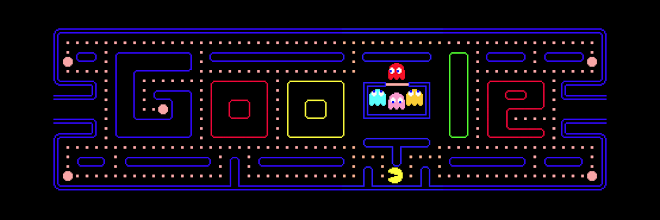
It is interesting to observe the cognitive bias that emerges in this kind of legendary narrative. Confirmation bias, whereby “surely everyone knows Ocarina of Time” – whether they are long-standing fans or simply those with an interest in the world of video games. Ocarina of Time is an iconic game in this context, just as much as certain games that are now inaccessible or unplayable. Or like others, still relevant today, that have transcended their era: Tetris, Pac-Man, etc. In fact, many played Pac-Man for the first time between 21 and 23 May 2010, to mark the game’s 40th anniversary. On that day, Google launched a ‘Doodle’ – an interactive version of its logo – allowing users to play a round. A little fun fact about this Doodle: according to The Guardian, this tribute is said to have resulted in the loss of 4.82 million hours of productivity worldwide. These figures are debatable, of course, but they did lead to Google’s playable logos being restricted and eventually phased out for various tributes and events.
Ocarina of Time has left its mark in many different areas. In level design, with those vast, seemingly open spaces which nevertheless require players to follow the game’s progression in order to enter them. In graphics, with 3D and its use. Even in narrative structure: this extends beyond the realm of video games. Ocarina of Time speaks to us of the transition from childhood to adulthood, of the difficulty of adapting, of seeing the world go on without us, and of the mark we leave on the minds of those around us.
This is how legends are forged. Through objects that transcend their sales figures, that stand the test of time, that grow with us and that shape within us a certain idea of the quest, of devotion, of the world to be saved and of the passing of time. For non-gamers, if we were to take it a step further, Ocarina of Time is almost the equivalent of those classics we’re told to read at school and which many have never even opened. We know Molière, Racine and other authors through their quotations, through the mark they’ve left on literature. We know Ocarina of Time through its gaming legacy, through its legacy and its aura that extends beyond the confines of the screen.
Of course, I realise that I am also speaking here to an audience already won over by the game – a specialist audience which, without necessarily realising it, is subject to the well-known confirmation and knowledge biases mentioned earlier. So, perhaps, this article will seem outdated and naïve. But take a look around. If we look beyond our own confirmation bias, we realise that many female gamers have only played Breath of the Wild or Tears of the Kingdom. That many recognise the ocarina as an iconic item without knowing its origins. That many are unaware of the true story behind Ocarina of Time. That discovery and sharing are also a unifying way of spreading pop culture.
Link transitions from childhood to adulthood, just as Ocarina of Time is passed on from the child you were yesterday to the adult you are today, and then back again to the child you know (your own child, your nieces and nephews, cousins, etc.) in a cyclical process that echoes the passage of time within the game.
In this Switch 2 version, Link rides Epona and sets off to cross the video game Alps to take over your memory and your consoles.
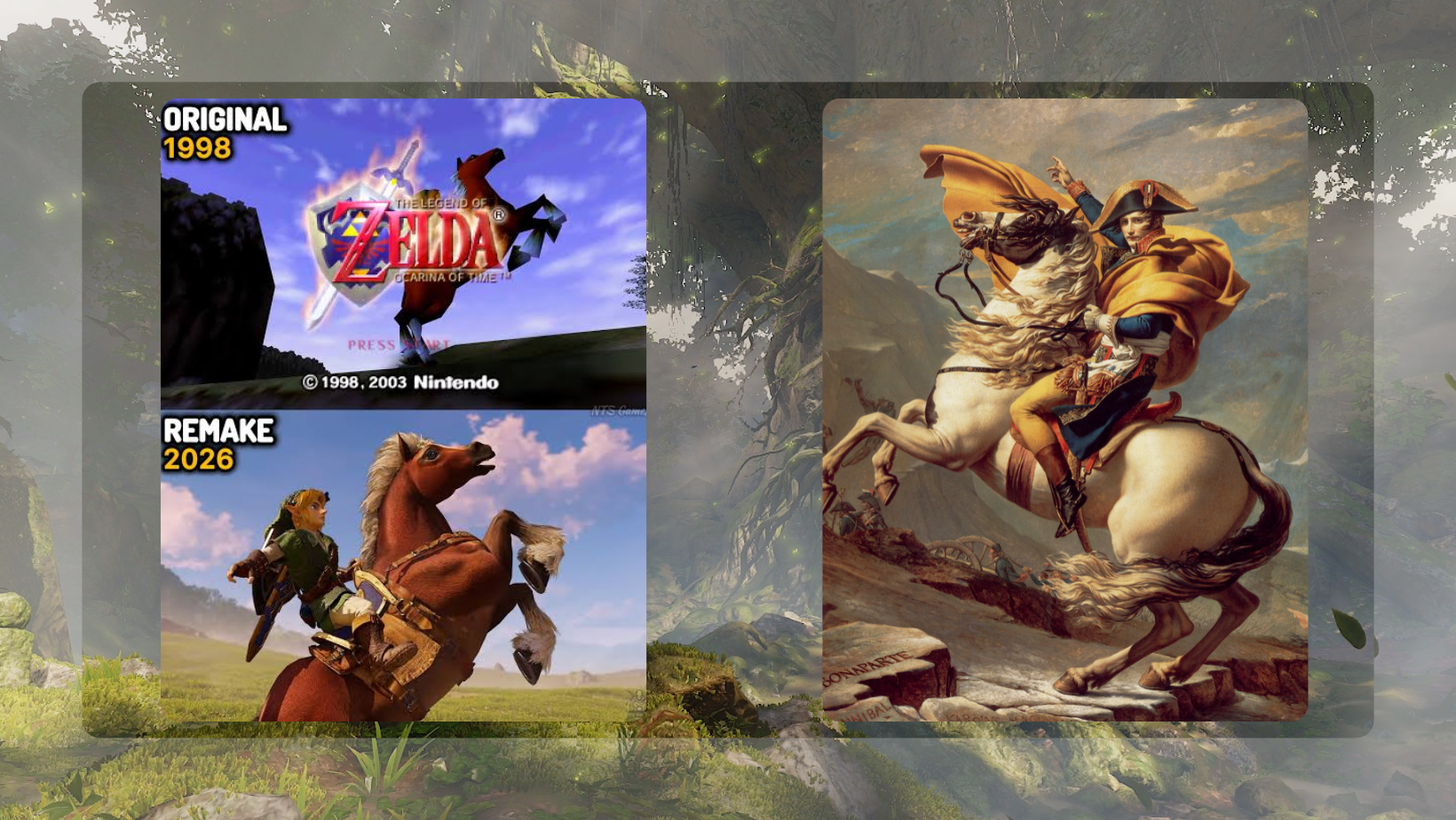
Ocarina of Time is our generational ‘Madeleine de Proust’. But it is also an ode to contemplation, beauty, childhood and innocence. A fable about growing up too quickly and failing to make the most of life.
So make the most of it, take a look around, and seek out those little ‘memorial Korogus’ hidden in your everyday life. Rediscover the games of your childhood and pass on your passion for the great outdoors and gem-like video games.
Sources
- https://www.lemonde.fr/pixels/article/2018/11/21/ocarina-of-time-un-des-inventeurs-du-jeu-video-moderne_5386651_4408996.html
- https://www.nintendo.co.jp/corporate/release/en/2026/261111.html
- https://www.theguardian.com/business/andrew-clark-on-america/2010/may/25/google-economics
- https://fr.wikipedia.org/wiki/The_Legend_of_Zelda#Historique_commercial
- https://www.nintendo.co.jp/ir/pdf/2025/250204e.pdf (et d’autres documents issus des bilans Nintendo)