
“Nothing beside remains. Round the decay
Of that colossal wreck, boundless and bare,
The lone and level sands stretch far away.”
– Ozymandias, Percy Bysshe Shelley
The concept of space is intrinsically tied to the medium of video games; the player’s agency in increasingly vast and detailed worlds has become a cornerstone of post-2010 gaming experiences. The race toward ever-greater vastness has never truly ceased, despite its status as an elusive dream, desirable solely for its instant marketing appeal (“do you see that mountain in the distance?”). Recent titles like Starfield or Crimson Desert certainly do not contradict this reality. Seeking the vast, then, is in a sense seeking the void; by striving too hard to expand, we can no longer fill the space. In this game of filling spaces, there is one type that is particularly resistant to any notion of being filled. Whether sandy, rocky, or icy, the desert cannot escape its nature as an empty place—a so-called lifeless ocean where nothing proliferates, nothing emerges. Unless, of course, this emptiness is deceptive—a banner for a world that has much more to offer.
What becomes of these static spaces once they are transposed into our digital worlds? Are they once again devoid of any movement, confined to transient states (such as the quick-travel system in Uncharted 3)? Or do they perhaps escape the harsh laws of the medium—as they exist in the era of the hegemonic open world—and become, in turn, worlds to be explored? The rarity and uniqueness of these places raise questions that go beyond the landscape itself. In a context where the video games we know (often) stem from Western visions, these desolate spaces also serve as representations: Have they been deliberately stripped of all human life out of a desire for isolation or out of indifference toward those who have made them part of their daily lives—much like other entertainment industries that are no strangers to a very Western-centric fascination with the desert, a perspective that is often highly militaristic? From colonial narratives to Hollywood adventure films, video games are, after all, heirs to these earlier forms of storytelling.
The horizon seems clear for an expedition that is as ancient as it is contemporary; it remains to be seen what the digital sand will reveal about the artificial dunes.
Oh, Sand, oh, despair!
Space, in the geographical sense of the term, is an issue in and of itself. Video games have quickly adopted cartographic standards to codify their worlds: borders, regions, natural landmarks, local place names… As a result, we have never truly gotten lost in these worlds—territories that are deliberately constructed. But this predictability stands in stark contrast to desert landscapes—places synonymous with perdition and the absence of landmarks. Consequently, there are few works that seek to depict these environments as inherently hostile, where the primary source of danger lies in the environment itself rather than in any obstacles one might encounter there. There’s no question of combat; the enemy is everywhere—our avatar is nothing more than a simple tumbleweed tossed about by the arid winds.
As mentioned earlier in the introduction, it’s hard not to recall the signature sequence from *Uncharted 3*, an adventure game whose action in the first two-thirds seemed to exist primarily to lead up to its memorable set piece (which was blithely ripped off by its cinematic counterpart). With a plane soaring through the sky, crates flying through the air, and a Nathan Drake in deeper trouble than ever, the sequence was already impressive—a few years before the insane chase scene in its successor. While there’s nothing to fault in this little masterpiece of filmmaking, we’ve nevertheless overlooked the sequence that followed: the protagonist’s desperate wanderings amid the dazzling golden dunes.
While Naughty Dog doesn’t completely abandon its scripted narrative to truly leave the player adrift in the ancient sands, the effect is nonetheless quite successful. Accustomed to breakneck action and typically linear levels, this brief desert sequence is unsettling, leaving you speechless for a few minutes in the face of a brilliantly rendered vastness. The DualShock 3’s joystick is pushed half-heartedly by a player exhausted by the frenzy that came before, and Drake’s movements become less assured, as if crushed by the heat of a merciless sun. The heat distortion surrounding this open-air furnace leaves no room for any sense of direction: everything seems lost.
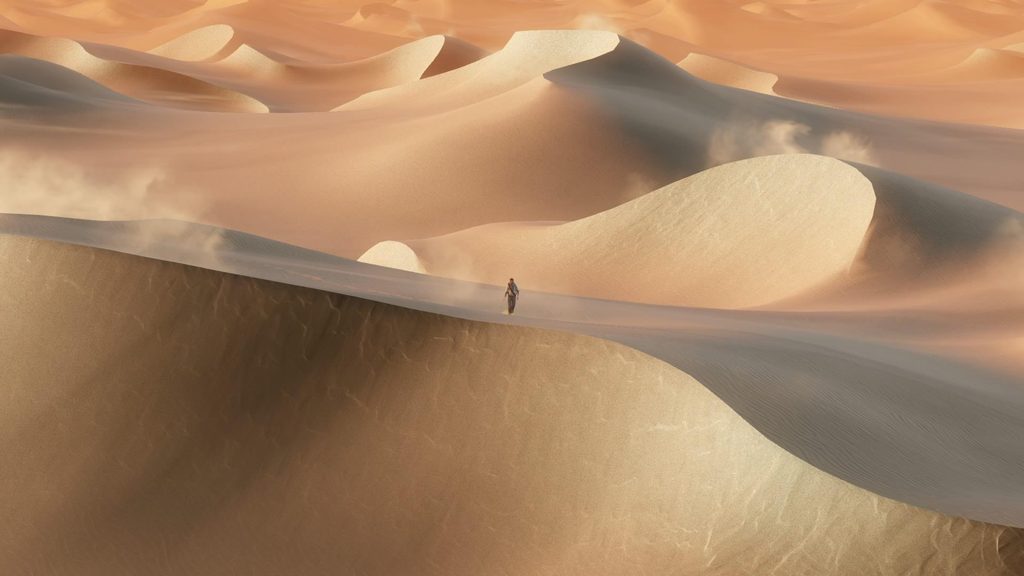
So, who are we shooting at? - Uncharted 3: Drake's Fortune
These fifteen minutes or so exemplify a role that the desert fulfills perfectly: an ideal place for contemplation. The camera’s sharp pullback—moving away from Nathan’s shoulder as he takes his first steps across the vast expanse—creates a remarkable sense of vertigo, relegating the standard TPS/shooter gameplay to the background, where it rarely takes center stage.
The player’s physical involvement is limited to the bare minimum: moving forward. It is the other senses that are thus called upon. While *Uncharted 3* guides the player’s progress through a few crude mirages, it’s impossible to escape a feeling of intense emptiness when a freezing night sets in or when a distant oasis turns out to be nothing more than a baseless mental projection. The sense of loss is profound, as it stands in stark contrast to the very nature of the Uncharted series, which had never before opened up its environments to such an extent; the desert is introduced as an element of surprise, designed to disorient and unsettle. However, any notion of danger is absent here, as the series’ characteristic linearity is not entirely abandoned. The constraints of the arid landscape are felt, but they remain harmless, purely visual. In any case, the game quickly returns to its Indiana Jones- and The Mummy-style action—two feature films from which it cheerfully borrows the repetitive music, designed to reproduce overused Middle Eastern sounds, a far cry from the diversity offered by Arab cultures, or more broadly, the “Greater Middle East.” This setting is by no means an interactive object; it is merely a simple arena serving as a cleverly crafted narrative framework. This lack of rough edges in landscapes that harbor danger at their core ultimately proves to be characteristic of AAA gaming and its obsession with excessive simplification. Far from being uninteresting, Assassin’s Creed Origins shares the same strengths and weaknesses as Uncharted 3 when it comes to its desert expanses: the atmosphere is there, but the substance is missing. For once, it is within a more intimate landscape that the most incisive ideas emerge, restoring the king of uninhabited lands to all his splendid gravity.
This desert will be your grave
It must be acknowledged that the indie scene has had an easier time presenting the desert as a standard setting. The design specifications for big-budget open-world games struggle to envision such a barren place as worthy of interest, whereas dreamlike qualities and radicalism flourish more in less sanitized offerings.
Kenshi has made radicalism its unwavering creed. The game from Lo-Fi Games is known above all for its ruthlessness, the epitome of deliberately unfair difficulty. The void thus becomes a complexity in and of itself—a group to sustain across kilometers devoid of civilization, teeming with ambushes, and marked by unrelenting slowness. Kenshi has built its world as a vast “nothingness” where only isolated pockets of “something” remain. It’s hard to imagine a game more desolate than one that shamelessly drags you through the dirt, where water is a rare commodity, and where the little life that remains seems to have merged with these lifeless landscapes. Violence is constant; the entire universe seems to proclaim that this profound emptiness is the result of centuries of infamy. The desert is a hostile force, and whatever manages to emerge from it seems far worse.
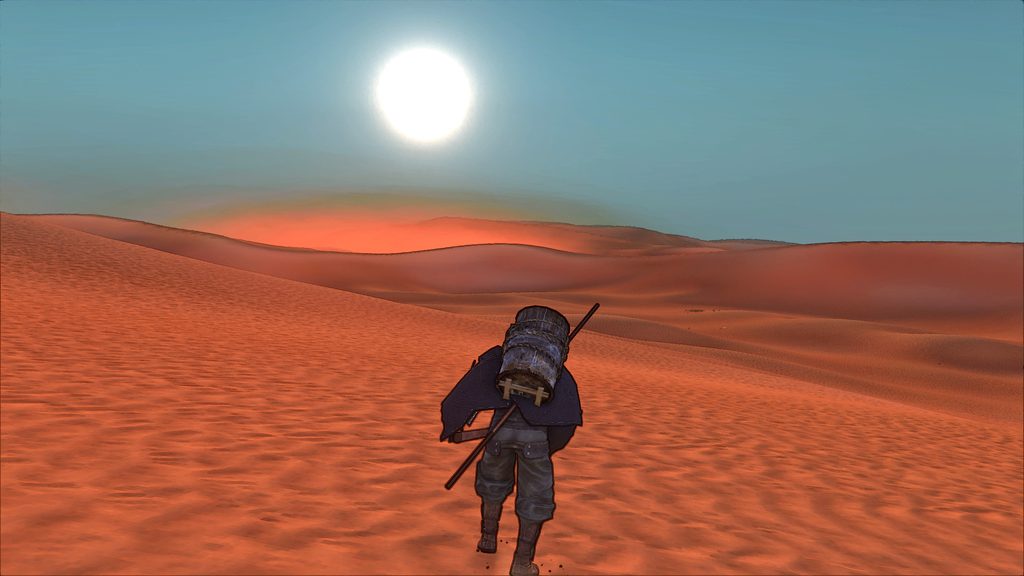
Kenshi and his Horizontal Void
Sandwalkers also shares this fascination with the dangers of the journey, this time making it the very core of its concept. Set in a slightly old-school atmosphere, the game invites players to take on the role of a generational caravan leader, in the style of Damasio’s narrative. Every step forward comes at the cost of invaluable resources, with water and food at the top of the list. The importance of planning your route through seas of dunes and endless regs becomes abundantly clear. Some squares require more effort than others; traveling along a river involves fewer constraints; a detour in search of an oasis can prove as life-saving as it is deadly. Sandwalker is all about making crucial choices in an environment that leaves no room for error. Bear Grylls has been warned: there are no camels in this world to save you from thirst and inclement weather.
However, by trading Kenshi’s misanthropic violence for optimism about the future, Sandwalker approaches aridity as a problem to be solved. The main quest, seamlessly woven into a well-crafted roguelike, aims for the complete restoration of a lush, green world, in which sand would be nothing more than a distant memory. Each playthrough allows you to map out a world that initially seems uninhabitable a little more clearly, while the actions of previous caravans change the face of a world that seemed to have abandoned all hope of renewal. Ecology finds a way to fit into a relatively simplistic narrative. The desert is temporary, treated as an apocalyptic sign. This is where its true danger lies: in the idea that it might be the only memory left in the wake of past civilizations.
“My Name is Ozymandias, king of kings.”
Sandwalker puts it just right: the desert is an inescapable future where only traces of the past can survive. Perhaps that is its true promise as a video game—to impose these empty spaces in order to better bring out their remnants. The player’s hat is then swapped for that of a digital archaeologist, forced to clear away this 3D sand, a technical challenge of yesteryear. There is no desert without ruins—or, in the context of level design, no interesting desert without them.
There’s no doubt that this notion of ruins evokes the excitement of the major Western explorations of the 19th and 20th centuries; it’s impossible not to imagine yourself as Howard Carter as you wander the corridors of Giza in *Assassin’s Creed Origins*, where the pyramids are particularly massive and imbued with a mystery that transcends mere virtual discovery. This thirst for discovery and for understanding ruins is firmly rooted in our collective imagination. While it is sometimes called into question (doesn’t it stem from a colonial framework, after all?), it remains undiminished in the adrenaline rush it provides, with desert environments highlighting these unique relics. The interactivity of the medium allows us to recreate those first experiences—those first entries into a tomb, those wanderings through the ruins of a lost world. Whether we’re fantasizing about the peoples who came before us or witnessing the fall of the Anthropocene, the desert embraces ruins like no other landscape.
Shadow of the Colossus makes ruin its main appeal; its world is nothing but a vast desert, dotted with rocky fragments that have long since lost their purpose. Every step is a rediscovery, as the promise of exploring a land abandoned by gods and men is made clear from the very first hours of gameplay. Ueda’s minimalist style blends seamlessly with these expanses stripped of all distraction—a desert at its most desolate. From this void emerge a few ancient structures, holding the promise of potential where everything is nothing. Take, for example, the castle where colossal statues stand, towering in the center of the arid plains—a striking visual landmark that also embodies one of the few remnants of the area’s history. There’s no need to recall the quest for the final secret, which has motivated hundreds of players to scour every inch of the landscape—but why, ultimately? Because an empty world invites secrets; if the surface is so predictable—visible at a glance across the horizon—it’s probably because the mystery lies elsewhere (“The desert is an ocean with a life underground,” as the band America aptly sang). Is it just one mirage among many, or proven reality? That is the very fascination of a space that reveals everything while saying nothing.
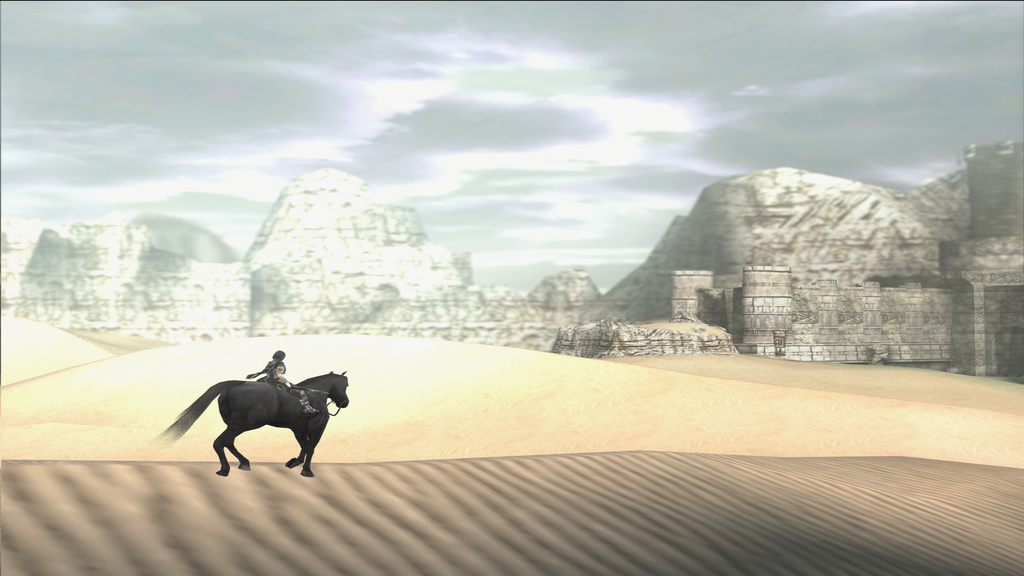
The Vastness of Days Gone By - Shadow of the Colossus
The desert is, in a way, a facet of the imagination, and these ruins, scattered throughout it, are the driving forces behind an unverifiable dream. They emerge from the sands, casting the only viable shadows across the vast aridity—remnants of the past, vestiges of a time we do not know. The void brings to the forefront a visual power that is far too often underestimated: the power to create our own mysteries, to fill in the gaps in the fabric of time. The desert ruin leaves all this room for interpretation; its eternal solitude invites us to imagine its former contours. It is not so much a design philosophy (as From Software might employ, by deliberately leaving the past vague) but rather the grandeur of a panorama that speaks for itself. The ruin is an invitation to reflect, walled in solitude, and to project oneself toward another place—one that no longer exists. The vast sea of sand is home to so many Ozymandias; though their empires may have fallen, the same cannot be said of their power to fascinate.
The Gerudo Desert in Zelda: Breath of the Wild and Tears of the Kingdom holds the same appeal. At first hostile, it eventually becomes a place of remarkable discoveries. One such discovery is the whale carcass lying in the heart of the dunes for no apparent reason other than to remind us that life once thrived there. However, it is the quest for the eighth heroine that best captures the mystery the desert has to offer. Seven statues perched in the desert, seven heroines standing in a circle, watch over the vast arid landscape. Were they once the objects of a cult, the saviors of days gone by? The answer will take time to reveal itself; in the meantime, theories about them will never cease. The desert has silenced all truth to leave room for interpretation. Video game archaeology reaches its pinnacle in a related quest, where players must solve the mystery of an eighth heroine—missing or erased from the annals of history. The vast, sun-drenched dunes of the Gerudo Desert invite exploration; anything could be hidden there, somewhere, amid the shifting sand dunes—an infinite, boundlessly vast expanse.Tears of the Kingdom will transform this quest—which is relatively mundane in its conception—into something truly special. After reaching the new, now-underground Gerudo City, the quest to uncover the mystery of the eighth heroine continues in this sequel, leading to a concrete conclusion: this missing heroine is none other than the ancestral embodiment of the hero—our own avatar. The desert gradually reveals itself, intertwining traces of the past with the movements of the present. The great sea of sand never ceases to bury its secrets. And here we are, the players, ready to unearth these revelations.
Ultimately, it’s no surprise to see these spaces, abandoned by all, bring yesterday’s stories back to life to turn them into tomorrow’s myths. Our own deserts are the cradles of religions, prophets, and legends. Video games have always embraced “the desert” as a universal form, preferring the image of a mystical place to that of a commonplace one. The desert encapsulates the ruins just as the ruins embody the desert’s thousand-year history; one bears witness to the other—a dream upon a dream, one theory upon another. Let us lull ourselves with illusions as long as the void reigns; nothing remains free of the present’s mark for very long.
Dream of Conquest
“The desert, straddling the paradisiacal utopia—a Robinson Crusoe-like existence—on the one hand, and war and the fear of threat on the other, symbolizes that sense of emptiness that both haunts and fascinates.”
– Olivier Mogin, Fear of the void.
This seemingly significant void may be nothing more than an illusion—a way of feigning disinterest in a space that is inevitably unstable. The desert is dead; death is a desert; the territory is hostile by nature, but it has also been shaped to serve as a theater of war. From the Battle of Kadesh to Napoleon’s Egyptian campaign, via Bir Hakeim, this void has never escaped human impulses. After all, is there any territory spared from the desire for power and the thirst for conquest? The famous Terra Nullius is merely a temporary definition of a space that will never be “no man’s land.” By its very nature as a foreign land, the place has witnessed the most egregious asymmetries, with colonizing powers remaining convinced that its riches belonged to them. This, in fact, is the legacy left by the desert in fiction and history: war and conquest. A cornerstone of cinema, David Lean’s *Lawrence of Arabia* quickly moves beyond wandering and wonder to focus on the violence of conflict. Frank Herbert’s *Dune* highlights the danger of foreign interference in a territory where apparent riches obscure the power of the people. Even some more contemporary works cannot hide the human savagery that the desert awakens; Peter Watkins’s *Punishment Park* and its barren setting remain the quintessential example.
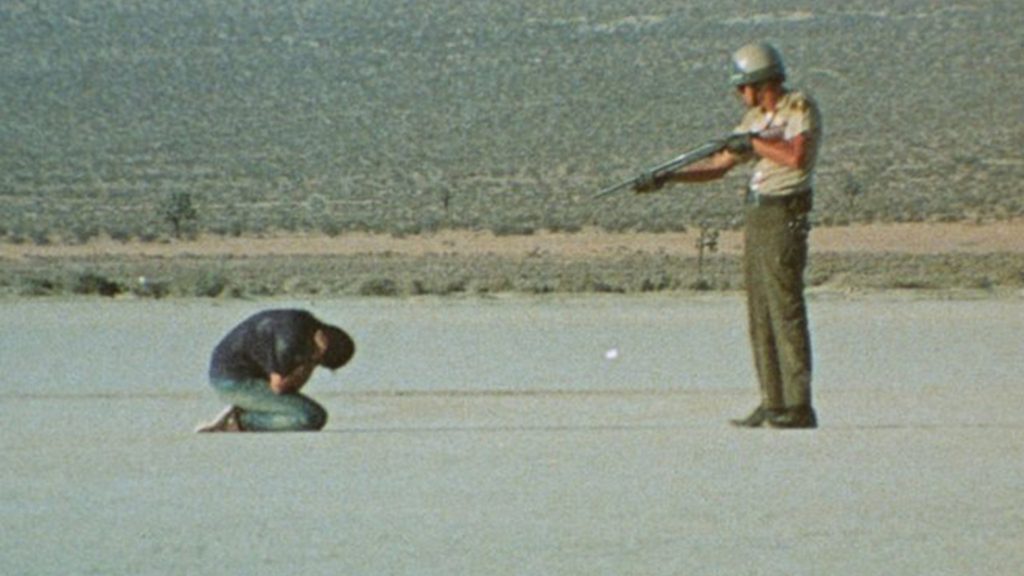
“Punishment Park,” or When the Desert Becomes a Battleground for Instincts
So when a medium all too often shaped by the dictatorship of guns and its thirst for battle takes over a war zone already ravaged by fighting, the outcome seems almost inevitable. The desert quickly became the scene of virtual clashes, the ideal place for shoot-to-kill. But these conflicts cannot be separated from conquest; it is not only death that is widespread, but also the appropriation of space. In this sense, *Dune Awakening* wonderfully captures the fears and horrors of Herbert’s series by opting for a lawless PvP mode (which has been scaled back since its release) set in the “deep desert”: whoever emerges victorious will retain the resources of their patch of sand and gain the upper hand over the other scrap dealers in the vicinity. Part of the game dedicates its desert to war, for the void cannot fear annihilation: it is and will remain; the bodies littering its arid ground are but details on the canvas of its immensity.
Even more intriguing, Donkey Crew’s Last Oasis links perpetual motion to unceasing violence. Players must build “walkers”—ever-more-imposing, ever-more-deadly war machines—in order to survive an increasingly unforgiving desert. The only source of power lies in the sheer scale of these sand-bound behemoths; speed allows players to escape the inevitable scorching heat of the sun, while their size creates a direct power dynamic with others: hostility is human, but more than ever, the danger is to eat or be eaten. Last Oasis brings its desolate world and its inhabitants into harmony by compelling them to cover as much ground as possible—through conquest or flight.
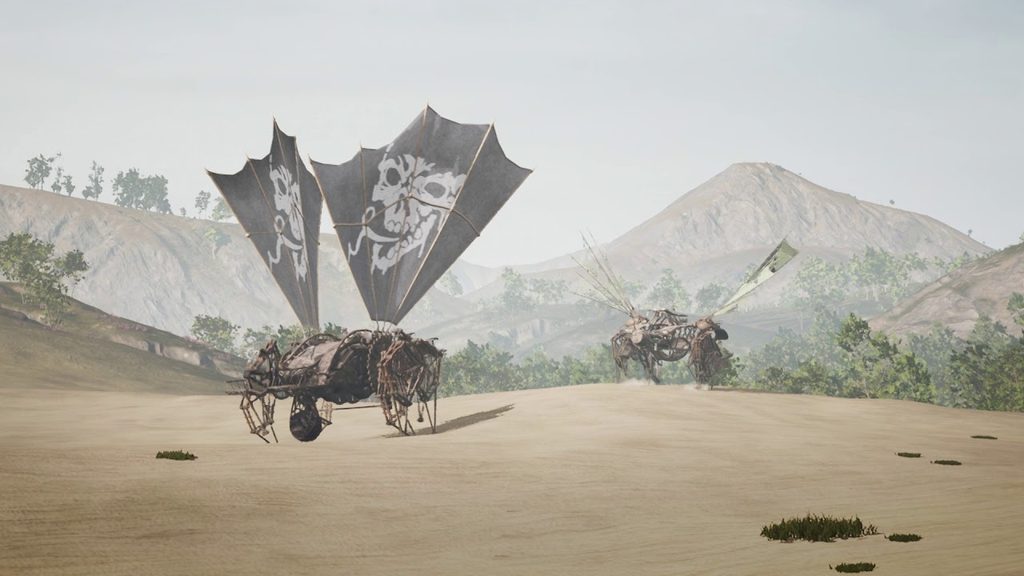
Walkers on the Run in Last Oasis
Last Oasis, in fact, was overwhelmed by its own concept—a social experiment in the middle of the desert that deserves a closer look. Limited access to available resources quickly transformed these fertile plains into unfair battlefields. The game blends the rigors of multiplayer PvP survival (where the most numerous and best-connected players win) with elements inherent to vast deserts: key locations are heavily guarded, and only the best-equipped will survive and thrive where nothing remains.
The desert sometimes finds its antithesis in its depictions; the 2015 *Mad Max* serves as a video game oxymoron when it comes to describing the vast nothingness, since *Mad Max* does everything. Enemy camps, car races, towers to activate, percentage-based completion—there’s no room for emptiness in a game with a divine post-apocalyptic atmosphere, yet one marked by blatant repetition. More than ever, the desire for conquest is embodied: alone and enraged, Max chains together waves of violence to pacify a desert that seems, at first glance, indomitable. As is typical of video games, the area quickly becomes a battleground dotted with numerous points of interest. Enemy outposts appear as stepping stones toward victory; the sand will be nothing but a witness to the blood spilled along our path. Avalanche Studio’s game sets the conquest of nothingness as its objective: one can only fight or die in a world that is already dead.
These arid spaces, rendered in our video games, embody reflections. When dreamlike imagery comes into play, it is the desert—as a mystical and profound setting—that dominates, a territory we see only through distant images and intangible landscapes. When war breaks out, the inspiration is less ancient and more contemporary. Lingering images of recent conquests resurface. Vast desert territories are appropriated in playful contexts; they become vessels for intentions, forever diminishing the immensity and mystery of a landscape with shifting contours.
Crossing and Trajectory
Video game deserts share one thing with their real-world counterparts: the challenge of crossing them. “The desert is the space where one sets out toward an unknown and mythical place; it evokes an endless journey […],” as Olivier Mongin aptly wrote. The sense of movement brings us back to the starting point of a work that seeks to open up its spaces; movement remains the primary link between the player and the video game. This basic need to make movement a pleasurable act—one that sustains the desire to move forward—is thus paired with environments that have no finite horizon. The goal, then, is to offer either a need for speed to fill the vastness or, conversely, a need for slowness to convey the sense of loss inherent in these abandoned territories. Crossing the desert is as much a challenge of level design as it is a human challenge in our reality.
Journey and Sword of the Sea have embraced the idea of gliding; dunes and ruins are merely slopes, trails that invite you to continue the journey. There are no constraints in a desert where a sense of fluidity reigns supreme. More than ever, the desert is synonymous with a playground; the landscape is soared over and traversed at speed, serving merely as the backdrop for a journey where contemplation reigns supreme. The desert is beautiful, sparkling—a sea of gold where one revels in such freedom of movement. These two works embrace the infinity of the sand: they transform it into perfect liberation, a definitive abandonment of the constraints of an empty world. Admittedly, the desert passes quickly, offering no real pauses as in *Uncharted 3*, where it becomes a fleeting enemy to the player; yet this passage has a light, respectful quality: the surfing sequence among the ancient ruins in *Journey* thus breaks free from the explorations mentioned earlier; here, we are not archaeologists, merely passing through a world that continues to vanish, to be buried. Speed is a form of acceptance: we will never be masters of these worlds.
The alignment between gameplay and emotion in Journey remains, in any case, quite unique, as the mechanics of traversal generally stem less from deliberate poetry than from absolute necessity. Thus, Sable or Caravan SandWitch provide the player with a vehicle more out of a fear of confronting the player with the vastness of the world. Walking is simply not an option in a digital environment so devoid of distractions. The desert thus becomes a mere transition between point A and point B; one doesn’t linger there unless one chooses to stop. Unlike more conventional open worlds, nothing escapes the player’s immediate attention—the eye knows where to go and where not to waste time. The scenery is magnificent; it doesn’t matter whether it serves a practical purpose at every turn.
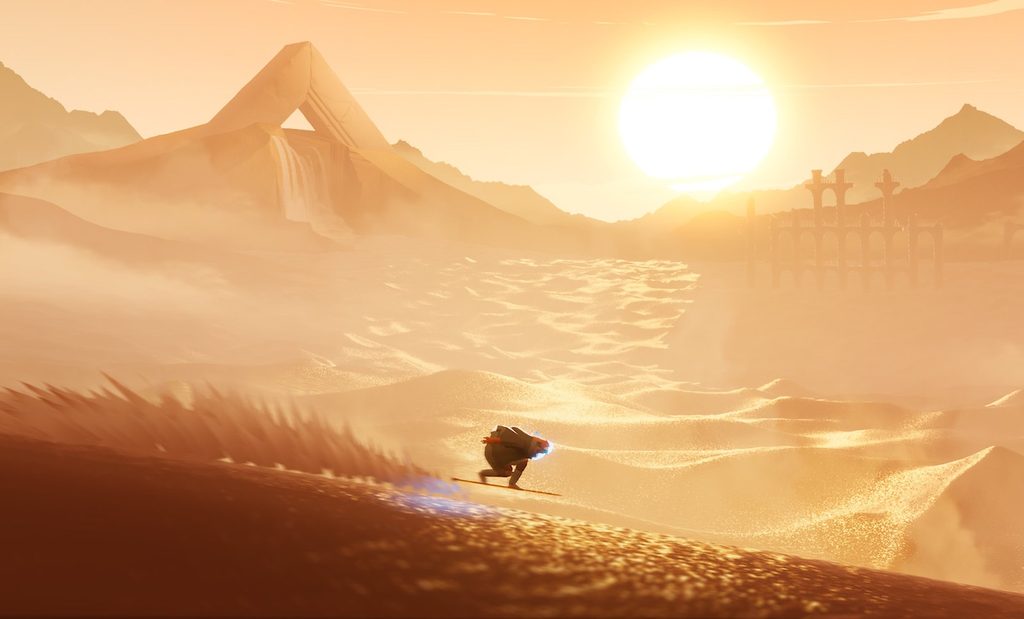
Surfing on the high dune
Conversely, violent solutions do exist; once again, the Mad Max car is a means of asserting dominance over a territory far too vast for a single person to cover. Metal and bullets counterbalance the vastness; the journey is swift and bloody, and every outing unleashes death from its rusted ramparts. The desert does not impress with its infinity, except in those moments when the game imposes lulls—while searching for water and fuel. These are rare moments when the usual violence gives way to a more human, less heroic fragility.
Perhaps the ultimate survival experience lies in *Outward*; while the desert is just one of many areas that make use of this modest RPG’s ruthless mechanics, the setting seems perfectly suited to the game’s masochistic spirit. No vehicles, no mounts, and no shortcuts—Outward forces you to walk as your only recourse against the adversity of the vast wasteland. Everything then becomes a countdown: water and food are running low, fatigue sets in, and the heat beats down. Here it is—a carbon copy of Man vs. Wild. The distant city of Levant serves as the only comforting refuge (or does it?). A poorly prepared outing is tantamount to an early end to the journey—a logical fate for those who forget that, day or night, the desert offers no mercy to the reckless.
The desert is therefore (almost) always a matter of compromise; one will notice the absence of “realistic” or restrictive representations, in favor of quicker solutions. By reducing the vast sea of dunes to a sort of very neatly delineated sandbox, the game highlights the paradoxes of these representations: aiming for the grand scale only to ultimately reduce it to a backdrop. Video games can only offer a fraction of the desert experience, conveying its emptiness without, however, illustrating its specific characteristics. It becomes, on the other hand, an exhilarating playground where the absence of obstacles fosters a sense of “flow” that is perfectly harnessed by the examples cited. Foremost among them is the recent *Sword of the Sea*, a worthy successor to the frantic races of *The Pathless*—minus the pine trees and mountains.
Is there Orientalism in my video game?
The desert is a matter of fantasy; from Egyptomania to the recent “Saharomania” (a particular fascination with the spaces of Egypt and the Sahara Desert, respectively), Orientalism has continually taken on different forms. Video games, as frivolous as they may seem to some, are no exception to these modes of representation deeply rooted in Western perspectives (though the industry is eclectic, it would be wrong to say that these viewpoints do not predominate). Not all games “orientalize” their desert settings (Mad Max is an apocalyptic tale without a distinct culture of its own; Kenshi draws relatively little from real-world inspiration…), but the fact remains that the desert is deeply linked to cultures that are inevitably distant from the main players in the video game industry. Visions emerge beyond the ruins and dunes; video games depict them faithfully or, conversely, through a biased design lens. This regime of emptiness demands a major overhaul of representations—which shows just how many designers have themselves fallen into the desert’s apparent traps: mistaking its aridity for a landscape to be filled in by oneself, without further questioning what it might mean to others.
In this sense, it’s impossible not to view Sable as a counterpoint to an industry that has stripped the (already empty) desert of its key inhabitants. Nomadic cultures—Bedouin, Tuareg—are, at best, mere footnotes; at worst, they are largely rendered invisible in the very spaces that are deeply intertwined with their way of life and their history. Fantasy—the genre of choice for RPGs in recent years and typically accompanied by a comprehensive “lore”—has, in fact, never truly sought to explore these worlds, opting instead for far more common imagery (knights in armor, European forests, Nordic mountains, and lush plains). So much so that rumors suggesting Hammerfell as the next setting for The Elder Scrolls saga are certainly intriguing.
In the meantime, one need only look at the questionable treatment of desert tribes in notable video game portrayals. Just recently, *Monster Hunter Wilds* portrayed the inhabitants of Kunafa as a primitive people ecstatic at the arrival of these hunters wielding unknown technologies. Once again, *Uncharted 3* quickly forces us to shamelessly shoot at turbaned faces. The people seem just as dehumanized as the environment, which is supposedly incapable of sustaining life.
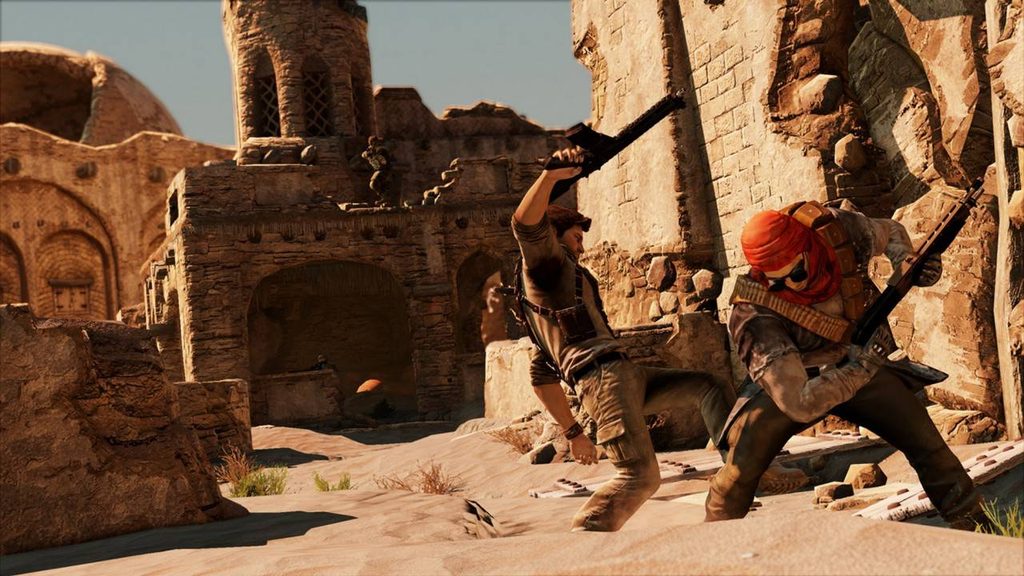
Did you say “ludonarrative dissonance”?
To return to this point, *Sable*, despite its sci-fi aesthetic—largely inspired by Moebius—does not forget to incorporate into its universe figures that echo these largely overlooked cultures. Gregorios Kythreotis and Martin Kvale have spoken at length about the various sources that have influenced their game; nomadic cultures, in particular, were drawn upon to create the movements specific to Sable’s protagonist: “Nomadic cultures have practical concerns very different from our own: sheltering from the heat, finding and maintaining sources of clean water. This sheds light on how they navigate their environment.” Similarly, the two designers say they drew inspiration from the Australian Walkabout to shape the game’s central coming-of-age journey—a practice among Australia’s Indigenous peoples in which adolescents go into exile in the desert for six months in search of spirituality and a path. The Moebius-inspired aesthetic does not hide the architectural influences present in the game’s art direction; the immense tents scattered throughout the various camps on the map closely resemble those of Bedouin traditions, as do the various tunics worn by the heroine. The nomadic way of life permeates *Sable* from start to finish; this is what makes it an example of Orientalism that moves away from the term’s negative connotations. *Sable* draws on these cultures to tell a story intertwined with the environment, and never forgets… The Moebius-inspired aesthetic doesn’t hide the architectural influences present in the game’s art direction; the immense tents scattered throughout the various camps on the map closely resemble those of Bedouin traditions, as do the various tunics worn by the heroine. The nomadic way of life runs through Sable from beginning to end; this is what makes it an object of Orientalism that moves away from the negative connotations of the term. Sable draws on these peoples to tell a story intertwined with the environment, and never forgets that the desert is not a place to be taken, but to be understood (the quest for the masks then takes on its full meaning).
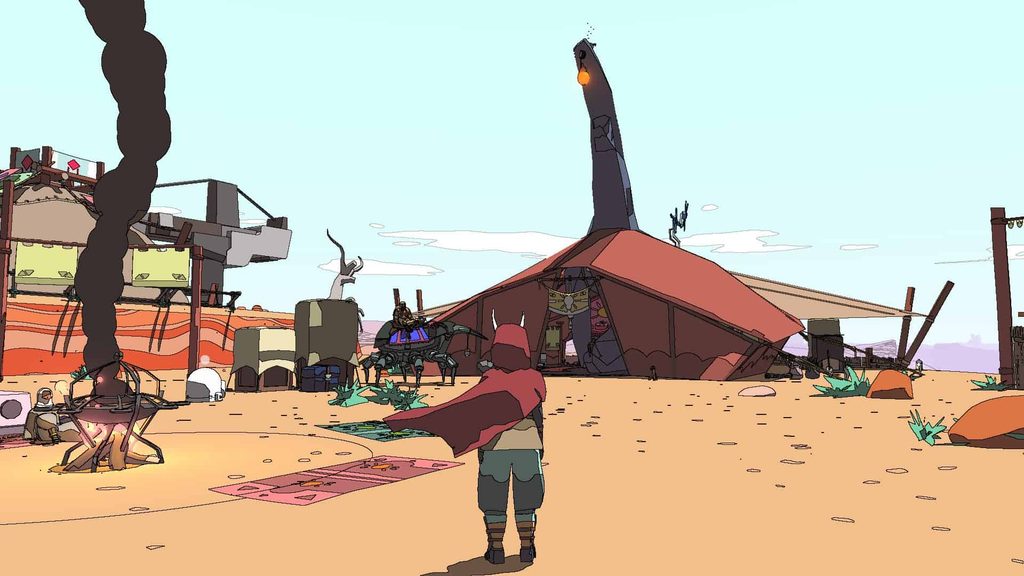
Campement nomade dans Sable
This void seems surprisingly dense as video games attempt to adapt it. It doesn’t always escape the medium’s limitations, but for the most part, it is brilliantly brought to life. A prime example of how a choice of environment can influence an entire design. We race through it at breakneck speed just as we struggle to endure it; it is inhabited more by violence than by those who seek to live in harmony. A land of every danger, a sandy ocean, or a witness to the past—there is no desert without a vast nothingness. All these “hole” games contrast in one way or another with their less rugged counterparts. Whether we like it or not, the void persists; it seems almost fun to traverse it as depicted in pixels; the desert is always a journey, an odyssey experienced in a thousand ways. Here is a fraction of what it is, what it has been, and probably what it will be.
Bibliography
BRUYÈRE-OSTELLS, Walter et SÈBE, Bernard, « Écrire le désert : aux sources de la “Saharomanie” », Outre-Mers, n° 428-429, 2025/2, p. 7-16. https://doi.org/10.3917/om.428.0007.
MALEMPREZ, Adrien, La représentation musicale du monde arabe à travers les bandes originales hollywoodiennes (1992-2004), mémoire universitaire, Université de Liège. https://matheo.uliege.be/bitstream/2268.2/13095/5/Adrien%20Malemprez%20-%20La%20représentation%20musicale%20du%20monde%20arabe%20à%20travers%20les%20bandes%20originales%20hollywoodiennes%20%281992%20-%202004%29%20-%20Texte.pdf.
MONGIN, Olivier, La peur du vide. Essai sur les passions démocratiques, Le Seuil, 2017, p. 41-61. https://shs.cairn.info/la-peur-du-vide-essai-sur-les-passions-democratiques–9782020130561-page-41?lang=fr.
Webography
COOK AND BECKER, « Sable: Exploration Through Line-Art ». https://www.cookandbecker.com/en/article/170/sable-exploration-through-line-art.html.